
The demand for labor depends primarily on the additional output produced as a result of
hiring an additional worker and
A) the additional revenue received from selling the output produced as a result of hiring
an additional worker.
B) the payment made to the worker for producing the additional output.
C) the elasticity of demand for the output produced by the worker.
D) the number of workers willing to produce the additional output.
If money demand is extremely sensitive to changes in the interest rate, the money
demand curve becomes almost horizontal. If the Fed expands the money supply under
these circumstances, then the interest rate will
A) fall substantially and investment and consumer spending will fall substantially.
B) rise substantially and investment and consumer spending will rise substantially.
C) fall substantially and investment and consumer spending will change very little.
D) change very little and investment and consumer spending will change very little.
Economic surplus is maximized in a competitive market when
A) demand is equal to supply.
B) the deadweight loss equals the sum of consumer surplus and producer surplus.

C) marginal benefit equals marginal cost.
D) producers sell the quantity that consumers are willing to buy.
According to projections for 2013 by the Tax Policy Center, the 20 percent of U.S.
taxpayers who make the highest incomes
A) use loopholes and tax exemptions to reduce their share of federal income taxes to
less than 20 percent.
B) pay almost 68 percent of federal income taxes.
C) pay about 92 percent of federal income taxes but only about 20 percent of Social
Security and Medicare payroll taxes.
D) pay more in excise and other taxes than they pay in Social Security and Medicare
payroll taxes.
Some policymakers have argue that products like cigarettes, alcohol, and sweetened
soda generate negative externalities in consumption. All else equal, if the government
decided to impose a tax on soda, the equilibrium quantity of soda would ________ and
the equilibrium price of soda would ________.
A) increase; increase
B) increase; decrease
C) decrease; increase
D) decrease; decrease
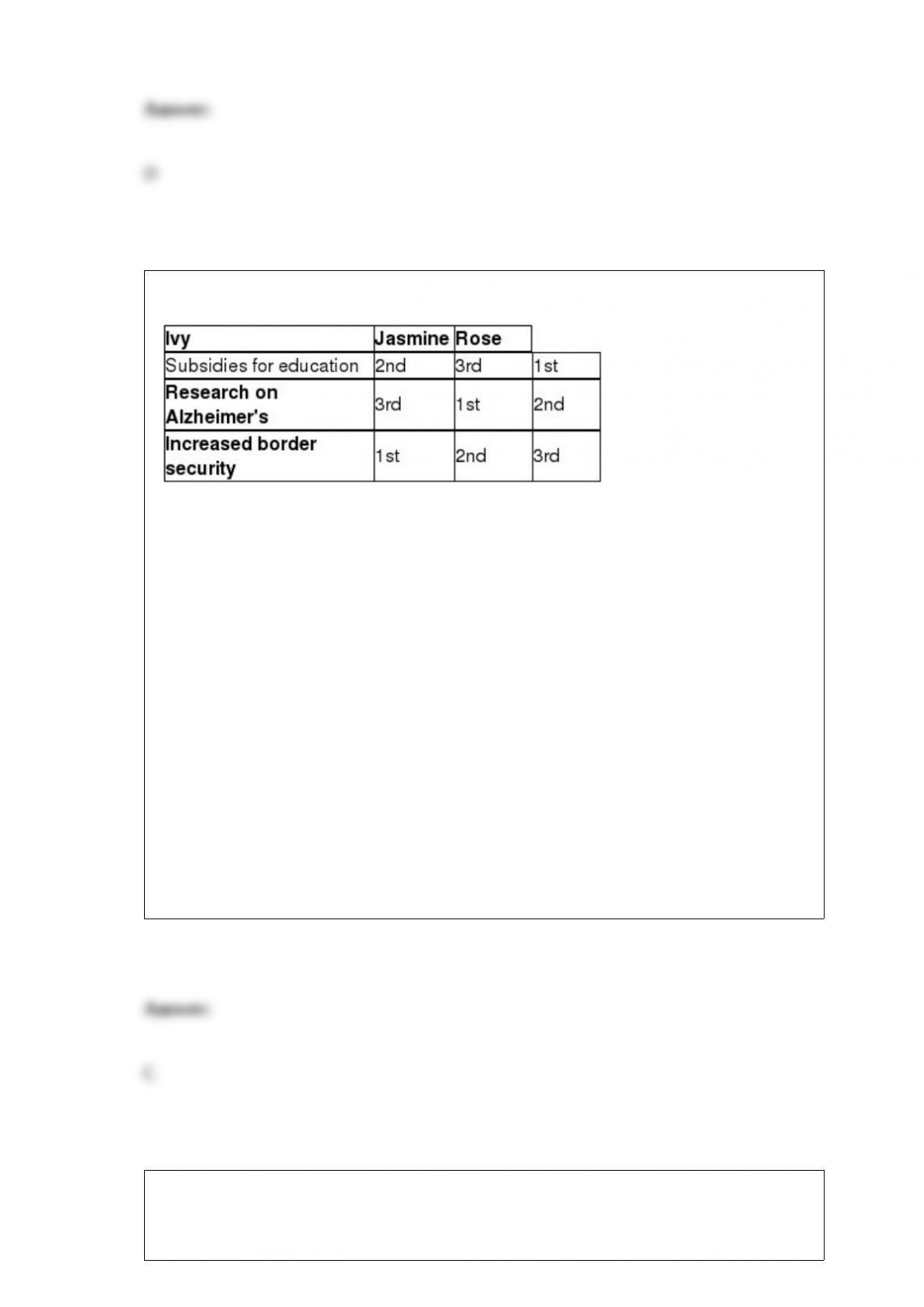
Table 18-1
Suppose $1 billion is available in the budget and Congress is considering allocating the
funds to one of the following three alternatives: 1) Subsidies for education, 2) Research
on Alzheimer’s or 3) Increased border security. Table 18-1 shows three voters’ rankings
of the alternatives. Suppose a series of votes are taken in which each pair of alternatives
is considered in turn. If the vote is between allocating funds to research on Alzheimer’s
and increased border security,
A) Ivy and Jasmine vote for Alzheimer’s research, Rose votes for increased border
security, and Alzheimer’s research wins.
B) Ivy and Rose vote for increased border security, Jasmine votes for Alzheimer’s
research, and increased border security wins.
C) Jasmine and Rose vote for Alzheimer’s research, Ivy votes for increased border
security, and Alzheimer’s research wins.
D) Jasmine and Ivy vote for increased border security, Rose votes for Alzheimer’s
research, and increased border security wins.
Since 2000, the Fed uses ________ to measure inflation.
A) the index of leading economic indicators

B) the personal consumption expenditures index
C) the consumer price index
D) the GDP deflator
E) the producer price index
In addition to covering the costs of unpredictable events, health insurance typically
covers many planned expenses, such as routine checkups, annual physicals, and the cost
of vaccinations. because of this, health insurance
A) discourages overuse of health care services.
B) encourages overuse of health care services.
C) generates an efficient quantity of health care services.
D) is not accepted by most doctors and hospitals.
If a country sets a pegged exchange rate that is below the equilibrium exchange rate,
how can the country maintain the peg?
A) by purchasing surplus domestic currency at the pegged rate
B) by selling surplus domestic currency at the pegged rate
C) by purchasing surplus domestic currency at the equilibrium exchange rate

D) by decreasing the pegged exchange rate
A decrease in input costs in the production of LCD televisions caused the price of LCD
televisions to decrease. Holding everything else constant, how would this affect the
market for video game consoles (a complement to LCD televisions)?
A) The supply of video game consoles would increase, and the equilibrium price of
video game consoles would decrease.
B) The demand for video game consoles would decrease, and the equilibrium price of
video game consoles would decrease.
C) The demand for video game consoles would decrease because consumers could
afford to buy fewer LCD televisions and video game consoles.
D) The demand for video game consoles would increase, and the equilibrium price of
video game consoles would increase.
In the long run firms in both monopolistically competitive markets and perfectly
competitive markets earn zero economic profits, but unlike perfectly competitive firms
in the long run, monopolistically competitive firms
A) charge a price that is greater than average revenue.
B) charge a price that is equal to marginal cost.
C) do not produce at minimum average total cost.
D) charge a price that is equal to average total cost.

Which of the following statements is true?
A) A long-run competitive equilibrium can only be achieved in constant-cost industries.
B) When an industry achieves a long-run competitive equilibrium, industry output will
not change in the future.
C) A long-run competitive equilibrium outcome is not economically efficient.
D) When an industry reaches a long-run competitive equilibrium, the typical firm in the
industry breaks even.
A ‘stockout” occurs when
A) brokers run out of shares of stock to sell of a particular company.
B) a disruption due to a power outage, etc., causes a temporary production shutdown.
C) a company holds too many goods in inventories.
D) a firm loses sales because goods consumers want are not available.

The term tax incidence refers to
A) the degree of progression of a tax.
B) the actual division of the burden of a tax between buyers and sellers in a market.
C) the amount of revenue government collects from a tax imposed on a good or service.
D) whether the burden of a tax rests more heavily on those with higher incomes or
those with lower incomes.
You own a business that answers telephone calls for physicians after their offices close.
You have an incentive to substitute capital for labor if the
A) price of capital increases.
B) price of labor decreases.
C) price of labor increases.
D) marginal product of labor increases.