A line is parallel to the horizontal axis. The slope of the line is
a. infinite.
b. indicative of an inverse relationship between two variables.
c. indicative of a direct relationship between two variables.
d. zero.
e. b and d
Refer to Exhibit 20-2. The market for good X is initially in equilibrium at $5. The
government then places a per-unit tax on good X, as shown by the shift of S1 to S2. As a
result,
Exhibit 20-2
a. consumers end up paying $6.25 per unit, and producers end up receiving $5.00 per
unit, but keeping only $4.00 per unit.
b. consumers end up paying $6.25 per unit, and producers end up receiving and keeping
$4.00 per unit.
c. consumers end up paying $5.00 per unit, and producers end up receiving and keeping
$5.00 per unit.
d. consumers end up paying $6.25 per unit, and producers end up receiving $6.25 per
unit, but keeping only $4.00 per unit.

e. none of the above
As price rises from $22 to $26, quantity supplied rises from 100 to 110 units and
quantity demanded falls from 90 units to 65 units. It follows that supply is __________
and demand is __________.
a. inelastic; elastic
b. elastic; inelastic
c. inelastic; unit elastic
d. elastic; elastic
e. unit elastic; inelastic
An increase in the quantity of resources available
a. shifts the PPF leftward.
b. shifts the PPF rightward.
c. moves the economy to a new point up along a given PPF.
d. moves the economy to a new point down along a given PPF.

“New industries should be protected from older established foreign competitors until
they are mature enough to compete on an equal basis.” This argument for trade
restrictions is called the __________ argument.
a. low-foreign-wages
b. foreign export-subsidies
c. anti-dumping
d. infant-industry
Suppose that there are two laws proposed for eviction notices. Plan A requires landlords
to give a renter 30 days to vacate an apartment once he has been served an eviction
notice. Under Plan B, he has 60 days to vacate an apartment once he has been served an
eviction notice. It follows that landlords will find
a. Plan A more expensive than Plan B.
b. Plan B more expensive than Plan A.
c. both plans to be equally expensive.
d. none of the above

If X is the actual amount of income or receipts and i is the interest rate (in decimals)
that could be earned on alternative uses of money that face the same risk, the present
value of X one year from now is computed by
a. X/(1-i).
b. X/(1+i).
c. i/(1+X).
d. (X)(1 + i).
e. (i)(1 + X).
If a firm is a price taker, its demand curve is
a. downward sloping.
b. upward sloping.
c. perfectly inelastic.
d. perfectly elastic.
A person who greatly prefers present consumption to future consumption has a(n)

__________ rate of time preference.
a. low
b. high
c. efficient
d. roundabout
Which of the following is a prediction of the median voter model for a two person
political race?
a. Candidates will try to present themselves as extremists.
b. Candidates who are behind in the polls will try to move closer to the position of their
opponents.
c. Candidates will try to label their opponents as “too middle-of-the-road.”
d. Candidates will try to be specific and clear about their own programs and the means
of achieving them.
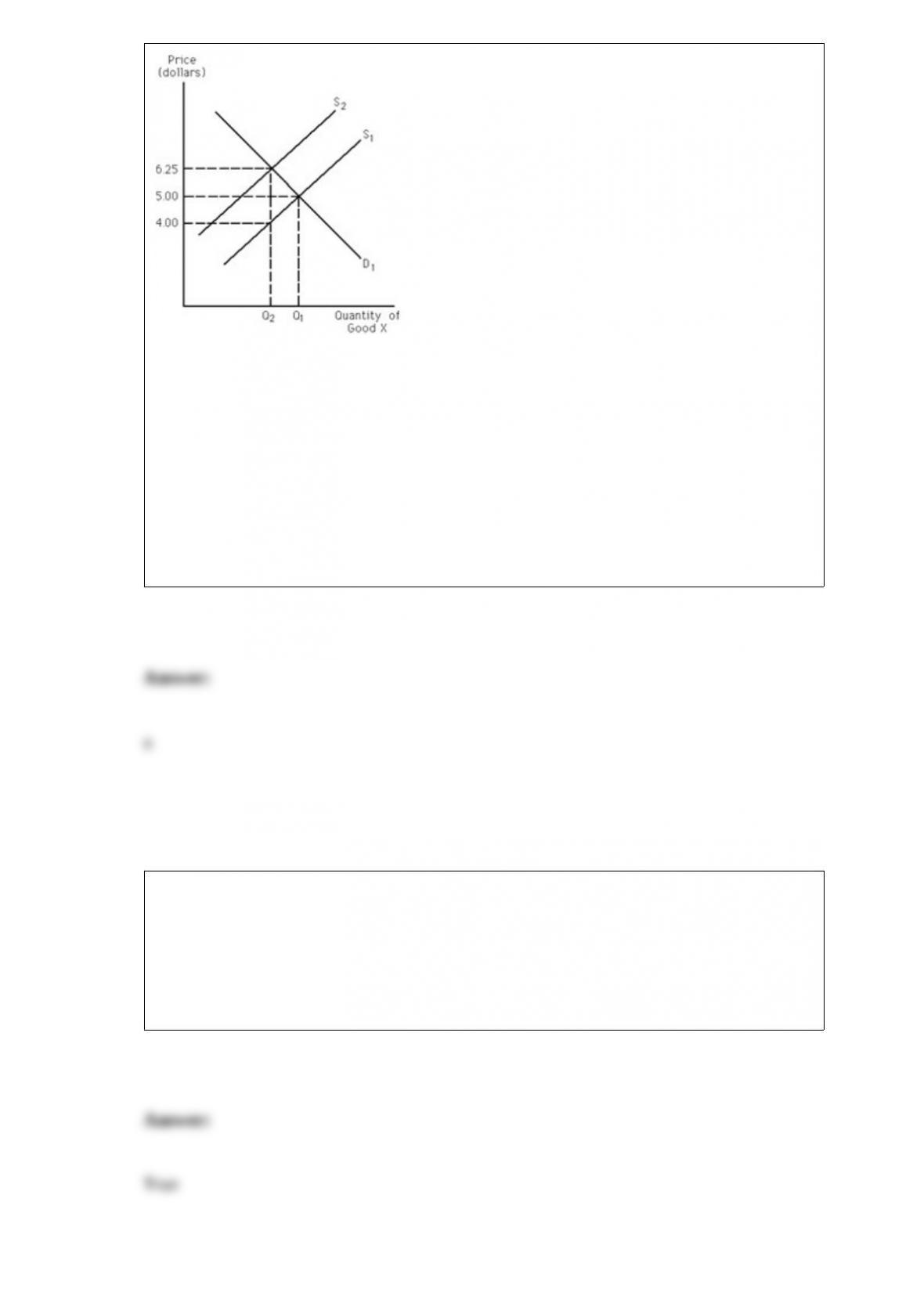
Refer to Exhibit 20-2. The market for good X is initially in equilibrium at $5. The
government then places a per-unit tax on good X as shown by the shift of S1 to S2.
What is an expression for the tax revenue raised?
Exhibit 20-2
a. $2.25 x Q2
b. $1.25 x Q2
c. $1.00 x Q2
d. ($1.00 x Q2) + [$1.25 x (Q1 – Q2)]
e. $2.25 x (Q1 – Q2)
One of the arguments in favor of trade restrictions is the foreign export subsidies
argument.
a. True
b. False
The Lorenz curve and the line of perfect income equality will be one and the same in an
economy if 20% of all households receive 20% of all income.
a. True
b. False
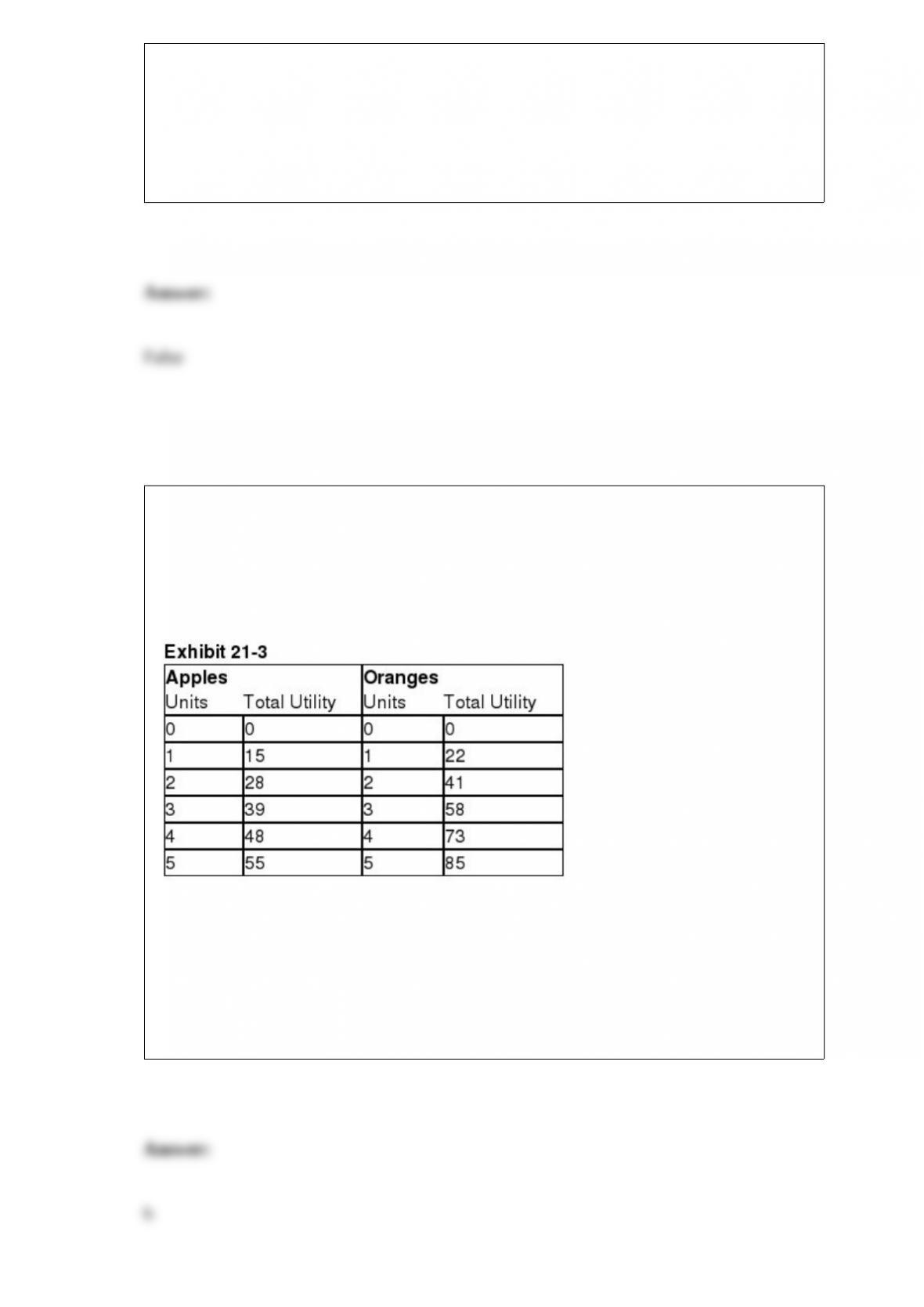
Refer to Exhibit 21-3. Assume that the price of oranges increases to $2, while the price
of apples remains at $1, and Linda allocates $5 of the weekly food budget to purchasing
apples and oranges. If Linda wants to maximize her utility, her new consumption
bundle will consist of
a. 1 apple and 2 oranges.
b. 3 apples and 1 orange.
c. 5 apples and no oranges.
d. none of the above
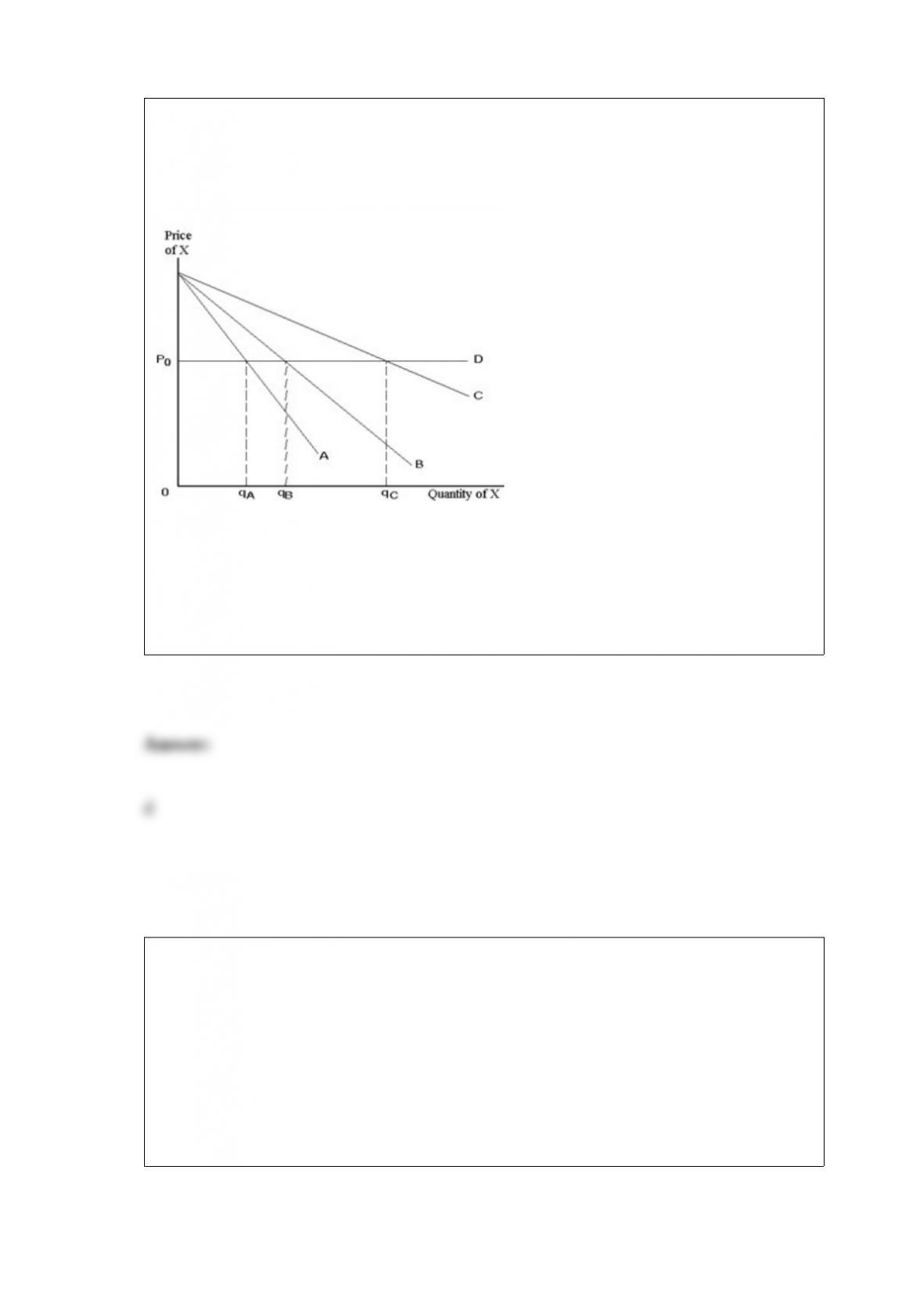
Refer to Exhibit 24-6. The marginal revenue curve of a perfectly competitive firm
producing X and selling it at the price P0 is represented by
Exhibit 24-6
a. A.
b. B.
c. C.
d. D.
If MR > MC, then
a. profits are being maximized.
b. the firm is producing too much of the good to be maximizing profits.
c. the firm can increase its profits (or minimize its losses) by increasing output.
d. the firm must be incurring losses.

A society is productive inefficient when
a. it produces at a point inside (below) its PPF.
b. it does not produce the maximum output with its given resources and technology.
c. it can produce more of one good without giving up some of another good.
d. both a and b
e. all of the above
Given a positive externality, the marginal private benefit curve lies to the __________
of the demand curve, with the market output __________ the socially optimal output.
a. right; above
b. right; below
c. left; above
d. left; below

The Taft-Hartley Act allowed states the right to
a. check into the past of prospective employees before they were hired.
b. prosecute labor union bosses who did not obey the labor practices deemed reasonable
by state authorities.
c. pass right-to-work laws.
d. b and c
e. none of the above
A currency has depreciated in value if it takes more of a foreign currency to buy it.
a. True
b. False
A good provides __________ and a bad provides __________.
a. utility; satisfaction
b. disutility; utility
c. dissatisfaction; satisfaction

d. utility; disutility
e. satisfaction; utility
If an industry is in long-run competitive equilibrium and experiences a decrease in
demand, then as a result the equilibrium price will __________, which will cause the
representative firm’s __________ curve to shift downward and some firms will
__________ the industry.
a. rise; marginal cost; enter
b. fall; marginal cost; enter
c. rise; marginal revenue; enter
d. fall; demand; exit
e. fall; marginal cost; exit
If Jamal successfully and completely internalizes a negative externality, it follows that
a. transaction costs are zero.
b. his marginal private costs are equal to marginal social costs.
c. information is asymmetric.

d. information is symmetric.
e. none of the above
If a person gives a gift to another person, an economist would say that it is because
a. the marginal benefit of giving the gift is at least as great as the marginal cost of
giving the gift.
b. the marginal cost of giving the gift is at least as great as the marginal benefit of
giving the gift.
c. he expects to receive a gift in return.
d. none of the above