
1) health care costs have risen absolutely but remained constant as a percentage of gross
domestic product.
2) exports are subtracted from imports in calculating u.s. gdp because exports are not
available for domestic consumption.
3) The principal beneficiaries of government agricultural aid have been the very
low-income farmers.
4) The time-value of money refers to the idea that a given amount of money is more
valuable to a person the sooner it is received.
5) normative statements are expressions of facts.
6) in determining gdp by the expenditures method it is appropriate to use net investment
rather than gross investment as a measure of investment spending.
7) If the MPC in the economy is .75, government could shift the aggregate demand
curve rightward by $30 billion by cutting taxes by $10 billion.
8) if total income is $200 billion, personal taxes are $40 billion, and consumption is
$140 billion, then personal saving must be $60 billion.
9) Permanent tax reductions are more likely to be expansionary than temporary tax
reductions.
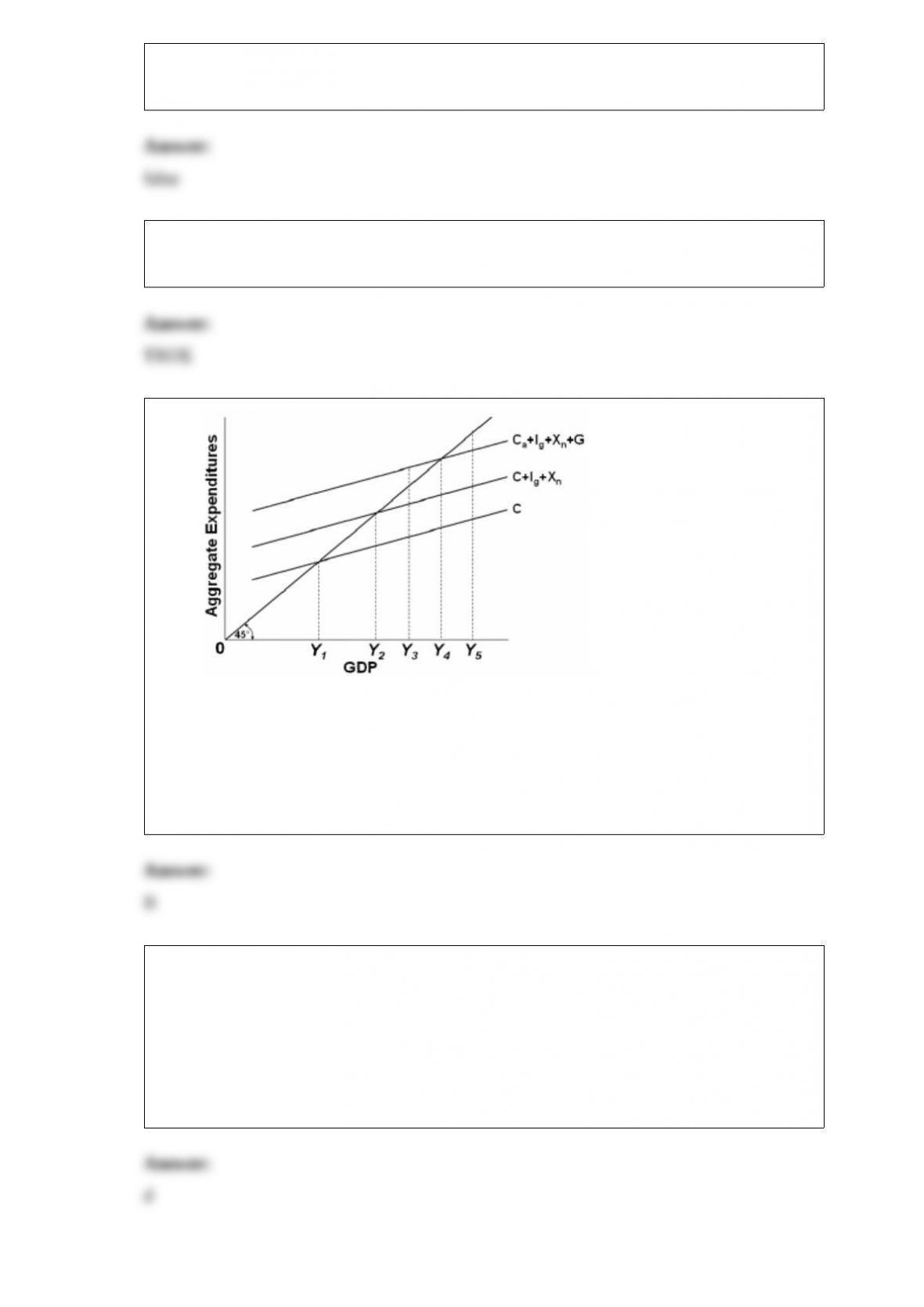
10)
In the above diagram it is assumed that investment, net exports, and government
purchases:
A.are leakages from the circular flow.
B.are independent of the level of GDP.
C.vary inversely with GDP.
D.vary directly with GDP.
11) assume that a decline in consumer demand occurs in a purely competitive industry
which is initially in long-run equilibrium. we can:
a.predict that the new price will be greater than the original price.
b.predict that the new price will be less than the original price.
c.predict that the new price will be the same as the original price.
d.not compare the original and the new price without knowing about cost conditions in
the industry.
12) use the list below to answer the following questions:
1. improvements in technology
2. increases in the supply (stock) of capital goods
3. purchases of expanding output
4. obtaining the optimal combination of goods, each at least-cost production
5. increases in the quantity and quality of natural resources
6. increases in the quantity and quality of human resources
refer to the above list. as distinct from the supply factors and demand factor of
economic growth, the efficiency factor of economic growth is:
a.1 only.
b.4 only.
c.1 and 3 only.
d.3 only.
13)
refer to the above data. the marginal cost of producing the sixth unit of output is:
a.$24.
b.$12.
c.$16.
d.$8.
14) physicians’ incomes:
a.yield a rate of return on educational expenses that is below the returns for lawyers and
holders of mba degrees.
b.yield a rate of return on educational expenses equal to the returns earned by lawyers
and holders of mba degrees.
c.yield a rate of return well above the returns for lawyers and holders of mba degrees.
d.have not risen fast enough to keep the number of physicians per 100,000 people from
falling.

15) A rightward shift of the AD curve in the very flat part of the upsloping AS curve
will:
A.increase real output by more than the price level.
B.increase the price level by more than real output.
C.reduce real output by more than the price level.
D.reduce the price level by more than real output.
16) the largest category of federal spending is for:
a.agriculture and rural development.
b.science, space, and technology.
c.pensions and income security.
d.national defense.
17) an income tax is progressive if the:
a.absolute amount paid as taxes varies directly with income.
b.percentage of income paid as taxes is the same regardless of the size of income.
c.percentage of income paid as taxes increases as income increases.
d.tax rate varies inversely with income.
18) If the nominal wage increases by less than the price level, the real wage:
A.will increase.
B.will decrease.
C.may either increase or decrease.
D.will diverge from labor productivity growth.
19) marginal revenue for a purely competitive firm:
a.is greater than price.
b.is less than price.
c.is equal to price.
d.may be either greater or less than price.

20) suppose that julia receives a $20 gift card for the local coffee shop, where she only
buys lattes and muffins. if the price of a latte is $4 and the price of a muffin is $2, then
we can conclude that julia:
a.should only buy muffins.
b.should only buy lattes.
c.can buy 5 lattes or 10 muffins if she chooses to buy only one of the two goods.
d.can buy 5 lattes and 10 muffins with her $20 gift card.
21) which of the following is correct?
a.if the demand for a product is inelastic, a change in price will cause total revenue to
change in the opposite direction.
b.if the demand for a product is inelastic, a change in price will cause total revenue to
change in the same direction.
c.if the demand for a product is inelastic, a change in price may cause total revenue to
change in either the opposite or the same direction.
d.the price elasticity coefficient applies to demand, but not to supply.
22) to economists, the main difference between the short run and the long run is that:
a.the law of diminishing returns applies in the long run, but not in the short run.
b.in the long run all resources are variable, while in the short run at least one resource is
fixed.
c.fixed costs are more important to decision making in the long run than they are in the
short run.
d.in the short run all resources are fixed, while in the long run all resources are variable.
23) Explain the difference between an equilibrium level of GDP and a level of GDP
which is in disequilibrium.
24) What arguments are made in support of social regulation?
25) Why might a business owner keep their business open but let it deteriorate, rather
than shut it down? Will this profitability last?
26) What are the three functions that a commodity must fulfill to be useful as money?
27) Unexpected inflation is more beneficial to those who save than those who borrow.
Evaluate this statement. How does your answer change if the inflation is expected?
28) Explain how monopoly causes an inefficient allocation of resources when the
competitive firm does not, even when both seek to maximize profits.
29) Describe the idea behind the cap-and-trade program for improving environmental
quality. Explain how supply and demand determine the price for pollution rights in this
case.
30) Of what use is national income accounting to economists and to policy makers?
31) Distinguish between and give examples of nonrenewable resources and renewable
resources.