Scenario: Money Supply Changes II
Charlotte withdraws $8,000 from her checkable bank deposit to pay tuition this
semester. Assume that the reserve requirement is 20% and that banks do not hold excess
reserves.
Look at the scenario Money Supply Changes II. As a result of the withdrawal, excess
reserves _____ by _____.
A) increase; $8,000
B) decrease; $8,000
C) decrease; $6,400
D) decrease; $1,600
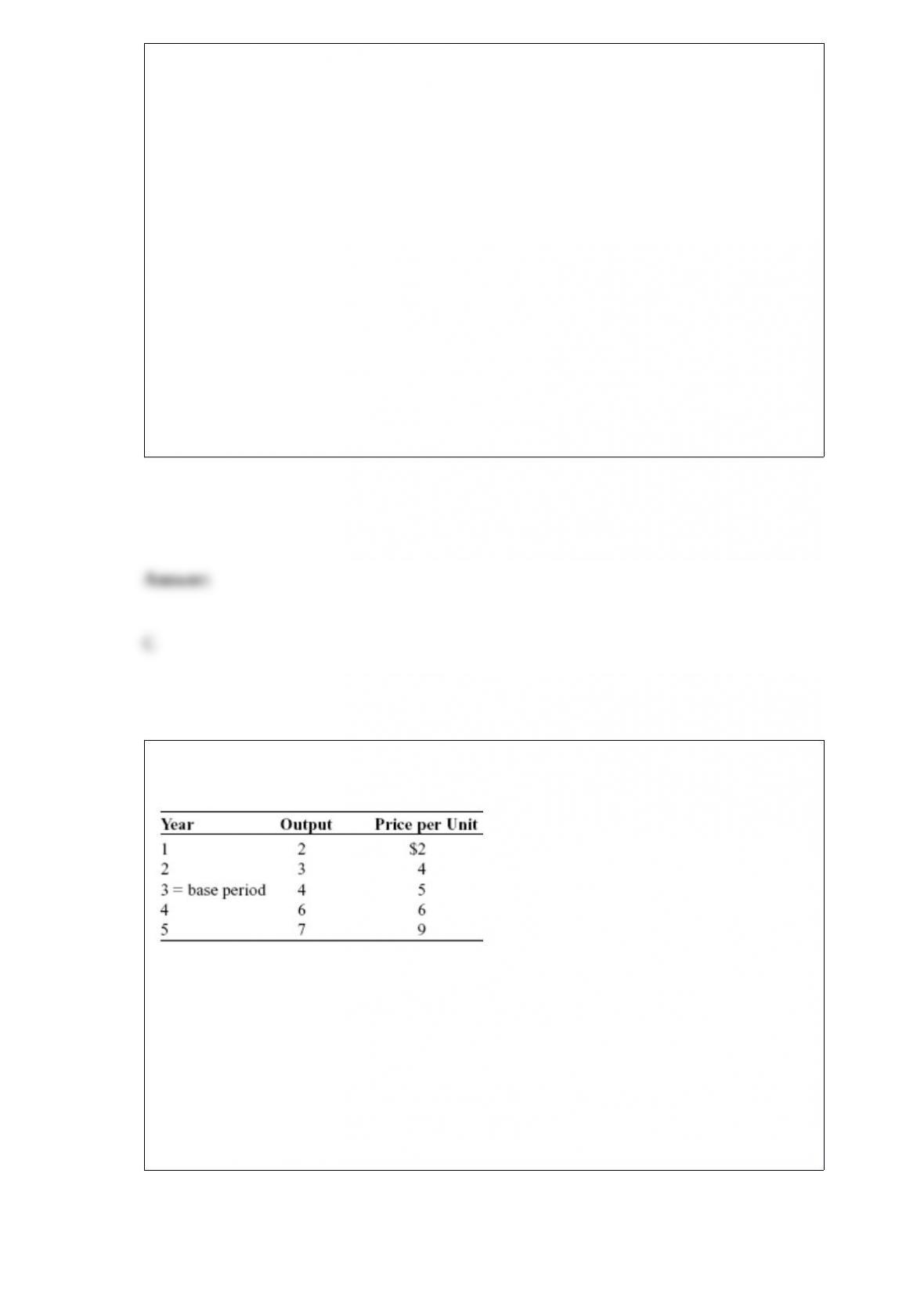
Table: Price and Output Data
Look at the table Price and Output Data.
The value of year 4’s output in nominal dollars is:
A) $6.
B) $24.
C) $30.
D) $36.

When a country’s currency depreciates:
A) foreigners find the country’s goods to be cheaper.
B) the country’s exports fall.
C) the country’s imports rise.
D) foreign goods become cheaper.
According to the convergence hypothesis, the poorest countries have the fastest growth
rate of real GDP per capita.
A) True
B) False
Most economists agree that a binding minimum wage causes structural unemployment.

A) True
B) False
The labor demand curve is negatively sloped because:
A) more people are willing to work at low wages than at high wages.
B) more people are willing to work at high wages than at low wages.
C) employers are willing to hire more people at low wages.
D) employers are willing to hire more people at high wages.
An increase in government spending, all other things unchanged, will cause the
aggregate demand curve to:
A) become positively sloped.
B) remain constant.
C) shift to the right.
D) shift to the left.
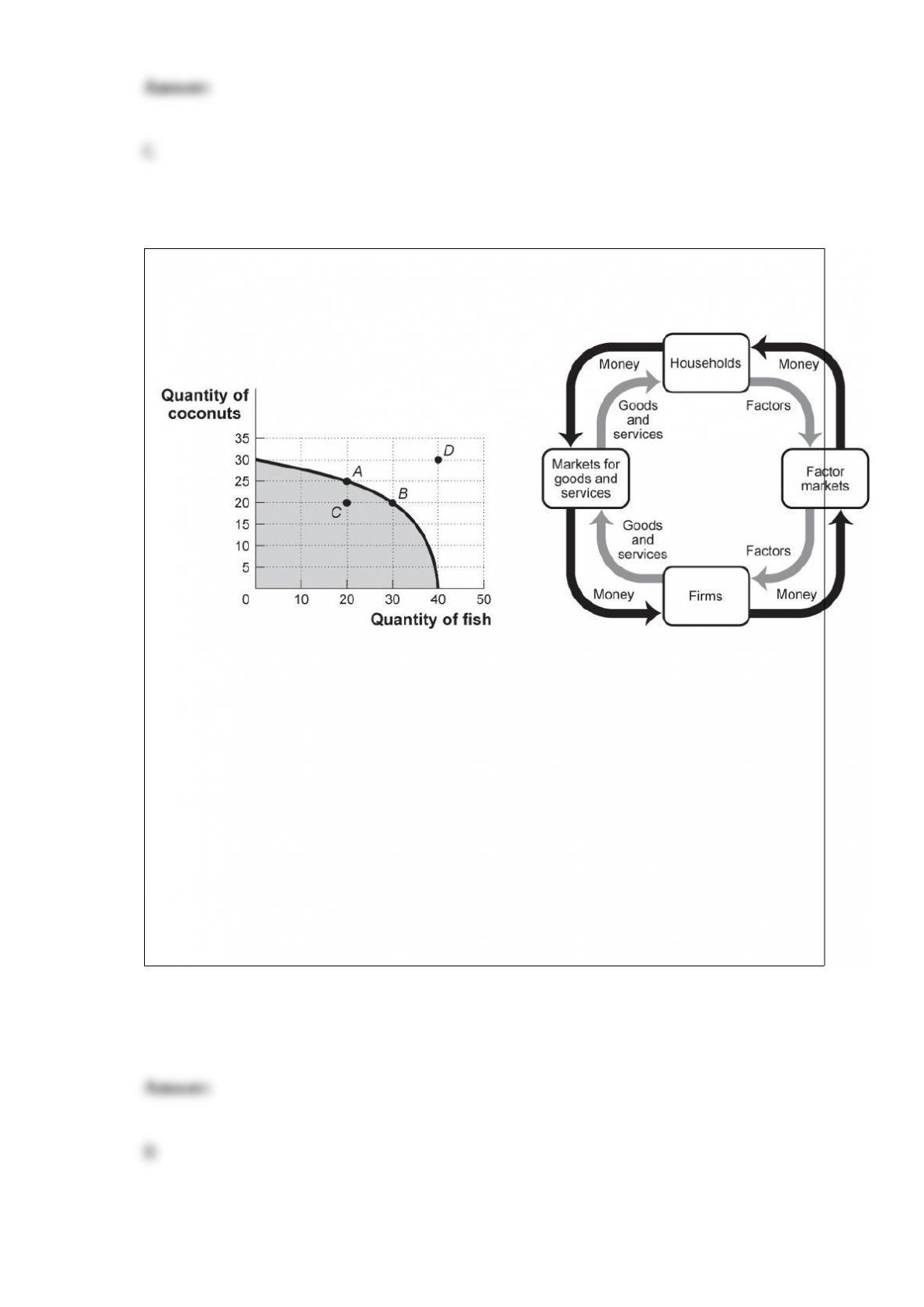
Figure: Production Possibilities and Circular-Flow Diagram
Look at the figure Production Possibilities and Circular-Flow Diagram. Assume the two
figures represent the same economy. Suppose that in the circular-flow diagram capital
that used to flow to firms producing coconuts now flows to firms producing fish. This
adjustment in the economy would be best represented in the production possibilities
figure by a move from point A toward:
A) point A (no movement).
B) point B (a decrease in coconut production and an increase in fish production).
C) point C (a decrease in coconut production).
D) point D (an outward shift of the entire curve).

The exchange rate is determined in the commodities markets.
A) True
B) False
Deflation was a problem in both the Great Depression and the recession of 1979″1982.
A) True
B) False
All other things unchanged, an increase in demand for loanable funds would most likely
be caused by a(n):
A) important forecast predicting solid economic growth.
B) important forecast predicting a recession.
C) increase in the market interest rate.
D) increase in the cost of new capital goods.

Which of the following financial assets is likely to be the MOST liquid?
A) stocks
B) bonds
C) mutual funds shares
D) bank demand deposits
A government with a large deficit will also produce high inflation in the economy if it:
A) raises taxes.
B) reduces government spending.
C) finances the deficit via seignorage.
D) imposes a debt ceiling.

The university recently inherited a large mansion from a wealthy alumnus. The
university plans to use the mansion for faculty parties and to house distinguished
guests. The opportunity cost of the mansion to the university is:
A) zero, because it was a gift.
B) the original cost of building the mansion.
C) the amount the university would receive if it sold the mansion.
D) the cost of catering the parties at the mansion.
Rational expectations theory asserts that because people have rational expectations, if a
policy of reducing the money supply is used:
A) it might affect both AD and potential real GDP.
B) consumers and firms observe that the money supply has fallen, anticipate the
eventual reduction in the price level, and adjust their expectations accordingly.
C) participants in economic activity react in such a way that shifts in aggregate supply
will reinforce shifts in aggregate demand, and real GDP will shift inevitably into
inflationary or recessionary gaps.
D) periods of unemployment will be very short.
The political business cycle refers to policies that:

A) slow down the economy in election years.
B) keep the economy on a constant growth path.
C) speed the economy up in election years.
D) run surpluses in election years.
During banking crises monetary policy is very effective, but fiscal policy is ineffective.
A) True
B) False
When the Federal Reserve buys Treasury bills, this leads to:
A) a decrease in the money supply.
B) an increase in the money supply.
C) an increase in short-term interest rates.
D) an increase in the Federal Reserve funds rate.

A _____ sells policies to savers and guarantees a payment to the policyholder’s
beneficiaries when the policyholder dies.
A) commercial bank
B) mutual fund
C) life insurance company
D) pension fund
A shift of a demand curve to the right, all other things unchanged, will:
A) increase equilibrium price and quantity.
B) decrease equilibrium price and quantity.
C) decrease equilibrium quantity and increase equilibrium price.
D) increase equilibrium quantity and decrease equilibrium price.
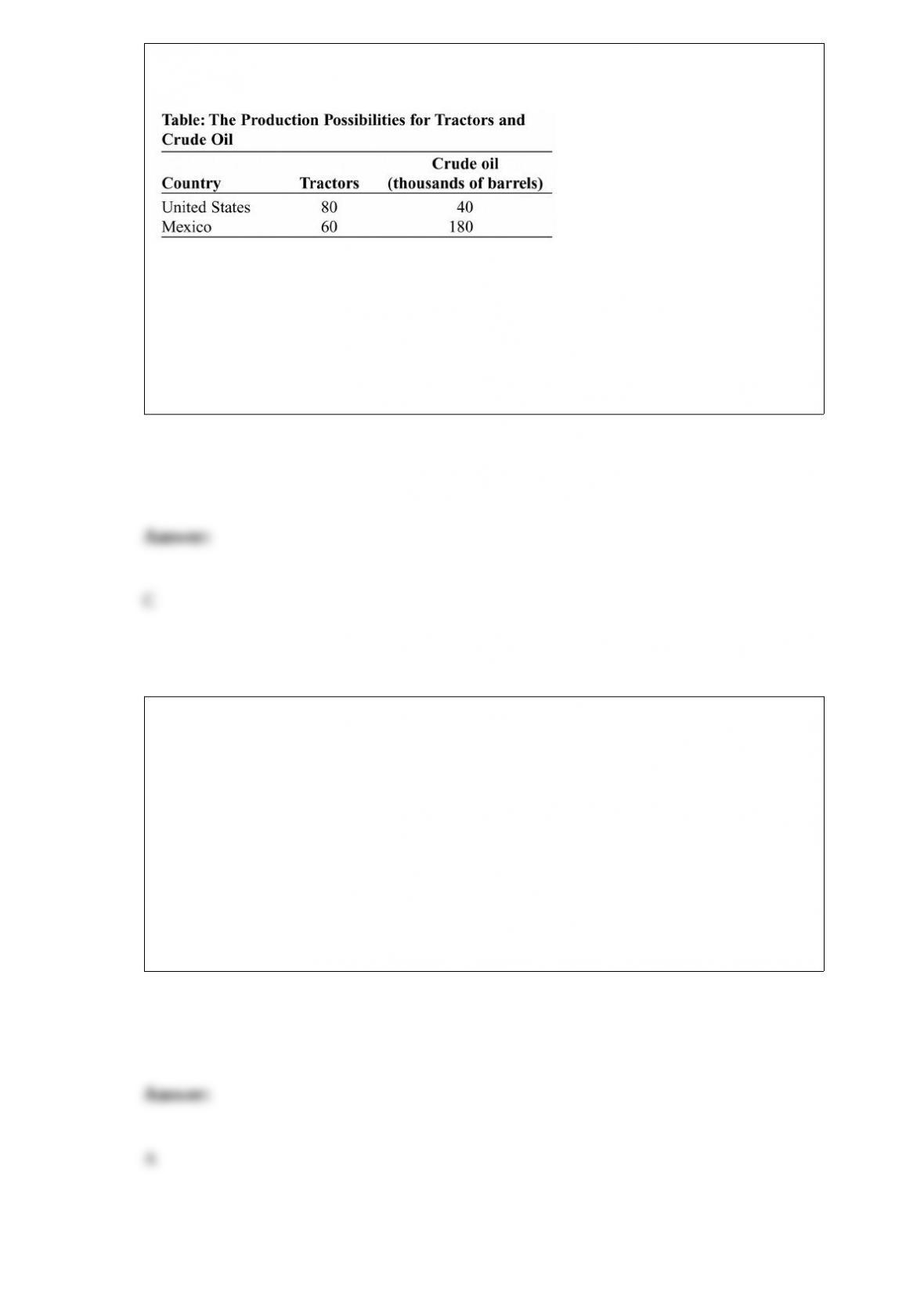
Look at the table The Production Possibilities for Tractors and Crude Oil. The United
States has a comparative advantage in _____ and Mexico has a comparative advantage
in _____.
A) both goods; neither good
B) neither good; both goods
C) tractors; crude oil
D) crude oil; tractors
An example of a double coincidence of wants is:
A) a car mechanic who wants a TV finding an owner of an electronics store who wants
a car repaired.
B) a car dealer who wants a TV finding an electronics store owner who wants money.
C) an electronics store owner who wants car repairs finding a car mechanic who wants
money.
D) a car dealer who wants a new employee finding a car mechanic who wants money.

To acquire human capital a person would:
A) save to buy a printing press.
B) purchase a printing press rather than a very large television.
C) learn to use a printing press.
D) sell the books that the printing press produces.
According to the _____, there is a positive relationship between planned investment
spending and the expected growth rate of real GDP.
A) paradox of thrift
B) life-cycle hypothesis
C) multiplier effect
D) accelerator principle
All points inside the production possibility frontier represent:
A) efficient production points.
B) inefficient production points.
C) infeasible production points.
D) economic growth.

When purchasing power parity is lower than the nominal exchange rate, over time one
can expect:
A) the exchange rate to fall.
B) the exchange rate to rise.
C) purchasing power parity to fall.
D) purchasing power parity to rise.
The expenses involved in actually putting together and executing a deal are called
transactions costs.
A) True
B) False

The inflation tax is likely to be high when:
A) there is a budget surplus.
B) the government relies on seignorage to finance large portions of a budget deficit.
C) the Fed decreases the money supply.
D) corporate and personal income tax rates are increased.
The convergence hypothesis says that:
A) differences in real GDP per capita among countries tend to narrow over time.
B) differences in real GDP per capita among countries tend to increase over time.
C) differences in real GDP per capita do not have much effect on living standards in the
long run.
D) aggregate production functions in different countries will all be the same in the long
run.
Spending promises made by governments that are effectively a debt, despite the fact
that they are not included in the usual debt statistics, are known as:
A) implicit liabilities.
B) explicit liabilities.
C) implicit assets.
D) explicit assets.
Monetary and fiscal policy are tools to reduce the severity of recessions.
A) True
B) False
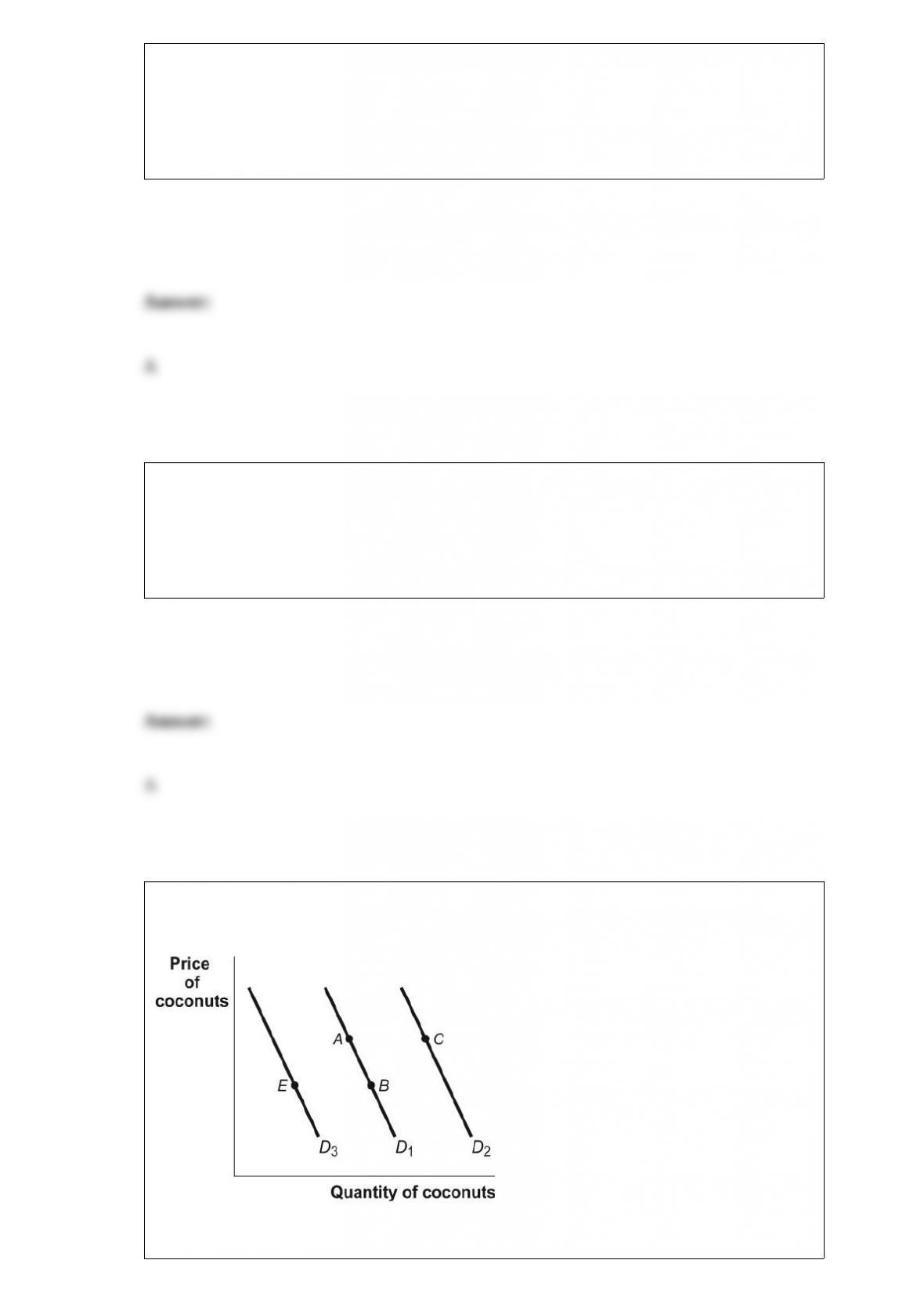
Figure: Demand for Coconuts
Look at the figure Demand for Coconuts. If coconuts are a normal good and the price of

coconuts increases, it will be represented in the figure as a movement from:
A) A to B.
B) B to A.
C) C to A.
D) E to B.
The level of productive capacity _____ planned investment spending.
A) has no effect on
B) is positively related to
C) is negatively related to
D) varies directly with
Your grandmother has promised you $1,000 when you graduate in one year. At a 6%
annual interest rate, you can borrow $943.40 and pay it back with your grandmother’s
gift at graduation.
A) True
B) False
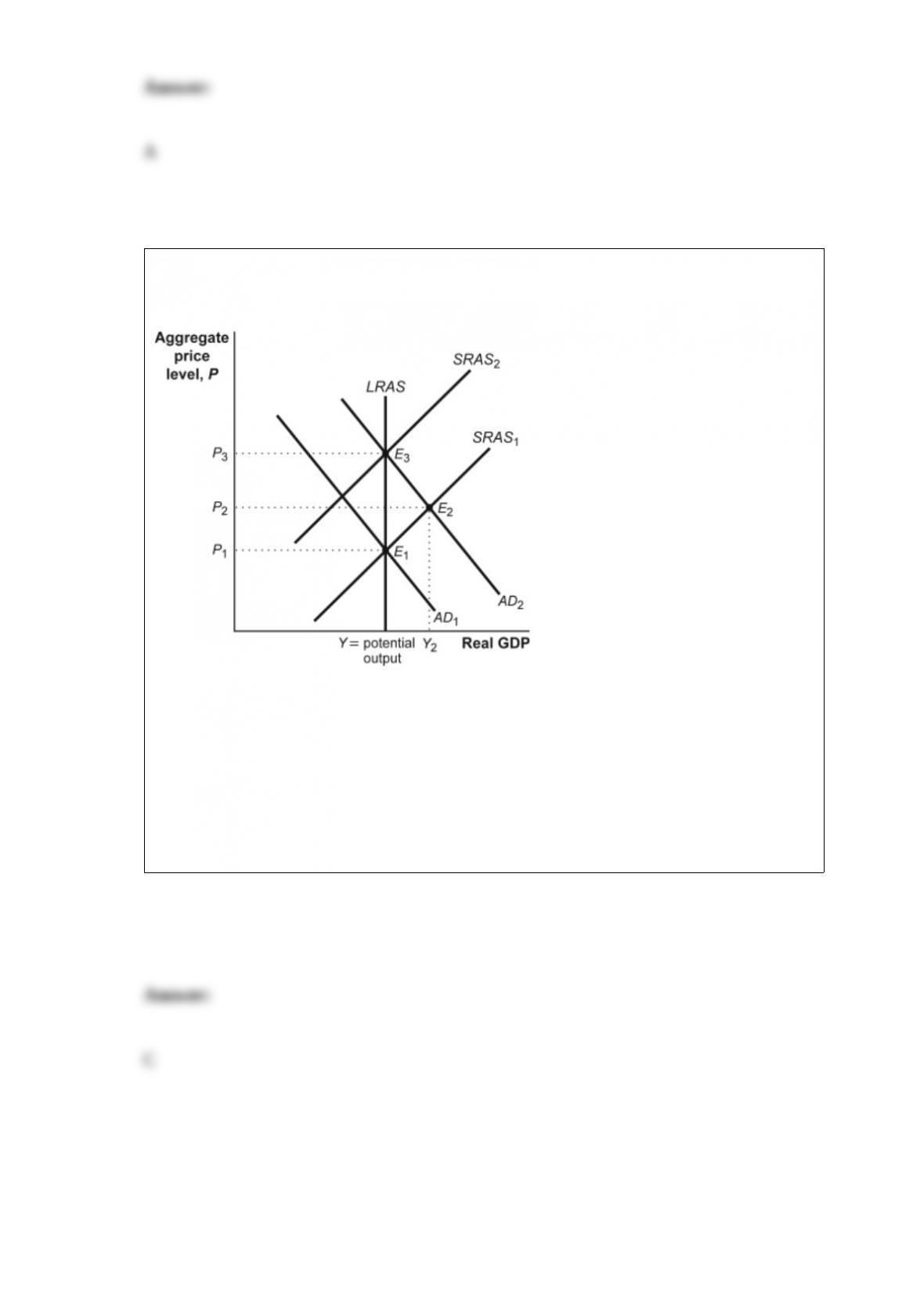
Figure: Short-Run and Long-Run Effects of Monetary Policy
Look at the figure Short-Run and Long-Run Effects of Monetary Policy. If the economy
is initially at E2and the central bank makes no change in its monetary policy:
A) AD2will shift to the right, increasing the existing inflationary gap.
B) AD2will shift to the left, closing the inflationary gap.
C) SRAS1will eventually shift to the left, closing the existing inflationary gap but
raising the aggregate price level.
D) SRAS2will immediately shift to the right, increasing the existing inflationary gap.