The most important barrier to entry is economies of scale.
A cash withdrawal reduces deposits, reserves and excess reserves in the banking
system.
For a perfectly competitive firm, at the profit-maximizing output average revenue
equals marginal cost.
There is no evidence that odd pricing succeeds in convincing consumers that prices are
lower than they really are.
Most food products have low income and price elasticities of demand.
Perfect price discrimination will lead a firm to produce up to the point where price
equals marginal cost, the efficient level of output.
If the demand for a product is elastic, the quantity demanded changes by a smaller
percentage than the percentage change in price.
On average, people in the United States spend a greater percentage of their income on
health care than do people in most other countries.
A quasi-public good Differs from a public good in that unlike a public good, it is
possible to keep out those who do not pay for the quasi-public good from enjoying the
benefits of the good.
Purchasing power parity is the theory that, in the long run, exchange rates should be at a
level such that equivalent amounts of any country’s currency
A) will equalize nominal interest rates across countries.
B) are valued inversely relative to the size of its GDP.
C) should earn the same real rate of return.
D) allow one to buy the same amount of goods and services.
One difference between the demand for a private good and that for a public good is that
A) with a private good, each consumer chooses the quantity she wants to consume but
with a public good, each consumer chooses the price she is willing to pay for a fixed
quantity.
B) with a private good, each consumer chooses the quantity she wants to consume but
with a public good, everyone consumes the same quantity.
C) with a private good, each consumer receives different amounts of benefit from
consuming the product but with a public good, every consumer realizes the same
amount of benefit from consuming the product.
D) the marginal benefit from consuming the last unit of a public good always exceeds
the marginal benefit from consuming the last unit of a private good because there are

externalities in the consumption of the former.
If real GDP exceeded potential real GDP and inflation was increasing, which of the
following would be an appropriate fiscal policy?
A) a decrease in the money supply and an increase in the interest rate
B) an increase in government spending
C) an increase in taxes
D) an increase in oil prices
The total value of U.S. Treasury bonds outstanding equals
A) the federal government deficit.
B) the federal government surplus.
C) the federal government debt.
D) the cyclically adjusted budget deficit.
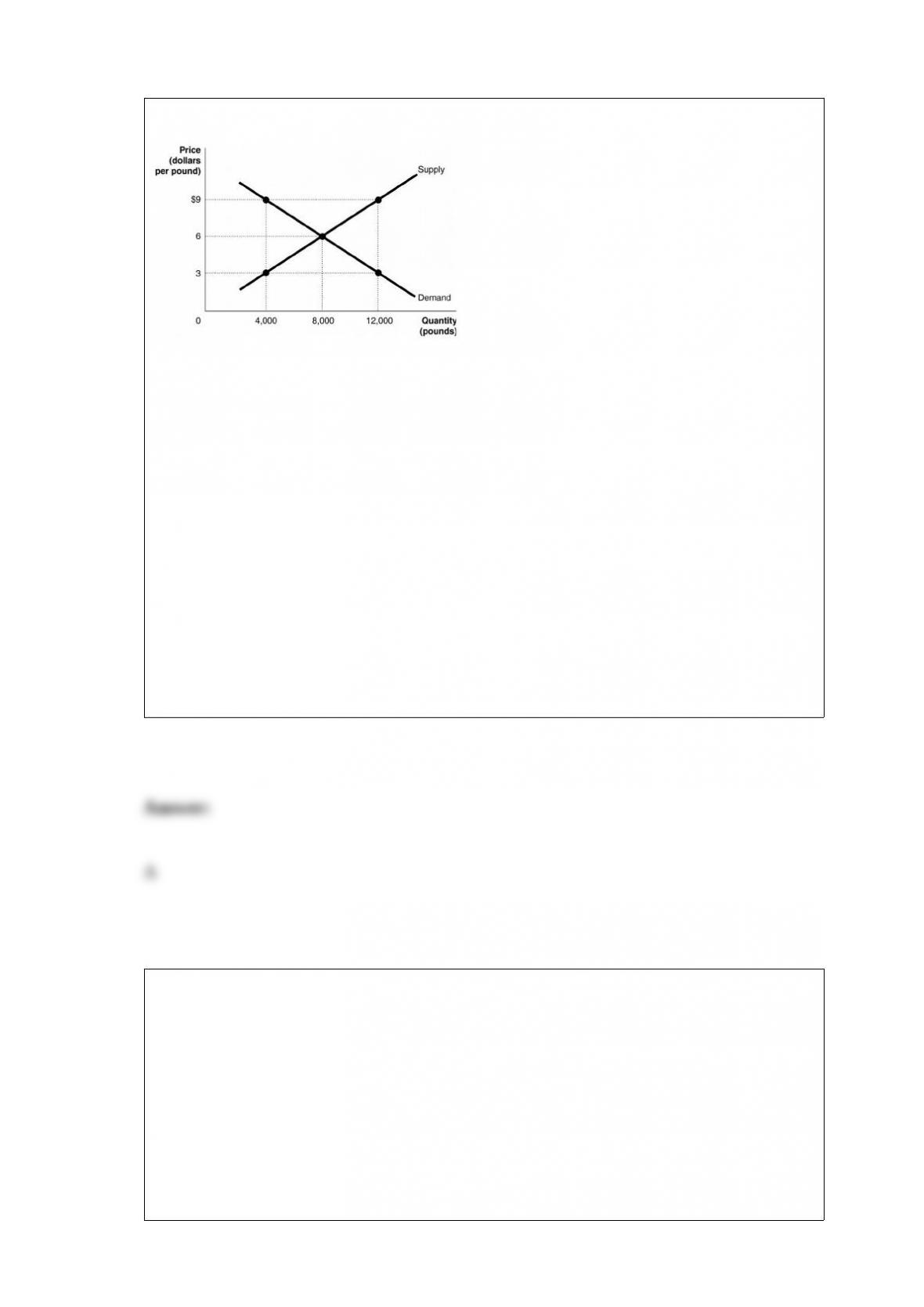
Figure 4-4
The figure above represents the market for pecans. Assume that this is a competitive
market. If the price of pecans is $9, what changes in the market would result in an
economically efficient output?
A) The price would decrease, the quantity supplied would decrease, and the quantity
demanded would increase.
B) The quantity supplied would increase, the quantity demanded would decrease and
the equilibrium price would decrease.
C) The price would decrease, the demand would increase and the supply would
decrease.
D) The price would increase, the quantity demanded would decrease and the quantity
supplied would increase.
If the Federal Reserve decided to include virtual money like Bitcoins in its measure of
the money supply, what would be the effect on M1 or M2?
A) M1 would rise.
B) M1 would fall.
C) M1 would rise and M2 would remain constant.
D) M2 would rise but M1 would remain constant.
An increase in Social Security payments will
A) increase consumption spending.
B) increase investment spending.
C) increase government spending.
D) increase export spending.
An example of a monopoly based on control of a key resource is
A) Major League Baseball.
B) the Paul Ecke Ranch monopoly on poinsettias.
C) Microsoft’s Windows operating system.
D) the U.S. Food and Drug Administration.
Mark Frost grows apples in a perfectly competitive market. If we drew a line in a graph
that illustrates Mark’s total revenue from selling apples, it would be
A) a straight, upward-sloping line.
B) a horizontal line.
C) a straight, downward-sloping line.
D) a curve that is negatively sloped at low levels of output and positively sloped at
higher levels of output.
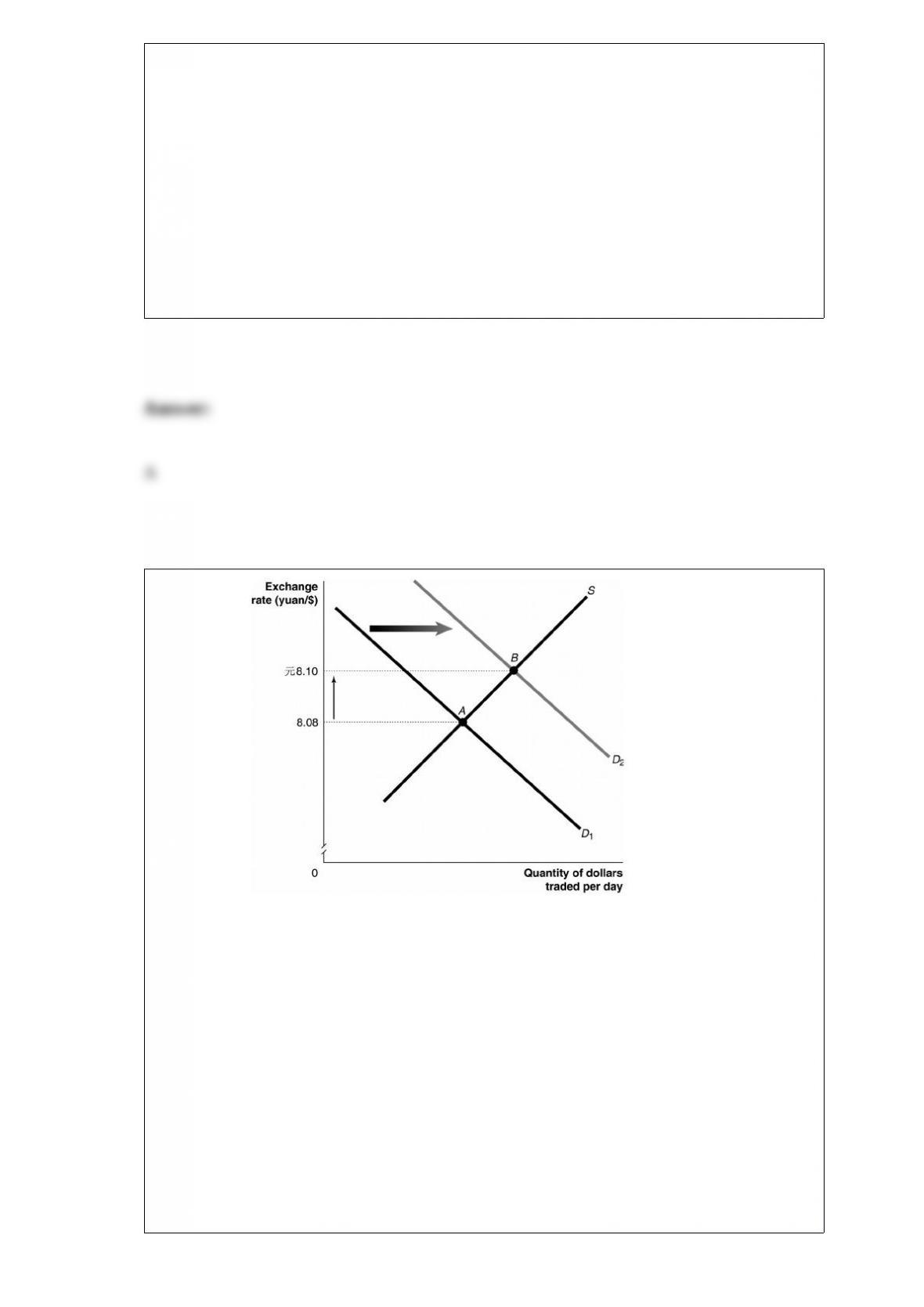
Figure 30-2
Which of the following would cause the change depicted in the figure above?
A) Lack of investment in infrastructure causes U.S. productivity to fall relative to
Chinese productivity.
B) Tainted cat food from China causes U.S. consumers to decrease their preferences for
Chinese goods relative to U.S. goods.
C) A new trade agreement with China results in the United States removing all tariffs on
clothing imported from China.
D) An expansionary monetary policy causes an increase in the price level of U.S. goods
relative to Chinese goods.

Which of the following statements best describes the concept of consumer surplus?
A) “Safeway was having a sale on Dreyer’s ice cream so I bought 3 quarts.”
B) “I was all ready to pay $300 for a new leather jacket that I had seen in Macy’s but I
ended up paying only $180 for the same jacket.”
C) “I paid $130 for a printer last week. This week the same store is selling the same
printer for $110.”
D) “I sold my Blu-ray copy of Ben-Hur for $18 at a garage sale even though I was
willing to sell it for $10.”
A teenaged babysitter is similar to a firm in a perfectly competitive industry in that, for
both
A) fixed costs are lower than variable costs.
B) there are many other suppliers of similar goods or services.
C) the implicit costs of production exceed the explicit costs of production.
D) average costs of production do not change when their industry expands.

The profit-maximizing level of output and the profit-maximizing price for an
oligopolist cannot be calculated when we don’t know
A) what the concentration ratio for the oligopolist’s industry is.
B) what the minimum efficient scale in the oligopolist’s industry is.
C) the demand curve and the marginal revenue curve of the oligopolist.
D) the type of barrier to entry that exists in the oligopolist’s industry.
If a corporation retains all its profits and distributes none of the profit to owners, how
can owners benefit?
A) If the retained earnings are expected to create future profits, the market price of the
firm’s stock will increase and create a capital gain for stockholders if the stock is sold.
B) Shares of stock can be converted into bonds so stockholders will be able to earn
coupon payments.
C) Owners will only benefit if some profits are paid out in the form of dividends.
D) Owners will benefit by changing the board of directors.
Table 10-2
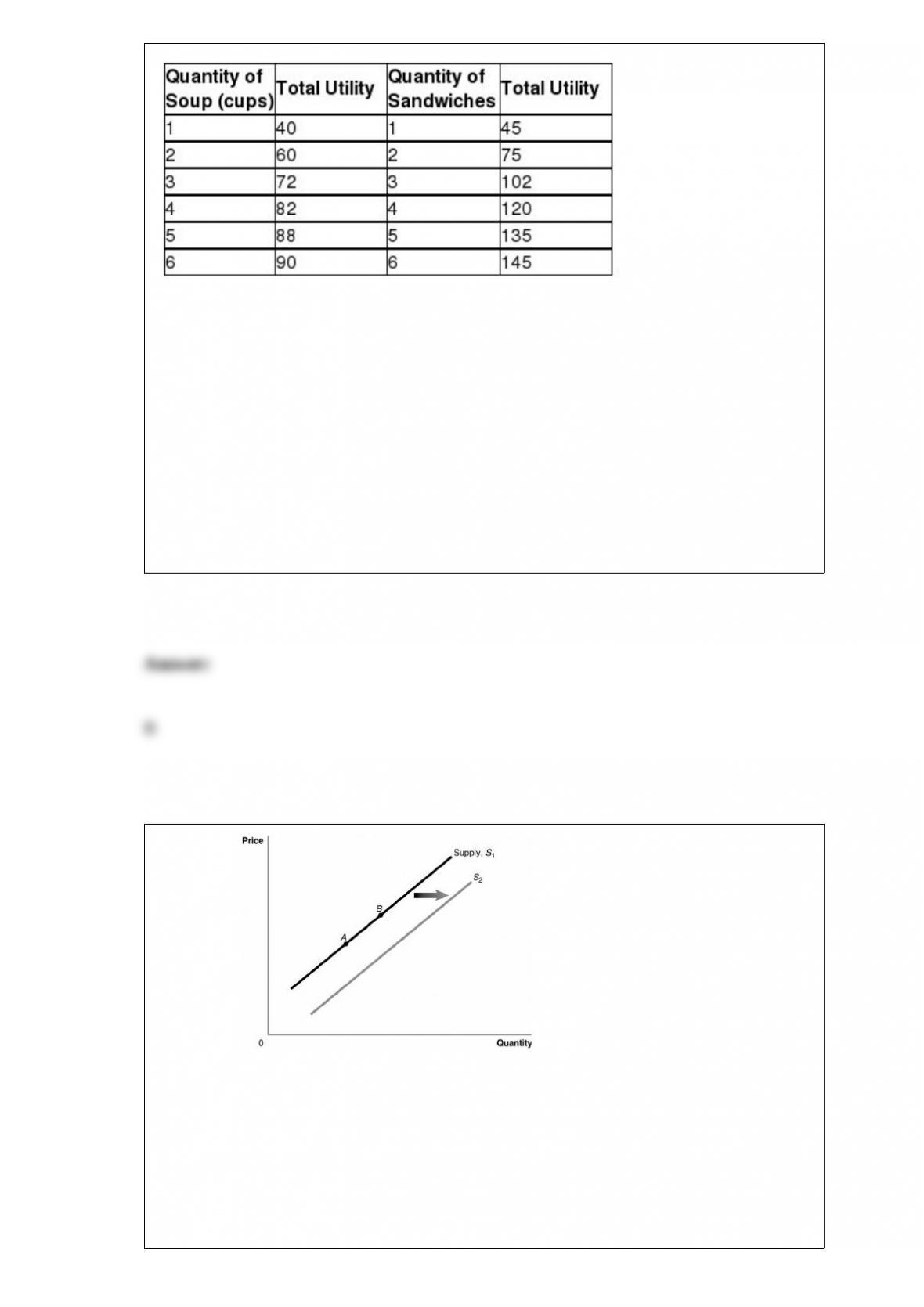
Table 10-2 above shows Keira’s utility from soup and sandwiches. The price of soup is
$2 per cup and the price of a sandwich is $3. Keira has $18 to spend on these two
goods. Suppose Keira’s income increases from $18 to $23 but prices have not changed.
What is her utility maximizing bundle now?
A) 6 cups of soup and 5 sandwiches
B) 4 cups of soup and 5 sandwiches
C) 5 cups of soup and 4 sandwiches
D) 5 cups of soup and 5 sandwiches
Figure 3-2
A decrease in the price of substitutes in production would be represented by a
movement from
A) A to B.
B) B to A.
C) S1 to S2.
D) S2 to S1.
If there is a market outcome in which the marginal benefit to consumers of the last unit
produced is equal to its marginal cost of production, and consumer surplus plus
producer surplus is maximized, then
A) maximum deadweight loss occurs.
B) economic efficiency is achieved.
C) profits are maximized.
D) costs are minimized.
Suppose you are an advisor to the Business Cycle Dating Committee. You are asked to
look at macroeconomic data to evaluate whether the economy has entered a recession
this year. Which data do you look at? How does the economy behave at the onset of a
recession?
The demand for labor is a derived demand. Explain what is meant by the term “derived
demand.”
What assumptions are necessary for a market to be perfectly competitive? Explain why
each of these assumptions is important.
The simple trade model demonstrates that countries can expand consumption by
specializing in the production of goods and services in which they have a comparative
advantage. In reality we do not see complete specialization in production. State three
reasons why this is case.
What is marginal cost? Which curve is also referred to as the marginal cost curve?
What is meant by the term “long-run competitive equilibrium?
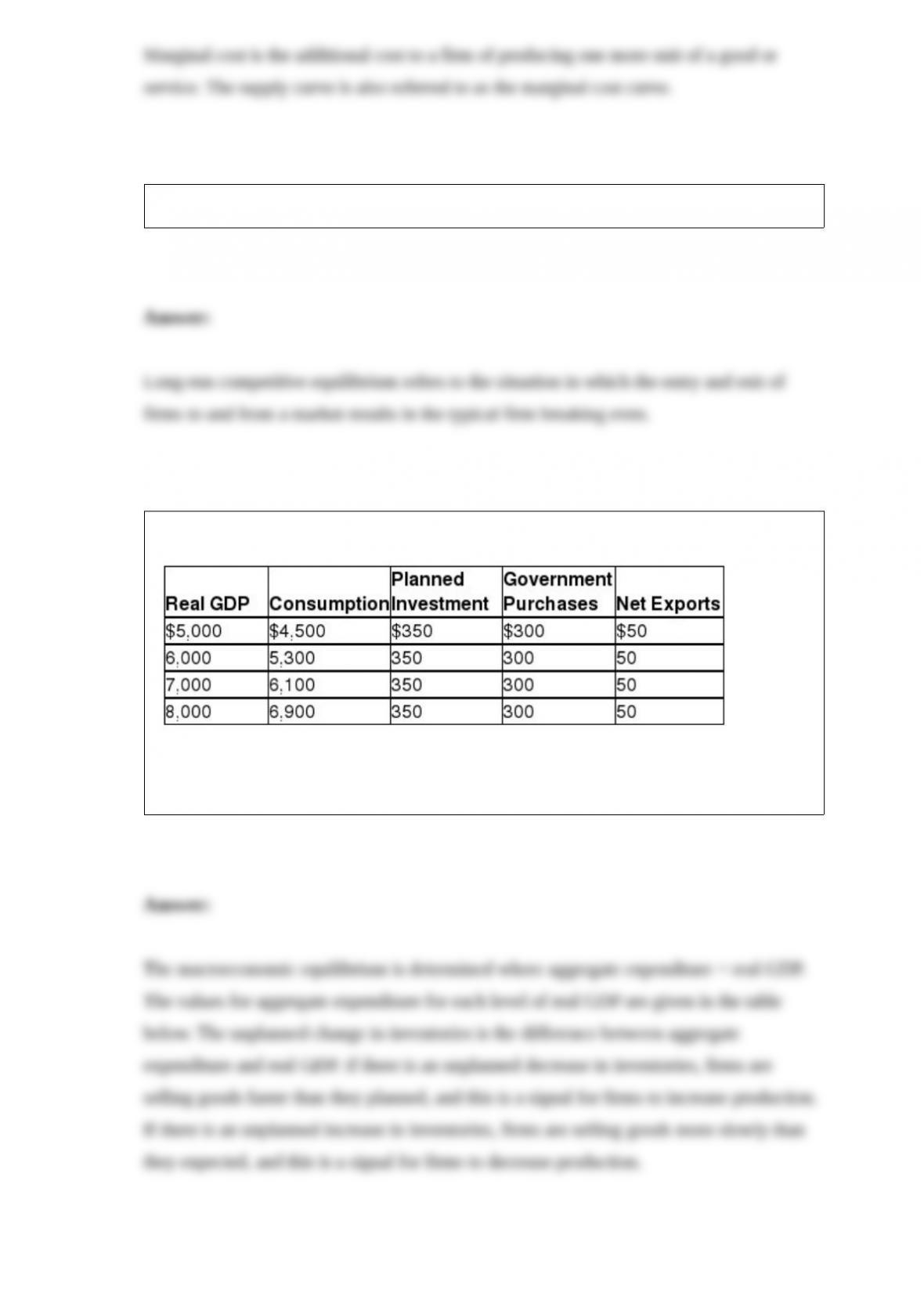
Table 12-11
Using the table above, calculate the unplanned change in inventories for each level of
GDP, and explain what will happen to GDP.