In making decisions about what to consume, a person’s goal is to
A) allocate her limited income among all the products she wishes to buy so that she
receives the highest total utility.
B) buy low-priced goods rather than high-priced goods.
C) maximize her marginal utility from the goods and services she wishes to buy using
her limited income.
D) consume as many necessities as possible and then, if there is money left over, to buy
luxuries.
Auctions in recent years have resulted in higher prices paid for letters written by John
Wilkes Booth than those written by Abraham Lincoln. What is a reason for this
difference in price?
A) There is a surplus of letters written by Booth and a shortage of letters written by
Lincoln.
B) Many people are more fascinated by villains and anti-heroes than by heroic figures.
C) There are more letters available for collectors to buy that were written by Lincoln
than there are letters that were written by Booth.
D) Booth was a well-known actor; the demand for his letters rose as wealthy actors
attempted to buy them.
Firms in a small economy planned that inventories would grow over the past year by
$300,000. Over that year, inventories actually grew by $400,000. This implies that
A) aggregate expenditure that year was less than GDP that year.
B) there was an unplanned decrease in inventories that year.
C) there was a planned decrease in inventories that year.
D) aggregate expenditure that year was equal to GDP that year.
An explicit cost is defined as
A) a cost that does not change as output changes.
B) a nonmonetary opportunity cost.
C) a cost that involves spending money.
D) a nonmonetary accounting cost.
Which of the following is an example of a “how much” decision?
A) Octavia is debating whether to buy a pair of Jimmy Choo shoes or Steve Madden
boots.
B) Humberto has taken a second job to earn money to buy a Harley-Davidson
SuperLow Sportster.
C) You plan on going to Las Vegas for your birthday and are deciding if you should fly
or drive.
D) Diana is trying to decide if she should open her pet shop on Sundays.
The German Hyperinflation of the early 1920s was caused by
A) the German government raising funds for expenditures by selling bonds to the
central bank.
B) an overly aggressive monetary policy implemented to combat a severe recession.
C) rising oil prices after World War I caused a severe stagflation and hyperinflation.
D) large deficits resulting from the high levels of war spending and falling taxes.
The decision about what goods and services will be produced made in a market
economy is made by
A) lawmakers in the government voting on what will be produced.
B) workers deciding to produce only what the boss says must be produced.
C) producers deciding what society wants most.
D) consumers and firms choosing which goods and services to buy or produce.
E) consumers dictating to firms what they need most.
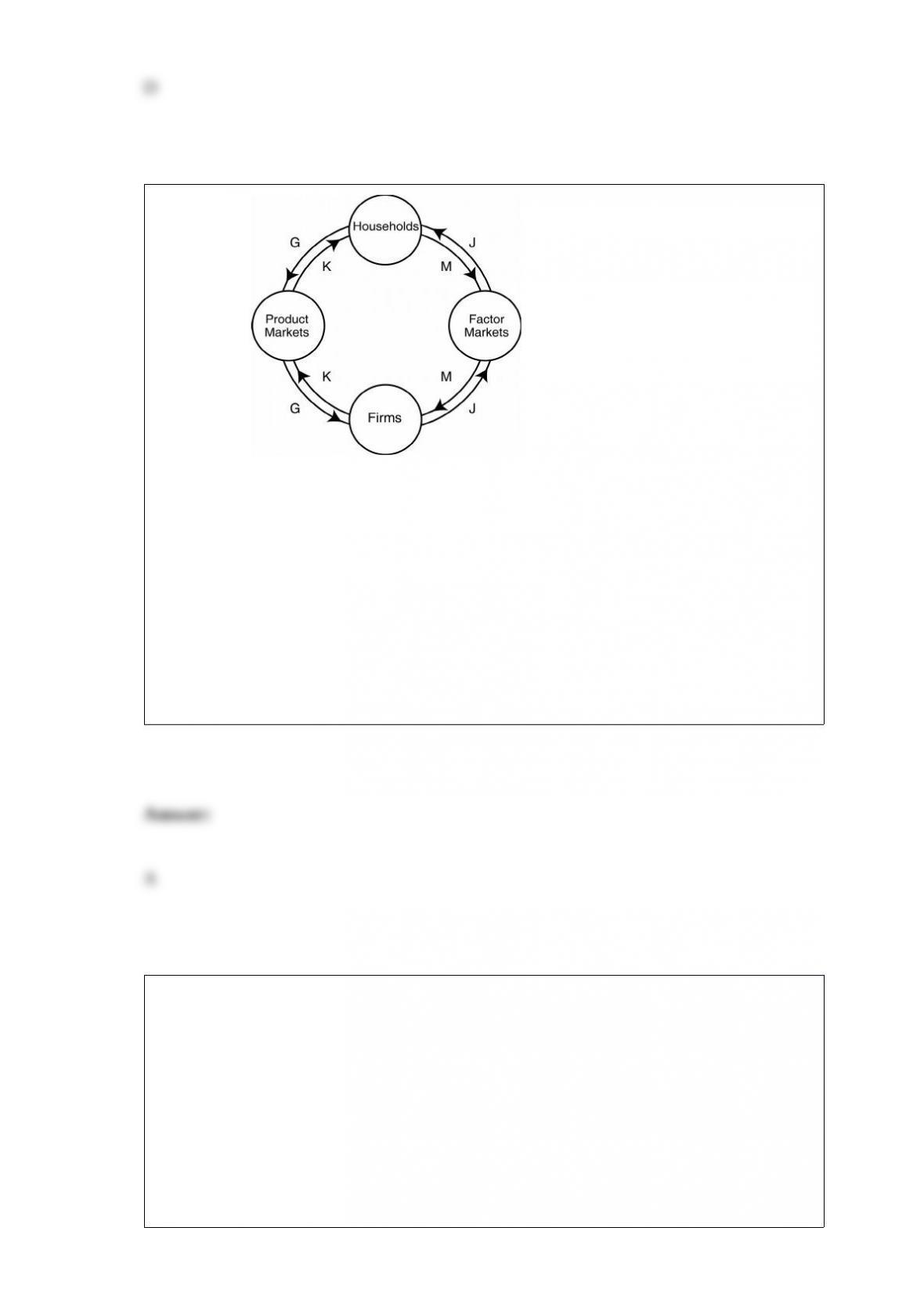
Figure 2-13
Which two arrows in the diagram depict the following transaction: Carter earns a $400
commission for selling men’s designer shoes at Brooks Brothers.
A) J and M
B) K and G
C) K and M
D) J and G
Which of the following is used to explain why a consumer’s willingness to buy a cell
phone increases as the number of other people who own and use cell phones increases?
A) network externalities
B) market failure
C) diminishing marginal utility
D) the income effect of a price change
Suppose a competitive firm is paying a wage of $12 an hour and sells its product at $3
per unit. Assume that labor is the only input. If the last worker hired produces four units
of output per hour, then to maximize profits the firm should
A) not change the number of workers it currently hires.
B) lay off some workers.
C) hire another worker.
D) There is not enough information to answer the question.
In cities with rent control, people have an incentive to list their apartments on sites such
as Airbnb at rents ________ the controlled rates, because rent control causes a
________ of apartments.
A) above; surplus
B) above; shortage
C) below; surplus
D) below; shortage
A cartel is
A) a temporary storage facility for automobiles.
B) a group of firms that enter into an informal agreement to fix prices to maximize joint
profits.
C) a group of firms that enter into a formal agreement to fix prices to maximize joint
profits.
D) an example of a group of firms that collectively regulate a competitive industry.
A decrease in aggregate demand in the economy will have what effect on
macroeconomic equilibrium in the long run?
A) The price level will fall, and the level of GDP will be unaffected.
B) The price level will fall, and the level of GDP will fall.
C) The price level will rise, and the level of GDP will fall.
D) The price level will rise, and the level of GDP will be unaffected.
The additional benefit to a consumer from consuming one more unit of a good or
service
A) is equal to consumer surplus.

B) is equal to the opportunity cost of consuming the good or service.
C) is equal to marginal benefit.
D) is equal to economic surplus.