1) Refer to Figure 9-17. When comparing no trade to free trade, the gains from trade
amount to a. $400.
b. $600.
c. $750.
d. $1,000.
2) When two variables move in the same direction, the curve relating them is downward
sloping, and we say the variables are negatively related.
a.True
b.False
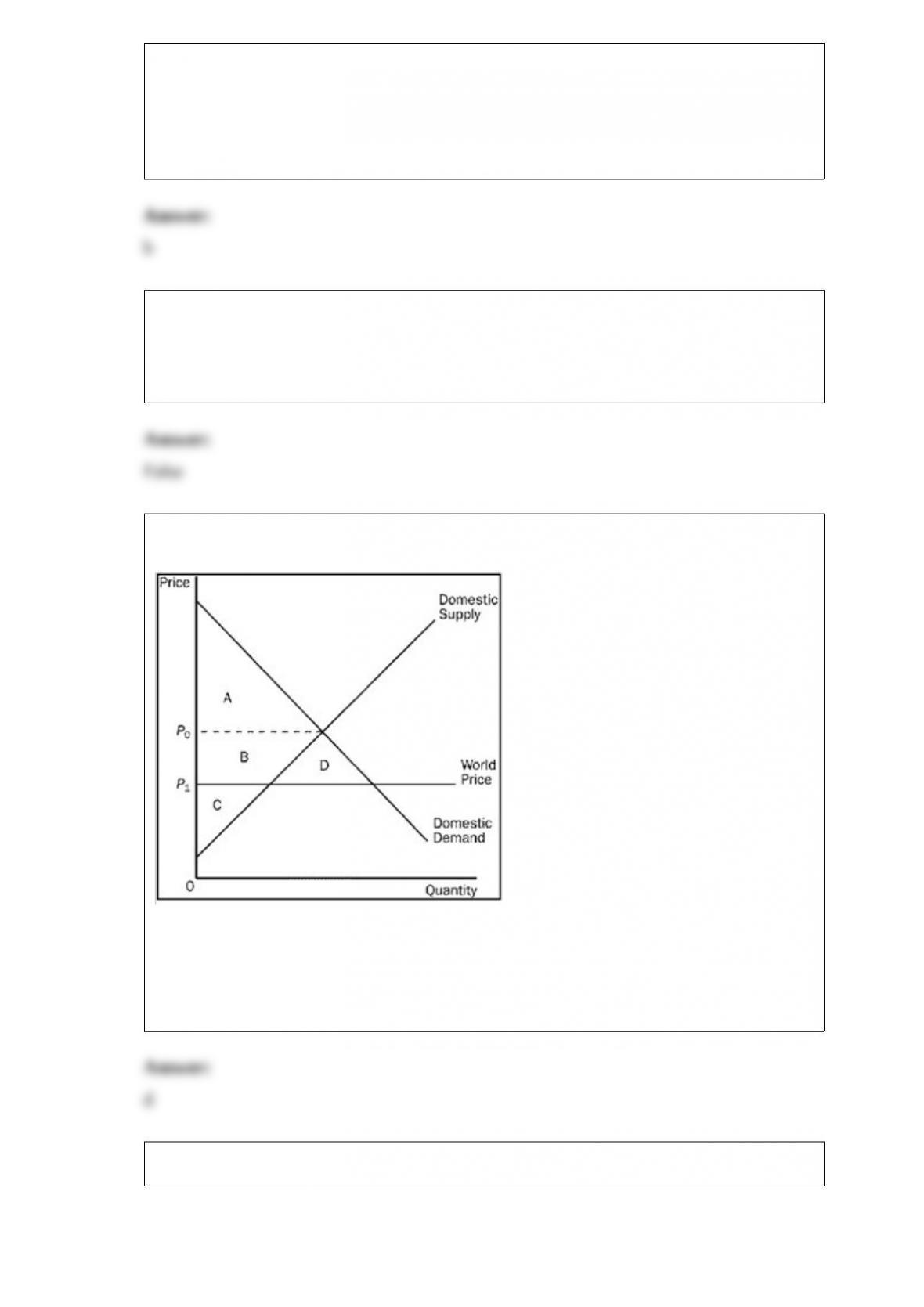
3) Figure 9-11
The change in total surplus in this market because of trade is
a.A, and this area represents a loss of total surplus.
b.B, and this area represents a gain in total surplus.
c.C, and this area represents a loss of total surplus.
d.D, and this area represents a gain in total surplus.
4) Figure 18-7
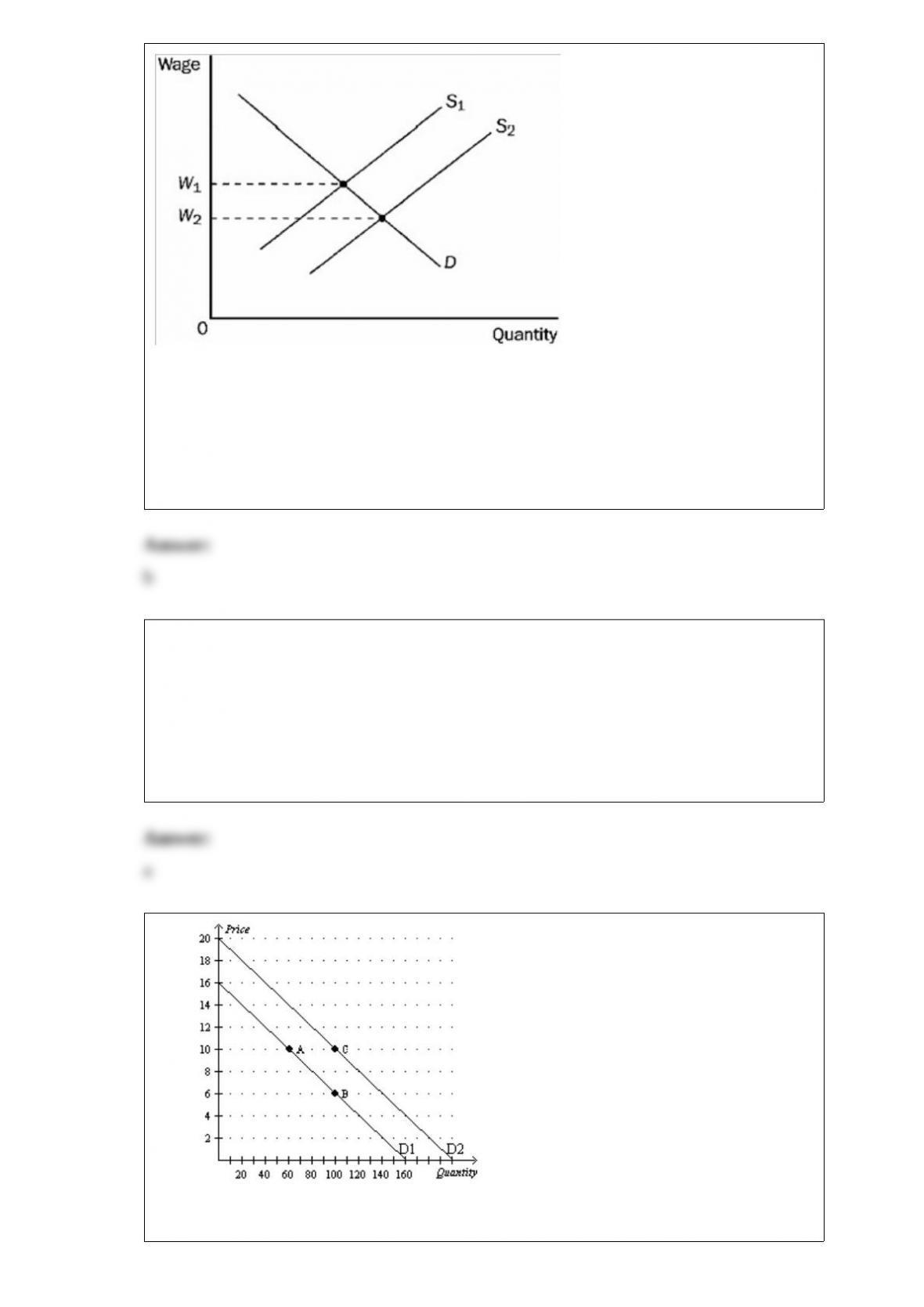
Refer to Figure 18-7. Assume W1 = $20 and W2 = $18, and the market is always in
equilibrium. A shift of the labor supply curve from S1 to S2 would
a.increase the value of the marginal product of labor by $2.
b.decrease the value of the marginal product of labor by $2.
c.decrease the value of the marginal product of labor by more than $2.
d.not change the value of the marginal product of labor.
5) For a ‘superstar” to emerge, it must be the case that
a.it is possible to supply the good or service that the superstar produces at low cost to
every customer.
b.some customers are willing and able to pay large sums of money to enjoy the good or
service provided by the superstar.
c.the superstar has a natural monopoly on his or her good or service.
d.the superstar can become sufficiently popular to earn income from advertisements.
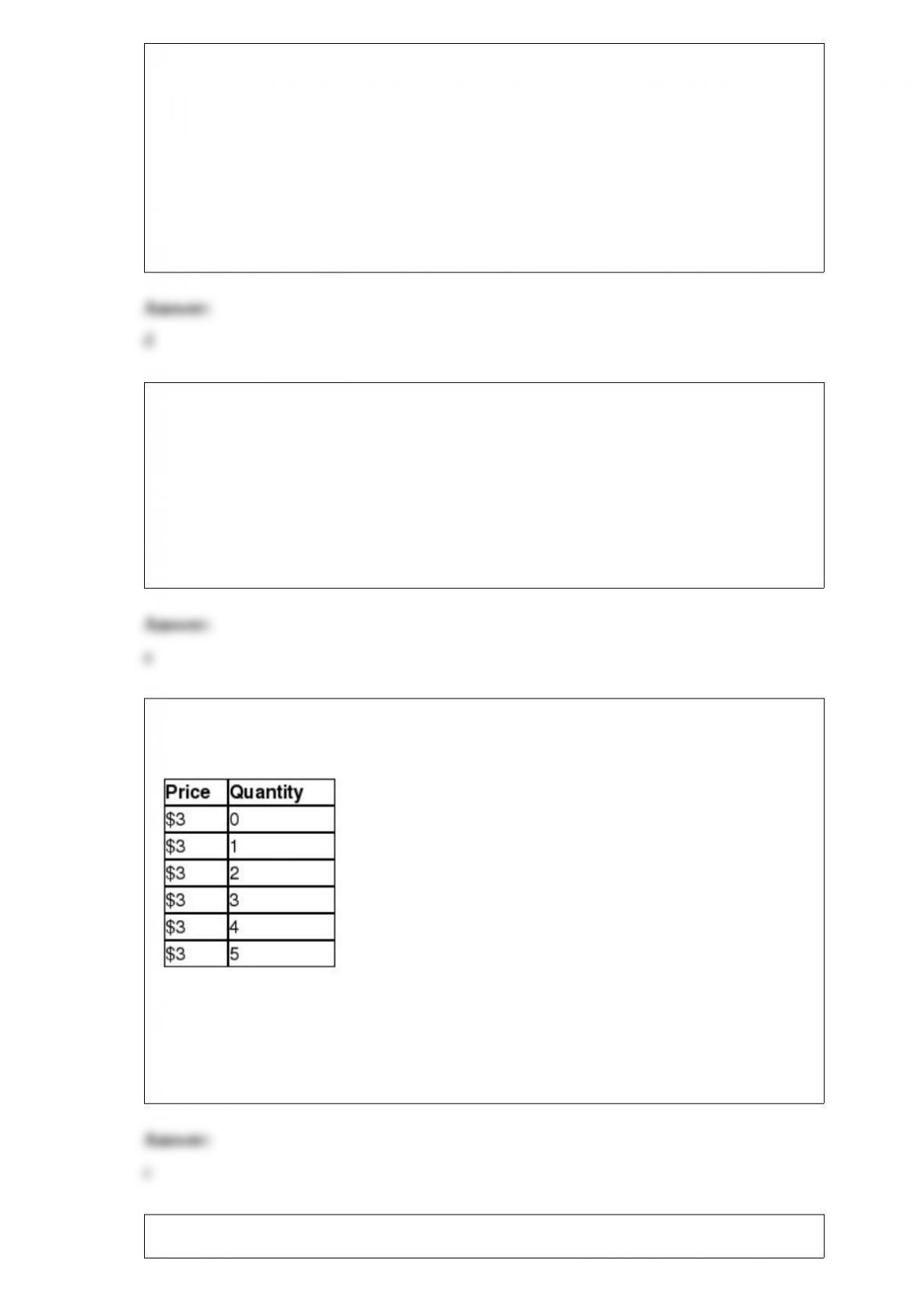
6)
Using the points on the figure, describe the change that would occur if a news report

stated that the price of this good was expected to increase next week.
7) Yi and Avik are both economists. Yi thinks that taxing consumption, rather than
income, would result in higher household saving because income that is saved would
not be taxed. Avik does not think that household saving would respond much to a
change in the tax laws. In this example, Yi and Avik
a.hold different normative views about the tax system.
b.disagree about the validity of a positive theory.
c.have a fundamental misunderstanding of the tax system.
d.More than one of the above is correct.
8) Which of the following is an example of public ownership of a monopoly?
a.DeBeers
b.Microsoft
c.U.S. Postal Service
d.AT&T
9) The marginal product of labor is defined as the change in
a.output per additional unit of revenue.
b.output per additional unit of labor.
c.revenue per additional unit of labor.
d.revenue per additional unit of output.
10) Economic mobility in the United States is so great that fewer than
a.3 percent of families are poor for 8 or more years.
b.5 percent of families are poor for 8 or more years.
c.8 percent of families are poor for 8 or more years.
d.10 percent of families are poor for 8 or more years.
11) Scenario 15-4
Suppose a monopolist has a demand curve that can be expressed as P=90-Q. The
monopolist’s marginal revenue curve can be expressed as MR=90-2Q. The monopolist
has constant marginal costs and average total costs of $10.
The profit-maximizing monopolist will have a deadweight loss of
a. $6,400.
b. $3,200.
c. $1,600.
d. $800.
12) Which of the following would be an example of capital for a retail gasoline station?
(i)the gas tanks and pumps
(ii)the service attendants’ time
(iii)the plot of land on which the station sits
a.(i) only
b.(iii) only
c.(i) and (iii) only
d.(ii) and (iii) only
13) Table 14-2
The table represents a demand curve faced by a firm in a competitive market.
For this firm, the average revenue from selling 3 units is
a. $12.
b.$4.
c.$3.
d.$1.
14) A benefit of a monopoly is
a.efficient production.
b.decreasing long-run marginal costs.
c.profit that can be invested in research and development.
d.All of the above are correct.
15) A country is using a proportional tax when
a.its marginal tax rate equals its average tax rate.
b.its marginal tax rate is less than its average tax rate.
c.its marginal tax rate is greater than its average tax rate.
d.it uses a lump-sum tax.
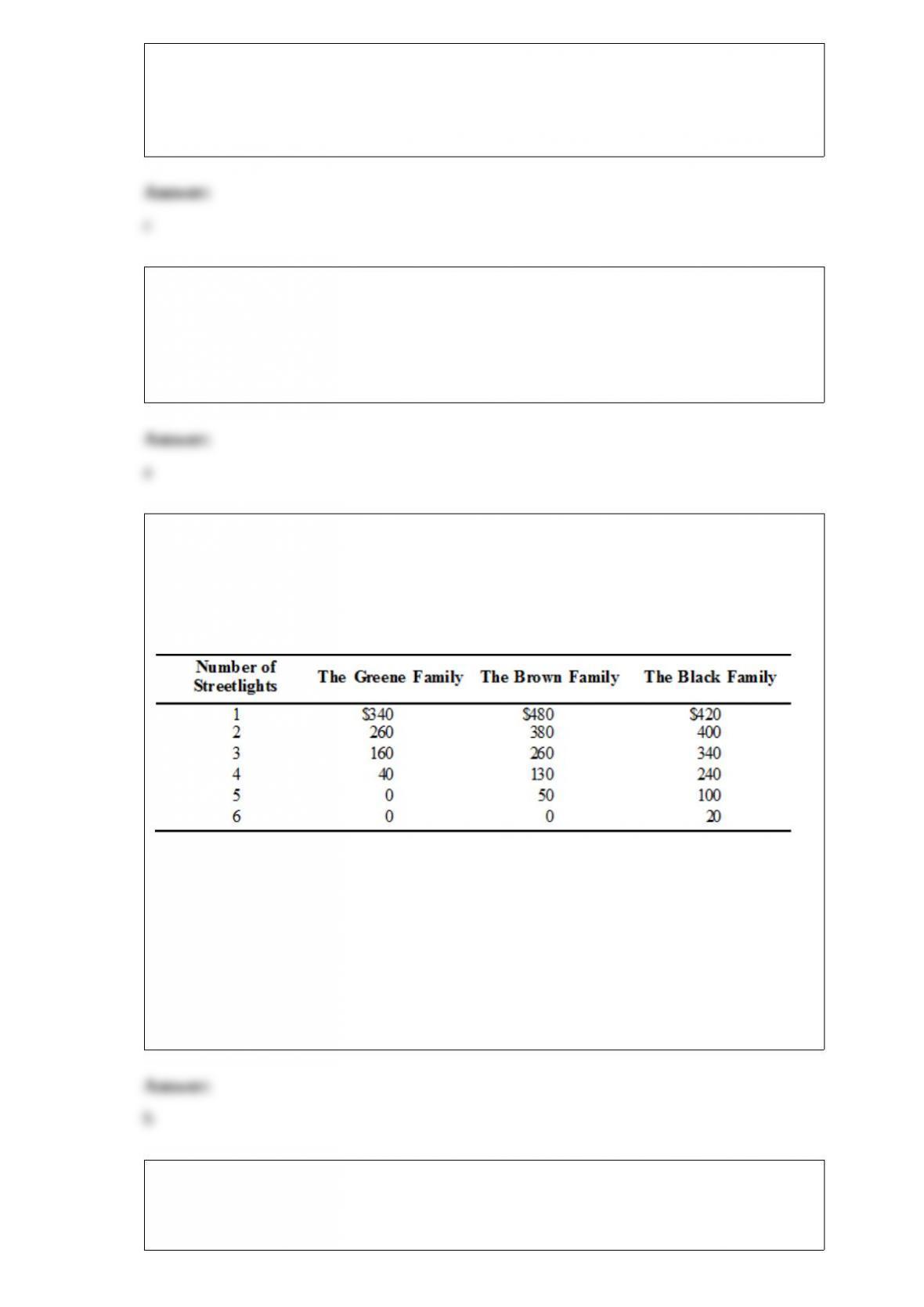
16) Consider a small town with only three families, the Greene family, the Brown
family, and the Black family. The town does not currently have any streetlights so it is
very dark at night. The three families are considering putting in streetlights on Main
Street and are trying to determine how many lights to install. The table below shows
each family’s willingness to pay for each streetlight.
Suppose the cost to install each streetlight is $360 and the families have agreed to split
the cost of installing the streetlights equally. If the residents choose to install the
number of streetlights that will maximize total surplus from the streetlights, how much
total surplus will the Greene family receive?
a.-$80
b.$320
c.$360
d.$480
17) Variations in the standard of living across countries are due almost entirely to
differences in each nation’s total output of goods and services.
a.True

b.False