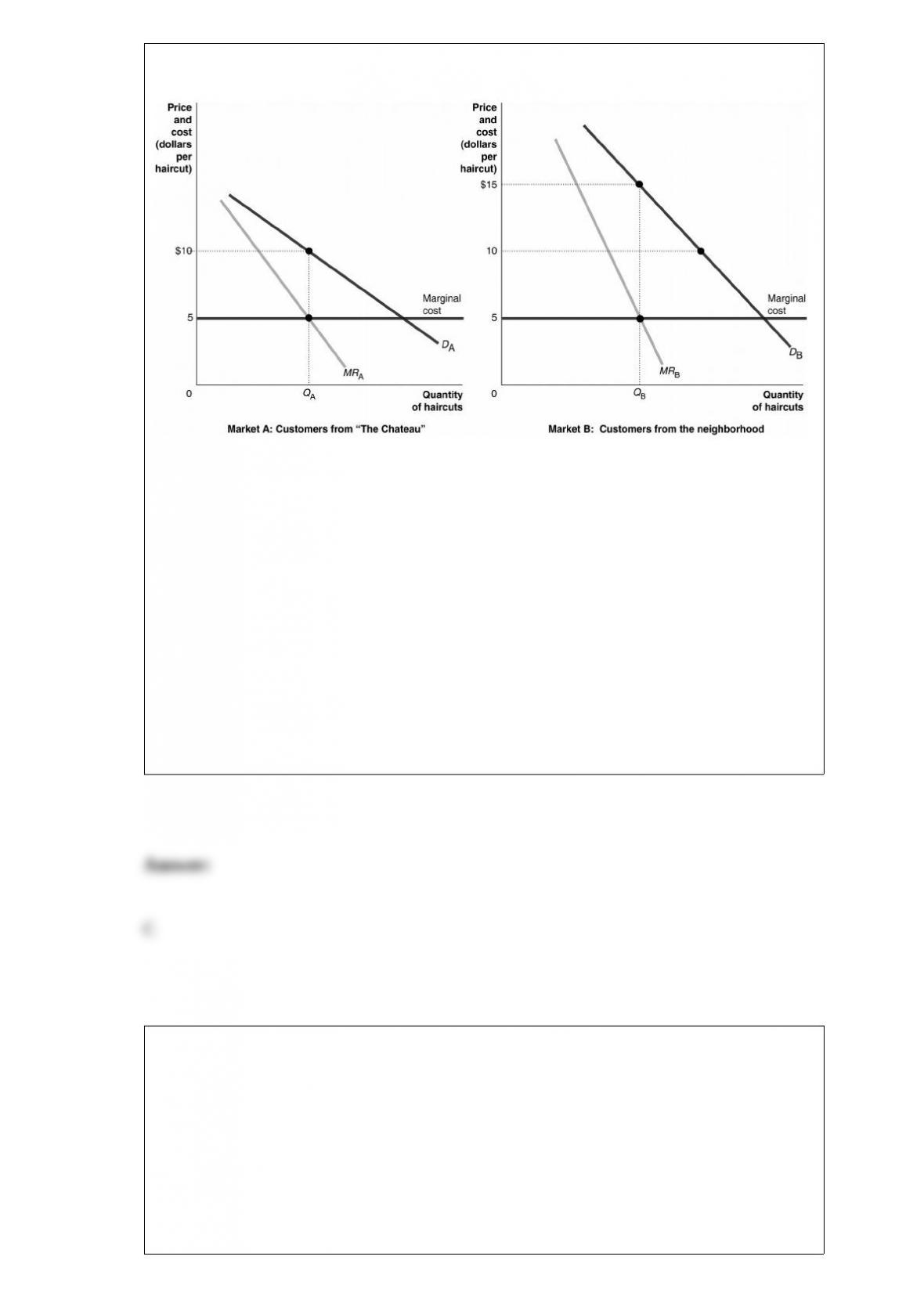
Figure 16-3
Chantal owns a hairdressing salon which caters to two main groups of customers:
residents of “The Chateau,” a retirement community, and other residents in the
neighborhood. Figure 16-3 shows the demand curves for the residents of the retirement
community, labeled Market A, and other residents in the neighborhood, labeled Market
B. The demand curves are not identical. Which group of customers is likely to have a
more elastic demand curve (more sensitive to price)?
A) the other residents of the neighborhood – market B
B) There is no difference in the elasticity of demand between the two groups.
C) the customers from “The Chateau” – market A
D) There is insufficient information to answer this question.
Which of the following is a reason why a firm would not engage in price
discrimination?
A) Price discrimination is illegal in some western states and the owners of firms in
these states face civil or criminal prosecution if they engage in price discrimination.
B) Some firms are not able to segment the market for the products they sell.
C) Some firms do not want to violate the law of one price.

D) The transactions costs associated with selling the product exceed the price of the
product.
The marginal revenue product of labor is defined as
A) the change in the firm’s revenue as a result of selling one more unit of output.
B) the change in the firm’s output as a result of hiring one more worker.
C) the change in the firm’s profit as a result of hiring one more worker.
D) the change in the firm’s revenue as a result of hiring one more worker.
Scenario 25-2 Imagine that Kristy deposits $10,000 of currency into her checking
account deposit at Bank A and that the required reserve ratio is 20%.
As a result of Kristy’s deposit, Bank A’s required reserves increase by
A) $2,000.
B) $8,000.
C) $10,000.
D) $50,000.

Article Summary. According to the Office for National Statistics in the United
Kingdom, productivity in the UK in 2012 was well below the average of the G7
countries, only faring better than Japan. The G7 is a group of the seven most
industrialized countries, and includes Canada, France, Germany, Italy, Japan, the
United Kingdom, and the United States. Compared to the G7 average, the UK was
16% less productive per hour worked, and output was 19% worse when measured
on a per worker basis. The productivity gap was the largest for the UK since 1994.
Worker productivity has increased in all of the G7 nations except for the UK since
2007, where it has fallen by two percentage points. The most productive workers
were in the United States, where workers were 29 percentage points more
productive per hour worked than in the UK. Source: “UK workers much less
productive than others in the G7,” Guardian, September 18, 2013. ________
depend on increases in labor productivity.
A) Advances in technology
B) Decreases in the inflation rate
C) Decreases in the unemployment rate
D) Increases in real GDP per capita
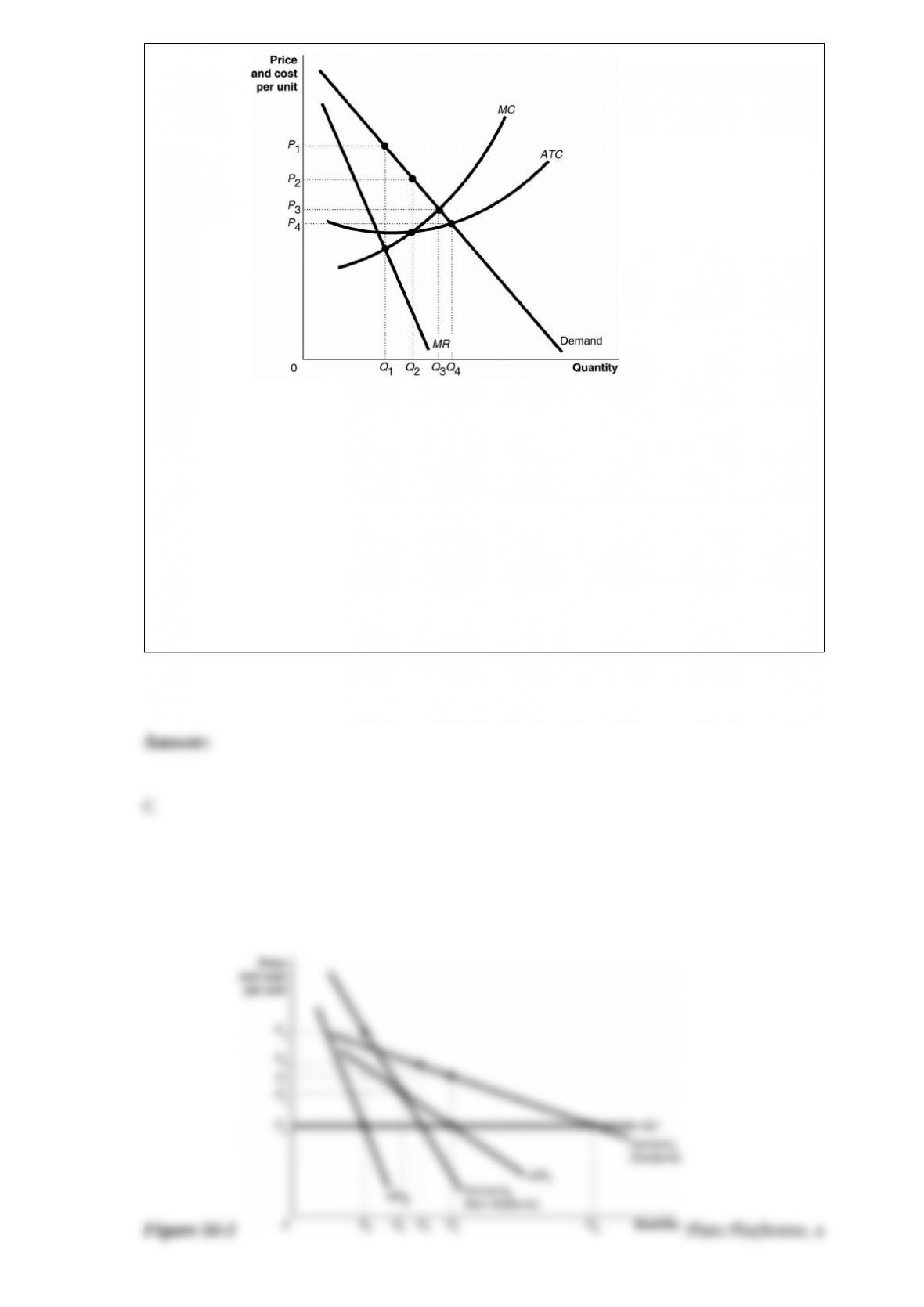
Figure 16-1
What is the economically efficient output level?
A) Q1 units
B) Q2 units
C) Q3 units
D) Q4 units

Which is the least common type of business?
A) corporation
B) partnership
C) sole proprietorship
D) impossible to determine without further information
An advantage of the personal consumption expenditures price index (PCE) over the
Consumer Price Index (CPI) as a measure of inflation is that the PCE
A) includes the prices of more consumer goods and services.
B) includes the prices of consumer goods, but not consumer services.
C) includes the prices of consumer services, but not consumer goods.
D) is a fixed market-basket price index that does not allow the mix of products to
change each year.
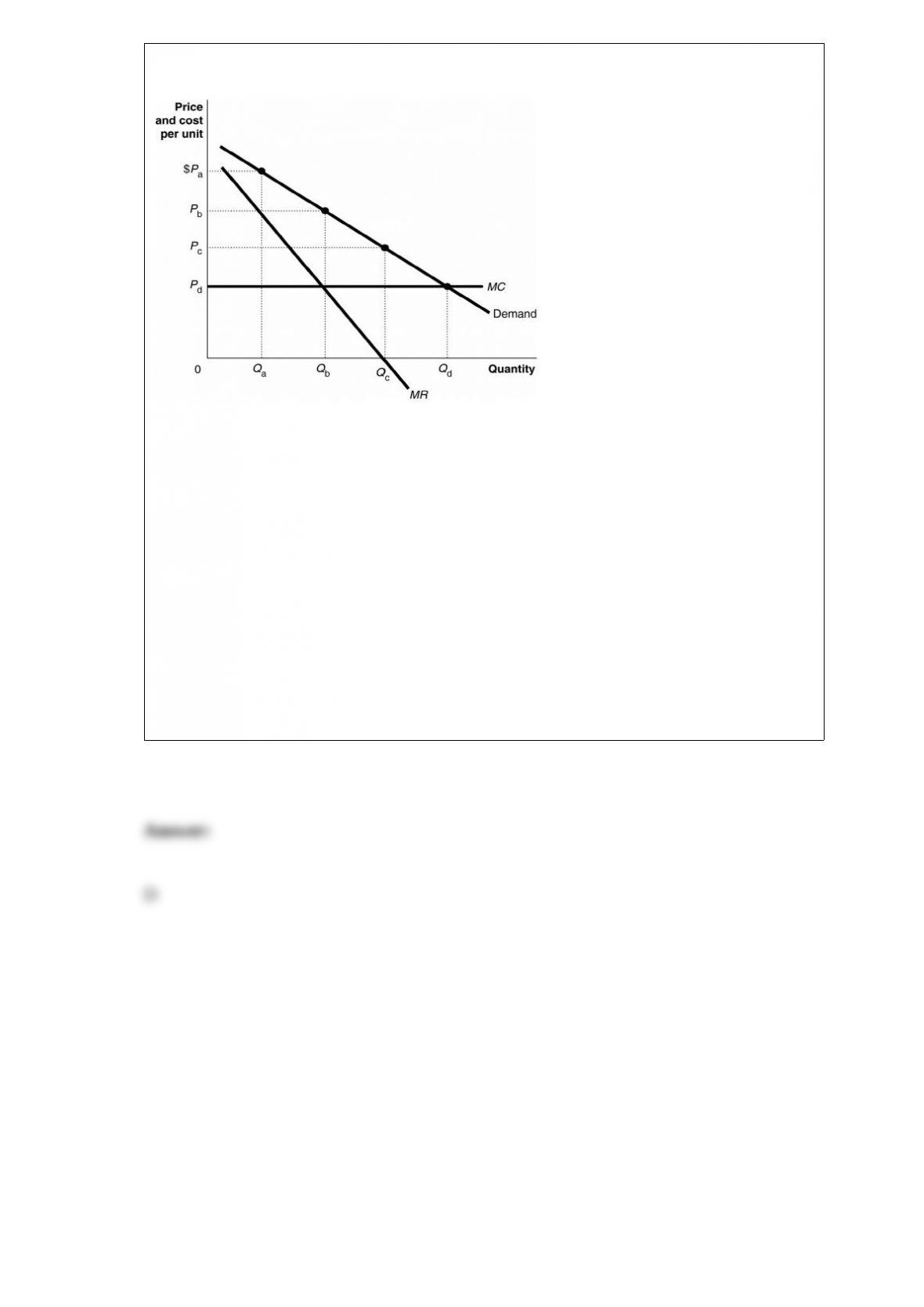
Figure 13-5
The candy store represented in the diagram is currently selling Qa units of candy at a
price of Pa. Is this candy store maximizing its profit and if it is not, what would you
recommend to the firm?
A) Yes, it is maximizing its profit by charging the highest price possible.
B) No, it is not; since its marginal cost is constant, it should produce and sell as much
candy as it can. It should sell Qd units at a price of Pd.
C) No, it is not; it should lower its price to Pc and sell Qc units.
D) No, it is not; it should lower its price to P and sell Q units.
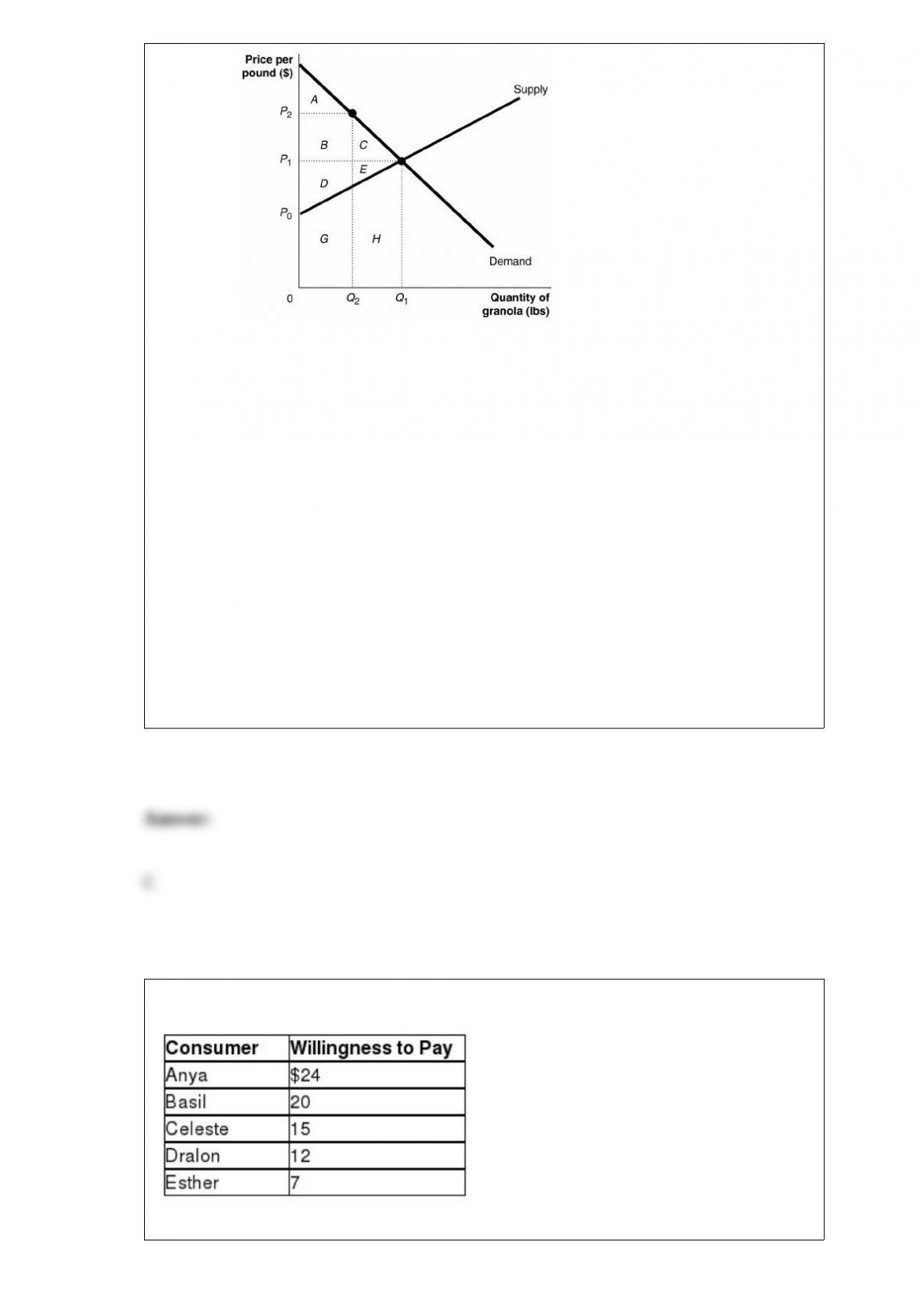
Figure 4-6 Figure 4-6 shows the market for
granola. The market is initially in equilibrium at a price of P1 and a quantity of Q1.
Now suppose producers decide to cut output to Q2 in order to raise the price to P2.
At the equilibrium price of P1, consumers are willing to buy the Q1pounds of granola.
Is this an economically efficient quantity?
A) No, the marginal benefit of the last unit (Q1) exceeds the marginal cost of that last
unit.
B) Yes, because marginal cost is zero at the price of P1.
C) Yes, because P1 is the price where marginal benefit equals marginal cost.
D) No, the marginal cost of the last unit (Q1) exceeds the marginal benefit of the last
unit.
Table 4-2

The table above lists the highest prices five consumers are willing to pay for a theater
ticket. If the price of one of the tickets is $18
A) Anya and Basil will each buy two tickets.
B) Basil will receive $2 of consumer surplus from buying one ticket.
C) Anya and Basil receive a total of $26 of consumer surplus from buying one ticket
each. No one else will buy a ticket.
D) Celeste, Dralon, and Esther will receive a total of $34 of consumer surplus since
they will buy no tickets.
The wage rate is the opportunity cost of
A) working.
B) working overtime.
C) leisure.
D) consumption.