
When the social costs of using a resource exceed the private costs
a. that resource is underutilized.
b. use of that resource becomes unprofitable.
c. the price of that resource is bid up.
d. an external diseconomy exists.
e. there is a shift in the production possibilities curve.
All output combinations that fall on an economy’s production possibilities curve
a. can be chosen simultaneously.
b. represent the minimum amounts of each good that can be produced.
c. show the distribution of goods and services in the economy.
d. tell us little or nothing about a society’s level and composition of output.
e. represent the full and efficient use of that economy’s resources.
The following questions are based on the following diagram, in which existing
aggregate supply and demand curves are AS0 and AD0, respectively:
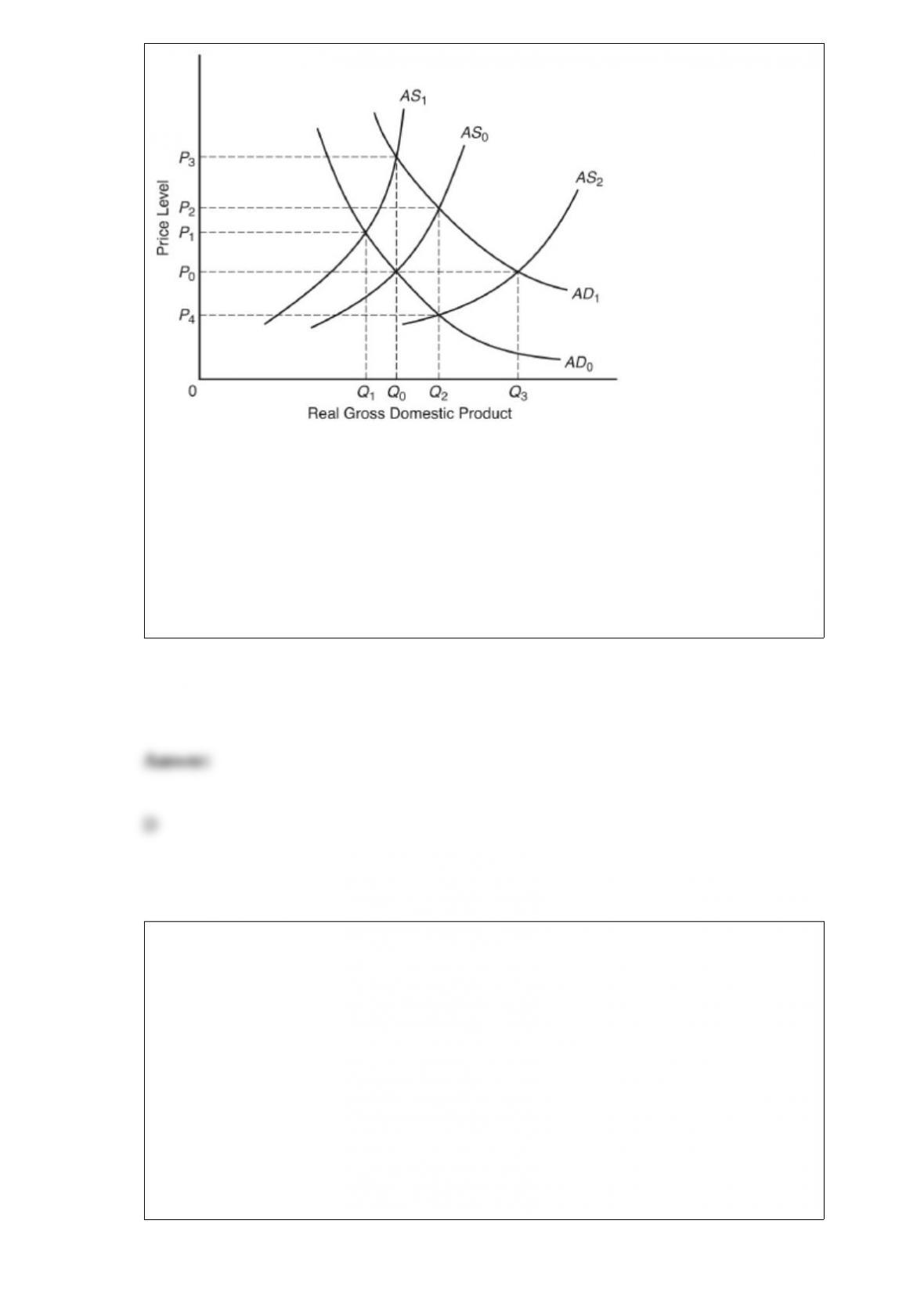
As a result of the monetary policy just undertaken, the price level
a. declines to 0P4. d. rises to 0P3.
b. declines to 0P1. e. remains at 0P0.
c. declines to 0P0.
Approximately ________ percent of nonfarm workers in the United States are union
members.
a. 80
b. 60
c. 40
d. 20
e. 10

Government management of the banking system’s reserves is known as ________
policy.
a. fiscal
b. incomes
c. trade
d. commercial
e. monetary
One reason current European unemployment rates are significantly above those in the
United States is that European
a. labor laws seem designed mainly to protect the higher wages received by mostly
male workers in the 25- to 54-year age bracket.
b. countries typically have less generous social welfare benefits than those in the United
States.
c. inflation-adjusted labor costs have risen less rapidly than those in the United States
over the last 30 years.
d. workers are more productive than U.S. workers.
e. countries import most of the goods they consume.

The use of government spending and taxes for stabilization purposes is known as
a. unemployment compensation.
b. fiscal policy.
c. budget multipliers.
d. employment finance.
e. Keynesian consumption.
The following questions are based on the following information:
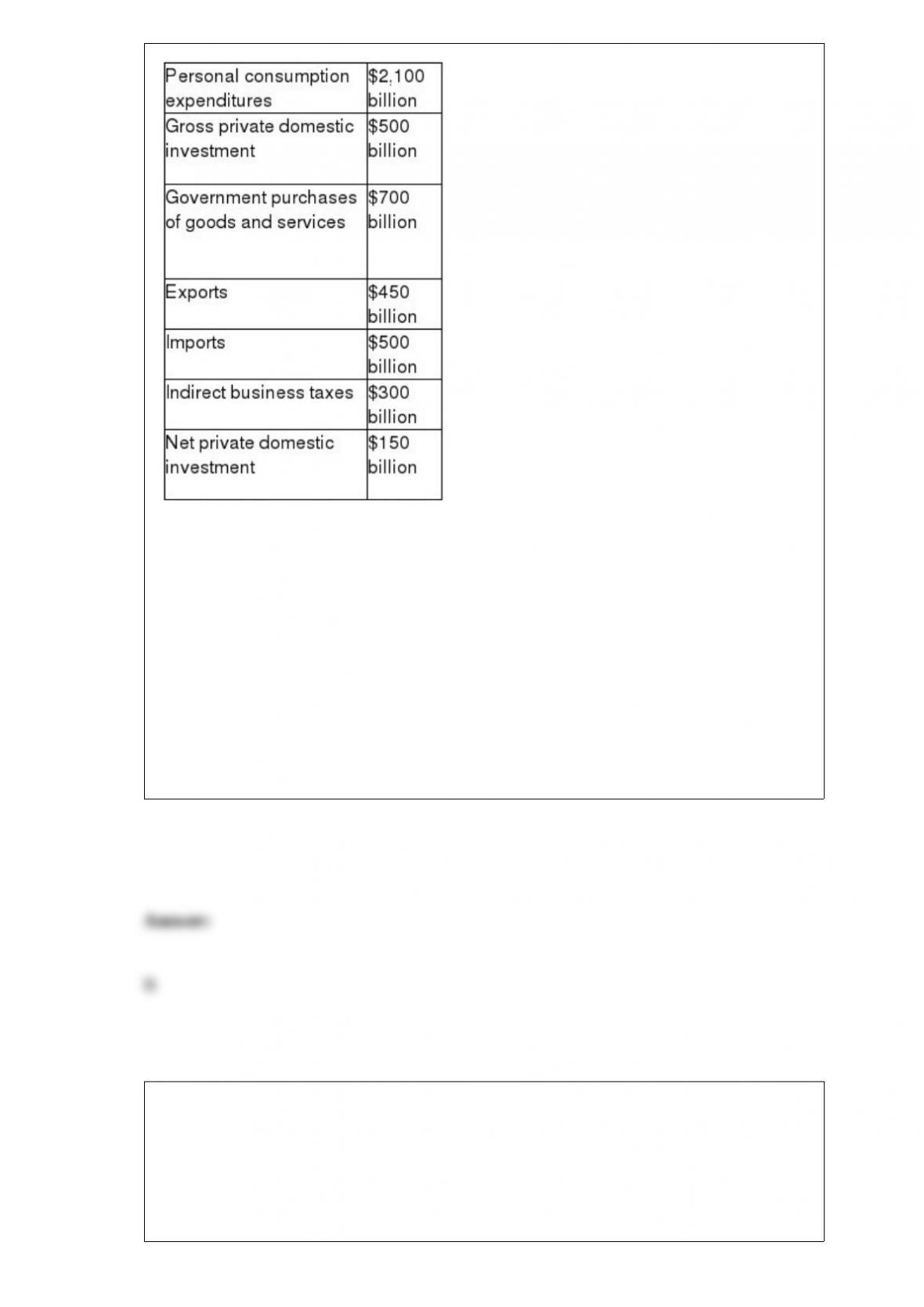
Gross domestic product equals ________ billion.
a. $3,050
b. $3,250
c. $3,350
d. $3,750
e. $4,250
Which of the following markets is the best example of differentiated oligopoly?
a. steel
b. cement

c. automobiles
d. electricity
e. agriculture
A decrease in supply
a. is unrelated to changes in the assumptions that underlie the supply curve.
b. produces a supply curve that slopes downward to the right.
c. is caused by a price change along a supply curve.
d. affects only an agricultural supply curve.
e. is synonymous with a leftward shift of the supply curve.
Under which of the following systems does a government commit itself to keep
fluctuations in its monetary unit within a narrow range?
a. the gold standard
b. the multinational exchange standard
c. flexible exchange rates

d. equation of exchange rates
e. fixed exchange rates
Frictional unemployment
a. exists when jobs are available for qualified workers but the unemployed lack the
required qualifications.
b. refers to the social frictions caused by unemployment.
c. results from the entrance of new workers into the labor market and the voluntary
movement of workers between positions.
d. was the major component of unemployment during the Great Depression.
e. can and should be completely eliminated.
The value of a dollar
a. has steadily declined since the Revolutionary War.
b. is determined by the amount of gold held by the government.
c. is inversely related to the price level.
d. is set by government fiat.
e. depends on the mix of money and near money.

If the aggregate demand and supply curves intersect in the positively sloped range of
the aggregate supply curve, a decrease in aggregate demand decreases
a. the price level but not total real output.
b. total real output but not the price level.
c. both total real output and the price level.
d. neither total real output nor the price level.
e. total employment while increasing the price level.
Investment in education enhances the rate of economic growth
a. because most of the important research and development is carried out in university
laboratories.
b. by educating people about the evils of materialism and the need to redistribute
income.
c. because the highest rates of labor-force productivity are found in educational
institutions.
d. by training scientists, engineers, and industrial managers.
e. because of its tendency to use endowment funds to invest in new technologies.

The promotion of increased competition among U.S. businesses is the major reason for
the existence of ________ laws.
a. capital gains tax
b. immigration
c. tariff
d. patent
e. antitrust
A market demand curve
a. shifts as the price falls.
b. slopes upward from left to right.
c. is unaffected by changes in consumers’ tastes and incomes.
d. measures the rate of growth of per capita output.
e. shows the amount buyers would like to purchase at various prices.
Under a system of flexible exchange rates, the currency of a country experiencing a
balance of payments deficit would (relative to other currencies)
a. appreciate, causing an increase in net exports.
b. appreciate, causing a decrease in net exports.
c. depreciate, causing a decrease in net exports.
d. depreciate, causing an increase in net exports.
e. depreciate or appreciate, depending on supply and demand.
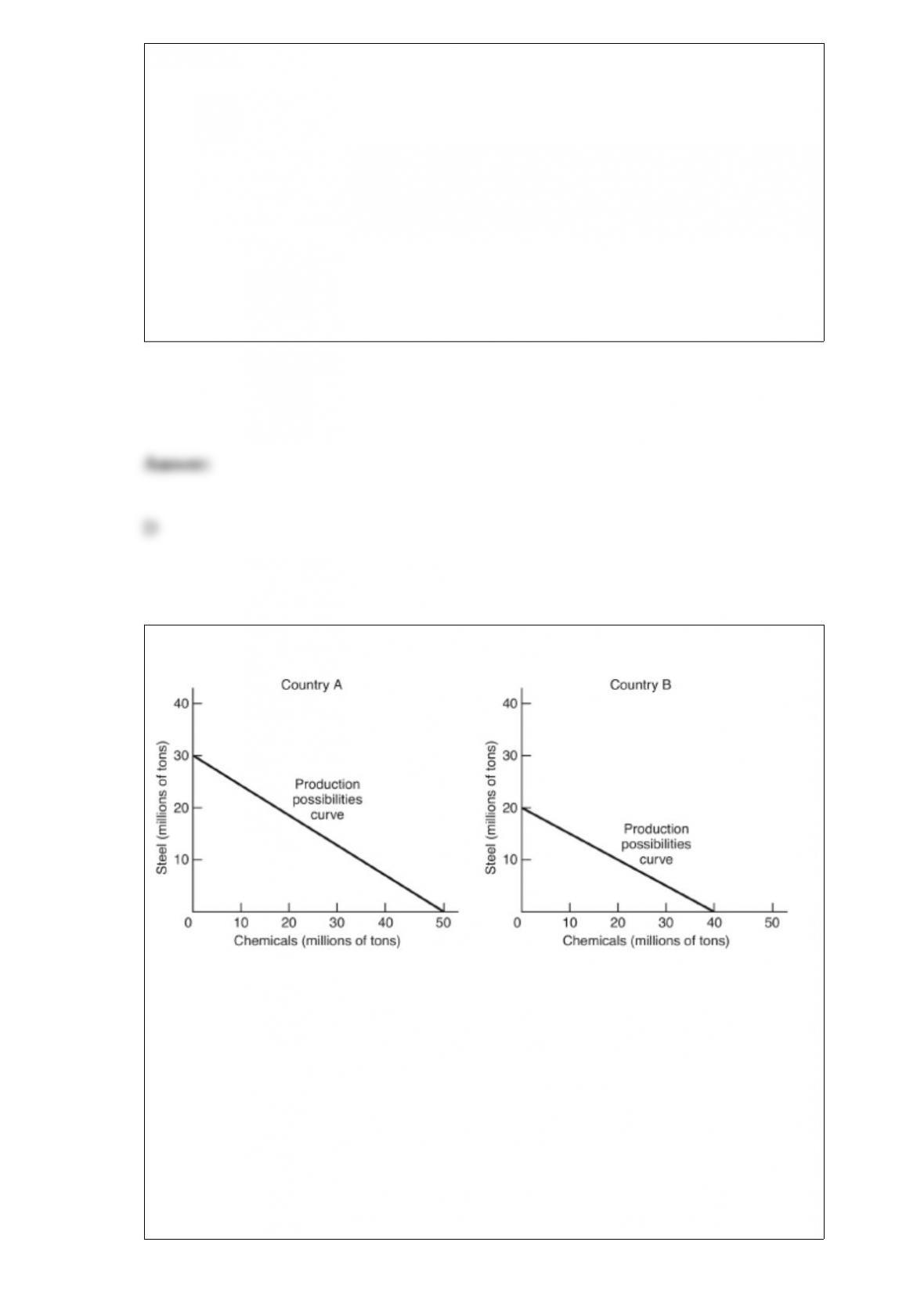
The following questions are based on the following diagrams:
If the countries should trade, which chemical/steel price ratio will most likely prevail?
a. 1 ton of chemicals/0.33 ton of steel
b. 1 ton of chemicals/0.40 ton of steel
c. 1 ton of chemicals/0.50 ton of steel
d. 1 ton of chemicals/0.55 ton of steel
e. 1 ton of chemicals/1 ton of steel
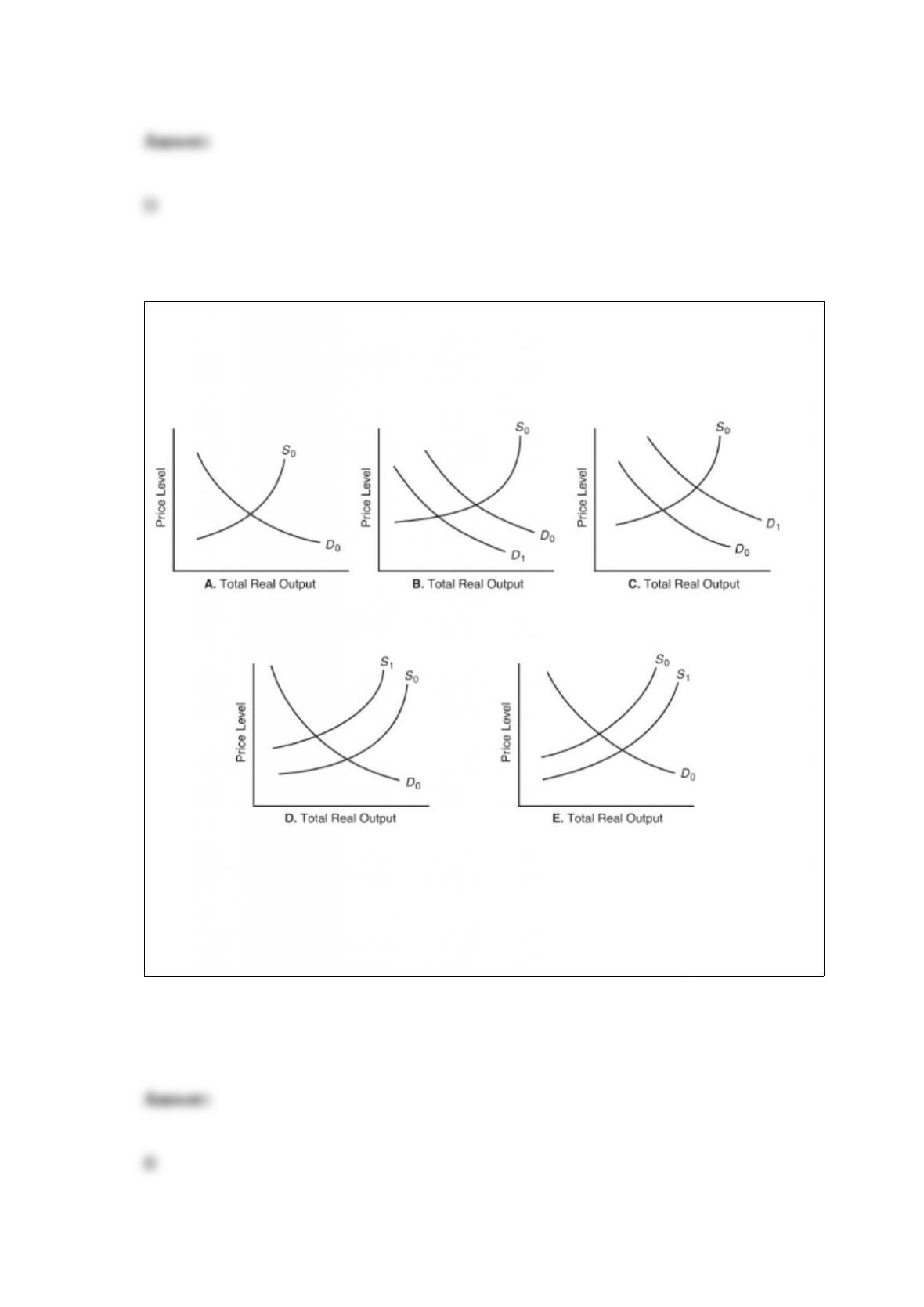
The following questions are based on the following diagrams in which D0and S0 refer
to the initial aggregate demand and short-run aggregate supply curves:
The Great Depression is best illustrated by diagram
a. A.
b. B.
c. C.
d. D.
e. E.

Suppose, in foreign exchange markets, the quantities supplied of U.S. dollars exceed
the quantities demanded of U.S. dollars. Under a flexible exchange rate system
a. the exchange rate (price in dollars of foreign currency) would rise.
b. the exchange rate (price in dollars of foreign currency) would fall.
c. the exchange rate (price in dollars of foreign currency) would remain unchanged
because the foreign demand for dollars would shift to the right.
d. the supply for dollars would shift to the left.
e. gold would flow into the United States, causing the price level to rise.
The deep recessions experienced in many fast-growing East Asian economies in
1997″98
a. were unexpected by virtually all economists who had been studying the “Asian
miracle.”
b. produced a significant shortage in overall global capacity.
c. led to a continuing and deepening condition of economic stagnation over the entire
region.
d. demonstrated that it is extremely unlikely that sustained economic growth can be
accomplished in developing countries.
e. were a direct result of the Asian financial crisis.

If merchandise exports exceed merchandise imports, the country has a
a. positive investment balance.
b. gold exchange standard.
c. balance-of-payments deficit.
d. favorable balance of trade.
e. leveraged trade advantage.
If a perfectly competitive firm in the short run can sell its output at $2.50 per bushel and
it has an average variable cost of $2.75 per bushel and a marginal cost of $2.50 per
bushel, it should
a. expand output.
b. raise its price.
c. cut output to zero.
d. advertise.
e. do nothing at all; it is currently maximizing profits.

The new chain-weighted estimate of GDP has the disadvantage that
a. real GDP is different in amount than GDP measured in current dollars.
b. it reflects only changes in current prices, not changes in the prices of previous years.
c. it is calculated on the basis of fewer goods and services than fixed-weight estimates.
d. the components of GDP do not precisely add up to total GDP.
e. it results in some double counting in the value of GDP.
A rising marginal cost curve reflects a falling ________ curve.
a. total product
b. marginal product
c. average fixed cost
d. total cost
e. long-run average cost
The major reason why the Iowa Dairy Farmers strike (and other similar protests)
against Sioux City Milk dealers failed was that

a. the market demand for milk is highly price elastic so that consumers substitute other
beverages when its price rises.
b. the strike raised costs of production because milk was destroyed, forcing dairy
farmers into bankruptcy.
c. there were so many dairy farmers that milk dealers could find enough milk elsewhere
to offset their losses from the striking farmers.
d. the U.S. government stepped in and forced the dairy farmers to go back to work.
e. Congress passed the Benson Brannan law, which raised farm prices and eliminated
the need for the dairy farmers’ protest.
The incidence of a sales tax falls more heavily on consumers when
a. the government receives the revenue from the tax.
b. the quantity demanded is insensitive to price changes.
c. the quantity supplied is very insensitive to price changes.
d. they give up consuming the taxed good.
e. the equilibrium market price is unaffected by the tax.
The difference between tax revenues and government expenditures that would result if

GDP were at its potential level is called the
a. permanent income budget balance.
b. net relative expenditure differential.
c. Ricardian equivalence.
d. balanced budget shortfall.
e. structural deficit.
The experience of 1971 price ceilings on oil taught us that a price ceiling curbs
technological research and development in an activity where
a. foreign competition is great.
b. supply exceeds demand.
c. employment is rising.
d. the risk is great.
e. equilibrium prices are falling.
Incremental research and development tax credits

a. allow firms to reduce the after-tax cost of their research and development activities.
b. fund federal government insurance on a portion of research and development costs.
c. generate revenues to subsidize government laboratories for research and
development.
d. are designed to reduce the amount of government regulatory restraints that limit
innovation.
e. fund a government prize for important industrial innovations.
A tariff is a(n)
a. limit on exports.
b. form of export subsidy.
c. tax on imports.
d. interest rate on foreign exchange.
e. license to import.
A negative cross elasticity of demand indicates that two commodities are
a. luxuries.

b. necessities.
c. unrelated.
d. substitutes.
e. complements.
The exchange rate is the
a. number of units of one currency that exchanges for a unit of another currency.
b. volume of currency that flows internationally during a year.
c. number of ounces of gold annually used in trade.
d. ratio of exports to imports.
e. annual turnover rate of the money supply.