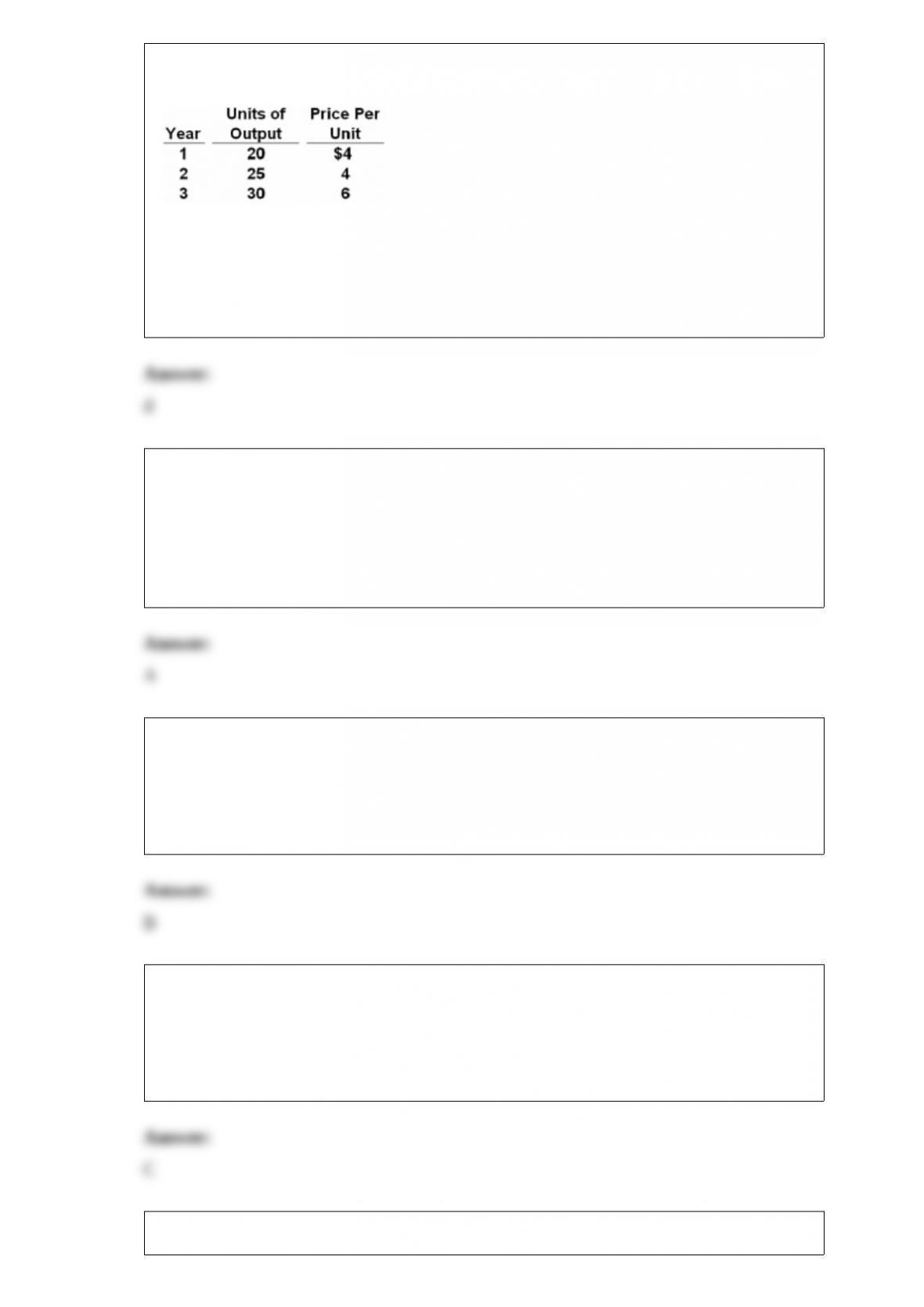
1) assume an economy that is producing only one product. output and price data for a
three-year period are as follows. answer the next question(s) on the basis of these data.
refer to the above data. if year 2 is chosen as the base year, real gdp for year 1 is:
a.$25.
b.$100.
c.$20.
d.$80.
2) An increase in the present value of the profit that can be obtained by delaying
resource extraction will lead profit-maximizing firms to:
A.reduce extraction in the present.
B.increase the current rate of extraction.
C.invest in less extraction equipment.
D.hire more workers to support current production.
3) Tying contracts are illegal under the:
A.Wagner Act of 1935
B.Clayton Act of 1914
C.FTC Act of 1914
D.Celler-Kefauver Act of 1950
4) Buyers will opt out of markets in which:
A.there are significant negative externalities.
B.standardized products are being produced.
C.there is inadequate information about sellers and their products.
D.there are only foreign sellers.
5) The pure interest rate is:
A.the nominal rate plus the rate of inflation.
B.not used in making investment decisions.
C.is the nominal rate of interest less the rate of return on an investment.
D.the rate paid on long term, relatively risk-free bonds.
6) Some economists have criticized standard government figures on income inequality,
arguing that these data:
A.exclude households whose earnings arise in the public sector.
B.conceal the strong trend toward greater equality in household sizes.
C.conceal the growth of poverty due to a growing number of discouraged workers.
D.overstate the degree of income inequality by failing to include noncash transfers as
income.
7) All of the following are regulatory commissions dealing with industrial regulation (as
distinct from social regulation) except the:
A.Food and Drug Administration.
B.Federal Energy Regulatory Commission.
C.Federal Communications Commission.
D.50 state public utility commissions.
8) In moving from a private closed to a mixed closed economy in the aggregate
expenditures model, taxes:
A.must be added to gross investment.
B.must be added to saving.
C.must be added to consumption and gross investment.
D.have no impact upon the equilibrium GDP.
9) According to the purchasing power parity theory of exchange rates:
A.a dollar, when converted to other currencies at the prevailing floating exchange rate,
has the same purchasing power in various countries.
B.in equilibrium, national currencies have equal value in terms of gold.
C.the higher a nation’s price level in terms of its own currency, the greater is the amount
of foreign exchange it can obtain for a unit of its currency.
D.nominal currency values will tend to equalize (become 1 = 1) in the long run.
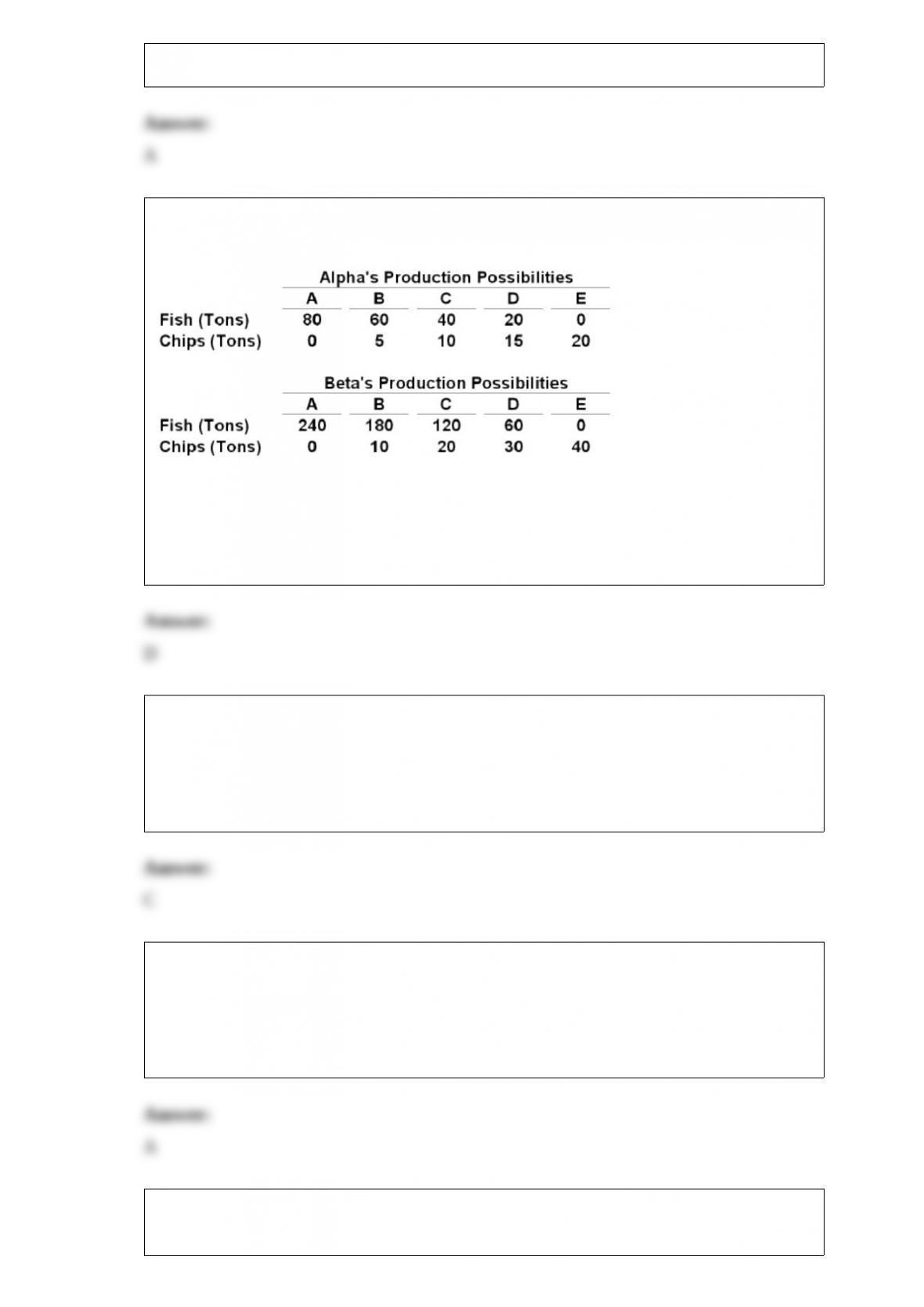
10) The following production possibilities data for two countries, Alpha and Beta,
which have populations of equal size.
The above data show that:
A.Beta has a comparative advantage in producing chips.
B.Alpha has a comparative advantage in catching fish.
C.Alpha is subject to constant costs and Beta is subject to increasing costs.
D.Beta is more efficient than Alpha both in catching fish and in producing chips.
11) The:
A.short-run aggregate supply curve is downward sloping.
B.short-run aggregate supply curve is vertical.
C.long-run aggregate supply curve is vertical.
D.long-run aggregate supply curve is upsloping.
12) The bank and thrift share of total financial assets has:
A.declined significantly since 1980.
B.increased significantly since 1980.
C.remained quite constant since the Second World War.
D.increased in the United States but declined abroad.
13) a supply curve that is parallel to the horizontal axis suggests that:
a.the industry is organized monopolistically.
b.the relationship between price and quantity supplied is inverse.
c.a change in demand will change price in the same direction.
d.a change in demand will change the equilibrium quantity but not price.
14) (Last Word) In 2001, Microsoft was found guilty of:
A.using anticompetitive means to maintain and broaden its monopoly in
Intel-compatible operating systems for personal computers.
B.monopolizing the market for word processing software.
C.conspiring with Netscape and Sun to monopolize the market for Internet browsers.
D.deliberately pricing Windows 95 and 98 below marginal cost to monopolize the
market for operating systems for personal computers.
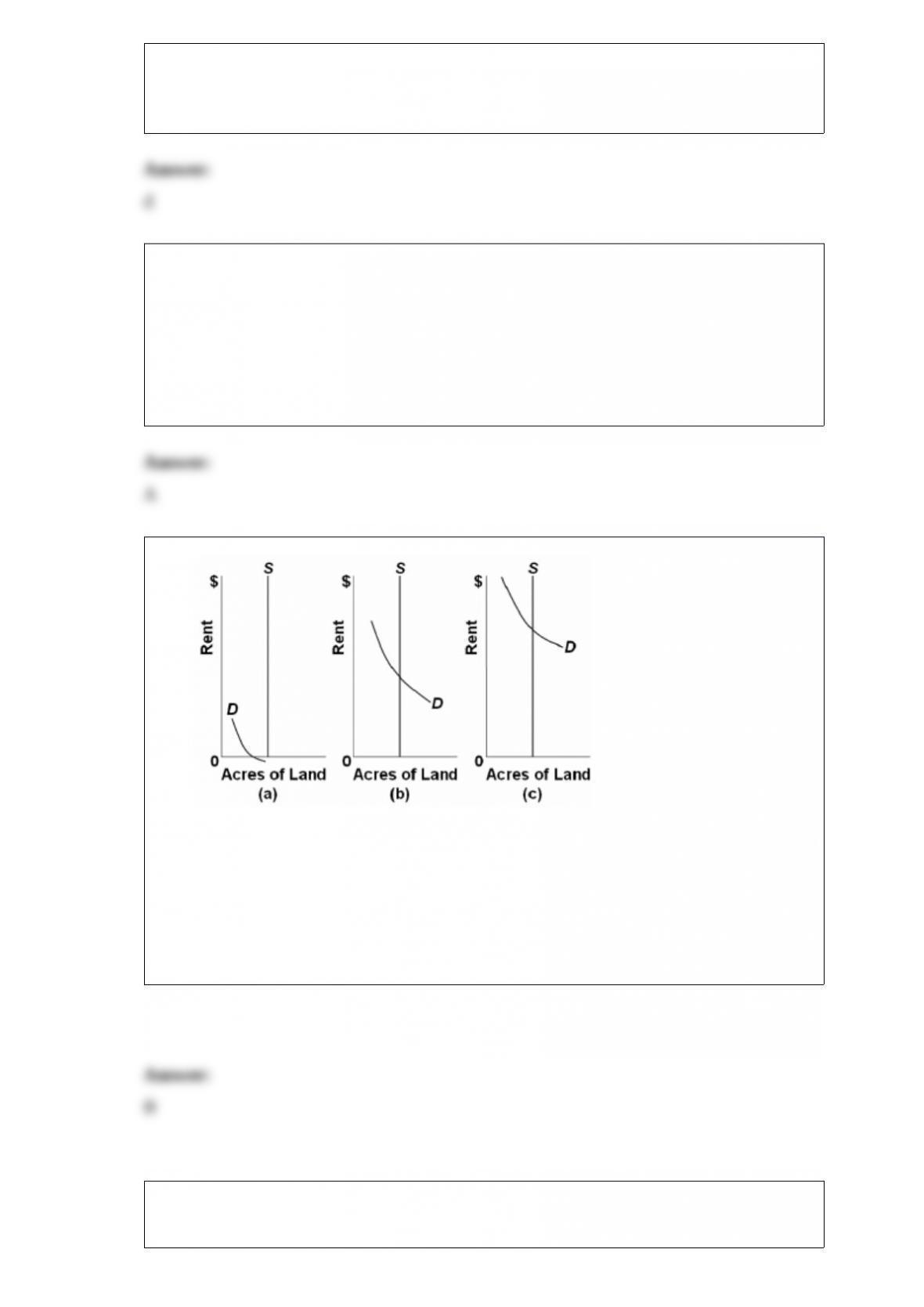
15)
Refer to the above diagrams. Assume that only wheat can be grown on the three grades
of land shown in Figures a, b, and c. Also assume that identical amounts of labor,
capital, and other needed inputs are used in farming each grade of land. On the basis of
these three figures we can say that:
A.the land shown in both Figures (a) and (b) is a “free good.”
B.the land shown in Figure (a) only is a “free good.”
C.the land shown in all three figures is a “free good.”
D.land is not a “free good” in any of the three figures.
16) The World Bank:
A.provides military assistance to those nations interested in improving national defense.

B.makes and guarantees loans for basic development projects such as the construction
of dams, roads, and schools.
C.provides gold for DVCs that want to go on the gold standard.
D.provides short-term loans to DVCs that are incurring balance of payments deficits.
17) In a nation’s balance of payments, which one of the following items is always
recorded as a positive entry?
A.goods imports
B.changes in foreign currency reserves
C.U.S. purchases of assets abroad
D.exports of services