If the demand for a product decreases and the supply of the same product increases, the
equilibrium quantity will increase.
Answer:
Expanding, contracting, and managing the money supply is easier for a central bank
under the gold standard.
Answer:
The absolute value of the price elasticity of demand for telescopes is 1.5. Therefore,
telescopes can be classified as a luxury.
Answer:
“An increase in the price of oranges will increase the demand for grapefruits.” This
statement is an example of a normative economic statement.
Answer:

Consider a country that produces only two goods: pineapples and tractors. Suppose it is
possible for this country to increase its production of pineapples without producing
fewer tractors. In this case, its current output combination is inefficient.
Answer:
Most economists believe that only a small gap between the wages of white males and
the wages of other groups is due to education. Most of the gap is explained by
discrimination.
Answer:
The full-employment rate of unemployment is zero.
Answer:
Competition from substitute goods is more of a threat when switching costs are high.
Answer:

A quota is a numerical limit on the quantity of a good that can be imported.
Answer:
Countries without well-developed financial systems are able to sustain high levels of
economic growth.
Answer:
Firms in perfect competition produce the allocatively efficient output in the short run
and in the long run.
Answer:
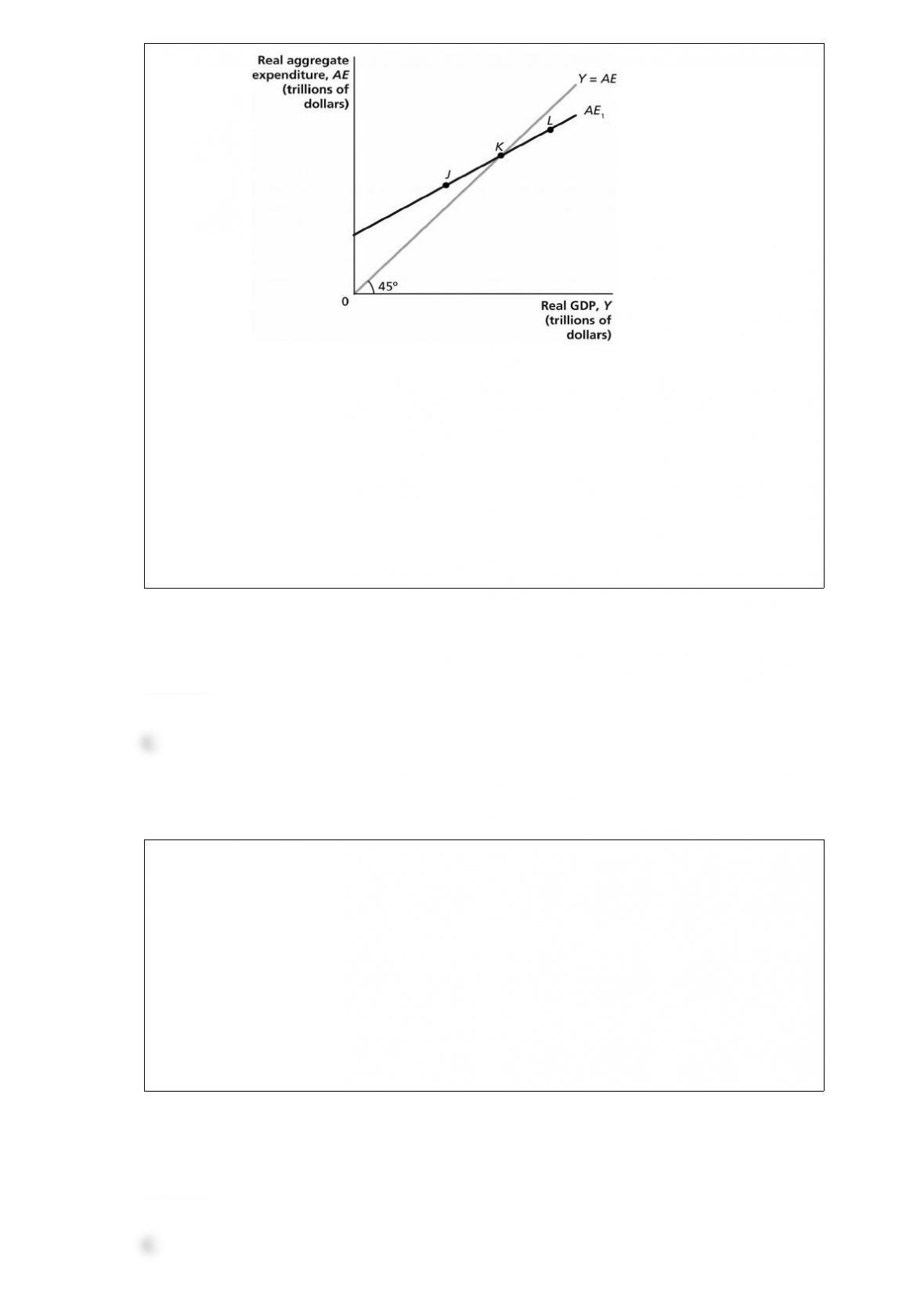
Figure 23-1
According to the figure above, at what point is aggregate expenditure less than GDP?
A) J
B) K
C) L
D) none of the above
Answer:
Economists use game theory to analyze oligopolies because
A) real markets are too complicated to analyze without using games.
B) it is more enjoyable for economists and students to learn by playing games.
C) game theory helps us to understand why interactions among firms are crucial in
determining profitable business strategies.
D) game theory is useful in understanding the actions of firms that are price takers.
Answer:

In both monopolistically competitive and perfectly competitive industries
A) firms produce products for which there are no close substitutes.
B) there are high barriers to entry.
C) there are many buyers and sellers.
D) firms are price takers.
Answer:
Consumers who will pay high prices to be among the first to own certain new products
are called
A) savvy consumers.
B) naive consumers.
C) gullible.
D) early adopters.
Answer:
A set of actions that a firm takes to achieve a goal is the definition of a
A) business plan.
B) business strategy.
C) business prospectus.
D) business goal.
Answer:
Arlene quits her $125,000-a-year job to take care of her ailing parents. What is the
opportunity cost of her decision?
A) zero, since she will no longer be earning a salary
B) It depends on the “going rate” for home-care providers.
C) at least $125,000
D) the value she attributes to the satisfaction she receives from taking care of her
parents
Answer:
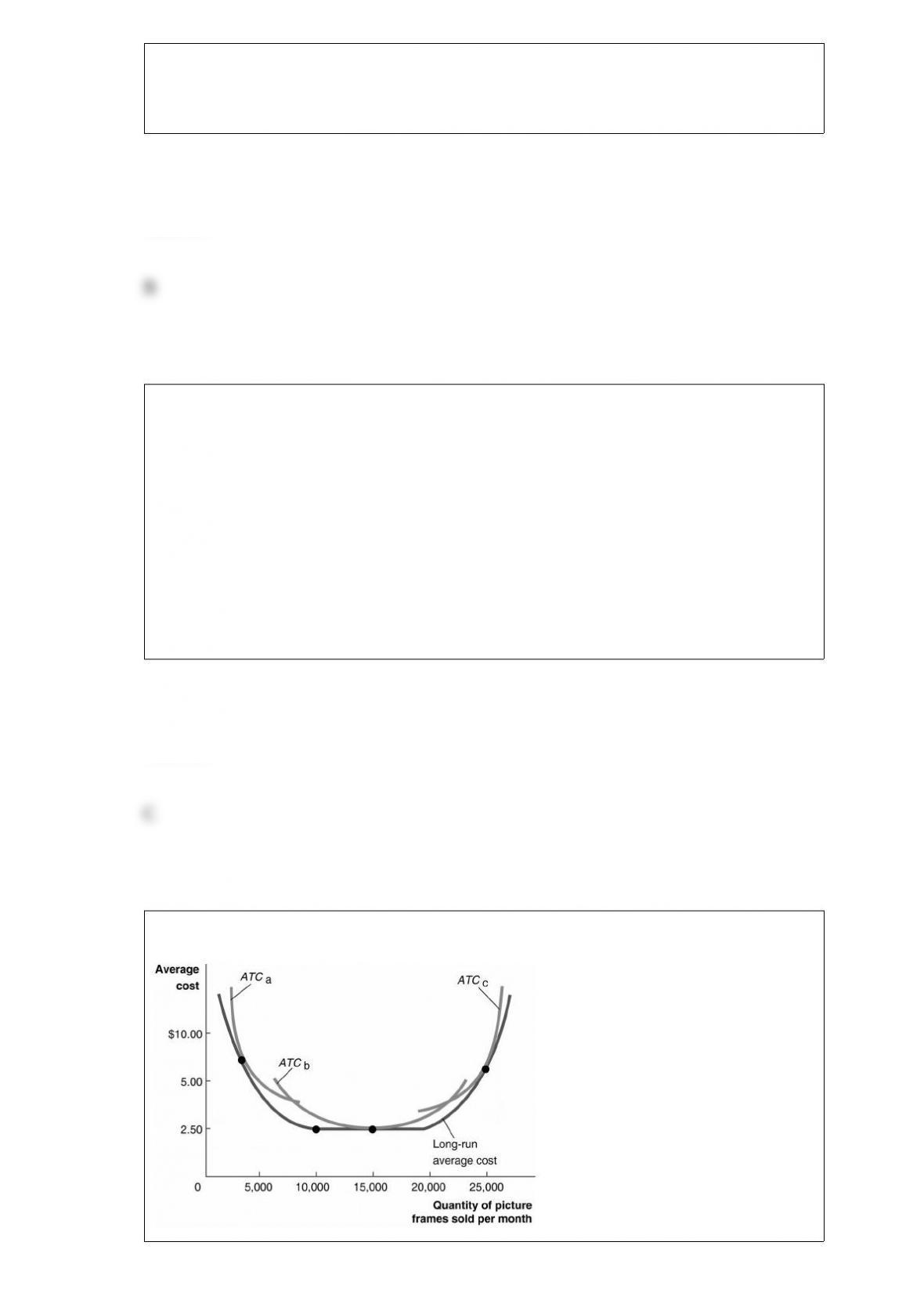
Figure 11-11
Figure 11-11 illustrates the long-run

average cost curve for a firm that produces picture frames. The graph also includes
short-run average cost curves for three firm sizes: ATCa, ATC and ATCc.
The minimum efficient scale of output is reached at what rate of output?
A) 10,000 workers
B) 5,000 picture frames
C) 20,000 picture frames
D) 10,000 picture frames
Answer:
Expansionary monetary policy refers to the ________ to increase real GDP.
A) government’s increasing spending and lowering taxes
B) government’s decreasing spending and raising taxes
C) Federal Reserve’s increasing the money supply and decreasing interest rates
D) Federal Reserve’s decreasing the money supply and increasing interest rates
Answer:
In early 2007, Pioneer and JVC, two Japanese electronics firms, each announced that
their profits were going to be lower than expected because they both had to cut prices
for LCD and plasma television sets. Which of the following could explain why these
firms did not simply raise their prices and increase their profits?
A) The move to cut prices is probably just a temporary one to gain market share. In the
long run the firms will raise prices and be able to increase their profits.

B) Most likely, intense competition between these two major producers probably
pushed prices down. Thereafter, each feared that it would lose its customers to the other
if it raised its prices.
C) In perfect competition, prices are determined by the market and firms will keep
lowering prices until there are no profits to be earned.
D) The firms are still making profits, just not as high as expected so there is room to
lower prices until one can force the other out of business.
Answer:
Private saving is defined as
A) Y + TR – C – T.
B) T + G + TR.
C) T – G + TR.
D) Y + TR + C – T.
Answer:
Table 4-8
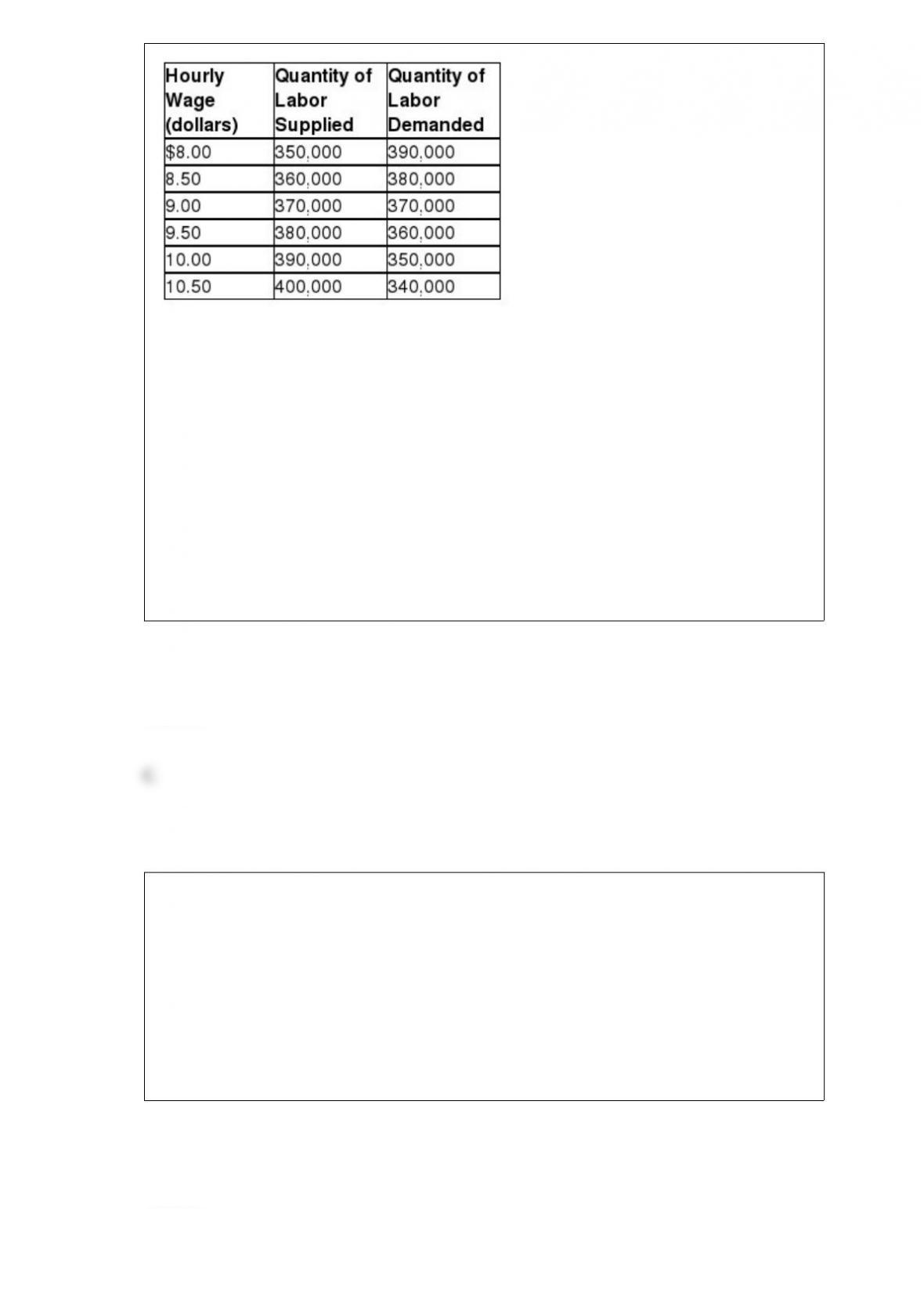
Table 4-8 shows the demand and supply schedules for the low-skilled labor market in
the city of Westover.
If a minimum wage of $10.00 an hour is mandated, what is the quantity of labor
demanded?
A) 390,000
B) 370,000
C) 350,000
D) 40,000
Answer:
Firms disclose financial statements in ________ and in ________.
A) periodic filings to the federal government; annual reports to shareholders
B) daily filings to the federal government; daily reports to shareholders
C) monthly reports to shareholders; 5-year balance statements to the board of directors
D) weekly filings with the SEC; monthly reports to the Fed
Answer:
Which of the following contributed to the downfall of the Soviet Union in 1991?
A) government dissatisfaction with high living standards and political freedom
B) an inability to produce low-cost consumer goods that households wanted
C) an overabundance of high-quality goods and services
D) the lack of a strong dictator who can coordinate economic activities
Answer:
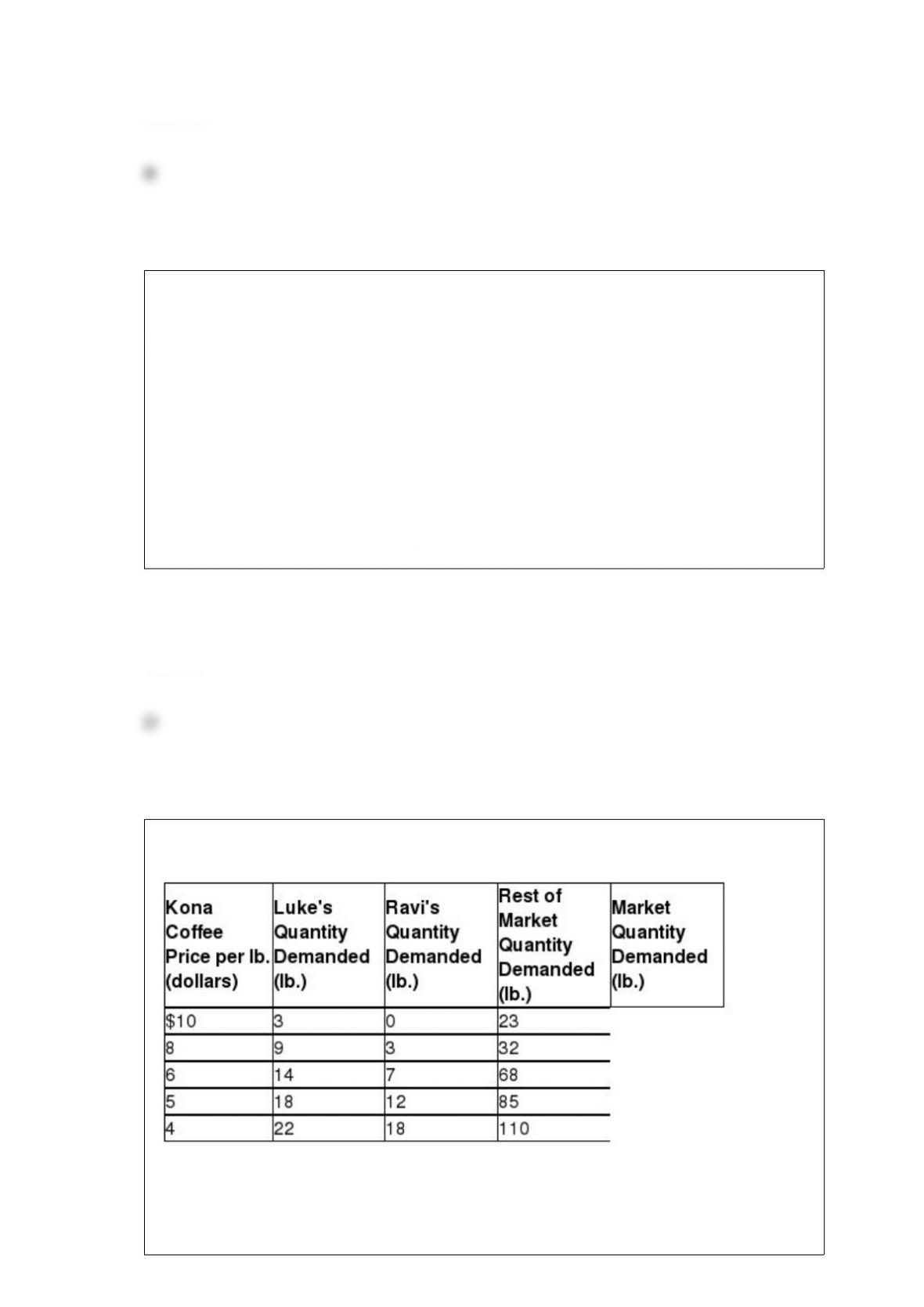
Figure 16-5
Suppose the firm represented in the diagram decides to act as a monopolist and charge a
single price. What is the profit maximizing quantity produced and what is the price
charged?
A) Q = 240 units; P = $28
B) Q = 320 units; P = $24
C) Q = 480 units; P = $16
D) Q = 560 units; P = $12
Answer:
German luxury car exports were hurt in 2009 as a result of the recession. How would
this decrease in exports have affected Germany’s aggregate demand curve?
A) The aggregate demand curve would have shifted to the right.
B) The aggregate demand curve would not have shifted, but there would have been a
movement up the aggregate demand curve.
C) The aggregate demand curve would not have shifted, but there would have been a
movement down the aggregate demand curve.
D) The aggregate demand curve would have shifted to the left.
Answer:
Table 3-3
The table above shows the demand schedules for Kona coffee of two individuals (Luke
and Ravi) and the rest of the market. At a price of $6, the quantity demanded in the
market would be

A) 36 lb.
B) 68 lb.
C) 89 lb.
D) 123 lb.
Answer:
Which of the following would cause both the equilibrium price and equilibrium
quantity of cotton (assume that cotton is a normal good) to increase?
A) an increase in consumer income
B) a drought that sharply reduces cotton output
C) a decrease in consumer income
D) unusually good weather that results in a bumper crop of cotton
Answer:
Trade-offs force society to make choices when answering what three fundamental
questions?
Answer:
Using a supply and demand graph, illustrate the effect of the addition of a $10.00 unit
tax on digital cameras, where the entire tax burden falls on the seller. Assume the
equilibrium price before the tax is $125 and the equilibrium quantity is 50,000. What
happens to the price and quantity after the tax is implemented?
Answer:
Ceteris paribus, how does an expansion in the United States affect U.S. net exports?
Answer:
Are restaurant coupons a form of price discrimination? Why or why not?
Answer:
What is meant by the term opportunity cost?
Answer:
What is the relationship between the short-run Phillips curve and the long-run Phillips
curve?
Answer:
Explain how collusion makes firms better off. Given the incentives to collude, briefly
explain why every industry does not become a cartel.
Answer:
Use a 45-degree diagram to illustrate macroeconomic equilibrium. Make sure your
diagram shows the aggregate expenditure function. Include in your diagram a point
where aggregate expenditure is greater than GDP and a point where aggregate
expenditure is less than GDP.
Answer: