
In September, buyers of silver expect that the price of silver will rise in October. What
happens in the silver market in September, holding all else constant?
A) The quantity demanded decreases.
B) The demand curve shifts to the left.
C) The demand curve shifts to the right.
D) The quantity demanded increases.
Firms in a small economy planned that inventories would grow over the past year by
$500,000. Over that year, inventories did grow by exactly $500,000. This implies that
A) aggregate expenditure that year was equal to GDP that year.
B) there was an unplanned increase in inventories that year.
C) there was an unplanned decrease in inventories that year.
D) aggregate expenditure that year was greater than GDP that year.
Gross national product is defined as
A) the value of final goods and services produced within the United States.
B) the value of final goods and services produced outside of the United States.
C) the value of final goods and services produced by residents of the United States even
if the production takes place outside of the United States.
D) the value of final goods and services produced within the United States, by United
States residents.
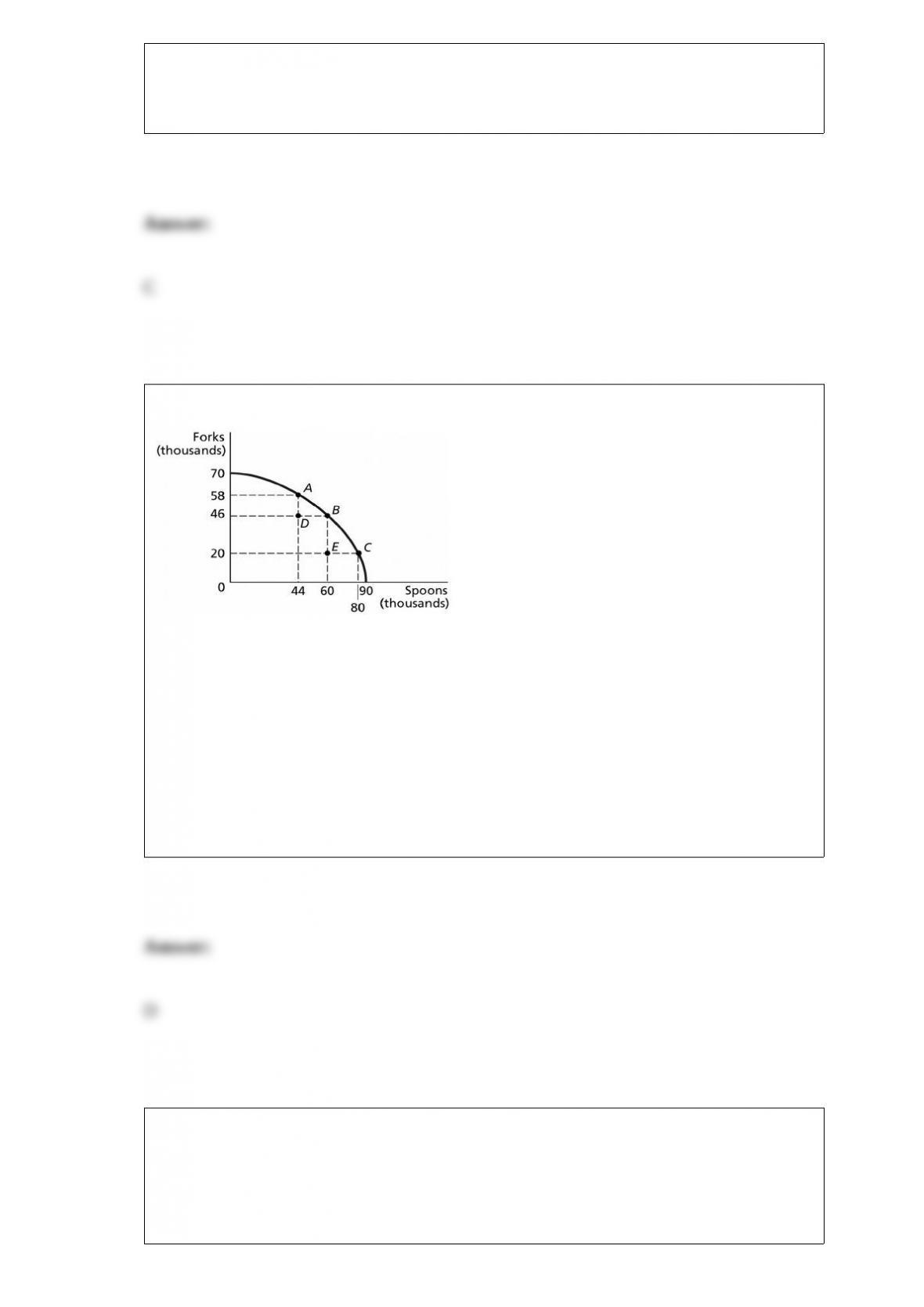
Figure 2-6
Refer to Figure 2-6. If the economy is currently producing at point D, what is the
opportunity cost of moving to point B?
A) 16 thousand spoons
B) 46 thousand forks
C) 60 thousand spoons
D) 0 forks
The new Keynesians emphasize the importance of
A) rational expectations.
B) the monetary growth rule.
C) real causes of the business cycle.
D) sticky wages and prices.
An increase in the expected inflation rate will
A) shift the short-run Phillips curve to the right.
B) shift the short-run Phillips curve to the left.
C) reduce the inflation rate.
D) reduce the unemployment rate.
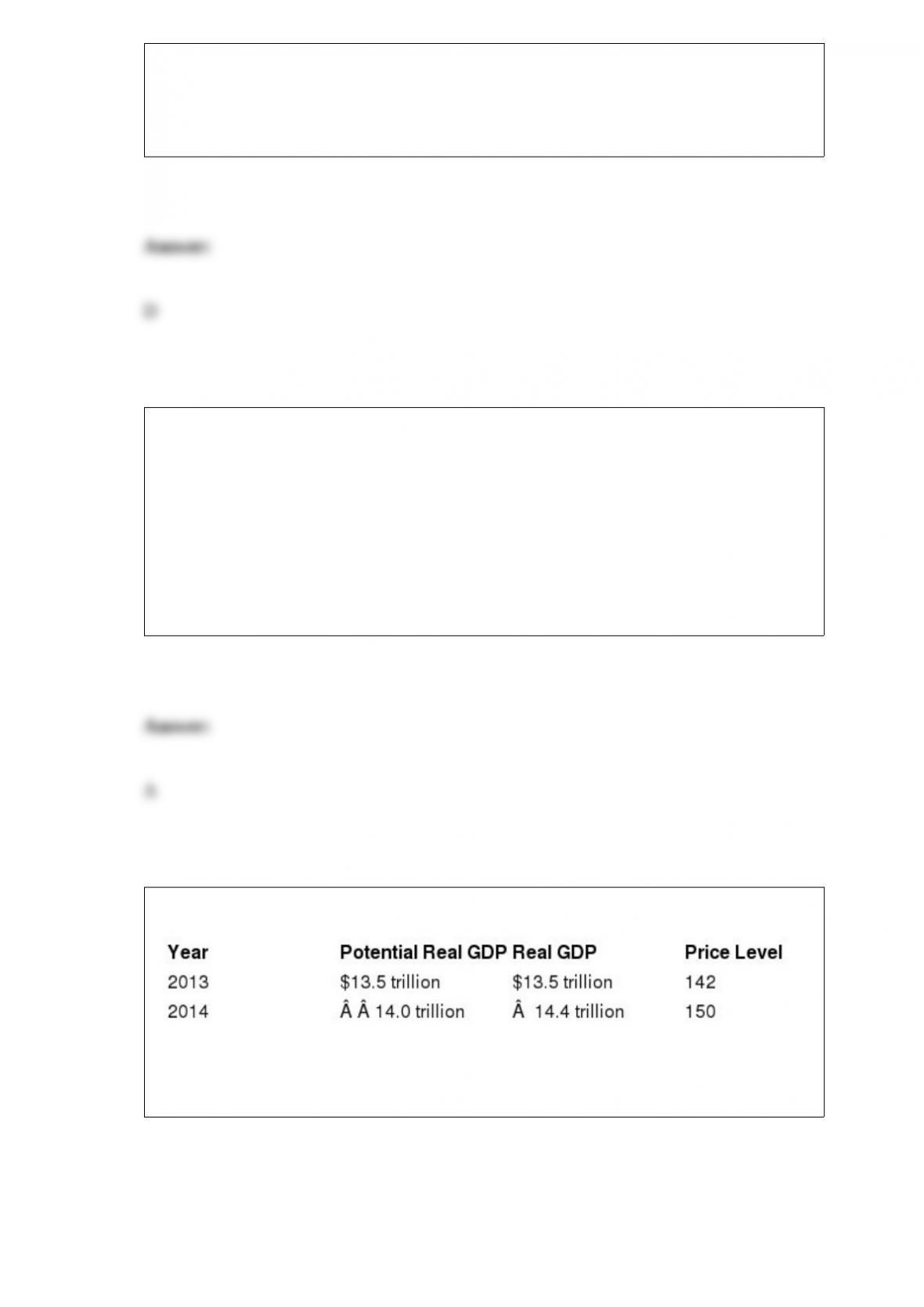
Table 15-8
Refer to Table 15-8. The hypothetical information in the table shows what the values
for real GDP and the price level will be in 2014 if the Federal Reserve does not use
monetary policy:
1. If the Fed wants to keep real GDP at its potential level in 2014, should it use an
expansionary policy or a contractionary policy? Should the trading desk buy T-bills
or sell them?
2. Suppose the Fed’s policy is successful in keeping real GDP at its potential level in
2014. State whether each of the following will be higher or lower than if the Fed
had taken no action:
(i) Real GDP (ii) Full-employment real GDP (iii)The inflation rate
(iv)The unemployment rate
1. Draw an aggregate demand and aggregate supply graph to illustrate your answer.
Be sure that your graph contains LRAS curves for 2013 and 2014; SRAS curves
2013 and 2014; AD curve for 2013 and 2014, with and without monetary policy
actions; and equilibrium real GDP and the price level in 2014 with and without
policy.

With a monetary growth rule as proposed by the monetarists, during a recession the rate
of growth of the money supply would
A) decrease.
B) increase.
C) not change.
D) decrease or increase depending on economic conditions.
If the number employed is 190 million, the number unemployed is 10 million, and the
working-age population is 250 million, then the labor force participation rate is
A) 4%.
B) 5.2%.
C) 60%.
D) 76%.
E) 80%.

Although the Federal Reserve had traditionally made discount loans only to commercial
banks, in response to the financial crisis in 2008 the Fed made ________ eligible for
discount loans as well.
A) the Treasury Department
B) mortgage brokers
C) savings banks
D) primary dealers
The CPI in 1990 was 131, and the CPI in 2010 was 218. If you earned a salary of
$40,000 in 1990, what would be a salary with equivalent purchasing power in 2010?
A) $45,977
B) $66,565
C) $87,200
D) $143,486
Health problems prevent people from working harder, which can lower a country’s total
income. This indicates that in effect, health problems
A) are a primary cause of price decreases.
B) increase the incentive to work.
C) shift country’s production possibilities frontier inward.
D) decrease consumer surplus.
Suppose the economy is at full employment and firms become more pessimistic about
the future profitability of new investment. Which of the following will happen in the
short run?
A) Output will rise.
B) Prices will rise.
C) Unemployment will rise.
D) The aggregate demand curve will shift to the right.
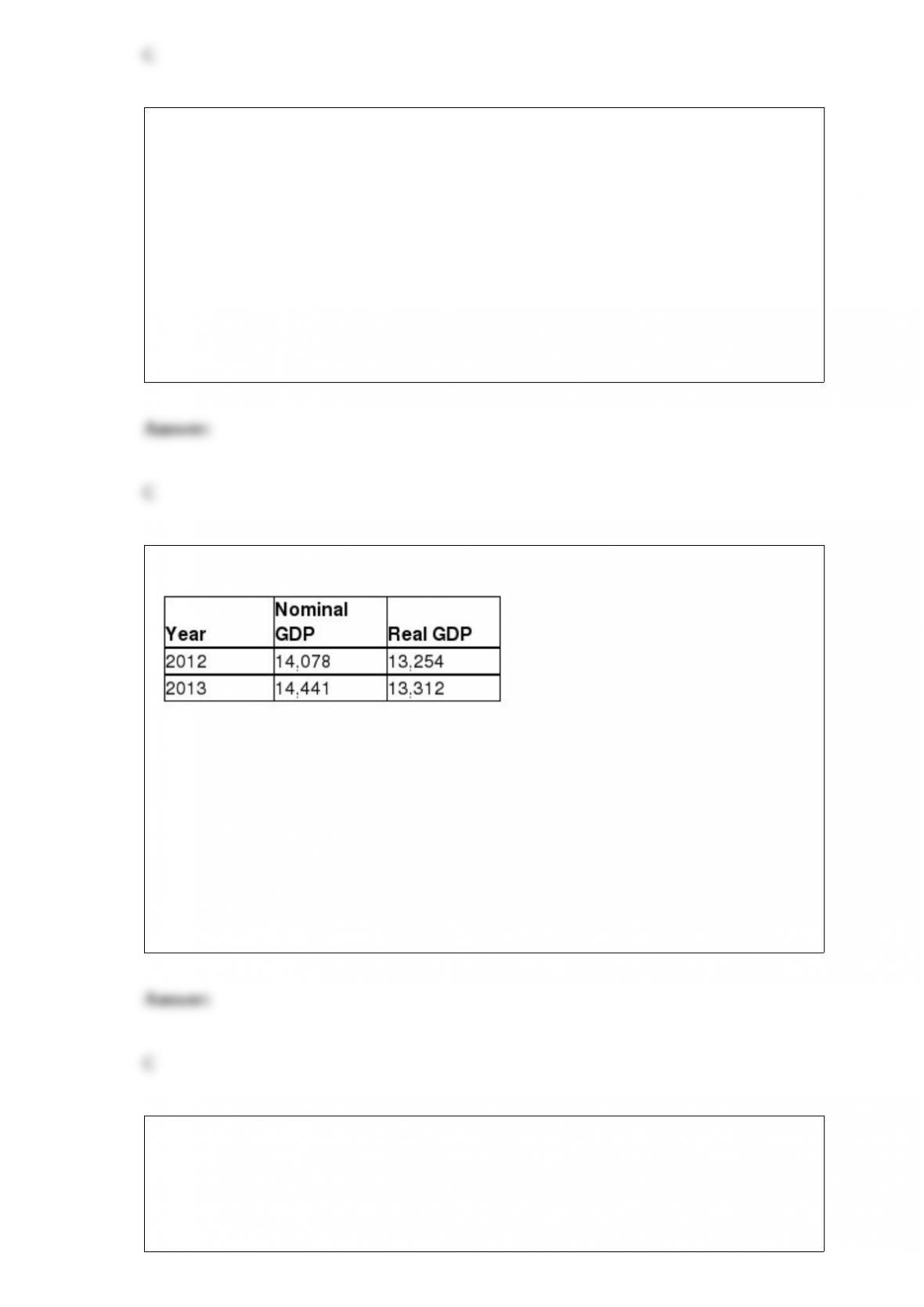
Table 8-14
Refer to Table 8-14. Consider the following data on nominal GDP and real GDP (values
are in billions of dollars): The GDP deflator for 2013 equals
A) 92.2.
B) 102.6.
C) 108.5.
D) 109.1.
Which of the following transactions would be included in the official calculation of
GDP?
A) A student buys a used textbook at the bookstore.

B) Firestone sells $2 million worth of tires to General Motors.
C) You wash and wax your father’s car as a favor to him.
D) You buy a new iPod.
E) You illegally download music off the Internet to put on your new iPod.