1) Other things being constant, what will be the effect of each of the following on
disposable income (or real GDP)?
(a)An increase in the amount of liquid assets consumers are holding
(b)A sharp rise in stock prices
(c)A rapid upsurge in the rate of technological advance
(d)A sharp increase in the real interest rate
2) the budget line shows:
a.the amount of product a that a consumer is willing to give up to obtain one more unit
of product b.
b.all possible combinations of two goods that can be purchased, given money income
and the prices of the goods.
c.all equilibrium points on an indifference map.
d.all possible combinations of two goods that yield the same level of utility to the
consumer.

3)
Refer to the above table representing Kara’s bank account. Assuming that $2000 was
deposited into her account at the beginning of year 1, and no further deposits or
withdrawals were made, the interest rate Kara is receiving on her account:
A.is 5 percent.
B.is 10 percent.
C.is 20 percent.
D.cannot be determined.
4) The velocity of money is equal to:
A.1/MPS.
B.1/reserve ratio.
C.M/GDP.
D.none of these.
5) An upward shift of the aggregate expenditures schedule might be caused by:
A.a decrease in exports, with no change in imports.
B.a decrease in imports, with no change in exports.
C.an increase in exports, with an equal decrease in investment spending.
D.an increase in imports, with no change in exports.
6) Industry A has a 60 percent concentration ratio, while industry B has a 40 percent
concentration ratio. According to the inverted-U theory, all else equal, we can conclude
that:
A.Industry A will be more technologically progressive than B.
B.Industry C with a 10 percent concentration ratio will be more technologically
progressive than either industry A or B.
C.Industry D with a 80 percent concentration ratio will be more technologically
progressive than either industry A or B.
D.none of these are necessarily true.

7) economists who believe in the permanence of the recent productivity acceleration
say that:
a.the united states is entering an era of high structural unemployment due to rapid
technological change.
b.technological advance creates its own supply, which in turn creates its own demand.
c.innovations in computers and communications, together with global capitalism, are
greatly boosting u.s. productivity and the economy’s potential economic growth rate.
d.technological change will require more central planning and government regulation.
8) global competition:
a.forces domestic producers to become more efficient and to improve product quality.
b.drives up prices worldwide.
c.reduces employment worldwide.
d.creates higher flows of international migration than without trade.
9) for an increase in demand the price effect is smallest and the quantity effect is
largest:
a.when supply is least elastic.
b.in the long run.
c.in the short run.
d.in the immediate market period.
10) Monetary policy is thought to be:
A.equally effective in moving the economy out of a depression as in controlling
demand-pull inflation.
B.more effective in moving the economy out of a depression than in controlling
demand-pull inflation.
C.more effective in controlling demand-pull inflation than in moving the economy out
of a depression.
D.only effective in moving the economy out of a depression.
11) the following production possibilities tables for countries alpha and beta:
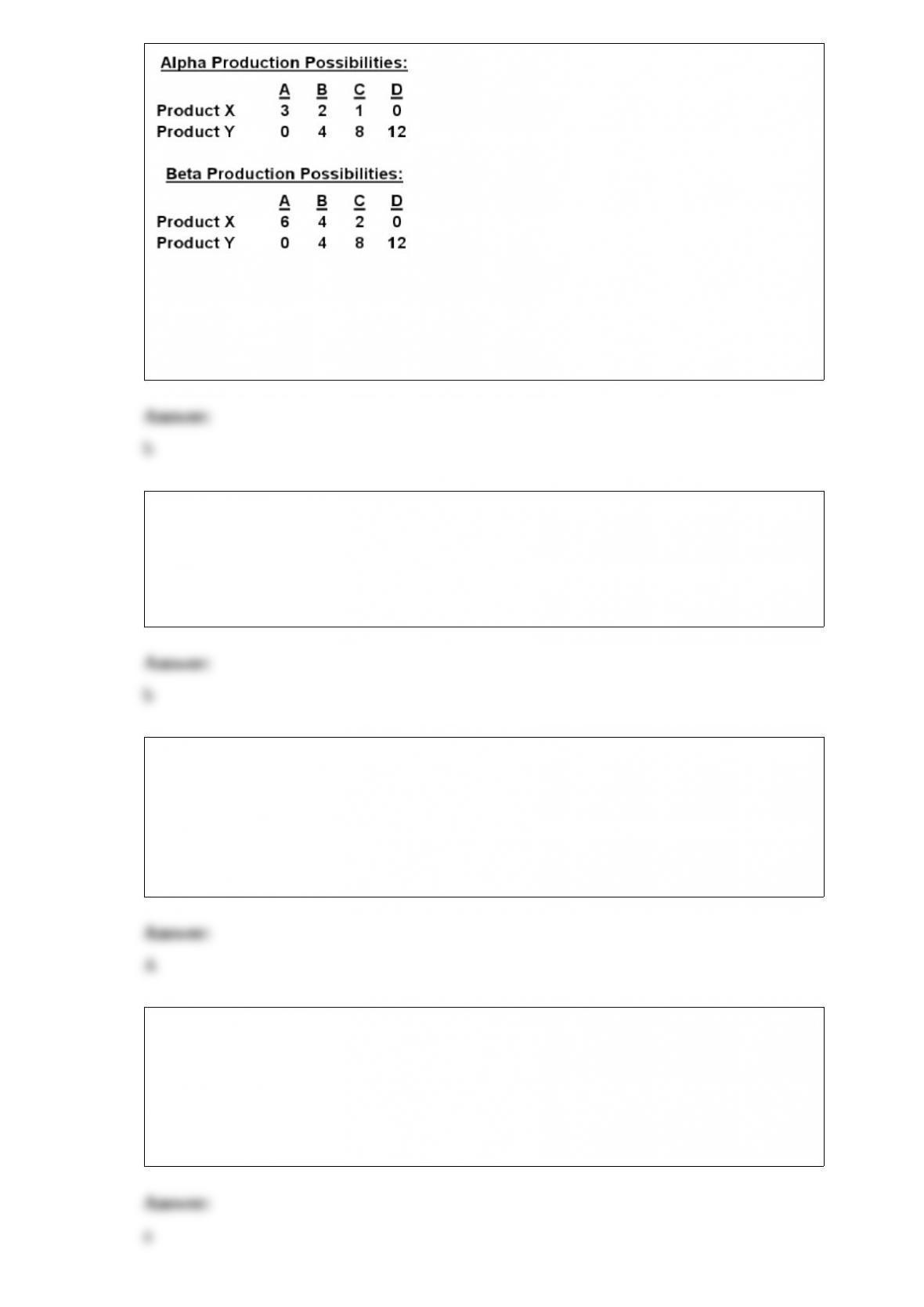
refer to the above tables. the domestic opportunity cost of one unit of x in alpha is:
a.2 units of y
b.4 units of y
c.1 unit of y
d.3 units of y
12) the health care market is characterized by:
a.extensive negative externalities.
b.significant positive externalities.
c.perfect knowledge by both buyers and sellers.
d.a perfectly inelastic demand.
13) A bank temporarily short of required reserves may be able to remedy this situation
by:
A.borrowing funds in the Federal funds market.
B.granting new loans.
C.shifting some of its vault cash to its reserve account at the Federal Reserve.
D.buying bonds from the public.
14) because of higher corn prices, firms producing corn-based products have
experienced:
a.an upward shift in their mc, avc, and atc curves.
b.an upward shift in their afc, avc, and atc curves.
c.a downward shift in their mc, afc, and avc curves.
d.greater economies of scale

15) a purely competitive firm is precluded from making economic profit in the long run
because:
a.it is a “price taker.”
b.its demand curve is perfectly elastic.
c.of unimpeded entry to the industry.
d.it produces a differentiated product.
16) The marginal revenue product of any input is the:
A.cost of an additional unit of that input.
B.added profits resulting from the use of one more unit of that input.
C.additional output resulting from the use of one more unit of that input.
D.additional revenue resulting from the use of one more unit of that input.
17) other things equal, immigration has what effects on the destination nation?
a.reduced average wage rate, increased domestic output, increased business income,
and lower total wage income of native-born workers.
b.reduced average wage rate, increased domestic output, increased business income,
and greater total wage income of native-born workers.
c.increased average wage rate, increased domestic output, increased business income,
and greater total wage income of native-born workers.
d.increased average wage rate, reduced domestic output, reduced business income, and
lower total wage income of native-born workers.
18) ebenezer likes to decorate the exterior of his house for the christmas holidays. if his
neighbors enjoy the display then it has created:
a.a negative externality, and government should respond by subsidizing holiday
displays.
b.a negative externality, and government should respond by taxing holiday displays.
c.a positive externality, and government should respond by subsidizing holiday
displays.
d.a positive externality and government should respond by taxing holiday displays.