A policy intended to reduce unemployment by taking advantage of a tradeoff between
inflation and unemployment leads to
a. both higher inflation and higher unemployment in the long run.
b. higher inflation and no change in unemployment in the long run.
c. the same inflation rate and lower unemployment in the long run.
d. higher inflation and lower unemployment in the long run
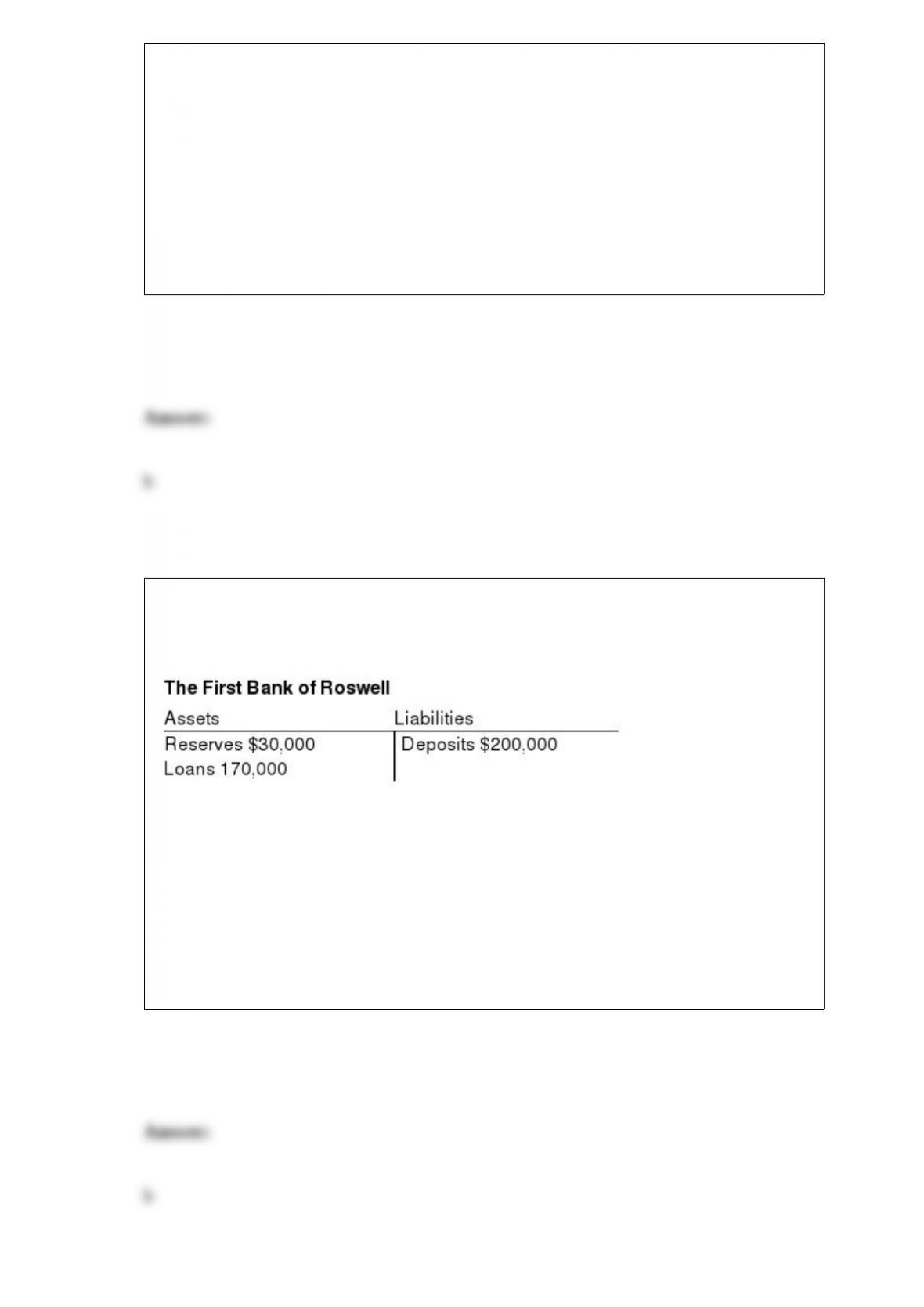
Table29-5.
RefetoTable29-5. If the bank faces a reserve requirement of 20 percent, then it
a. has $10,000 of excess reserves.
b. needs $10,000 more reserves to meet its reserve requirements.
c. needs $20,000 more reserves to meet its reserve requirements.
d. just meets its reserve requirement.

Who among the following would be counted as “unemployed”?
a. Shasta, who is waiting to be recalled to a job from which she has been laid off.
b. Karen, who neither has a job nor is looking for one.
c. Mary, who worked only 35 hours last week.
d. None of the above is correct.
Specialization and trade can make everyone better off if a person can obtain goods at
prices that are less than that person’s opportunity cost.
a. True
b. False
If the government cuts the tax rate, workers get to keep
a. less of each additional dollar they earn, so work effort increases, and aggregate
supply shifts right.
b. less of each additional dollar they earn, so work effort decreases, and aggregate
supply shifts left.
c. more of each additional dollar they earn, so work effort increases, and aggregate
supply shifts right.

d. more of each additional dollar they earn, so work effort decreases, and aggregate
supply shifts left.
According to the open-economy macroeconomic model, if the United States moved
from a government budget deficit to a government budget surplus, U.S. real interest
rates would increase and the real exchange rate of the U.S. dollar would appreciate.
a. True
b. False
For a market for a good or service to exist, there must be a
a. group of buyers and sellers.
b. specific time and place at which the good or service is traded.
c. high degree of organization present.
d. All of the above are correct.

Suppose the price level rises, but the number of dollars you are paid per hour stays the
same. This means that your
a. nominal wage is higher.
b. nominal wage is lower.
c. real wage is higher.
d. real wage is lower.
An essential piece of the liquidity preference theory is the demand for money.
a. True
b. False
Which of the following statements is correct? In the special case of the 100-percent
reserve banking the money multiplier is
a. 0 and banks create money.

b. 0 and banks do not create money.
c. 1 and banks create money
d. 1 and banks do not create money.
People who are unemployed because of job search are best classified as
a. cyclically unemployed.
b. structurally unemployed.
c. frictionally unemployed.
d. discouraged workers.
Marcus is of the opinion that the theory of liquidity preference explains the
determination of the interest rate very well. Most economists would say that Marcus’s
opinion is
a. Keynesian in nature, and that his view is more valid for the long run than for the
short run.
b. classical in nature, and that his view is more valid for the long run than for the short
run.

c. Keynesian in nature, and that his view is more valid for the short run than for the
long run.
d. classical in nature, and that his view is more valid for the short run than for the long
run.
When a shortage exists in a market, sellers
a. raise price, which increases quantity demanded and decreases quantity supplied until
the shortage is eliminated.
b. raise price, which decreases quantity demanded and increases quantity supplied until
the shortage is eliminated.
c. lower price, which increases quantity demanded and decreases quantity supplied until
the shortage is eliminated.
d. lower price, which decreases quantity demanded and increases quantity supplied until
the shortage is eliminated.
Countries with high population growth rates tend to have lower levels of educational
attainment.
a. True
b. False

Government purchases include spending on goods and services by
a. the federal government, but not by state or local governments.
b. federal and state governments, but not by local governments.
c. federal, state, and local governments.
d. federal, state, and local governments, as well as household spending by employees of
those governments.
Inflation reduction has the highest cost when the efforts are
a. credible so that the sacrifice ratio is low.
b. credible so that the sacrifice ratio is high.
c. unexpected so that the sacrifice ratio is high.
d. unexpected so that the sacrifice ratio is low.

If the government of Venezuela made policy changes that increased national saving, the
real exchange rate of the peso would
a. depreciate and Venezuelan net exports would rise.
b. depreciate and Venezuelan net exports would fall.
c. appreciate and Venezuelan net exports would rise.
d. appreciate and Venezuelan net exports would fall.
Figure 3-14
Refer to Figure3-14. At which of the following prices would both Arturo and Dina
gain from trade with each other?
a. 12 burritos for 21 tacos
b. 12 burritos for 27 tacos
c. 12 burritos for 36 tacos
d. Arturo and Dina could not both gain from trade with each other at any price.

The price level is a
a. relative variable.
b. dichotomous variable
c. real variable.
d. nominal variable.
Nominal exchange rates
a. vary little over time.
b. vary substantially over time.
c. appreciate over time for most countries.
d. depreciate over time for most countries.
If Shawn can produce more donuts in one day than Sue can produce in one day, then
a. Shawn has a comparative advantage in the production of donuts.
b. Sue has a comparative advantage in the production of donuts.
c. Shawn has an absolute advantage in the production of donuts.

d. Sue has an absolute advantage in the production of donuts.
If people decide to hold more currency relative to deposits, the money supply
a. falls. The larger the reserve ratio is, the more the money supply falls.
b. falls. The larger the reserve ratio is, the less the money supply falls.
c. rises. The larger the reserve ratio is, the more the money supply rises.
d. rises. The larger the reserve ratio is, the less the money supply rises.
Over the period 19002010, Brazil’s rate of economic growth exceeded that of China.
a. True
b. False

To maintain their standard of living, most people rely on
a. government assistance.
b. their personal savings.
c. their labor earnings.
d. rental income.
Suppose that fundamental analysis indicates a particular company’s stock is overvalued.
a. This means its present value is less than its price. You should consider adding the
stock to your portfolio.
b. This means its present value is less than its price. You shouldn”t consider adding the
stock to your portfolio.
c. This means its present value is more than its price. You should consider adding the
stock to your portfolio.
d. This means its present value is more than its price. You shouldn”t consider adding the
stock to your portfolio.
Suppose that a worker in Cornland can grow either 40 bushels of corn or 10 bushels of

oats per year, and a worker in Oatland can grow either 5 bushels of corn or 50 bushels
of oats per year. There are 20 workers in Cornland and 20 workers in Oatland. If the
two countries do not trade, Cornland will produce and consume 400 bushels of corn and
100 bushels of oats, while Oatland will produce and consume 60 bushels of corn and
400 bushels of oats. If each country made the decision to specialize in producing the
good in which it has a comparative advantage, then the combined yearly output of the
two countries would increase by
a. 280 bushels of corn and 450 bushels of oats.
b. 340 bushels of corn and 500 bushels of oats.
c. 360 bushels of corn and 520 bushels of oats.
d. 360 bushels of corn and 640 bushels of oats.
Which of the following would tend to shift the supply of dollars in the market for
foreign-currency exchange in the open-economy macroeconomic model to the right?
a. the exchange rate rises
b. the exchange rate falls
c. the expected rate of return on U.S. assets rises
d. the expected rate of return on U.S. assets falls

U.S. dollars are an example of commodity money and hides used to make trades are an
example of fiat money.
a. True
b. False
When the Fed sells government bonds,
a. the money supply increases and the federal funds rate increases.
b. the money supply increases and the federal funds rate decreases.
c. the money supply decreases and the federal funds rate increases.
d. the money supply decreases and the federal funds rate decreases.
Which of the following would notbe a result of replacing the income tax with a
consumption tax so that interest income was no longer taxed?
a. The interest rate would decrease.
b. Investment would decrease.
c. The standard of living would eventually rise.
d. The supply of loanable funds would shift right.