
In order to increase value, an organization must do all of the following EXCEPT:
a. increase perceived benefits while holding price or cost constant.
b. increase perceived benefits while reducing price or cost.
c. keep the proportion of price or cost to perceived benefits constant.
d. decrease price or cost while holding perceived benefits constant.
Answer:
A tool used for presenting a chain of causes and effects is called a _____.
a. run chart
b. fishbone diagram
c. scatter diagram
d. checksheet
Answer:
A high definition television manufacturer in Asia wants to develop a new smart
television as fast as possible using Program Evaluation and Review Technique (PERT)
and must complete the design and testing work first. The objective is to be the first to
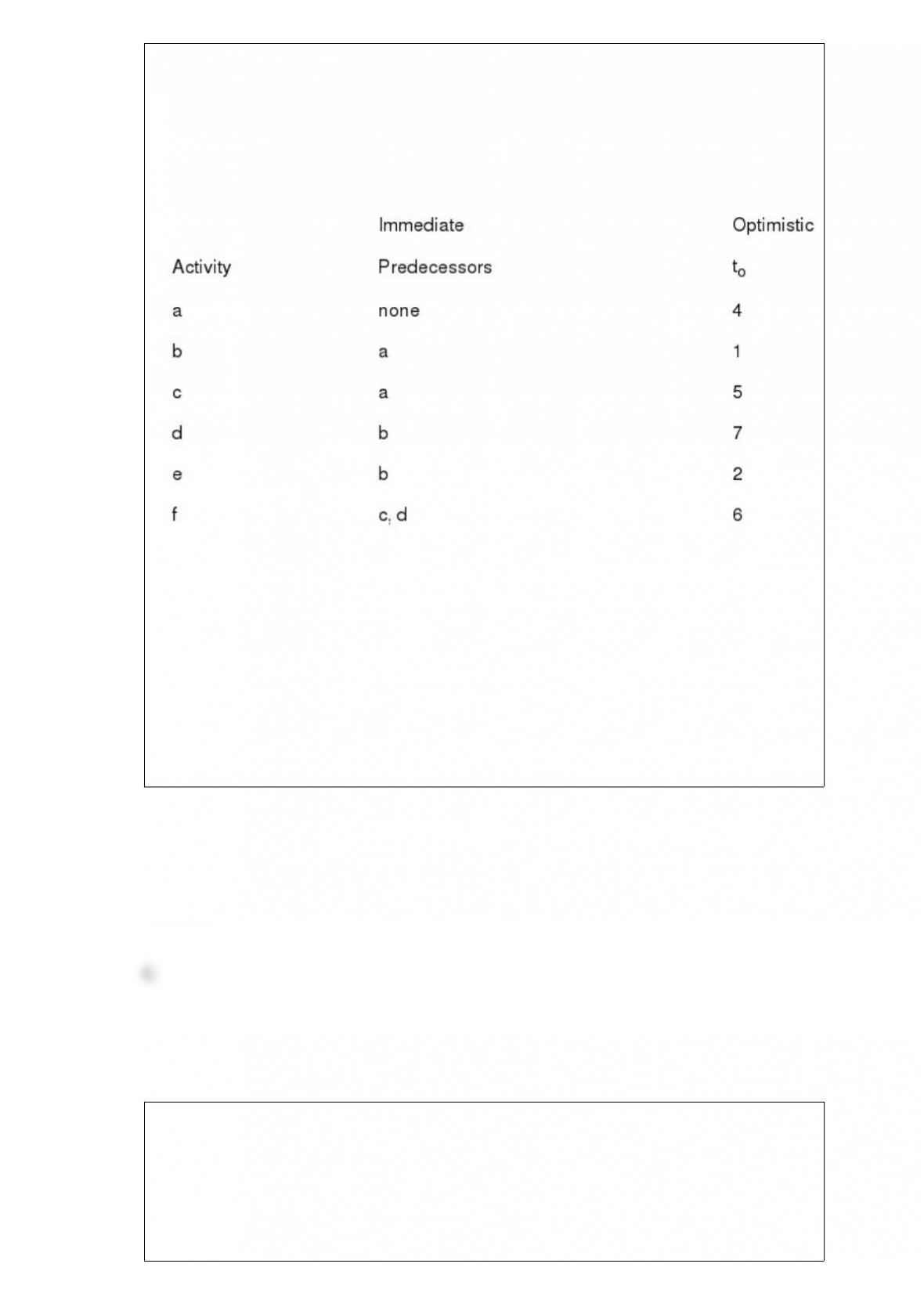
market the most innovative smart television on the planet and capture the first adopter
market share. The manufacturer has determined the following activities, precedence
relationships, and time estimates in days for the project:
The expected duration of Activity A is _____.
a. Less than or equal to 2 days
b. Greater than 2 but less than or equal to 4 days
c. Greater than 4 but less than or equal to 6 days
d. Greater than 6 days
Answer:
Explain the three lot sizing methods, and under what circumstances each works best:
a. Lot-for-lot (LFL)
b. Fixed-order quantity (FOQ)
c. Periodic-order quantity (POQ)
Answer:
Which of the following categories in Baldrige model of organizational performance
addresses how an organization designs, manages, and improves its work systems to
deliver customer value?

a. Leadership
b. Workforce focus
c. Customer focus
d. Operations focus
Answer:
Which of the following statements is TRUE of expected value of perfect information
(EVPI)?
a. EVPI mostly applies to situations that require one-time decisions.
b. EVPI is a numerical value associated with a decision coupled with some event.
c. EVPI is calculated by adding the expected payoff under perfect information to the
expected payoff of the optimal decision without perfect information.
d. EVPI can be computed by determining the best decision and payoff if each event
occurs.
Answer:
The manufacture of a product requires five sequential steps. The reliability of each of
the steps is 0.97, 0.88, 0.95, 0.92, and 0.99, respectively. What is the reliability of the
manufacturing process (system)?

a. Less than 0.60
b. Equal to or greater than 0.60 but less than 0.70
c. Equal to or greater than 0.70 but less than 0.80
d. Equal to or greater than 0.80 but less than 0.90
Answer:
Which of the following expressions is used to measure productivity?
a. Quality of output/Quantity of input
b. Quality of input/Quantity of output
c. Quantity of output/Quantity of input
d. Quantity of input/Quantity of output
Answer:
Which of the following is NOT related to a continuous metric?
a. Length
b. x-bar and R-charts
c. p-chart
d. Time
Answer:
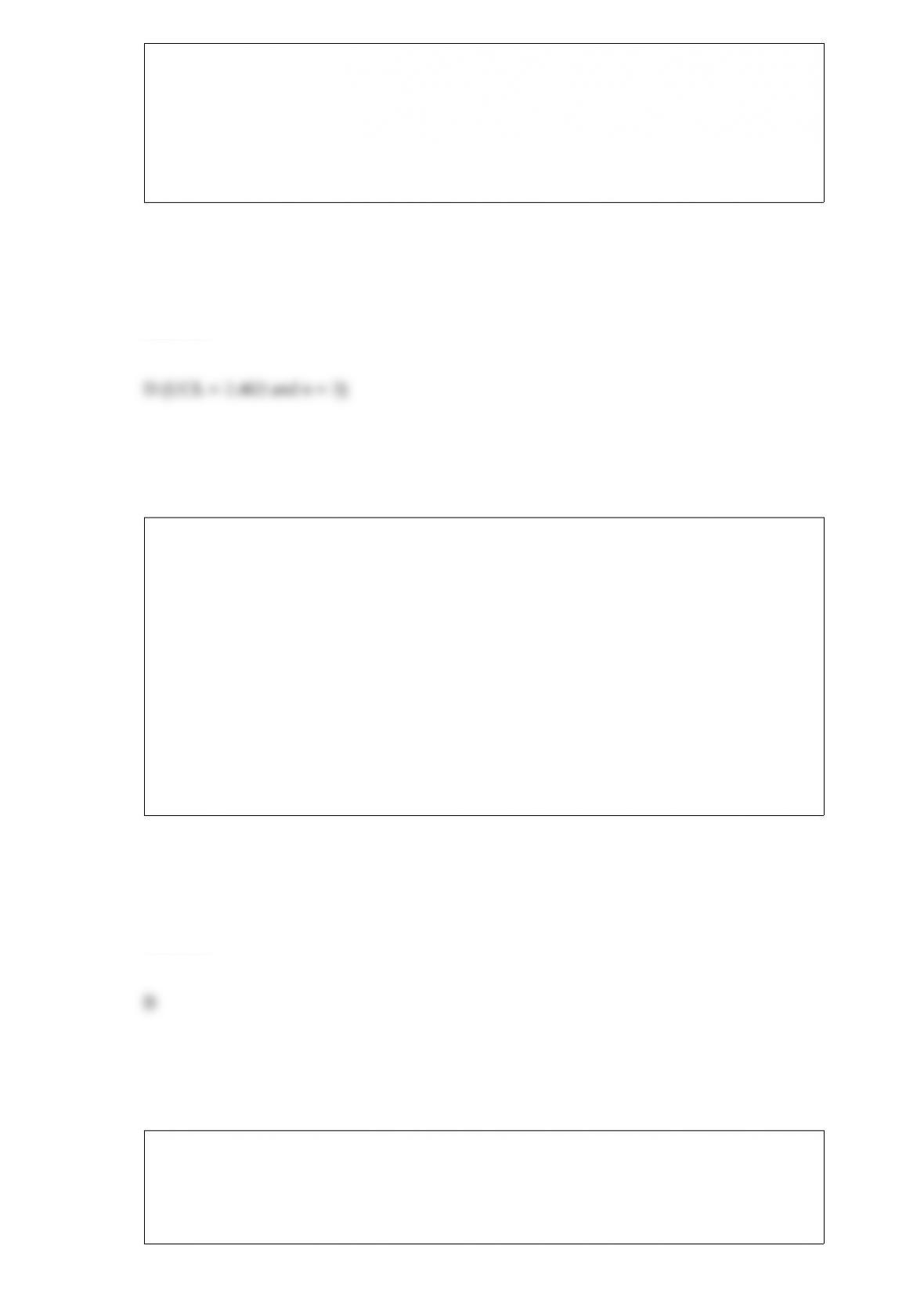
Table 1 Statistical Process Control (SPC) Problem Data*
*The range and row average help you avoid simple math errors and quicken the time to
complete the SPC analysis but you have to know what to use when.
Using Table 1, the sample values represent service times in minutes. For the R-chart,
what is the value of UCLR?
a. Less than or equal to 1.0
b. Greater than 1.0 but less than or equal to 1.5
c. Greater than 1.5 but less than or equal to 2.0
d. Greater than 2.0 but less than or equal to 2.5
Answer:
To create and deliver a service, four steps are required and based on collecting
information on errors per step, the following reliabilities have been determined: Step 1
= 0.92, Step 2 = 0.88, Step 3 = 0.94, and Step 4 = 0.84. The reliability of the total
service system is:
a. less than 0.60.
b. equal to or greater than 0.60 but less than 0.70.
c. equal to or greater than 0.70 but less than 0.80.
d. equal to or greater than 0.80 but less than 0.90.
Answer:
Which of the following is NOT an important element in the definition of reliability?
a. Probability

b. Time
c. Redundancy
d. Operating conditions
Answer:
A(n) _____ is a group of tasks needed to create and deliver an intermediate or final
output.
a. process
b. activity
c. value chain
d. prototype
Answer:
An assembly line with 28 activities is to be balanced. The total amount of time required
for all 28 activities is 88 minutes. The longest activity is 2.2 minutes and the shortest is
0.8 minutes. The line will operate for 450 minutes per day. Using a cycle time of 60
seconds, determine an assembly-line balance by selecting the longest-processing-time
task available. Compute the total idle time and assembly-line efficiency. The total idle
time is _____ seconds.

a. less than or equal to 20
b. more than 20 but less than or equal to 30
c. more than 30 but less than or equal to 40
d. more than 40 but less than or equal to 50
Answer:
Which one of the following is NOT directly related to a supply chain?
a. Distribution center
b. Inventory
c. Promotion
d. Supplier
Answer:
Which one of the following statements is TRUE regarding the Bookmaster case study?
a. One advantage of the virtual (web-based) value chain is mass customization using
self-service (i.e., customer labor).
b. One advantage of the bricks-and-mortar value chain is more customer convenience

and scope of greater product selection.
c. One advantage of the virtual (web-based) value chain is more management control.
d. One advantage of the bricks-and-mortar value chain is less of a carbon footprint.
Answer:
A ground wave radar unit developed by a defense contractor has four critical
components. If any one component should fail, the radar unit would be rendered
ineffective. The component reliabilities are 0.982, 946, 0.913, and 0.969 respectively.
Based on this data, answer the questions below.
a. What is the system reliability?
b. If the reliability of the third component is changed from 0.913 to 0.950, what does
the system reliability become?
c. If the company decides to build in system redundancy for the third component, what
does the third component’s reliability become?
d. What is the system reliability with redundancy for the third component?
Answer:
In reference to quality cost classifications, information-systems development costs
would normally fall in _____category.
a. prevention costs
b. appraisal costs
c. internal failure costs
d. external failure costs
Answer:
Which of the following statement is TRUE about a process map (flowchart)?
a. It does not have boundaries.
b. It does not include information flow.
c. It is often used as a baseline to describe how a process is performed.
d. It must include a line of customer visibility.
Answer:

_____ represent a future outcome that can occur after a decision is made that are not
under the control of the decision maker.
a. Decision alternatives
b. Events
c. Payoffs
d. Probabilities
Answer:
_____ is the process of a customer evaluating the waiting line and server system and
deciding not to join the queue.
a. Triage
b. Reneging
c. Balking
d. Preemption
Answer:

A(n) _____ is a process of determining the amount of labor and machines required to
accomplish the tasks of production on a more detailed level.
a. action schedule (AS)
b. master production schedule (MPS)
c. material requirements plan (MRP)
d. capacity requirements plan (CRP)
Answer:
Building a House of Quality begins by identifying the:
a. competitive evaluation.
b. marketplace evaluation.
c. voice of the customer.
d. design of a customer benefit package.
Answer:
You are in charge of the “advertising program” for the Boston Red Sox baseball team
during their spring training in Fort Myers, Florida. You have defined the advertising
program as a project with the following characteristics. The goal is to fill all stadium
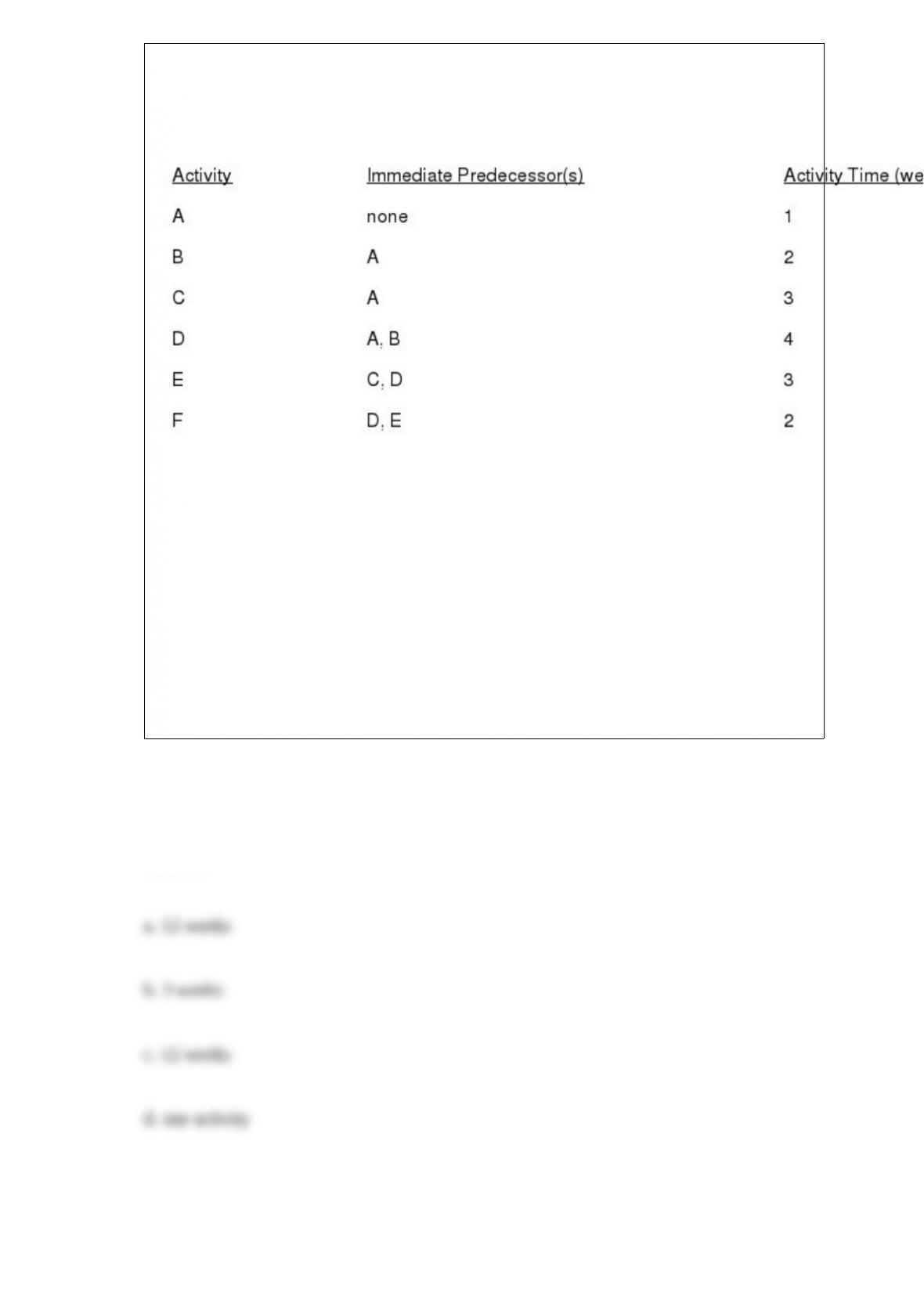
seats during the spring training season.
a. What is the earliest completion time for this project?
b. What is the largest amount of slack that any activity has in this project?
c. If activity C is delayed by three weeks, what is the revised earliest project completion
time?
d. For the original Critical Path Method problem, what is the minimum number of
activities that would have to be crashed in order to reduce the project’s earliest
completion time by two weeks, assuming all activity crash costs per week are the same
and all activities can be crashed?
Answer:
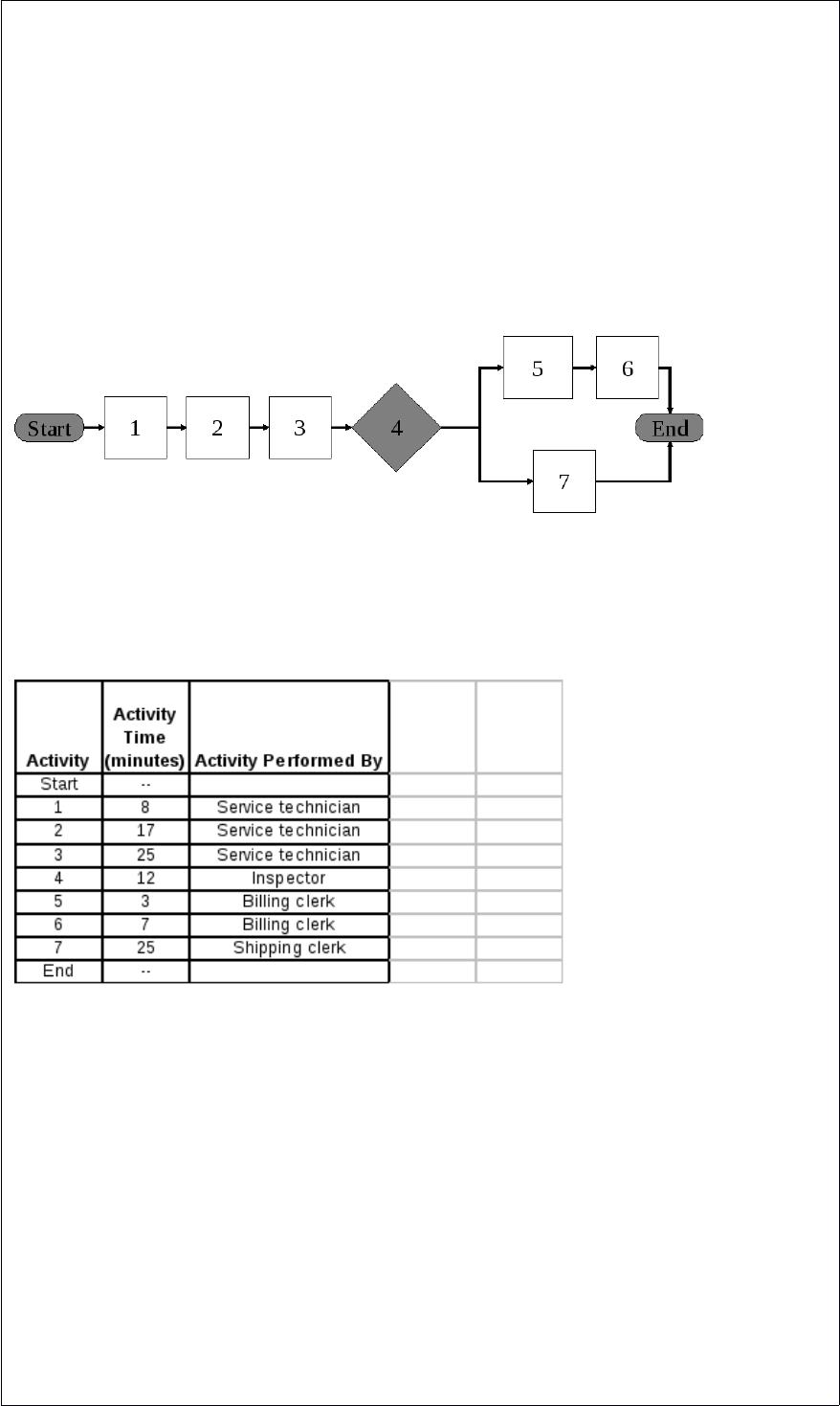
A medical equipment testing and calibration service is depicted in Figure 1. The
customer usually brings the equipment to the service center. The service process
requires service technicians to perform three process steps #1 to #3. Each technician is
cross-trained so they can perform any of the three steps. The inspector does Step # 4
alone. After step #4, two parallel work activities are performed. That is, a shipping clerk
packs the work (step 7) while a billing clerk prepares the invoice (step 5)
simultaneously, and the customer is contacted by phone for pick-up (step 6). The
average throughput is 3 equipment units per hour.
Figure 1 Flow chart of the medical equipment testing and calibration service
process
The table below
shows the work
content of the
process steps,
activity times in
minutes per unit,
shared and
non-shared work
activities, and the
type of resource
required. There are 3 service technicians on duty: 1 inspector, 1 billing clerk, and 1
shipping clerk.
An order fulfillment process normally operates two shifts a day, six days per week.
Under normal conditions, 380 orders can be processed per shift. The weekly capacity is
_____.
a. less than 1,000 orders per week
b. more than 1,000 orders but less than or equal to 2,000 order per week
c. more than 2,000 orders but less than or equal to 3,000 orders per week
d. more than 3,000 orders per week.
Answer:
Costs associated with configuring tools, equipment, and machines within a factory to
produce an item are components of _____ costs.
a. ordering
b. inventory-holding
c. shortage
d. unit
Answer:
Which one of the following statements is TRUE of sustainability?
a. Environmental sustainability applies only to goods-producing firms.
b. Resource management is a component of social sustainability.
c. The three dimensions of sustainability are often referred to as the “triple bottom line.”
d. Sustainability includes the idea of preserving resources for three years.
Answer:
A bank provides four sequential services to its customers. Over the last quarter, the
reliability of each of these services was 92%, 97%, 95%, and 90%. What is their overall
reliability?
a. 0.9700
b. 0.9350
c. 0.7630
d. 0.7400
Answer:
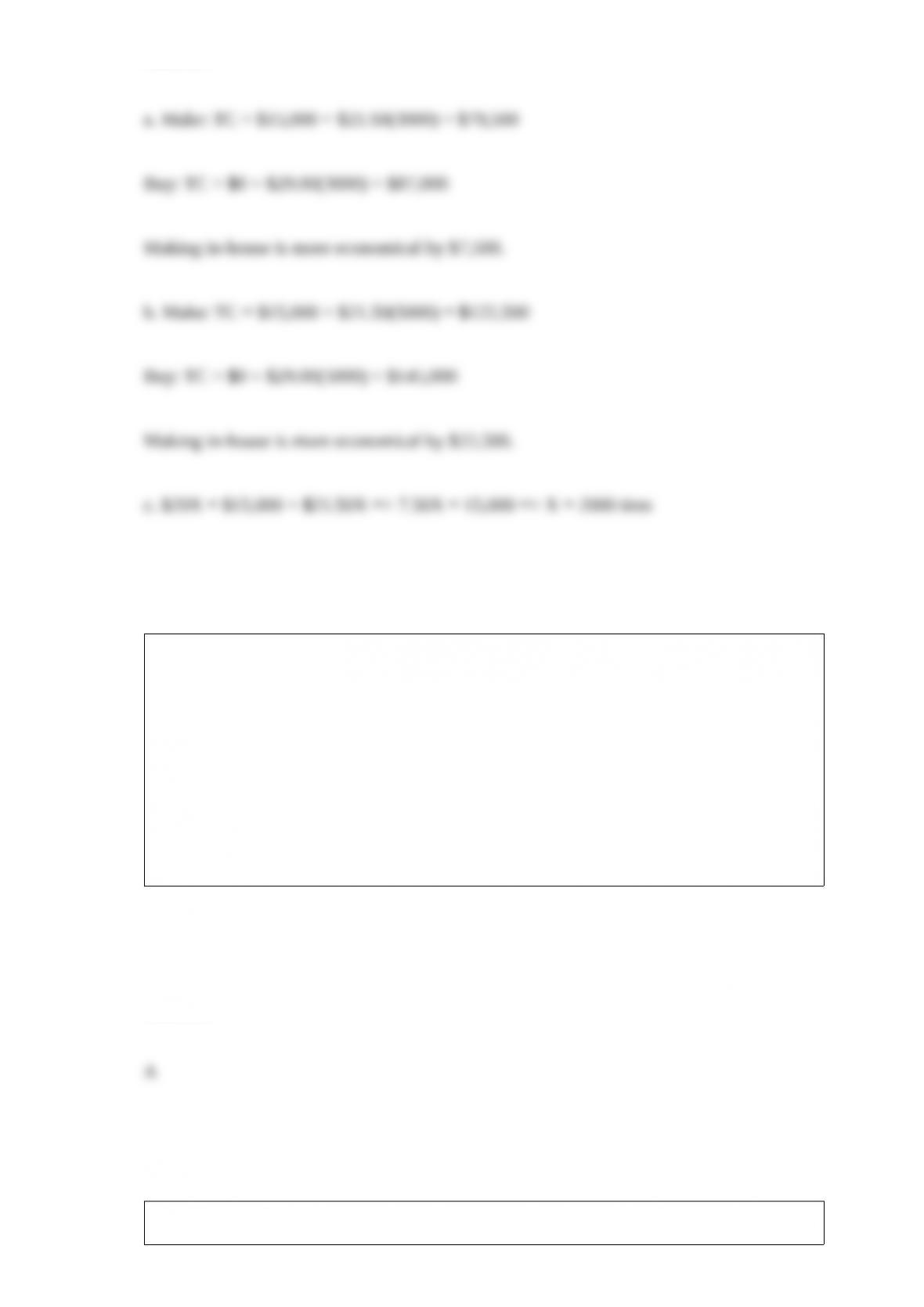
A U.S. motorcycle manufacturer has the option of either making the tires in their newly
designed motorcycle, or subcontracting it out to a manufacturer from Singapore. Costs
for the two options are:
a. Which option would be preferred at an annual volume of 3,000 tires?
b. Which option would be preferred at an annual volume of 5,000 tires?
c. For what range of production volume would it be better to make the tires in-house?
Answer:
In the value chain model for a hospital, pharmaceutical companies and organ donors
would be considered as _____.
a. suppliers
b. inputs
c. processes
d. outputs
Answer:
A fast-food stand has a thriving business in downtown Portland. They serve 3,500
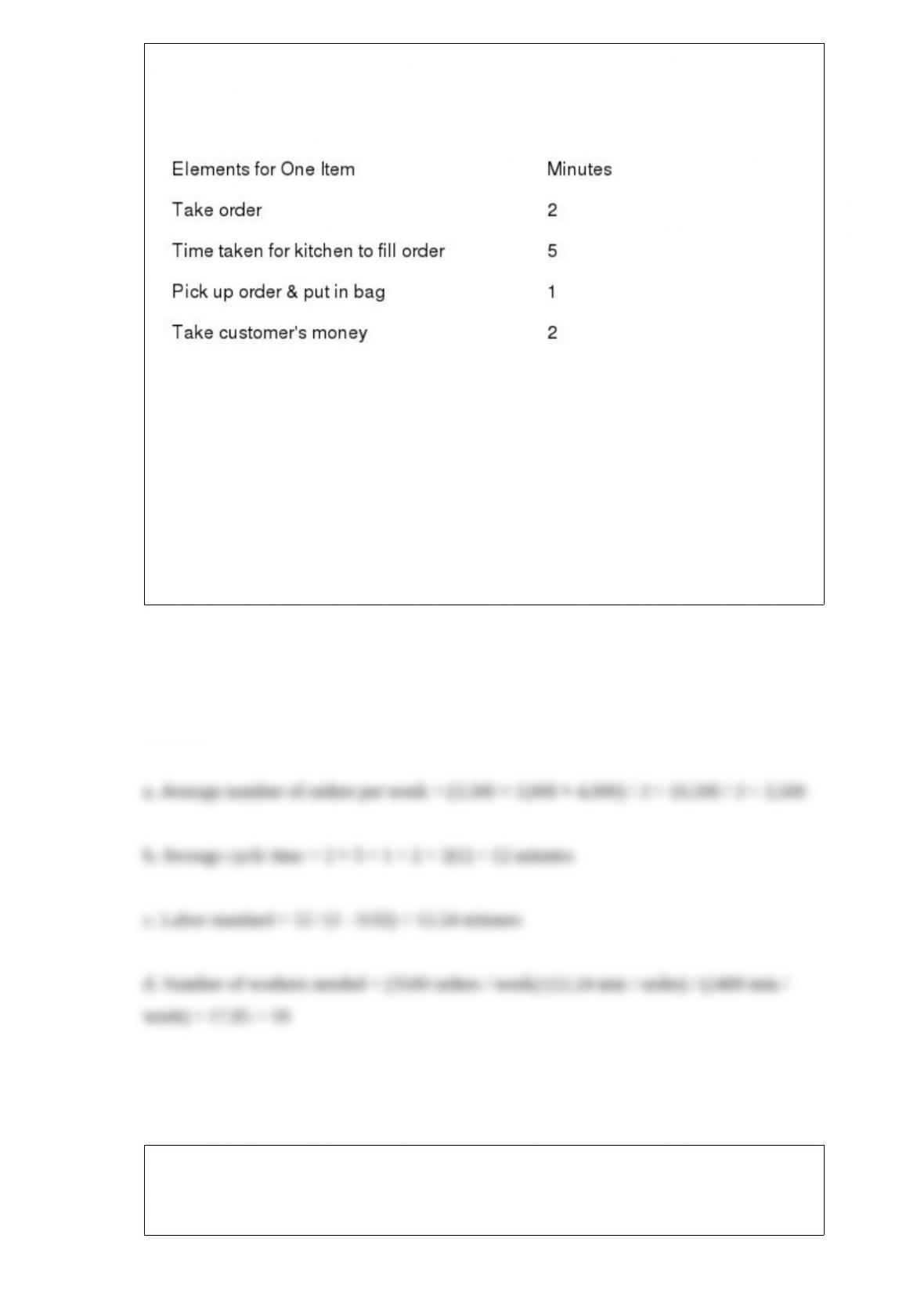
burgers; 3,000 orders of fries; and 4,000 soft drinks per week. The workers work 40
hours per week but are idle two percent of the time. The manager wants to try to
become more efficient. He has done a time study and found:
It takes 1 additional minute per additional item. The average order size is 3 items.
a. What is the average number of orders per week?
b. What is the average cycle time (in minutes) per order?
c. What is the labor standard (in minutes) per order?
d. How many workers does the manager need per week?
Answer:
A manufacturing firm is considering three alternatives for automation. They anticipate
the annual production volume to be 75,000 units. The costs for each alternative are as
shown:
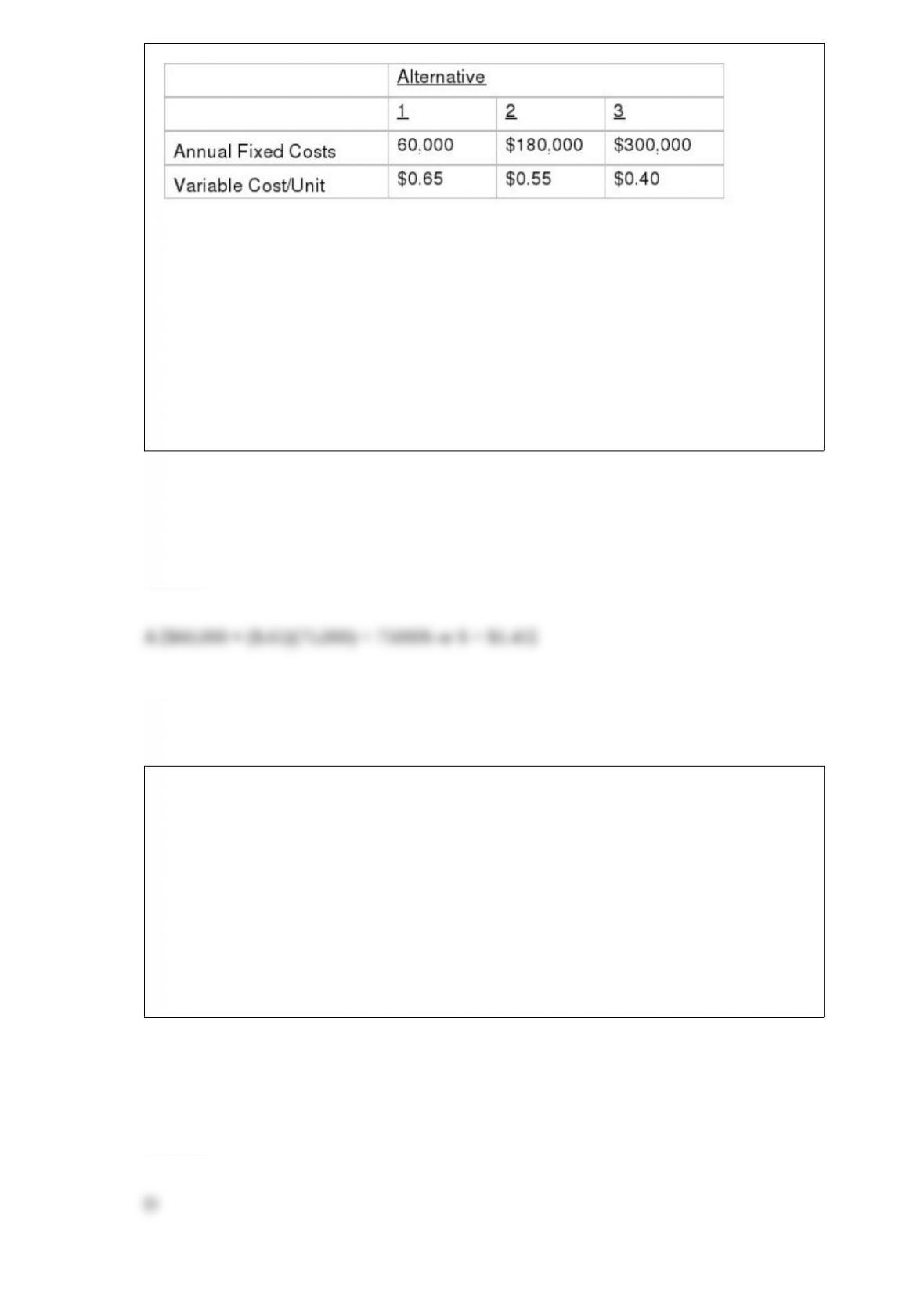
What sales price must be charged for Alternative 1 to break even?
a. Less than or equal to $2.00
b. More than $2.00 but less than or equal to $3.00
c. More than $3.00 but less than or equal to $4.00
d. More than $4.00 but less than or equal to $5.00
Answer:
Given the results in Question #22 and a capacity of 900 minutes, the best short-term
capacity option for the lab is:
a. to buy extra equipment and hire one more lab technician.
b. to sell unused capacity.
c. to add an extra shift of two technicians and related equipment.
d. to work overtime to finish the job.
Answer:

Scheduling and sequencing methods used in manufacturing are more beneficial in
low-contact, than high-contact, service processes.
Answer:
Deciding on how much of each grade of gasoline to produce is an example of the linear
programming model for blending applications.
Answer:
Webster Manufacturing Inc. is implementing a Just-in-Time (JIT) system and wants to
know how many Kanbans to use for the initial setup of its JIT system. The daily
demand is 400 units and each Kanban (i.e., container) holds 15 units. The combined
processing and waiting time per container is 0.7 days. If the initial alpha value for
safety stock is 0.6 and the processing and waiting time is reduced by 30 percent due to
job and process improvements, by how many units is the maximum authorized
inventory reduced from the original Webster problem #23 and #24?
a. Less than 100 units
b. More than 100 but less than or equal to 200 units
c. More than 200 but less than or equal to 300 units
d. More than 300 but less than or equal to 400 units

Answer:
Which of the following statements is TRUE?
a. Inventory is any physical asset held for future use or sale.
b. When using ABC analysis, C items require close control by operations managers as
they account for a large dollar value but a relatively small percentage of total items.
c. Dependent demand is directly related to the demand of other stock-keeping units
(SKUs) and can be calculated without needing to be forecasted.
d. Stockouts occur in a fixed-quantity system (FQS) whenever the lead-time demand
exceeds the replenishment level (M).
Answer:
Peripheral goods and services are NOT essential to a primary good or service.
Answer:
When would an analytical queuing model be used? When would a simulation model be
used?
Answer:
Explain the notion of value chain integration.
Answer:
Cycle time should be smaller than the largest operation time.
Answer:
Explain a value proposition. Relate this to a customer benefits package of goods and
services.
Answer:
Knowledge bottlenecks and equipment breakdowns are a form of waste in
organizations.
Answer:
The maximum authorized inventory for this part is _____.
a. less than 25 parts
b. more than 25 but less than or equal to 50 parts
c. more than 50 but less than or equal to 100 parts
d. more than 100 but less than or equal to 150 parts
Answer:
The cost of quality refers to the out-of-pocket costs that customers incur if they receive
a poor quality good or service.
Answer:
A manufacturer of paint has two factories located in France and Spain and due to
economic conditions must close one of them. The factory productivity data is as
follows:
Gallons of Paint Total Costs

Produced (1,000s) (millions $)
Factory (Spain) 4,600,000 $5,250,000
Factory (France) 4,000,000 $3,500,000
Based on the productivity analysis of both the factories, which of the following
statements is true?
a. The factory in Spain is more productive than the factory in France.
b. Based solely on this productivity analysis, the factory in Spain must be closed.
c. Based solely on this productivity analysis, the factory in France must be closed.
d. Both factories have identical productivity levels. So, other criteria must be used to
make this decision.
Answer:
E-communication changes the operation, speed, and efficiency of the value chain.
Answer:
When the range of process variation does not conform to the design specifications, the
process capability index will be less than 1.
Answer: