
Money market mutual funds sell shares to investors and use the money to buy
A) mortgage-backed securities.
B) foreign currency.
C) short-term securities.
D) overseas assets through foreign direct investment.
Arnold Harberger was the first economist to estimate the loss of economic efficiency
due to market power. Harberger found that
A) the loss of economic efficiency in the U.S. economy due to market power was less
than 1 percent of the value of production.
B) because of the increase in the average size of firms since World War II, the loss of
economic efficiency has been relatively large, about 10 percent of the value of total
production in the United States.
C) although the number of monopolies was small, the large number of other
non-competitive firms in the United States resulted in a large loss of economic
efficiency, about 20 percent of the value of total production.
D) the loss of economic efficiency in the U.S. economy due to market power was small
around 1973, about 1 percent of the value of production, but has since grown to about
10 percent.
With a monetary growth rule as proposed by the monetarists, during a recession the rate
of growth of the money supply would

A) decrease.
B) increase.
C) not change.
D) decrease or increase depending on economic conditions.
A member of a corporate board of directors that is also a manager of the business is
known as
A) a shareholder.
B) an inside director.
C) a partner.
D) a corporate governor.
If a perfectly competitive firm raises the price it charges to consumers, which of the
following is the most likely outcome?
A) The firm’s revenue will not change because some consumers will refuse to pay the
higher price.
B) The firm will not sell any output.
C) The firm’s total revenue will increase only if the demand for its product is inelastic.
D) The firm’s total revenue will increase only if the demand for its product is elastic.
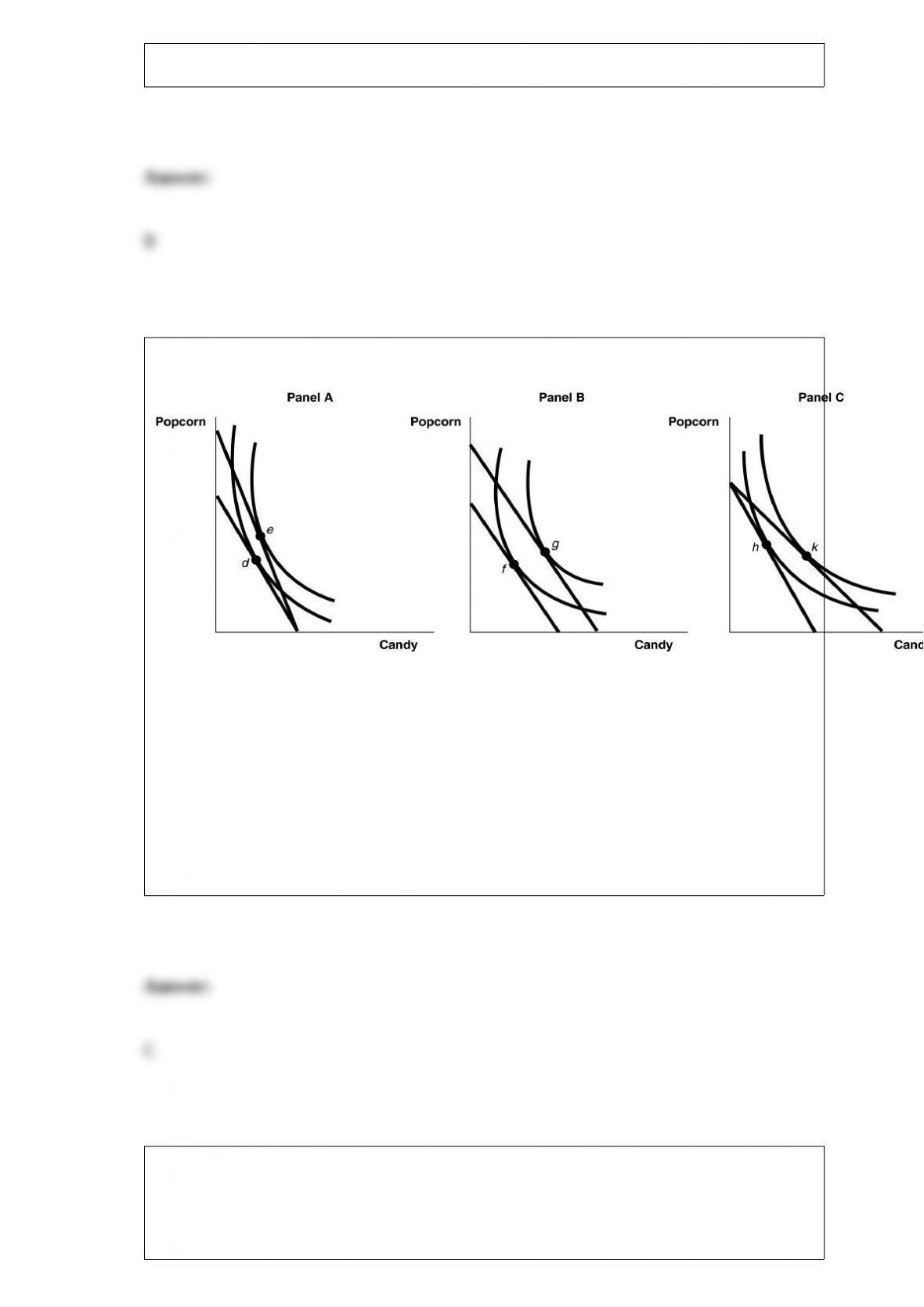
Figure 10-6
A change in the price of candy only is shown in
A) Panel A.
B) Panel B.
C) Panel C.
D) none of the above panels.
Which of the following is a common mistake consumers commit when they make
decisions?
A) They take into account nonmonetary opportunity costs but ignore monetary costs.

B) They are overly pessimistic about their future behavior.
C) They fail to ignore sunk costs.
D) They sometimes value fairness too much.
A monopolistically competitive firm maximizes profit where
A) price = marginal revenue.
B) price > marginal cost.
C) marginal revenue > average revenue.
D) total revenue > marginal cost.
All of the following are part of the “taxes” provision of the Patient Protection and
Affordable Care Act (ACA) except
A) pharmaceutical firms and health insurance firms will pay new taxes.
B) investors earning more than $200,000 will pay a new tax on their investment
income.
C) beginning in 2018, all taxes on employer-provided health insurance plans will be
reduced or eliminated.
D) workers earning more than $200,000 will have their share of the Medicare payroll
tax increase.

Which antitrust law prohibited firms from buying stock in competitors and from having
directors serve on the boards of competing firms?
A) the Clayton Act
B) the Securities and Exchange Act
C) the Sherman Act
D) the Robinson-Patman Act
In 2011, a number of Canadians purchased homes in Arizona. Which of the following
would not be a logical explanation for this?
A) The value of the Canadian dollar relative to the U.S. dollar increased during this
time.
B) The U.S. dollar depreciated during this time.
C) The Canadian dollar appreciated during this time.
D) The U.S. dollar appreciated relative to the Canadian dollar during this time.

Whenever a buyer and a seller agree to trade, both must believe they will be made
better off
A) unless the buyer resides in a different country than the seller resides in. International
trade may make the buyer or seller worse off.
B) unless one party is richer than the other.
C) only if the buyer and seller live in countries with market economies.
D) whether the buyer and seller live in the same city or different countries.