1) The equation of exchange suggests that, if the supply and velocity of money remain
unchanged, an increase in the physical volume of goods and services produced will
cause:
A.the unemployment rate to rise.
B.the Federal Reserve Banks to sell securities in the open market.
C.a decline in the price level.
D.an automatic budget deficit.
2) Economists regard expenditures on education as investments because:
A.they are subject to tax deductions at the same rate as are expenditures on machinery
and equipment.
B.education is economically beneficial at the same time it is being acquired.
C.such expenditures are current costs that are intended to enhance future earnings.
D.they differ from expenditures on health and worker mobility.
3) if price is above the equilibrium level, competition among sellers to reduce the
resulting:
a.surplus will increase quantity demanded and decrease quantity supplied.
b.shortage will decrease quantity demanded and increase quantity supplied.
c.surplus will decrease quantity demanded and increase quantity supplied.
4) the demand for commodity x is represented by the equation p = 100 – 2q and supply
by the equation p = 10 + 4q.
refer to the above information. the equilibrium price is:
a.$50
b.$70
c.$80
d.$130
5) suppose that a person’s nominal income rises from $10,000 to $12,000 and the
consumer price index rises from 100 to 105. the person’s real income will:
a.fall by about 20 percent.
b.fall by about 2 percent.
c.rise by about 15 percent.
d.rise by about 25 percent.
6) In the market for loanable funds:
A.an increase in bank lending will increase the interest rate.
B.a decrease in saving will reduce the interest rate.
C.an increase in borrowing for investment will increase the interest rate.
D.a decrease in government borrowing will increase the interest rate.
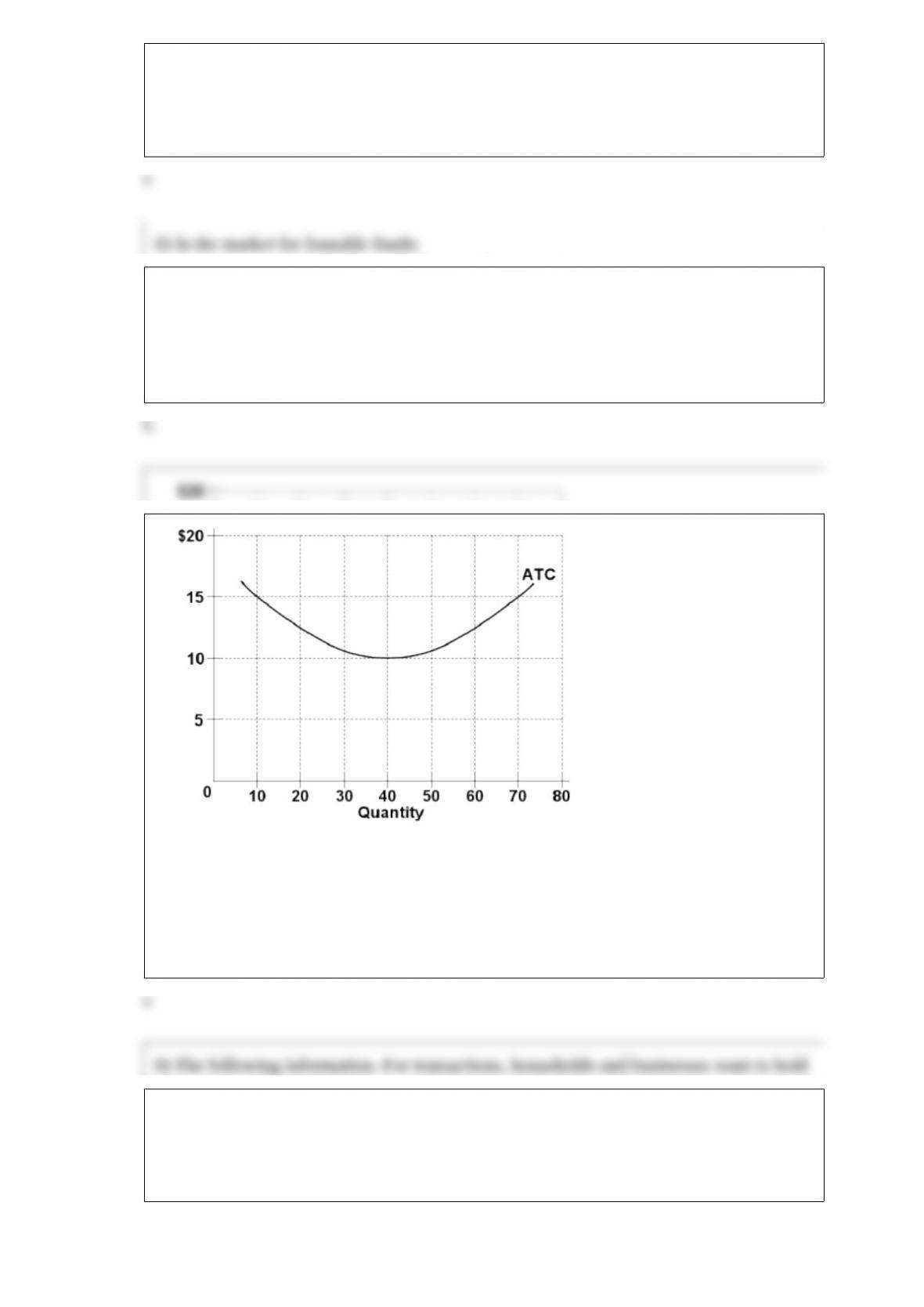
7)
refer to the above diagram showing the average total cost curve for a purely competitive
firm. at the long-run equilibrium level of output, this firm’s total cost:
a.is $10.
b.is $40.
c.is $400.
d.cannot be determined from the information provided.
8) The following information. For transactions, households and businesses want to hold
an amount of money equal to one half of nominal GDP. The table shows the amounts of
money they want to hold as an asset at various interest rates.
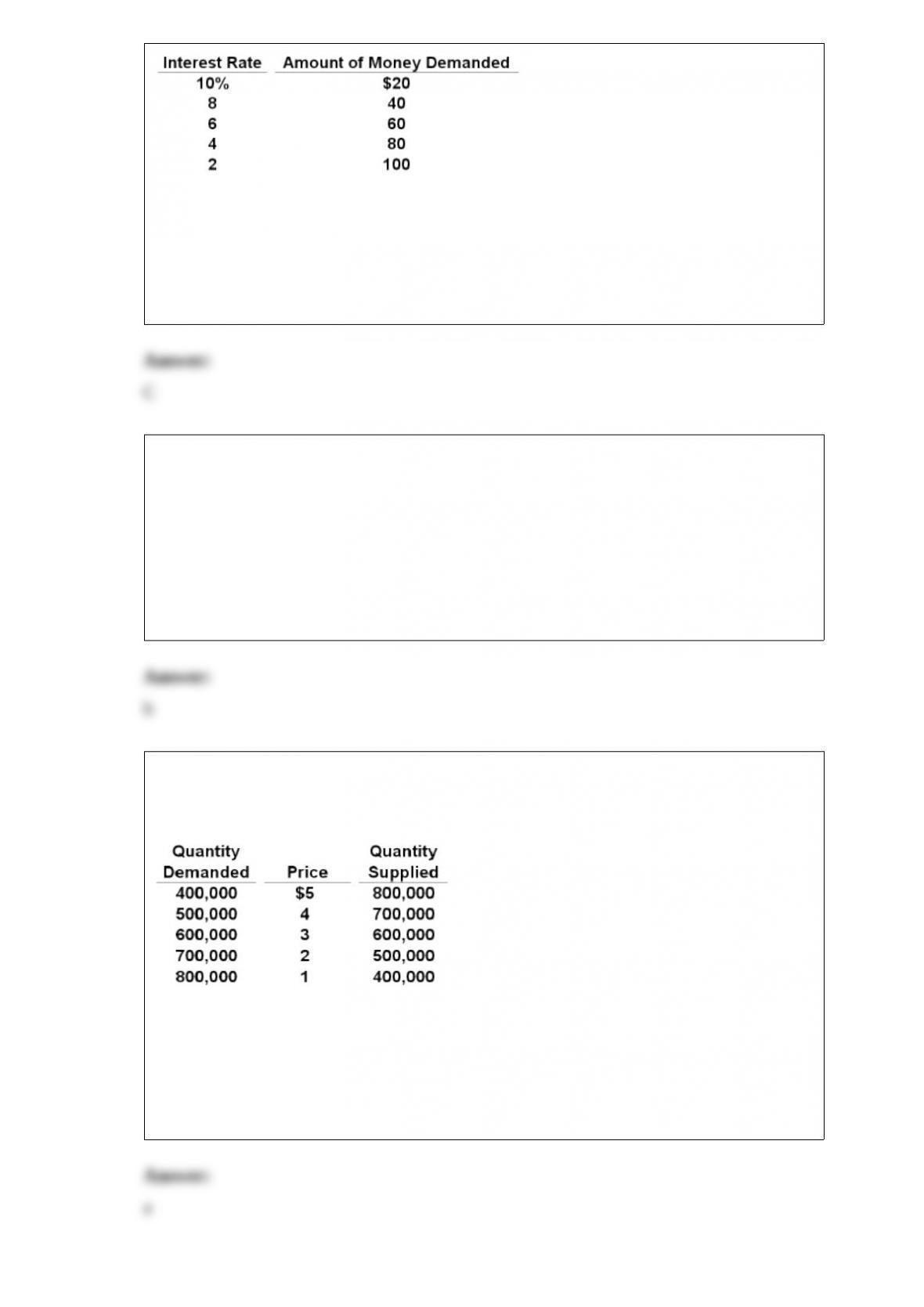
Refer to the above information. If nominal GDP is $300 and the supply of money is
$230, the equilibrium interest rate will be:
A.8 percent.
B.6 percent.
C.4 percent.
D.2 percent.
9) noncash gifts:
a.increase the utility of recipients by introducing them to products they have not
consumed before.
b.reduce recipient utility relative to a cash gift because noncash gifts often fail to match
recipient preferences.
c.entail as much utility as do cash gifts.
d.increase the utility of recipients because many people are uncertain of their own
preferences.
10) the following table applies to a purely competitive industry composed of 100
identical firms.
refer to the above table. if each of the 100 firms in the industry is maximizing its profit
and earning only a normal profit, each must have a total cost of:
a.$18,000.
b.$20,000.
c.$22,000.
d.$24,000.