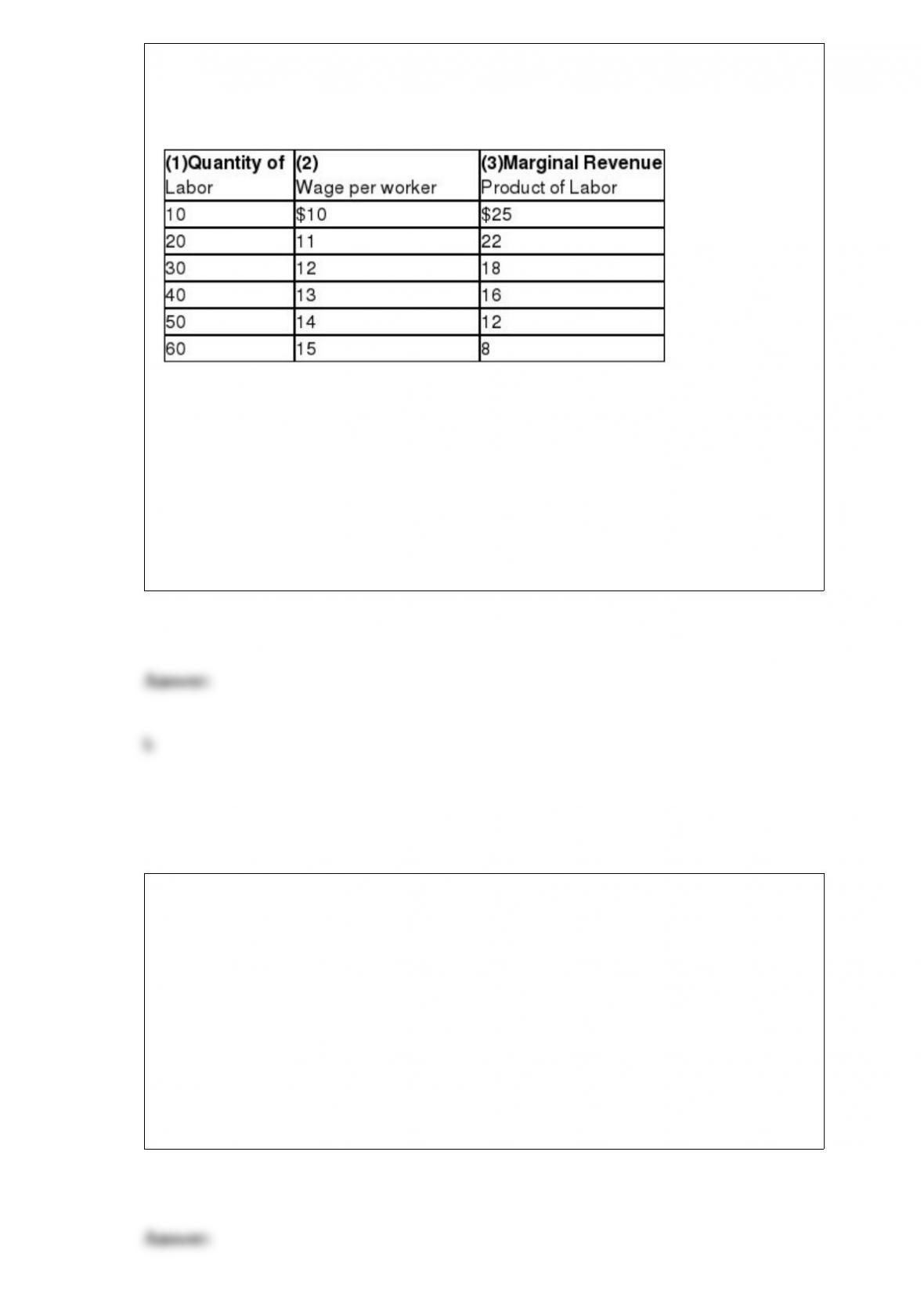
Refer to Exhibit 28-7. The marginal factor cost of increasing employment from 40 to 50
workers is
Exhibit 28-7
a. $120.
b. $18.
c. $14.
d. $160.
e. $15
Total costs are
a. fixed costs plus average total costs.
b. average fixed costs plus variable costs.
c. fixed costs plus variable costs.
d. fixed costs minus variable costs.
e. fixed costs divided by total variable costs.

Suppose that unit costs are the same at both 100 units of output and 150 units of output.
Unit costs are higher at output levels less than 100 units and at output levels greater
than 150 units. It follows that minimum efficient scale exists
a. somewhere between 100 and 150 units.
b. at 100 units.
c. at 150 units.
d. at less than 100 units.
e. at greater than 150 units.
Marginal revenue product is equal to marginal revenue multiplied by
a. average fixed cost.
b. marginal physical cost.
c. marginal physical revenue.
d. average total cost.
e. none of the above

A perfectly competitive market is initially in long-run competitive equilibrium. Each
firm in the market is earning zero economic profit. The owner of one firm decides to
discriminate against employees of race X by not hiring them, or by firing those
employees of race X who currently work for him. If employees of race X are
high-quality employees, and other firms hire them, then the owner of the discriminating
firm will soon find that his costs rise (above that of other firms) and he will begin
earning
a. below normal profits.
b. normal profits.
c. positive economic profits.
d. losses.
e. a and d
Antitrust law is legislation passed for the stated purpose of
a. reducing the profits of chain stores.
b. promoting U.S. banking practices in foreign countries.
c. controlling labor union practices in the states of New York, California, and Texas.
d. controlling monopoly power and preserving and promoting competition.
e. none of the above

A negative externality exists and government wants to impose a tax in order to bring
about an efficient outcome. To accomplish its objective, government must set the tax
equal to marginal
a. private cost.
b. social benefit.
c. external cost.
d. social cost.
e. external benefit.
The sum of consumers’ surplus and producers’ surplus is maximized at equilibrium.
a. True
b. False
Refer to Exhibit 23-9. Following an increase in market demand from D1 to D2, the
firm’s profits in the short run will
Exhibit 23-9
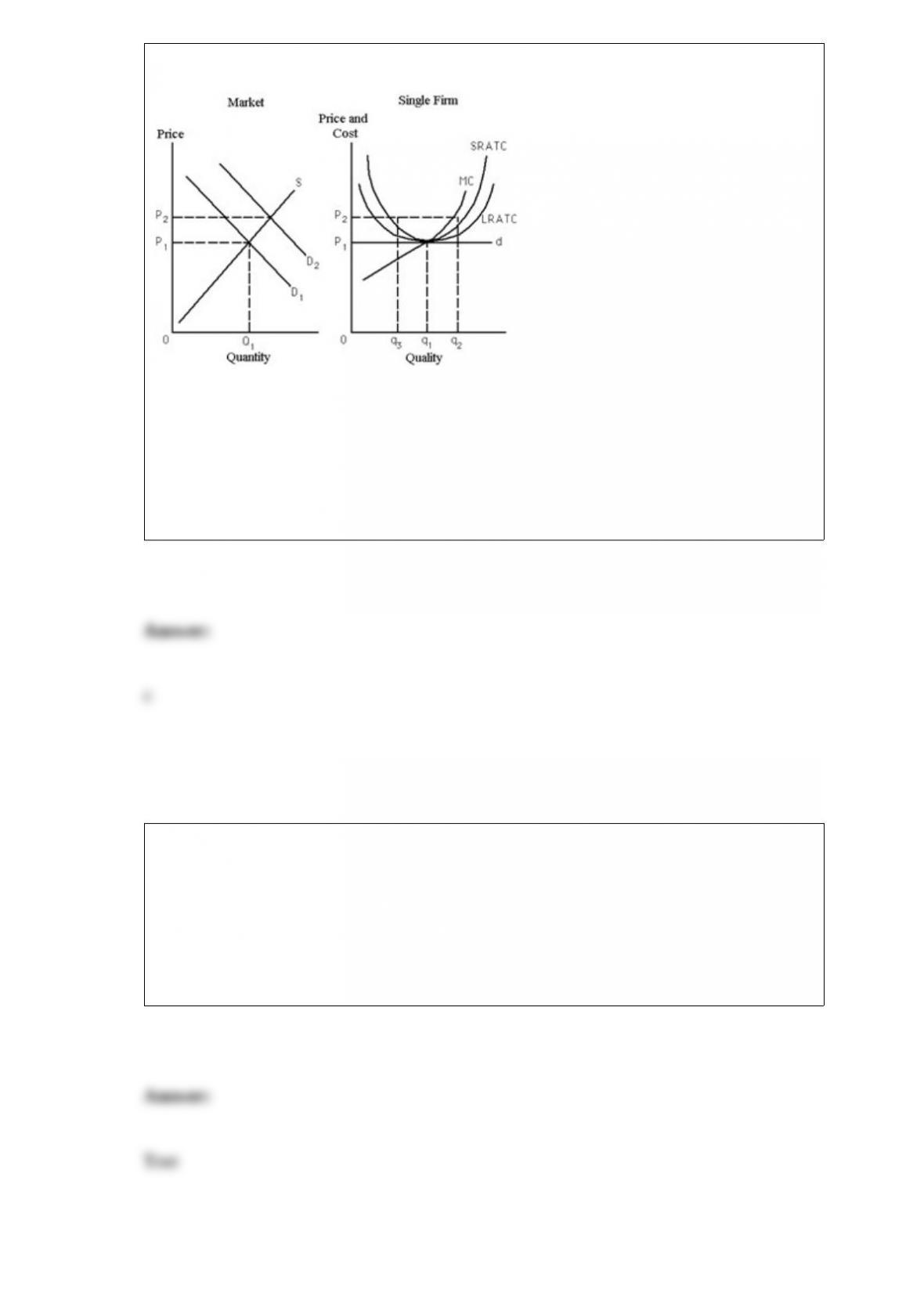
a. remain the same at P1 times q1.
b. remain the same at zero.
c. increase by less than (P2 – P1) times q2.
d. increase by (P2 – P1) times q3.
The Clayton Act of 1914 makes price discrimination, exclusive dealers, tying contracts,
and the acquisition of competing companies’ stock illegal when their effects
‘substantially lessen competition or tend to create a monopoly.”
a. True
b. False

If the marginal cost (MC) curve is rising and is above the average fixed cost (AFC)
curve, then
a. the AFC curve is rising.
b. the AFC curve is declining, although the MC curve has nothing to do with this.
c. the AFC curve is at its minimum point.
d. the AFC curve is at its maximum point.
e. Nothing certain can be said about the AFC curve without additional information.
A monopolistic competitive firm is a price taker, while an oligopolist is a price searcher.
a. True
b. False
Refer to Situation 22-l. What will Diane’s total costs be if she sells 2,500 donuts in her
first week and then goes out of business?
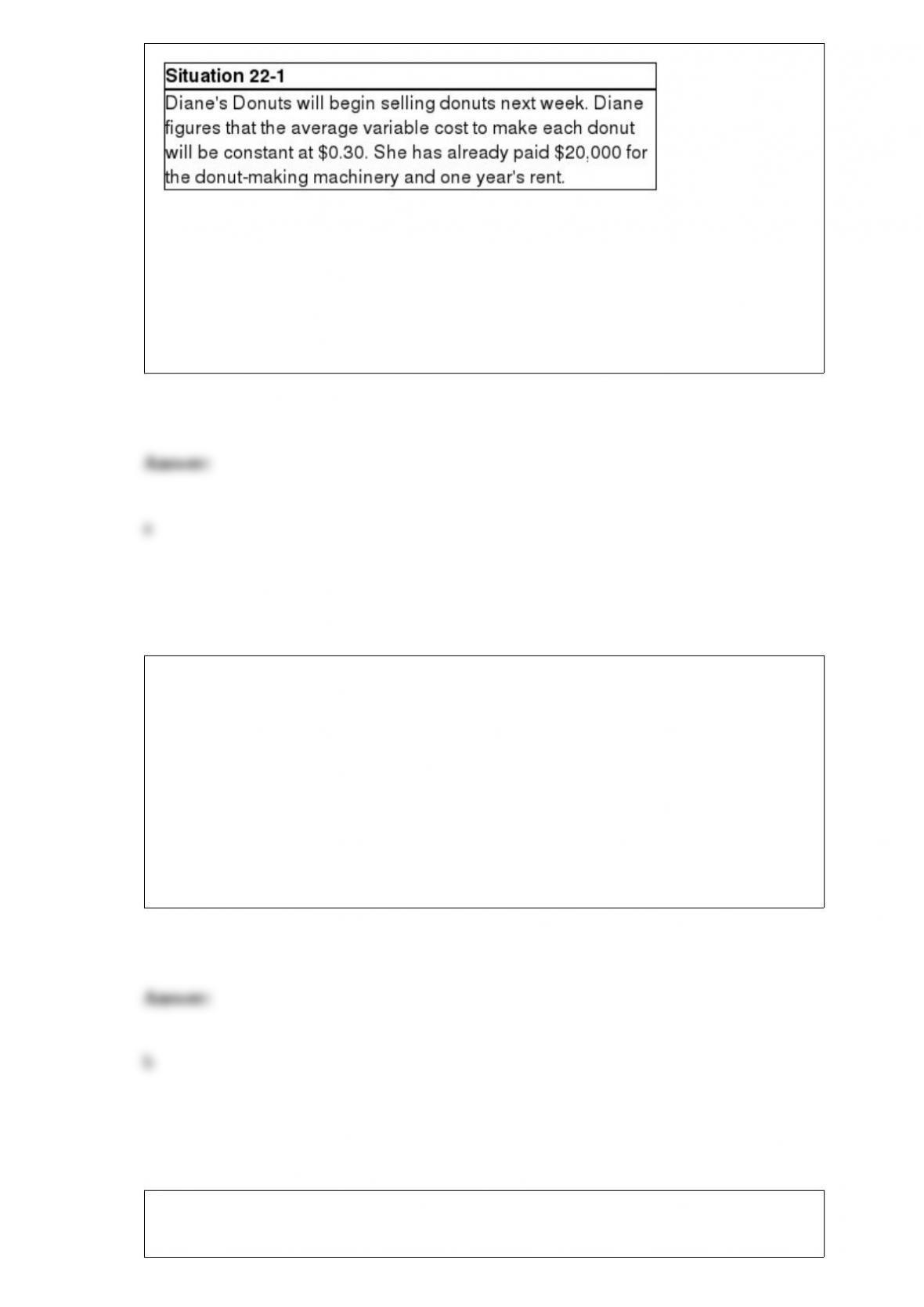
a. $20,750
b. $10,950
c. $20,880
d. $30,500
According to information in the textbook, in the early West, many of the open lands
were overgrazed. This was largely because
a. landowners charged ranchers a fee to graze their cattle.
b. the lands were unowned.
c. a government policy in effect at the time subsidized cattle production.
d. none of the above
To an economist, utility means:

a. additional.
b. usefulness.
c. satisfaction.
d. marginal.
Suppose that when the price of cigarettes decreases by 20 percent, the quantity
demanded increases by 10percent. The price elasticity of demand for cigarettes is
__________, making cigarettes an ____________ product (in this example).
a. 0.6; elastic
b. 1.7; inelastic
c. 0.5; inelastic
d. 1.7; elastic
e. 2.0; elastic
Refer to Exhibit 34-10.Who has the comparative advantage when it comes to cleaning
the house?

a. Danielle
b. Jason
c. neither Jason nor Danielle
d. both Danielle and Jason
Which of the following is a reason why wage rates differ?
a. In the short run, demand conditions are not the same in all labor markets.
b. Some jobs have special nonpecuniary aspects.
c. Labor is not homogeneous.
d. b and c
e. a, b, and c
If price elasticity of supply is greater than 1, it means that the percentage change in
quantity supplied is

a. less than the percentage change in price.
b. greater than the absolute change in price.
c. greater than the percentage change in price.
d. equal to the absolute change in price.
If income elasticity of demand for food is 1.55 it follows that
a. a 10 percent rise in the price of food lowers the quantity demanded of food by 15.5
percent.
b. if income rises by 10 percent, consumption of food rises by 15.5 percent.
c. if income rises by 10 percent, consumption of food falls by 15.5 percent.
d. a 1 percent rise in the price of food decreases the quantity demanded of food by 1.55
percent.
e. none of the above
The state of choosing not to acquire information because the costs of acquiring the
information are greater than the benefits is referred to as
a. logrolling.

b. rational ignorance.
c. market failure.
d. government failure.
The profit-maximizing perfectly competitive firm charges a price equal to __________
while the profit-maximizing monopolistic competitive firm charges a price
__________.
a. marginal revenue; equal to marginal cost
b. marginal cost; greater than marginal cost
c. marginal revenue; greater than marginal revenue
d. average fixed cost; greater than average total cost
e. b and c
Variables X and Y are independent of each other. If we plot X on the horizontal axis and
Y on the vertical axis, the line that connects combinations of X and Y in a two-variable
diagram is
a. parallel to the horizontal axis.
b. downward-sloping (left to right).

c. parallel to the vertical axis.
d. upward-sloping (left to right).
e. a or c
Special interest group Z receives a 1/200th slice of the economic pie.Its net benefit from
both an economic growth policy and a transfer policy is $30,000.How much does the
size of the economic pie (Real GDP) need to grow before group Z is indifferent
between the two policies?
a. $150
b. $600,000
c. $600,000,000
d. $6,000,000
e. none of the above
Refer to Situation 33-1.If the prospective criminal sets the following values:
Situation 33-1Suppose that the equation that represents the expected benefits of
burglary for a given prospective criminal is as follows:
EB = Ps x Loot
The criminal’s cost equation is as follows:

EC = [Pp x (I + F)] +AC
Where:
EB is the expected benefits of burglary
Ps is the probability of successfully burglarizing a house
Loot is the dollar take from the burglary
EC is the expected costs of burglary
Pp is the probability of imprisonment
I is the income the criminal gives up if caught and imprisoned
F is the dollar value the criminal puts on freedom
AC is the anguish cost of committing a burglary Ps = 50 percent
Loot = $30,000
Pp = 10 percent
I = $10,000
F = $25,000
AC = $5,000
The prospective criminal’s expected benefit from committing the burglary is
______________ and his expected cost of committing the burglary is
_______________.Economic theory tells us that under these circumstances, the
prospective criminal ______________ commit the burglary. a. $15,000; $8,500; will
b. $15,000; $8,500; will not
c. $15,000; $40,000; will not
d. $17,500; $12,000; will
As discussed in the textbook, describe some policy changes the government could make
in order to make it easier for people to buy houses.Using supply and demand analysis,
explain how these policy changes could indirectly lead to fewer people being able to
afford to purchase a home.
Describe one of the two reasons given in the textbook to help explain why price and
quantity demanded are inversely related.
Explain the difference between price elasticity of demand and the slope of a demand
curve.
Explain what an economist means when he says, “You don’t find any $10 bills on the
sidewalk.”
Compare and contrast the following market structures: oligopoly and monopolistic
competition.
Assume that there are only two countries in the world, the United States and Japan.
What creates the demand for and supply of Japanese yen on the foreign exchange
market?Name three different things that could cause the yen to appreciate in value.
Explain how nonrecourse loans operate and how they help to support crop prices.
How does price elasticity of demand vary along a straight-line downward-sloping
demand curve?Why does this occur?
Describe the average-marginal rule.Give a hypothetical numerical example that
illustrates the average-marginal rule.
Describe the condition under which a profit-maximizing monopolist will be resource
allocative efficient.