
A yellow dog contract is an agreement
a. by labor not to strike.
b. by employers not to participate in a lockout.
c. in which a worker agrees not to join a union.
d. to engage in pattern bargaining.
e. not to seek injunctions to prevent strikes and lockouts.
Measures taken to reduce inequality are likely to cause economic efficiency to
a. increase indefinitely at an increasing rate.
b. increase steadily.
c. increase significantly at first and then level off.
d. fall.
e. remain unchanged.
An appropriate way for government to intervene when external diseconomies exist in
an industry is to

a. shift the industry demand curve to the right by subsidizing consumers.
b. shift the industry supply curve to the left by taxing producers.
c. subsidize the industry to raise its profits.
d. encourage imports of the good to replace domestic production.
e. make the industry’s supply curve more nearly reflect the supply curve of a
competitive industry.
When an increase in the price of good A leads to a decrease in the price of good B, then
these goods are said to be
a. generic.
b. inferior.
c. abundant.
d. complements.
e. replacements.
A demand-estimating procedure in which a firm changes the price of its product to see
the effect on sales is the

a. interview approach.
b. price extrapolation procedure.
c. direct market experiment.
d. derived demand method.
e. open market method.
The corporate form of business has the major advantage of
a. less red tape.
b. no double taxation.
c. limited liability.
d. unlimited liability.
e. complete control.
The price system functions most effectively when
a. supply equals demand.
b. there is no divergence between private costs and social costs.
c. prices equal output.
d. external diseconomies equal external economies.
e. there is a complete absence of direct regulation.
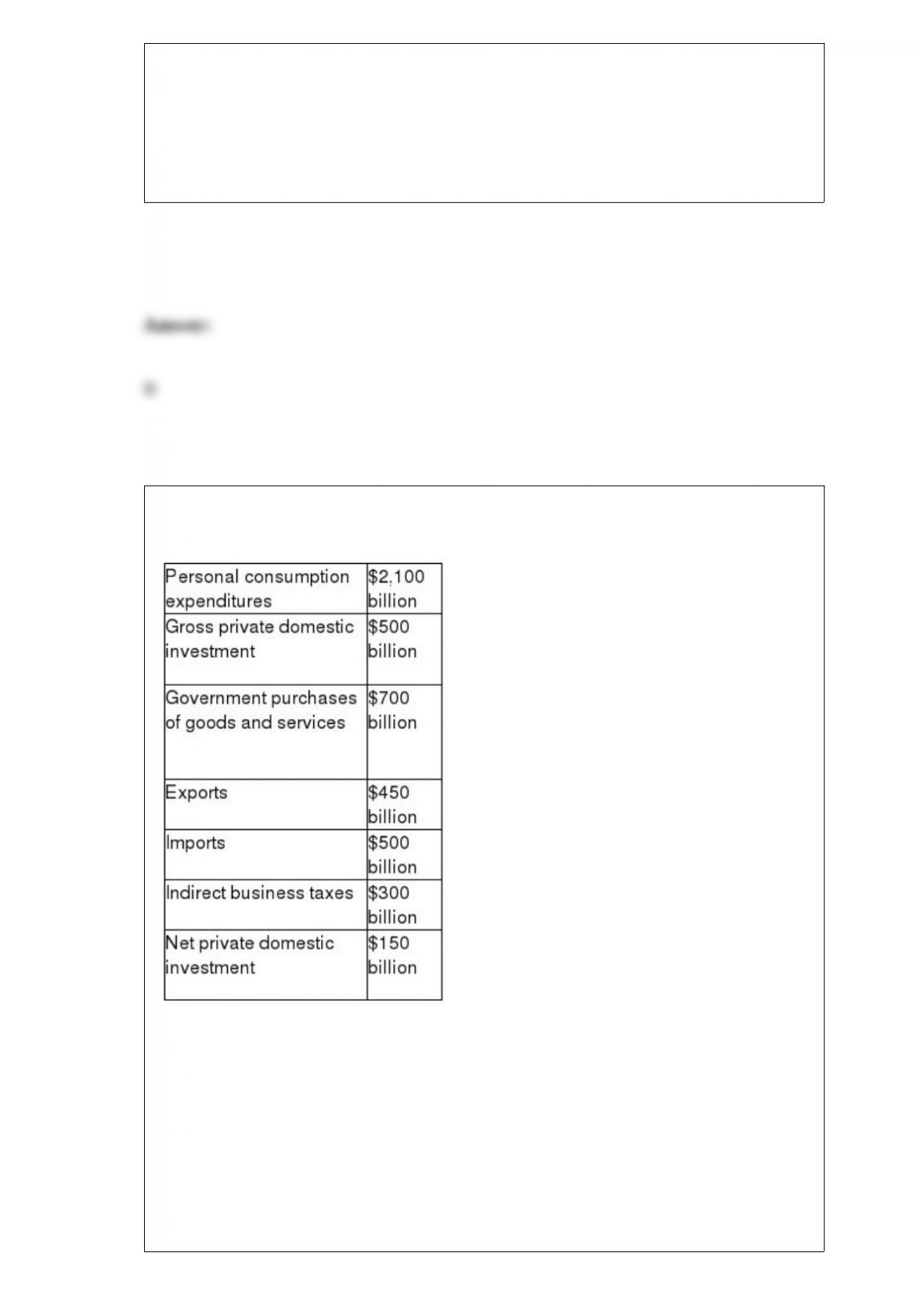
The following questions are based on the following information:
Depreciation equals ________ billion.
a. $50
b. $150
c. $350
d. $850

e. $1,350
The monetary base is defined as
a. total demand deposits.
b. total demand deposits minus free reserves.
c. bank reserves plus currency outside member banks.
d. the interest rate on federal funds.
e. M1.
The following questions are based on the following diagram:
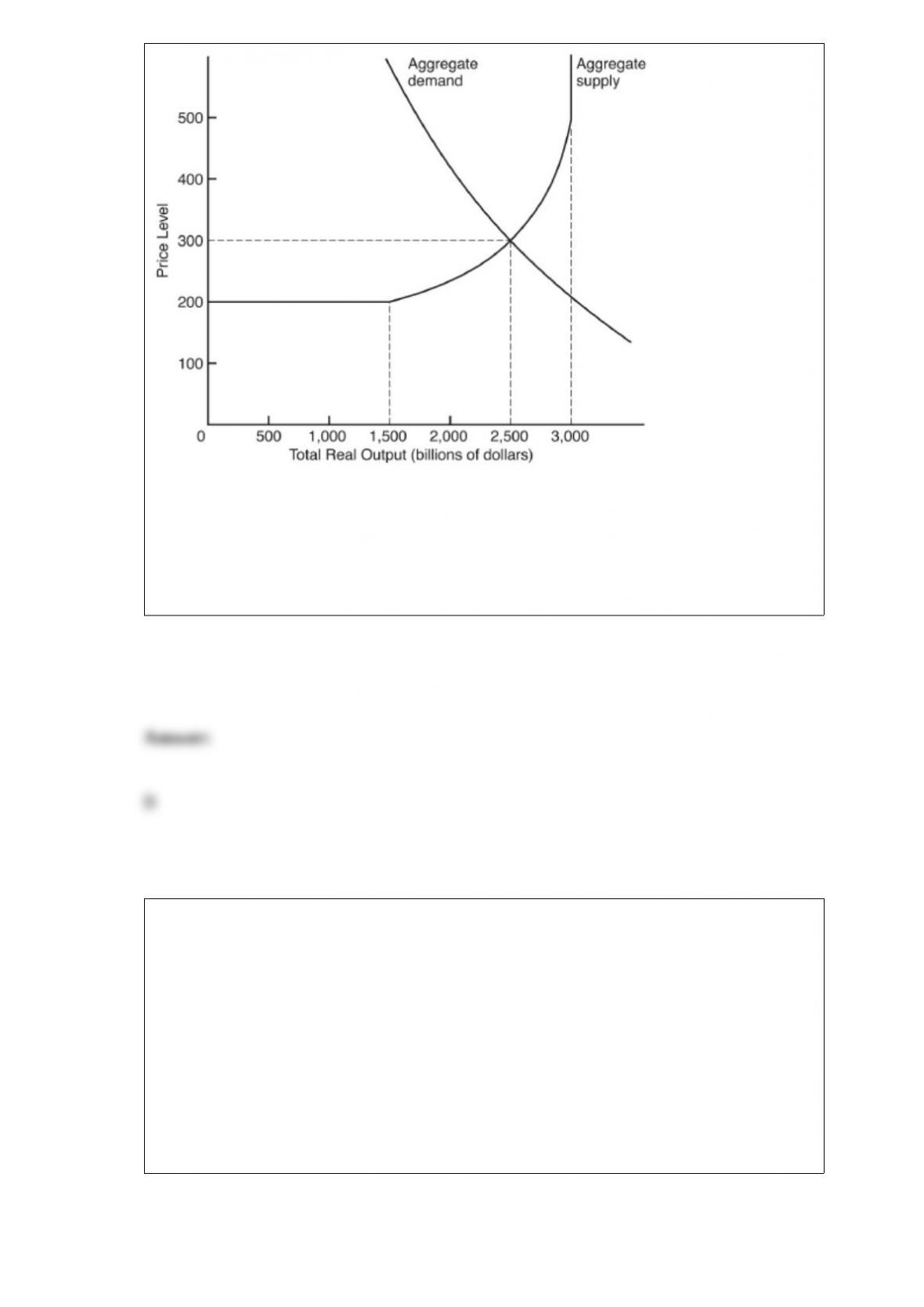
High levels of resource unemployment and excess capacity would imply a price level of
a. 100.
b. 200.
c. 300.
d. 400.
e. 500.
Automatic stabilizers
a. make sure that the government budget is balanced every year.
b. give Congress the complete authority for determining fiscal policy.
c. are under the control of the Council of Economic Advisers.
d. force Congress to expedite budget hearings during times of economic hardship.
e. come into play without the need for new legislation or administrative decisions.

Gross domestic product is a measure of the country’s
a. leisure.
b. price level.
c. quantity of money in circulation.
d. population.
e. output.
Over the last 45 years, the price level has
a. been cut in half.
b. remained constant.
c. doubled.
d. risen fivefold.
e. risen and fallen frequently.

The primary function of interest rates is to
a. determine the demand for labor.
b. allocate the supply of loanable funds.
c. compute the rate of profit.
d. serve as a price for fixed inputs such as land.
e. serve as a reward for uncompensated risk.
The demand for labor (and other inputs), not as ends in themselves but as means to
produce other things, is called ________ demand.
a. derived
b. aggregate
c. complementary
d. transactions
e. exogenous

In deciding on a policy, the Fed is faced with two difficult problems: the inability of
experts to agree on the best measure of the degree of tightness of monetary policy and
a. a lack of data on financial markets.
b. a need for approval from Congress and the president.
c. the long lag between an action taken by the Fed and its effect on the economy.
d. an inability to decide on a proper definition of the monetary base.
e. the lack of an adequate research staff.
Higher personal tax rates
a. cause the relationship between consumption expenditures and GDP to become flatter.
b. increase household disposable income.
c. change the amount people want to spend out of each after-tax dollar but leave the
spending percentage of pretax income unchanged.
d. cause equilibrium levels of GDP to rise.
e. are mandated by the Employment Act of 1946.
Inflation

a. depreciates money.
b. benefits lenders.
c. leaves income distribution unchanged.
d. penalizes speculators.
e. encourages the productive uses of savings.
The market supply curve for a perfectly competitive, constant cost industry is
a. identical with the supply curve of a perfectly competitive firm.
b. horizontal in the short run.
c. the numerical average of all the individual firms’ supply curves.
d. likely to become perfectly inelastic as the length of time covered by the curve grows.
e. the horizontal summation of the marginal cost curves for all firms above the
minimum average variable cost.
The following questions are based on the following graph illustrating the market for
scallops:
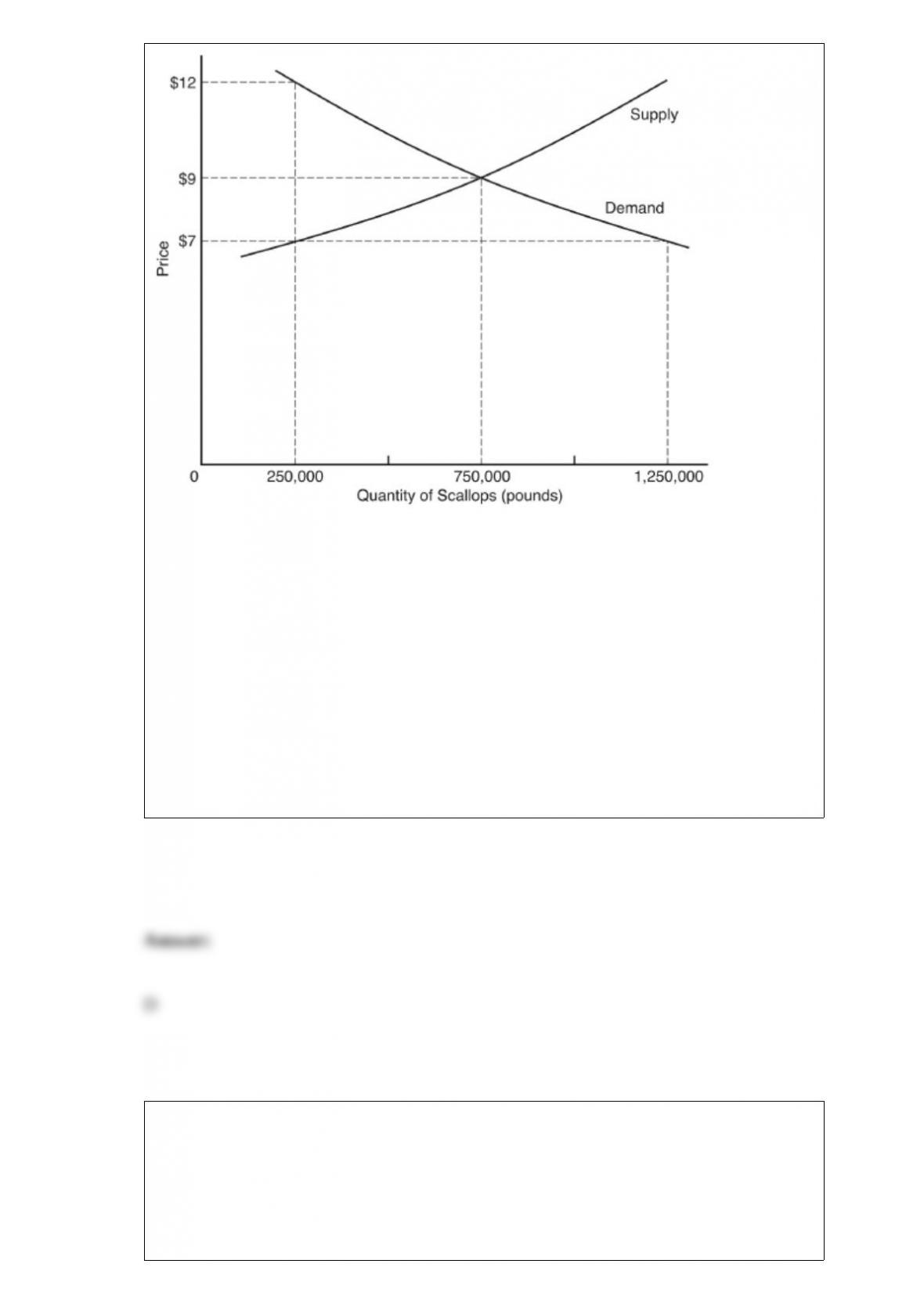
If the actual price for scallops is $7 per pound, there would be an excess demand of
________ pounds.
a. zero
b. 250,000
c. 750,000
d. 1,000,000
e. 1,250,000
Which of the following is excluded from GDP?
a. gasoline purchased for the family car
b. services performed by municipal law enforcement officials

c. the purchase of cloth by a homemaker to make draperies for the bedroom
d. steel sold to a refrigerator manufacturer
e. goods and services sold to foreigners
Opponents of policy activism argue that even if intended private spending is NOT
stable, economic stability nonetheless occurs because of
a. large government budget deficit spending.
b. the willingness of banks to hold excess reserves.
c. offsetting fluctuations in the velocity of circulation.
d. flexible wages and prices.
e. the acceleration effect.
The following questions are based on the following data for a monopolist:
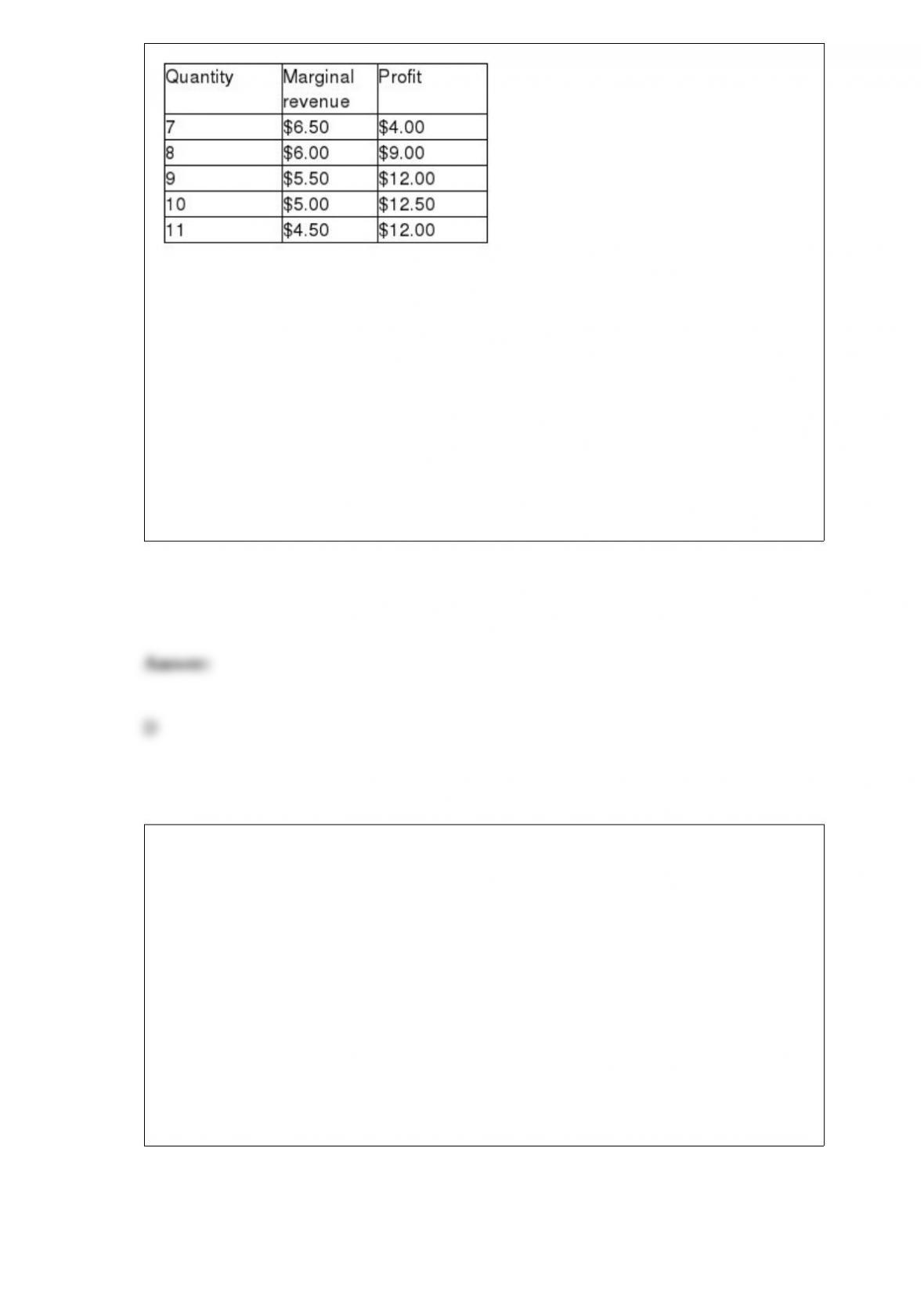
The profit-maximizing output rate is
a. 7.
b. 8.
c. 9.
d. 10.
e. 11.
When a central bank is required to provide enough information for markets and the
public to understand and evaluate what the monetary authorities are doing, the central
bank must have adopted a monetary policy framework known as
a. the cult of personality.
b. time inconsistency.
c. menu pricing.
d. functional finance.
e. inflation targeting.

Which of the following was NOTused by firms in the soft drink, automobile, and
newspaper industries shown in The Business Firm video as a way to reduce costs in a
competitive environment?
a. substituting inputs
b. producing their products in a foreign country
c. adopting new technology
d. achieving economies of scale
e. colluding with one another
The advantage of trade, both for individuals and countries
a. always nets out to zero.
b. disappears when one has an absolute advantage over the other.
c. is that trade permits specialization and specialization increases output.
d. is increased when tariffs are imposed.
e. can benefit only one party in the transaction.

Maquiladoras are
a. Mexicans who illegally cross the U.S. border in search of employment.
b. programs designed to encourage Mexican investment in the United States.
c. Mexican border factories where U.S.-made components are assembled for export
with reduced tariffs to the U.S. market.
d. Mexican agricultural cooperatives that produce food products for sale in the United
States.
e. Mexican truck drivers who, under the North American Free Trade Agreement, are
allowed to transport goods into the United States.
Increasing bank reserves would be an appropriate measure
a. during a recession.
b. to balance the government budget.
c. to contain strong inflationary pressures.
d. to promote an increased level of business borrowing.
e. to increase the M1 money supply.

An individual who smokes in a public place is an example of
a. public choice.
b. the ability-to-pay principle.
c. an external diseconomy.
d. nonselectivity.
e. a transfer payment.
If in the preceding question the multiplier is 3, the new level of GDP will be ________
billion.
a. $545
b. $515
c. $485
d. $470
e. $455
Over the past 50 years, the value of a U.S. dollar
a. has remained remarkably stable.
b. has steadily shrunk to less than one-sixth its previous value.
c. has gone up and down, finally declining to about one-half its former value.
d. declined steadily until the early 1980s, when it began to slowly rise again.
e. has risen steadily, hurting people on fixed incomes.
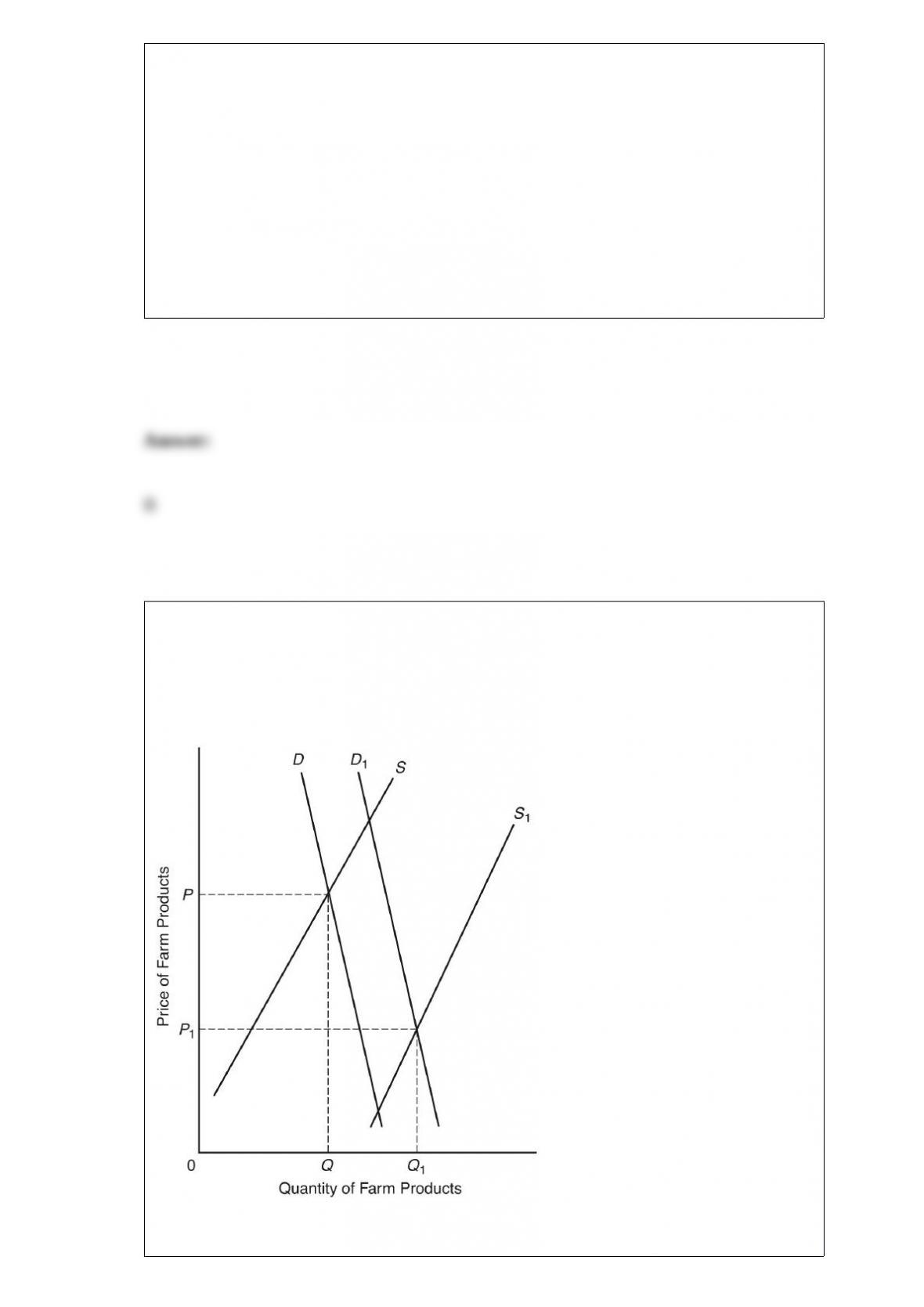
The following questions are based on the following graph. The curves D and S
represent the market demand and supply curves for farm products in 1960. The curves
D1 and S1 represent the market demand and supply curves for farm products in It is
supposed that there were no support programs in either year.
The relatively small shift of the demand curve over the 40 years can be attributed to the

fact that
a. the quantity of food demanded does not vary much with the price of food because
food is a necessity.
b. consumption of food per capita faces natural limits and hence responds by only a
small amount to changes in per capita income.
c. farmers have only limited control over their outputs.
d. there has been rapid technological change in agriculture.
e. poor climatological conditions led to decreasing harvests.
Experience with public regulation of monopolies indicates that
a. on the average, regulated prices are clearly lower than unregulated prices of the same
item.
b. regulation provides a stronger set of incentives than competitive markets for firms to
increase efficiency.
c. a decision to base a fair rate of return on either historical cost or replacement cost
yields the same pricing result.
d. most public utility regulation should be in the hands of federal rather than state
commissions.
e. if a firm is guaranteed a fixed amount of profit, it will be less efficient than if its
profits depend on how efficiently it operates.

Employers are more likely to accept union demands when
a. income, employment, output, and sales levels are high.
b. there is significant competition from foreign firms.
c. they have the strength to ride out a strike.
d. the economy is in a recession.
e. unions face significant competition from nonunionized workers.