1) Research involving industrially advanced countries suggests that:
A.the more independent the central bank, the lower the average annual growth of real
GDP.
B.the more independent the central bank, the higher the average annual growth of real
GDP.
C.there is no relationship between the degree of independence of a country’s central
bank and the growth rate of its real GDP.
D.the less independent the central bank, the higher the average annual rate of inflation.
2)
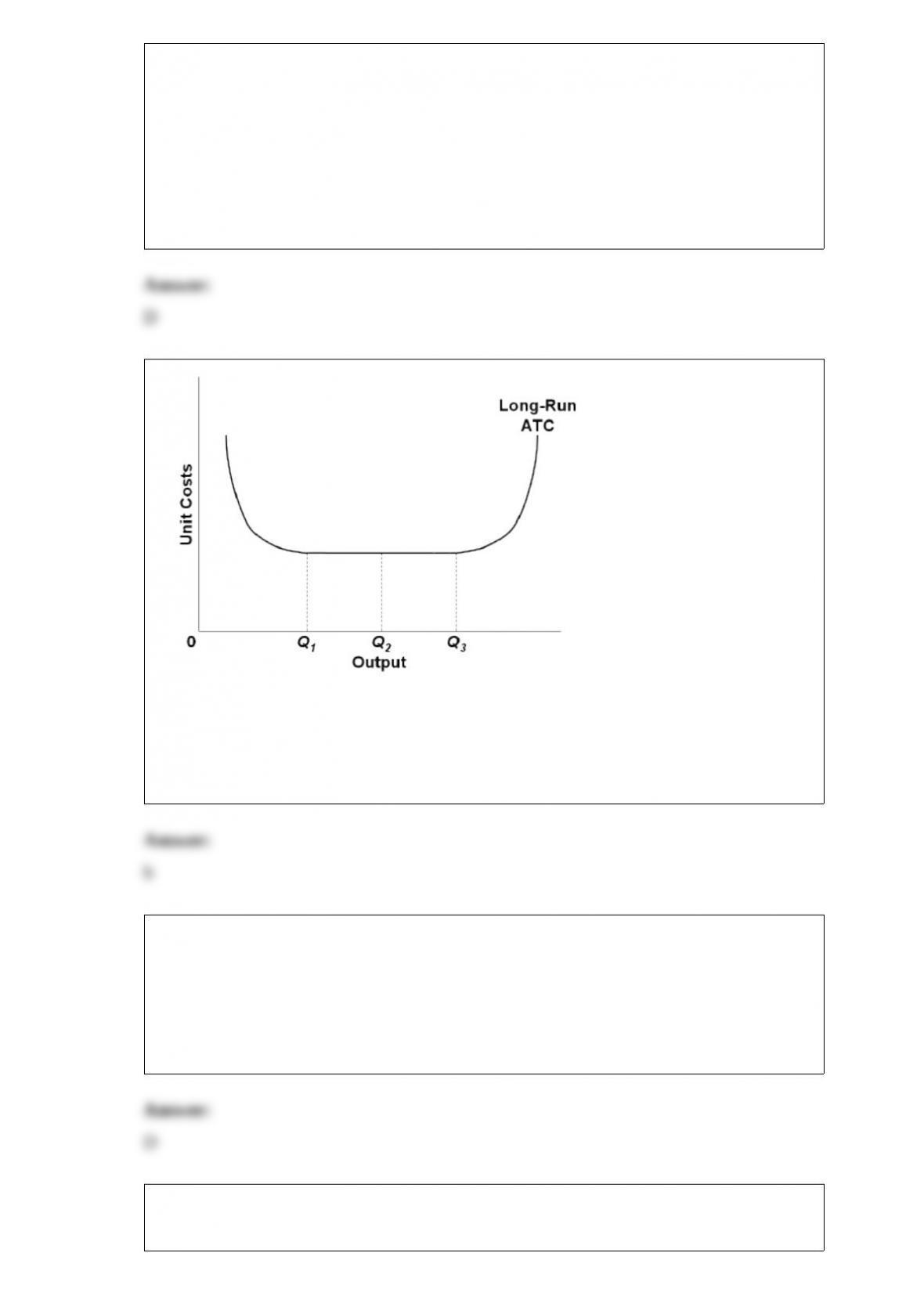
refer to the above diagram. economies of scale:
a.are evident over the entire range of output.
b.occur over the 0q1 range of output.
c.begin at output q3.
d.occur only over the q1q3 range of output.
3) Firm ABC designs and implements a lower-cost method of producing its product.
This is an example of:
A.product innovation.
B.the inverted U-theory.
C.economies of scale.
D.process innovation.
4) In building the aggregate expenditures model, Keynes believed that:
A.economies are normally at full employment and thus frequently susceptible to bouts

of inflation.
B.government intervention into the economy is the primary cause of business cycle
fluctuations.
C.changes in aggregate expenditures are unable to affect the level of real output in the
economy.
D.massive unemployment of labor and capital created conditions where sudden demand
changes are unlikely to change prices.
5) in the short run a pure monopolist’s profit:
a.will be maximized where price equals average total cost.
b.may be positive, zero, or negative.
c.are always positive.
d.will be zero.
6) Marginal product is:
A.the output of the least skilled worker.
B.a worker’s output multiplied by the price at which each unit can be sold.
C.the amount an additional worker adds to the firm’s total output.
D.the amount any given worker contributes to the firm’s total revenue.
7) an increase in the excise tax on cigarettes raises the price of cigarettes by shifting
the:
a.demand curve for cigarettes rightward.
b.demand curve for cigarettes leftward.
c.supply curve for cigarettes rightward.
d.supply curve for cigarettes leftward.
8) total utility may be determined by:
a.multiplying the marginal utility of the last unit consumed by the number of units
consumed.
b.summing the marginal utilities of each unit consumed.
c.multiplying the marginal utility of the last unit consumed by product price.
d.multiplying the marginal utility of the first unit consumed by the number of units
consumed.
9) Using income as the tax base, which of the following best illustrates a regressive tax?
A.the Federal inheritance tax
B.a 7 percent general sales tax
C.the corporate income tax
D.the personal income tax
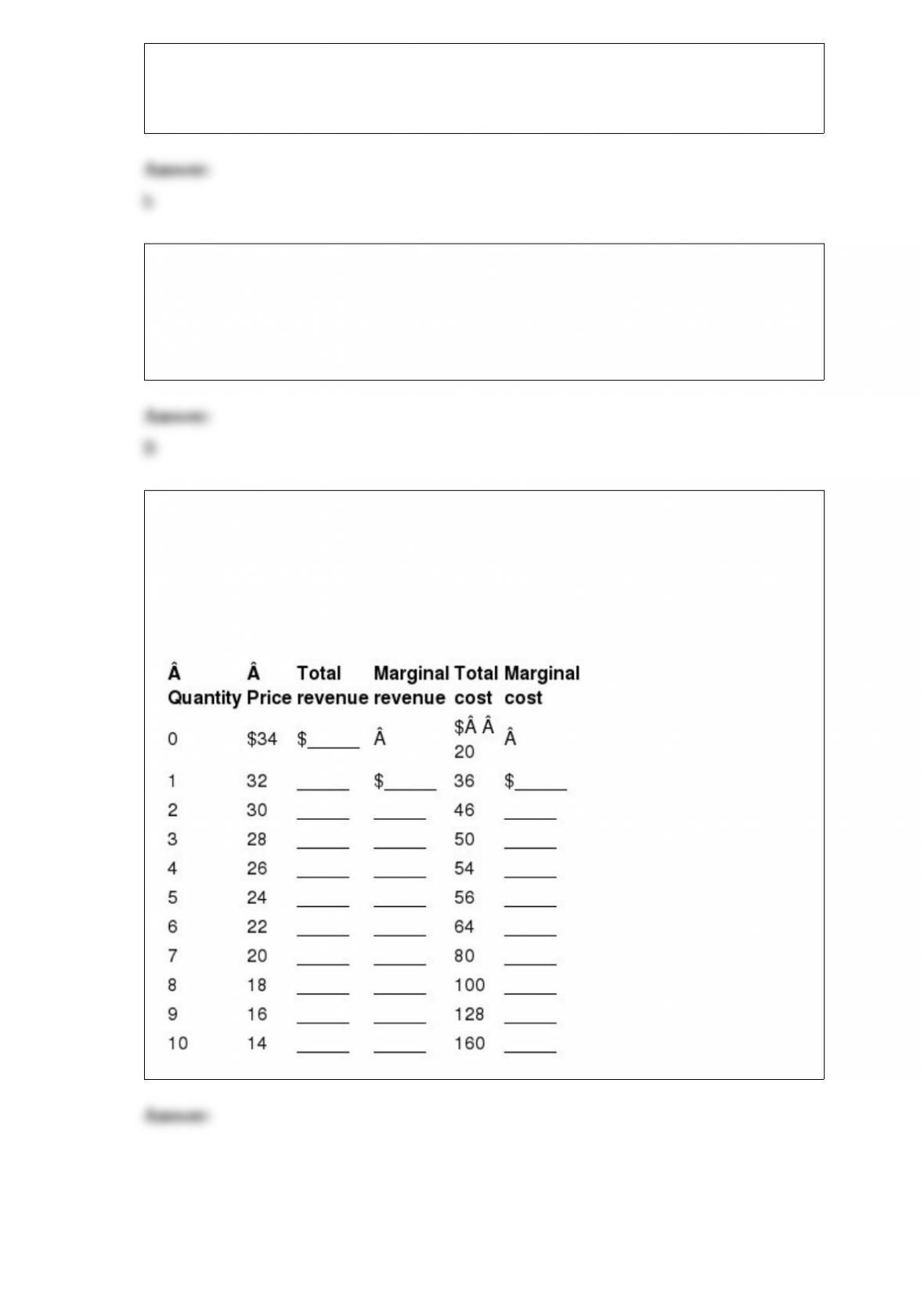
10) In the following table are demand and cost data for a pure monopolist. Complete
the table by filling in the columns for total revenue, marginal revenue, and marginal
cost. Answer these three questions: (a) What output will the monopolist produce? (b)
What price will the monopolist charge? (c) What total profit will the monopolist receive
at the profit-maximizing level of output?
11) (consider this) the nuclear particle accelerators now used for cancer treatments:
a.considerably less expensive than more traditional cancer treatments on a per patient
basis.
b.considerably more expensive than more traditional cancer treatments on a per patient
basis.
c.an example of a cost-saving medical technology.
d.an example of the benefits of government tax subsidies for medical research.
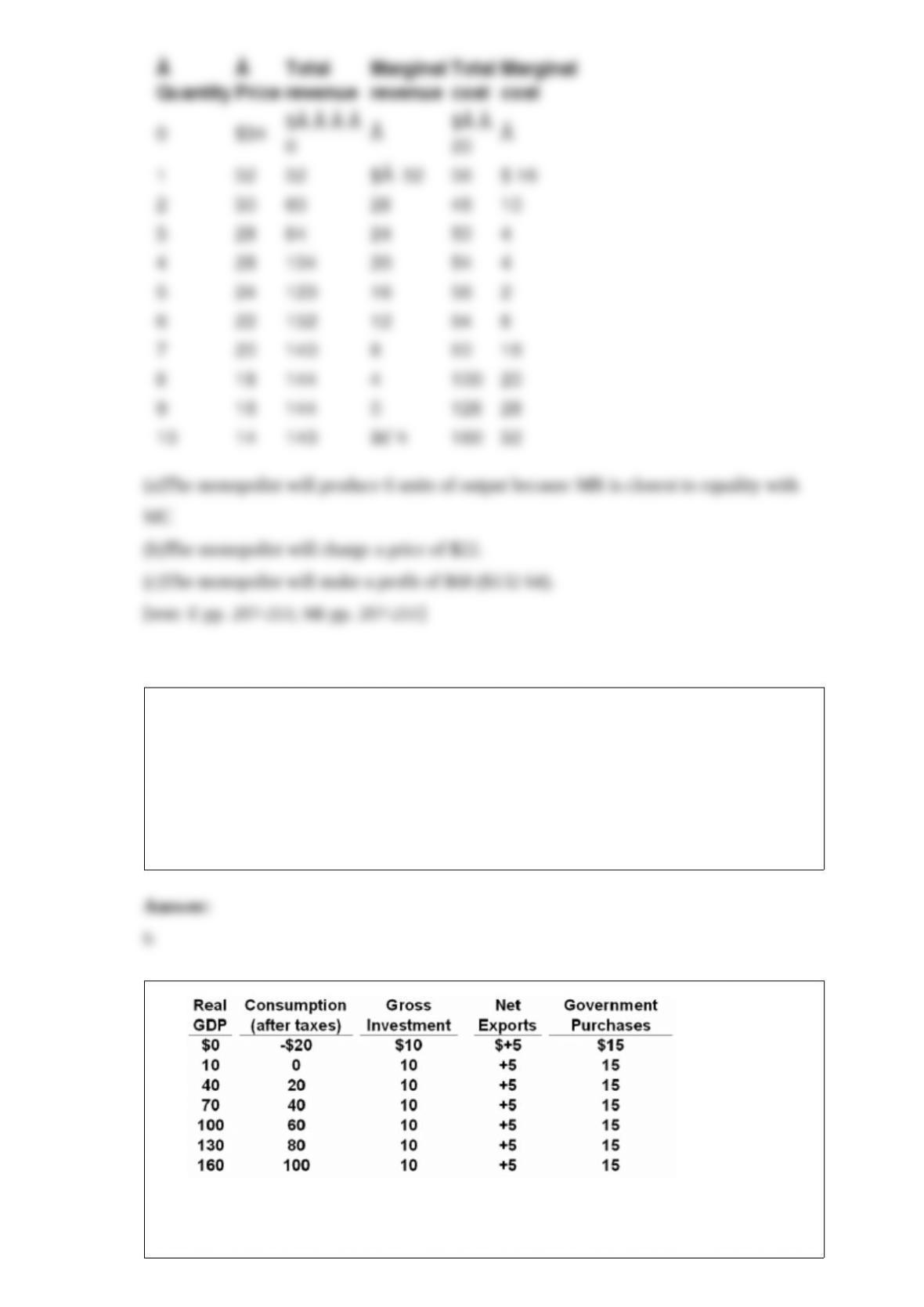
12)
Refer to the above table. The economy shown is a:
A.private economy.

B.private open economy.
C.mixed closed economy.
D.mixed open economy.