
Article Summary. Seeking ways to improve education, Garrett Johnson has
organized technology competitions called hackathons where participants such as
students, teachers, and engineers build applications designed to improve
secondary and higher education systems. These applications can include ways for
teachers to improve skills, more productive study habits for students, improving
school safety, or any number of ideas related to education. Several hackathons
have been planned for around the country, including a virtual hackathon, entry is
free, and each contest will award $5,000 in prizes to the winners.
Source: Nancy Dahlberg, “Hackathon tackling education reform this week,”
Miami Herald, October 7, 2013.
The article addresses education reform by way of newly designed applications. If any of
these apps lead to a more skilled and better trained public, the economy would
experience
A) an increase in human capital.
B) an increase in the supply of labor.
C) an increase in comparable worth.
D) a decrease in compensating differentials.
Consider this quote from an article in the Wall Street Journal: “The stock of educated
workers isn’t increasing fast enough to keep up with rising demand. ……. Employers are
paying the typical four-year college graduate [without graduate school] 75% more than
they pay high-school grads. Twenty-five years ago, they were paying 40% more.
Employers insist on ever better-educated, skilled workers. “
Source: David Wessel, “Lack of Well-Educated Workers Has Lots of Roots, No
Quick Fix”, Wall Street Journal, April 19, 2007, Page A2. Which of the following
best explains the rapid increase in the wage differential between college graduates and
high school graduates?
A) The demand for college educated workers shifted to the right while the supply of
college educated workers shifted to the left.
B) The supply of high-school educated workers shifted to the right faster than the
demand for college educated workers shifted to the right.
C) The demand for college educated workers shifted to the right faster than the supply
of college educated workers shifted to the right.

D) The demand for high-school educated workers shifted to the left faster than the
supply of college educated workers shifted to the right.
Table 8-19
Given the information above, calculate the GDP deflator in 2012.
A) 87
B) 95
C) 105
D) 114

Figure 4-4 Figure 4-4 shows the market for tiger
shrimp. The market is initially in equilibrium at a price of $15 and a quantity of 80.
Now suppose producers decide to cut output to 40in order to raise the price to $18.
What is the value of consumer surplus at the equilibrium price of $15?
A) $60
B) $120
C) $180
D) $240
The Danish currency, the krone, is pegged to the euro at a rate of 7.43 kroner (kroner is
the plural of krone) to the euro. At the pegged exchange rate, how many euros would be
exchanged for one krone?
A) 0.135
B) 1.00
C) 2.48
D) 7.43

Jeremy is thinking of starting up a small business selling NASCAR memorabilia. He is
considering setting up his business as a corporation. What is one advantage to Jeremy
of setting up his business as a corporation?
A) By setting up the business as a corporation, Jeremy would not face double taxation.
B) By setting up the business as a corporation, Jeremy would have the ability to share
risk with shareholders.
C) By setting up the business as a corporation, Jeremy would have both ownership and
control over the business.
D) All of the above would be advantages of setting up his business as a corporation.
If the government purchases multiplier equals 2, and real GDP is $14 trillion with
potential real GDP $14.5 trillion, then government purchases would need to increase by
________ to restore the economy to potential real GDP.
A) $7.25 trillion
B) $1 trillion
C) $500 billion
D) $250 billion

Which of the following would be considered an active fiscal policy?
A) The Fed increases the money supply.
B) Tax incentives are offered to encourage the purchase of fuel efficient cars.
C) Spending on the war in Afghanistan is increased to promote homeland security.
D) A tax cut is designed to stimulate spending passed during a recession.
Personal income is defined as
A) national income less retained earnings plus transfer payments and plus interest on
government bonds.
B) national income plus retained earnings less transfer payments and less interest on
government bonds.
C) national income less depreciation.
D) national income less personal taxes.
The small group of East Asian countries that experienced high rates of growth in the
1980s and 1990s are referred to as
A) newly industrializing countries.
B) countries with low standards of living.
C) education-deprived countries.
D) industrial countries.
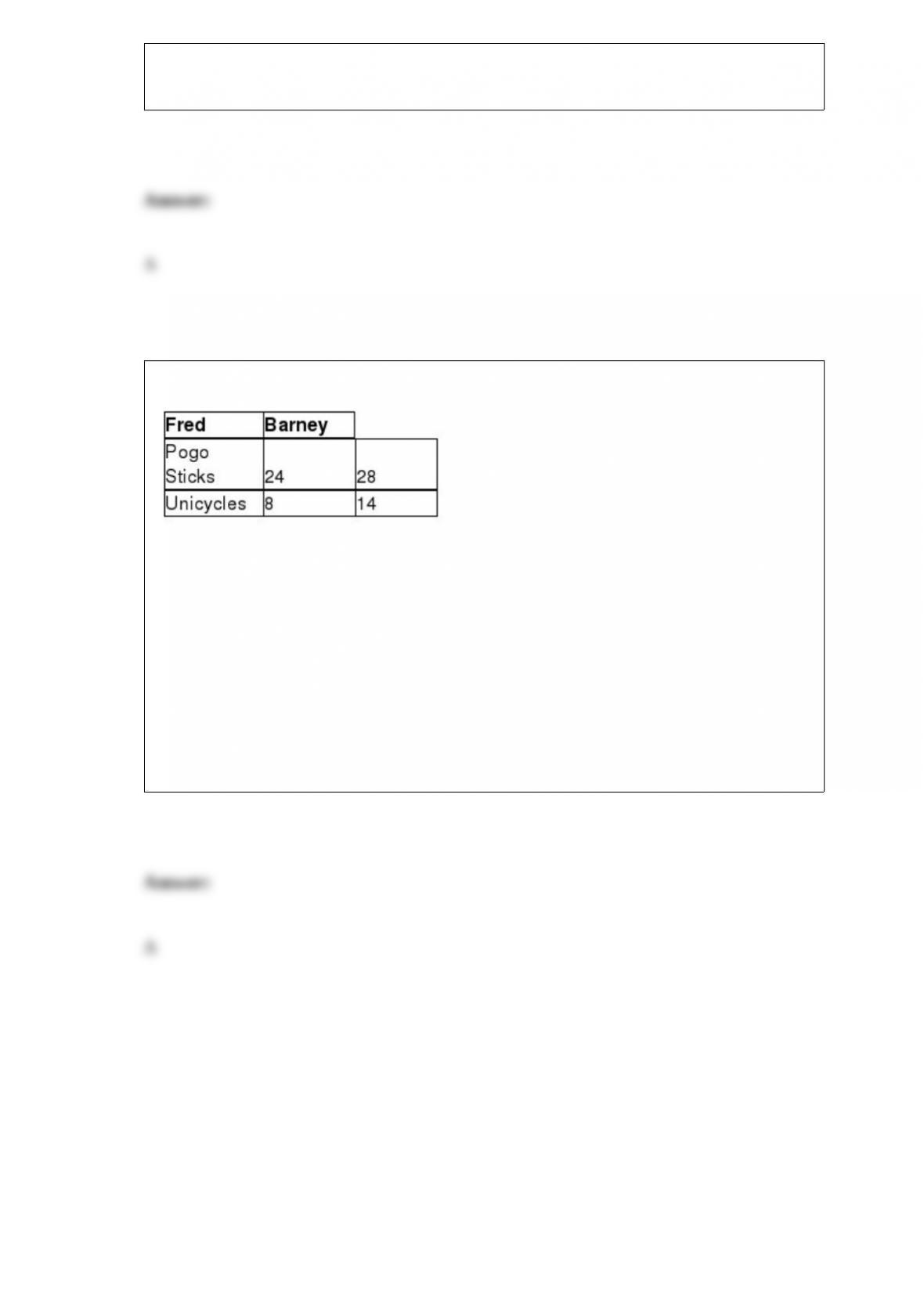
Table 2-7
Table 2-7 shows the output per month of two people, Fred and Barney. They can either
devote their time to making pogo sticks or making unicycles. What is Fred’s
opportunity cost of making a pogo stick?
A) 1/3 unicycle
B) 3 unicycles
C) 6/7 pogo stick
D) 1/2 unicycle

Figure 2-17 One segment of the circular flow
diagram in the figure shows the flow of goods and services from market C to economic
agents A. What is market C and who are economic agents A?
A) C = factor markets; A = households
B) C = product markets; A = households
C) C = factor markets; A = firms
D) C= product markets; A = firms
In October 2008, Congress passed the ________, under which the Treasury provided
funds to banks in exchange for stock.
A) Bank Rescue Alliance Treaty (BRAT)
B) Mortgage Transfer Agency (MTA)
C) Troubled Asset Relief Program (TARP)
D) Financial Assurance Association (FAA)

If a good has a negative income elasticity of demand, this indicates that the good is
A) a substitute with another good.
B) a complement with another good.
C) inferior.
D) normal.
A recession tends to cause the federal budget deficit to ________ because tax revenues
________ and government spending on transfer payments ________.
A) increase; rise; falls
B) increase; fall; rises
C) decrease; rise; falls
D) decrease; fall; rises