1) A “national bank holiday” that closed all banks for a week and resulted in Federal
deposit insurance occurred in the United States in:
A.1903, following the “Louisiana stampede.”
B.1987, following the collapse of numerous savings and loan associations.
C.1945, following the end of the Second World War.
D.1933, following the bank panics of 1930-1933.
2) When economists view technological change as internal to the economy, they mean
that it:
A.occurs randomly.
B.occurs accidentally.
C.arises deliberately from the profit motive and competition.
D.arises mainly from government subsidies.
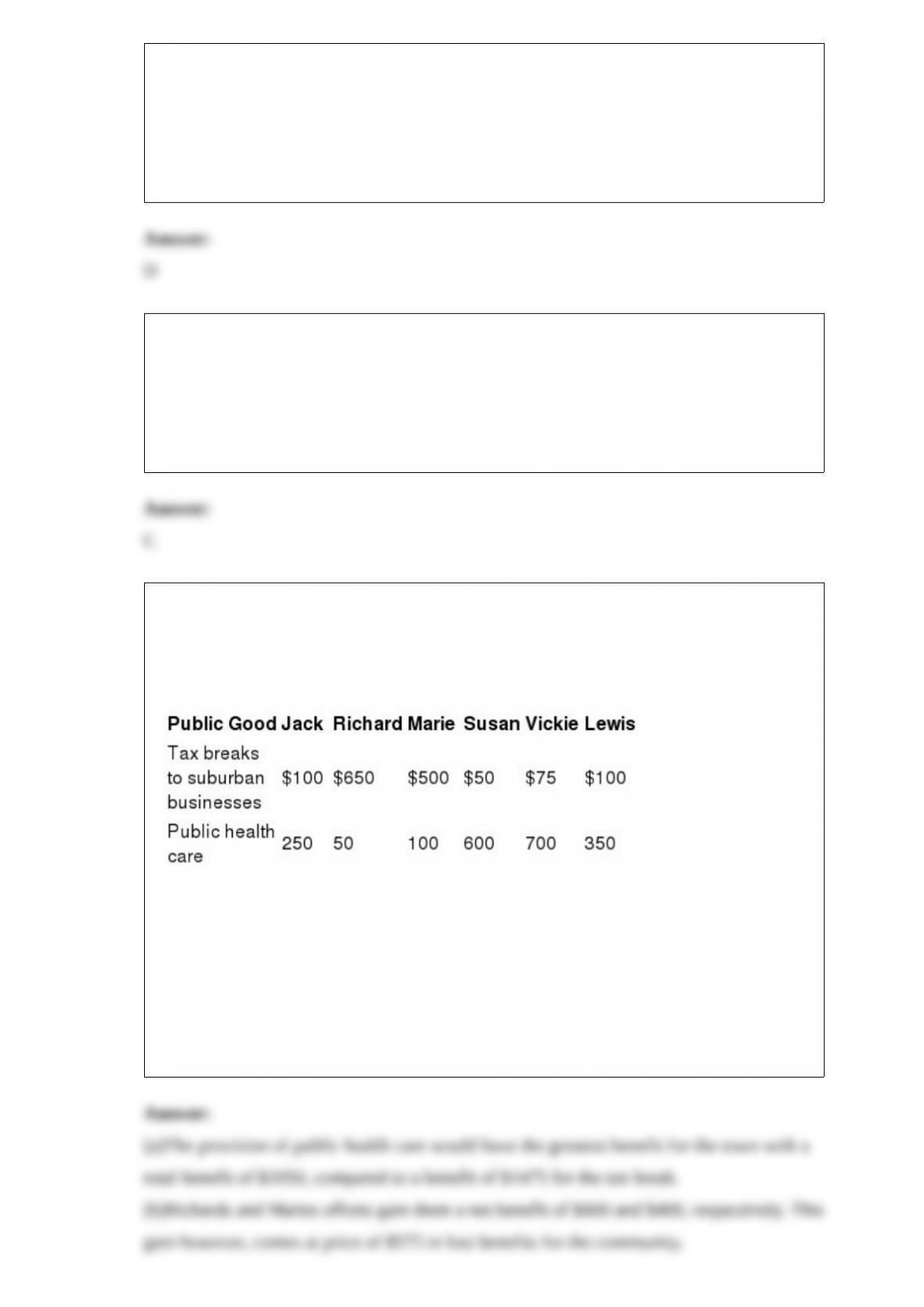
3) Suppose a town is considering either providing a tax break to suburban businesses in
the city or to provide public health care in an effort to promote growth in the city.
Assume there are 5 people living in the city: Jack, Richard, Marie, Susan, and Lewis.
Their willingness to pay for the policies is summarized in the table below.
(a)Which policy would have the greatest gain for the towns citizens?
(b)Suppose that Richard and Marie, the two businesspersons of the town, have been
closely following this debate and decide to lobby for the tax break, as they stand to
make significant gains from the policy. To further cement their effort, they make
contributions to key city council persons campaign funds and in the end, they are able
to get the tax breaks passed. What effect does this have on the total benefit for Richard
and Marie? For the community as a whole?
(c)What type of government failure does this example illustrate?

4) The current system of exchange rates can best be described as:
A.freely fluctuating exchange rates.
B.managed floating exchange rates.
C.rigidly fixed exchange rates.
D.an adjustable peg system.
5) proponents of economic growth say that pollution:
a.is an inevitable by-product of growth.
b.occurs, not because of growth, but because common properties are treated as free
goods.
c.declines as a country moves from agriculture to industry.
d.is detrimental to economic growth.
6) The Food for Peace program is designed to:
A.achieve 100 percent price parity for all farm products.
B.discover new uses for farm products through research and development.
C.take agricultural land out of the production of feed grains.
D.facilitate the distribution of U.S. farm products in the developing countries.
7) if products a and b are complements and the price of b decreases the:
a.demand curves for both a and b will shift to the left.
b.amount of b purchased will increase, but the demand curve for a will not shift.

c.demand for a will increase and the amount of b demanded will increase.
d.demand for a will decline and the demand for b will increase.
8) the invisible hand promotes society’s interests because:
a.individuals pursuing their self-interest will try to produce goods and services that
people in society want and are willing to purchase.
b.individuals will produce goods for others out of concern for their fellow human
beings.
c.it makes sure that everyone wins from competition in the market.
d.government regulation pushes business into producing the right mix of goods and
services.
9) any point inside the production possibilities curve indicates:
a.the presence of technological change.
b.that resources are imperfectly substitutable among alternative uses.
c.the presence of inflationary pressures.
d.that more output could be produced with available resources.
10) (Last Word) According to economists Ayres and Levitt, owners of car that have
traditional automobile alarms:
A.may impose costs on owners of unalarmed cars whose cars become greater targets for
thieves.
B.create spillover benefits for owners of unalarmed cars.
C.cause widespread negative externalities in the form of the noise pollution that results
from false alarms.
D.create a moral hazard problem because they tend to park their cars in riskier locations
than they would otherwise.
11) structural unemployment:
a.is also known as frictional unemployment.
b.is the main component of cyclical unemployment.
c.is said to occur when people are waiting to be called back to previous jobs.
d.may involve a locational mismatch between unemployed workers and job openings.

12) Refer to the above diagram. Assume that nominal wages initially are set on the
basis of the price level P2 and that the economy initially is operating at its
full-employment level of output Qf. In the long run, demand-pull inflation could best be
shown as:
A.a move from b to c on AS2.
B.a move from b to f to d.
C.a change of aggregate supply from AS2 to AS1.
D.a move from b to d.
13) Suppose in some economy there are 100 million workers; 8 million of those
workers work in retail trade, and 2 million of the retail workers belong to unions. Total
union membership in this economy is 30 million. The rate of unionization in the
economy is:
A.30 percent and the rate of unionization in retail trade in 20 percent.
B.8 percent and the rate of unionization in retail trade is 2 percent.
C.30 percent and rate of unionization in retail trade is 25 percent.
D.20 percent and rate of unionization in retail trade is 25 percent.
14) transfer payments differ from government purchases in that the:
a.former make a contribution to the domestic output, while the latter do not.
b.former are associated with state and local governments, while the latter are associated
with the federal government.
c.latter are not directly resource absorbing, while the former are.
d.former are not directly resource absorbing, while the latter are.
15) the following data confronting a firm:
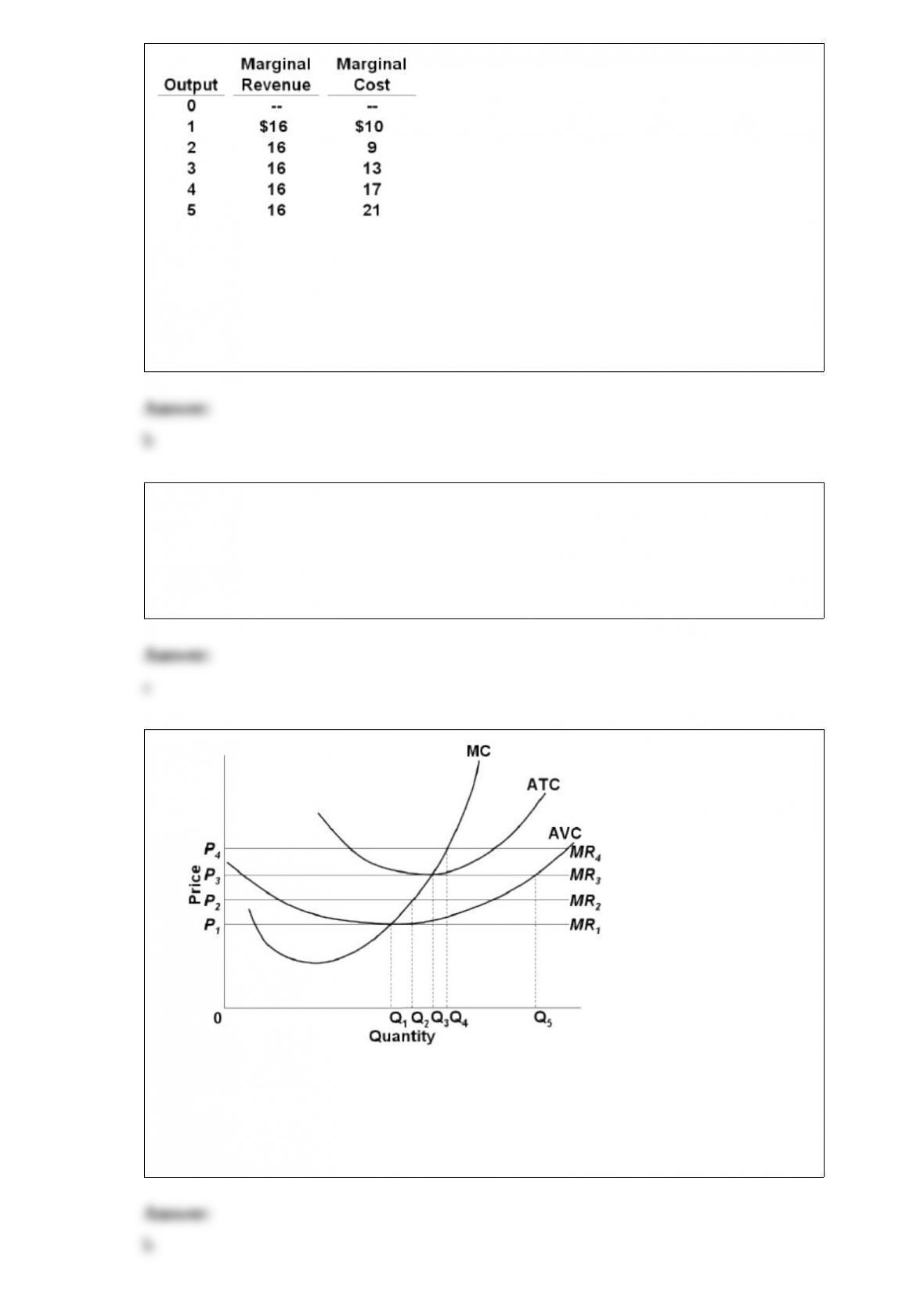
refer to the above data. if the firm’s minimum average variable cost is $10, the firm’s
profit-maximizing level of output would be:
a.2.
b.3.
c.4.
d.5.
16) pure monopolists may obtain economic profits in the long run because:
a.of advertising.
b.marginal revenue is constant as sales increase.
c.of barriers to entry.
d.of rising average fixed costs.
17)
refer to the above diagram. the firm will produce at a loss if price is:
a.less than p1
b.p2
c.p3
d.p4
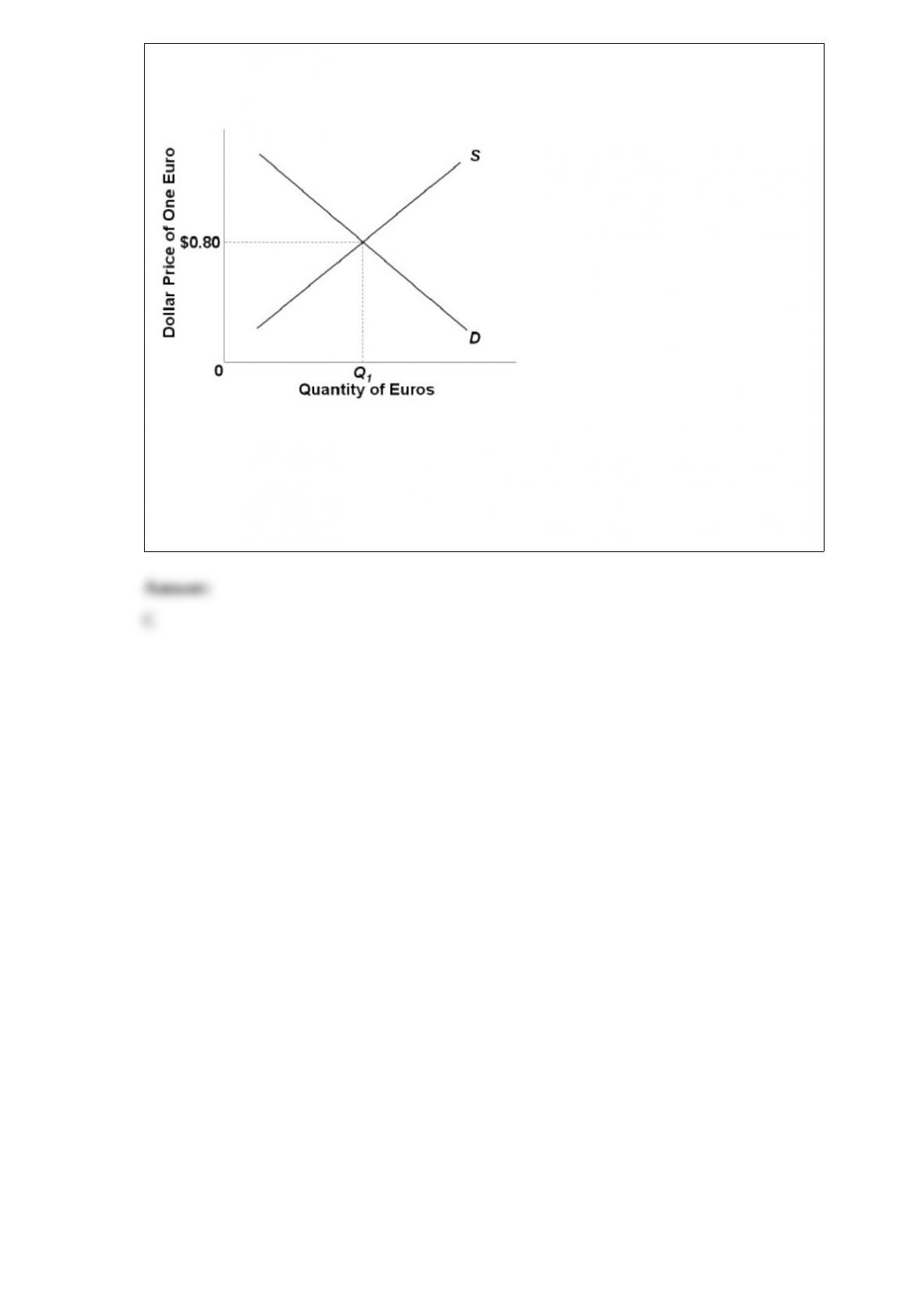
18) The following diagram is a flexible exchange market for foreign currency:
Refer to the above diagram. Other things equal, a leftward shift of the demand curve
would:
A.depreciate the dollar.
B.appreciate the euro.
C.reduce the equilibrium quantity of euros.
D.cause a surplus of euros.