Marginal productivity theory implies that a worker will be paid an amount
a. equal to his or her contribution to the productive process.
b. less than his or her contribution to the productive process.
c. greater than his or her contribution to the productive process.
d. determined by his or her individual bargaining.
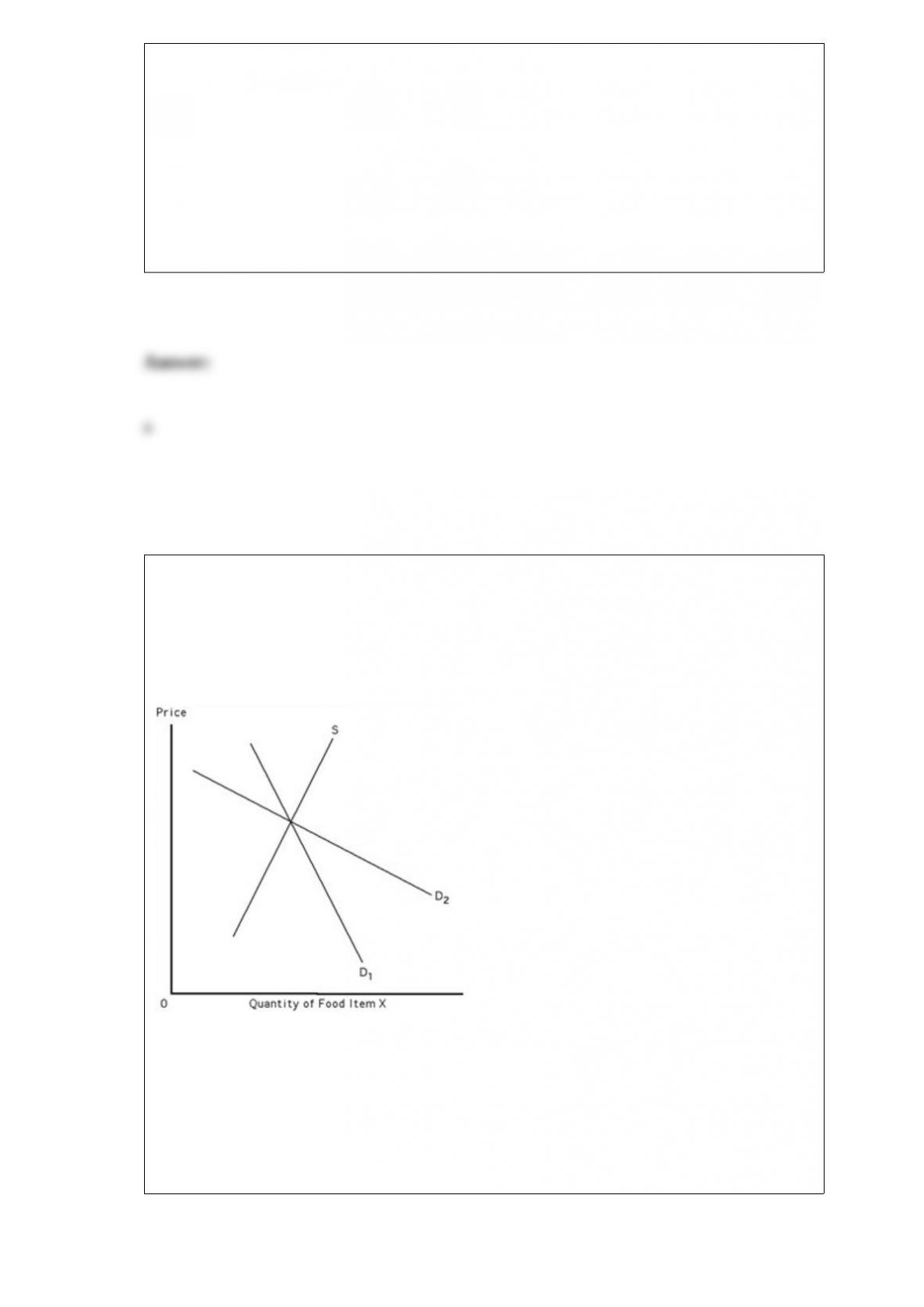
Refer to Exhibit 39-6. A major change in weather conditions favorable to the production
of X will shift the supply curve for X from its original position. The consequent change
in price and total revenue would be less sharp if the demand curve for X is __________
because it is __________ over the relevant region.
Exhibit 39-6
a. D1; more elastic than D2
b. D1; more inelastic than D2
c. D2; more elastic than D1
d. D2; more inelastic than D1

Which of the following statements is true?
a. The supply curve for land is upward sloping in the short run, but is perfectly inelastic
in the long run.
b. The supply curve for land is upward sloping in the short run, but is perfectly elastic
in the long run.
c. The supply curve for land is upward sloping when considering a small portion of the
total amount of land, but is perfectly inelastic when considering the total amount.
d. The supply curve for land is upward sloping when considering the total amount of
land, but is perfectly inelastic when considering a small portion of the total amount.
If a good is income elastic, it follows that the percentage change in quantity demanded
of a good
a. is less than the percentage change in income.
b. is greater than the percentage change in income.
c. is equal to the percentage change in income.
d. is greater than the percentage change in the price of another good.
e. none of the above

The law of diminishing marginal returns states that as ever larger amounts of a variable
input are combined with
a. fixed inputs, the marginal physical product of the variable input rises.
b. other variable inputs, the marginal physical product of the variable input declines.
c. fixed inputs, eventually the marginal physical product of the variable input declines.
d. other variable inputs, eventually the marginal physical product of the variable input
declines.
Which of the following statements is false?
a. A positive externality is internalized if the person that generated the externality
incorporates into his or her own private cost-benefit calculations the external benefits
that third parties receive.
b. Internalizing externalities is not the same as adjusting for externalities.
c. An externality has been completely internalized if the socially optimal output
emerges.
d. Assigning property rights is one way to internalize externalities.
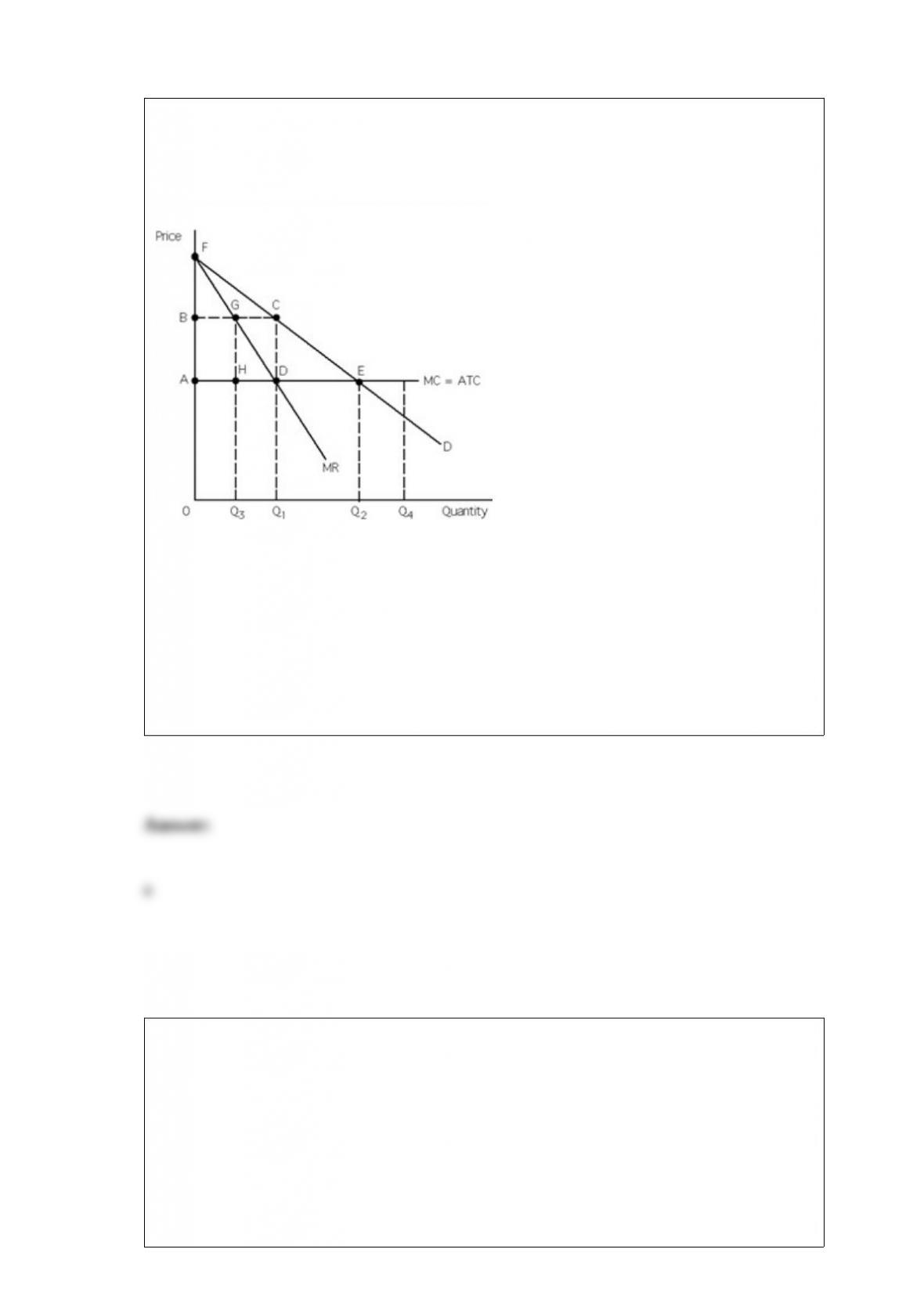
Refer to Exhibit 24-10. The profit-maximizing single-price monopolist earns total
revenue equal to what area?
Exhibit 24-10
a. 0BCQ1
b. 0ADQ1
c. DCE
d. ABCD
e. GFC
What is the approximate present value of a future income stream of three $1,000
payments to be received one, two, and three years from today if the interest rate is 6.75
percent?
a. $2,814
b. $2,636
c. $2,882

d. $3,205
Suppose a factor price taker purchases one unit of factor X for $10. At what price would
it purchase the second unit, and what would marginal factor cost (MFC) equal?
a. It would purchase the second unit for $10, and MFC equals $10.
b. There is not enough information to know what it would purchase the second unit for,
and thus we do not know what MFC equals.
c. It would purchase the second unit for $10, but there is not enough information to
know what MFC equals.
d. There is not enough information to know what it would purchase the second unit for,
but MFC equals $10.
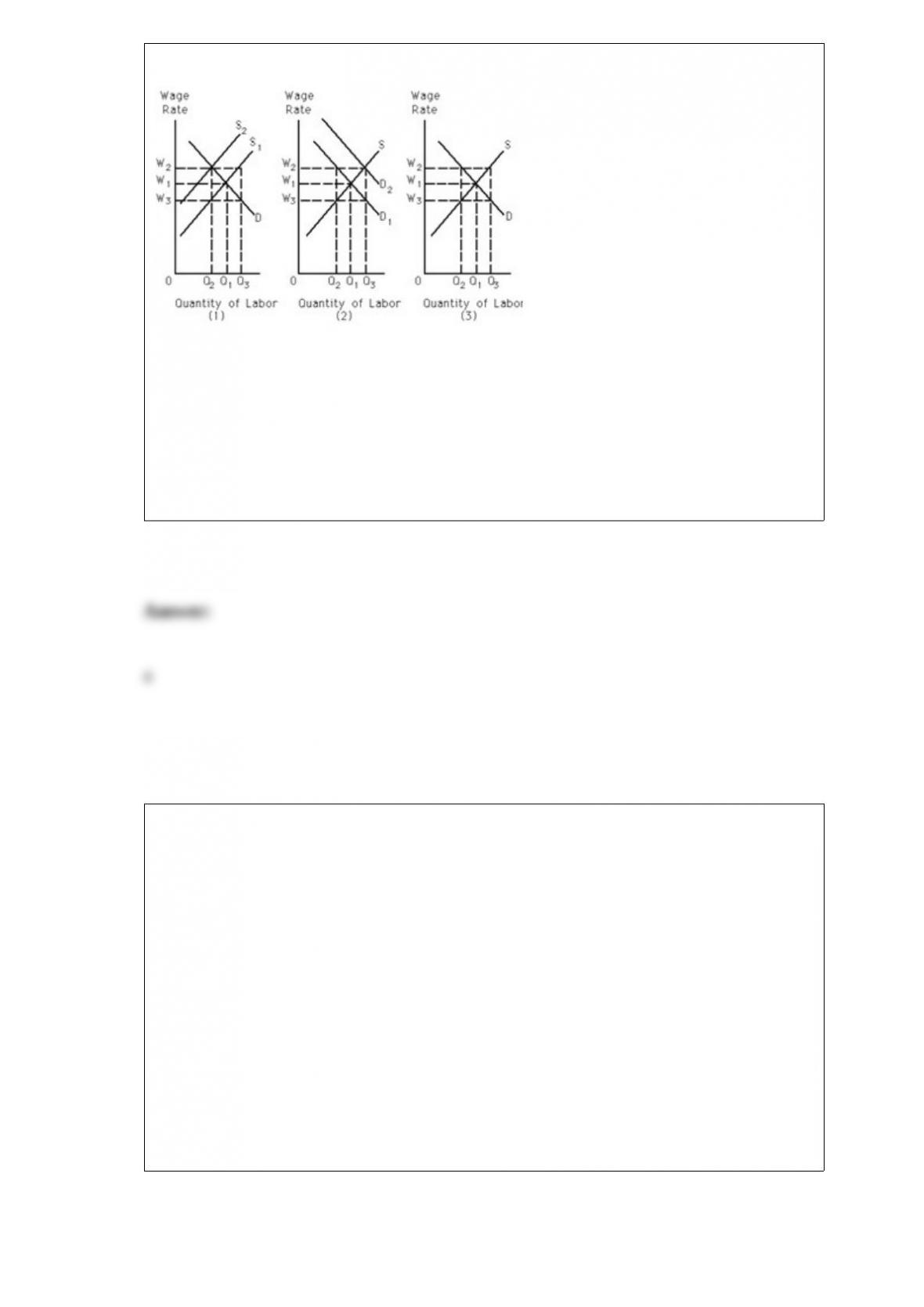
Refer to Exhibit 28-5. In which of the following cases has the increase in the wage from
W1 to W2 been brought about by a country-wide legalization of union shops?
Exhibit 28-5
a. (1)
b. (2)
c. (3)
d. none of the above
If a firm is a monopsonist, then it faces
a. a downward sloping demand curve for its product, and its marginal revenue curve
will lie below its demand curve.
b. a horizontal marginal factor cost curve.
c. an upward sloping factor supply curve, and its marginal factor cost curve will lie
above the factor supply curve.
d. an upward sloping factor supply curve, and its marginal factor cost curve will
coincide with the factor supply curve.
e. an upward-sloping factor supply curve, and its marginal factor cost curve will lie
below the factor supply curve.

Average productivity of labor equals
a. the change in output divided by the change in labor.
b. output divided by the MPP of labor.
c. output divided by marginal cost.
d. output divided by the quantity of labor.
e. the quantity of labor divided by output.
If the nominal interest rate is 9 percent and expected inflation rate is 7 percent, the real
interest rate equals
a. 2 percent.
b. 16 percent.
c. 11.5 percent.
d. 8 percent.
e. none of the above

If, as a person consumes additional units of a good, total utility rises by a constant
amount, it follows that
a. marginal utility is rising.
b. marginal utility is falling.
c. total utility and marginal utility are equal.
d. marginal utility is constant.
e. marginal utility is negative.
X-inefficiency occurs when a monopolist produces output at a cost that is greater than
the lowest possible cost.
a. True
b. False
Exhibit 4-2 represents the orange juice market. The horizontal line at $2 shows a price
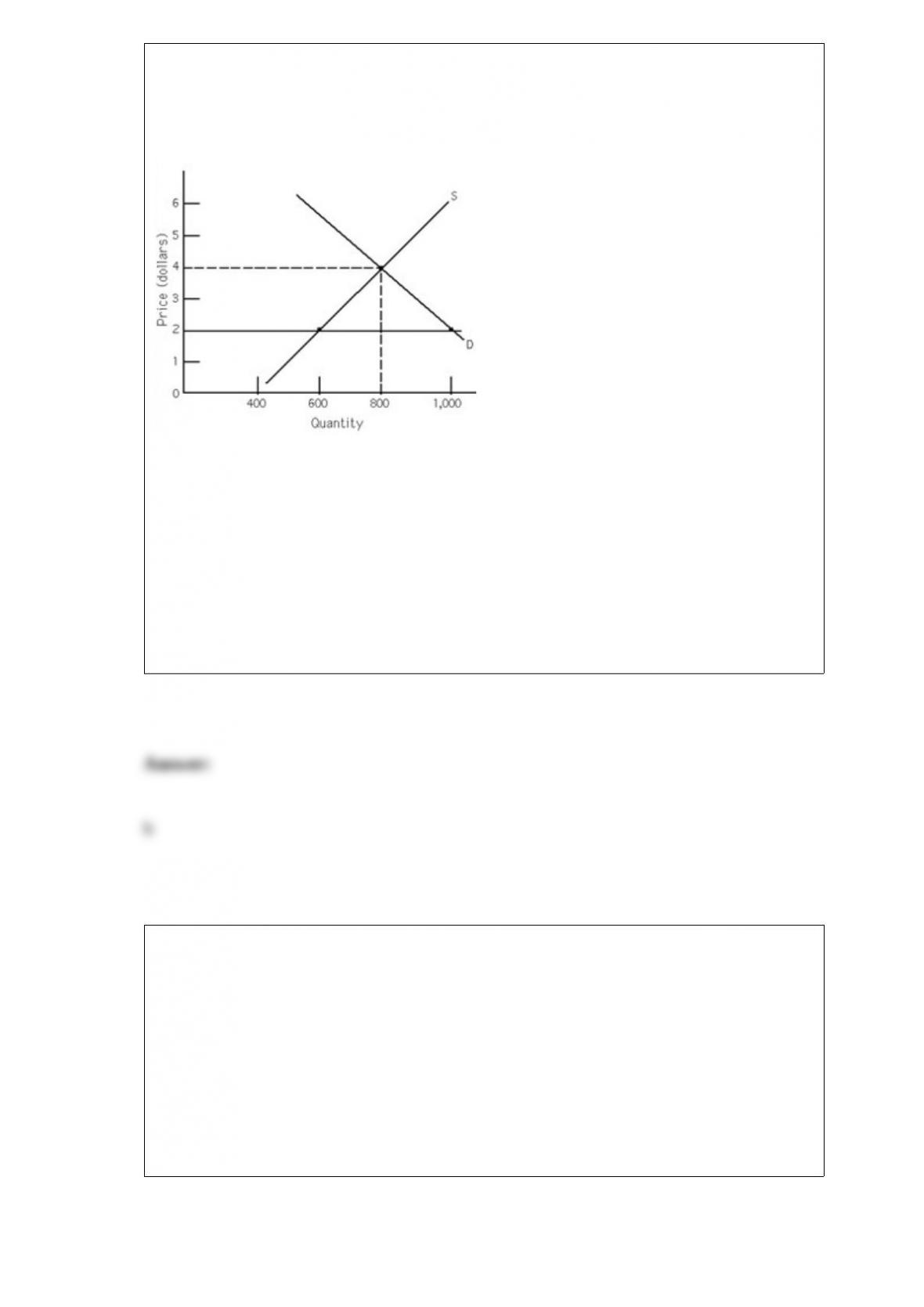
ceiling imposed by the government. Which of the following statements is true at this
price?
Exhibit 4-2
a. At the price ceiling the surplus equals 400 units.
b. At the price ceiling the shortage equals 400 units.
c. At the price ceiling the surplus equals 300 units.
d. At the price ceiling the shortage equals 200 units.
e. none of the above
Suppose the economy goes from a point on its production possibilities frontier (PPF) to
a point below that PPF. Assuming that the PPF has not shifted, this could be due to
a. a gain of resources.
b. a loss of resources.
c. technological improvement in the production of both goods.
d. a new law that interferes with economic efficiency.

In general, there is a ______________ relationship between the number of hours spent
studying for a test and the grade earned on the test.
a. independent
b. direct
c. inverse
d. smooth
Unlike the New York Stock Exchange, NASDAQ is an electronic stock market with
trades executed through a sophisticated computer and telecommunications network.
a. True
b. False
Marginal utility is defined as the
a. change in marginal utility a person derives from the consumption of a good.

b. change in total utility a person derives from the consumption of a good divided by
the price of that good.
c. change in total utility a person derives from the consumption of a good divided by the
change in the quantity of the good consumed.
d. sum of the amounts of satisfaction a person receives from consuming a good.
e. change in total utility a person derives from the consumption of a good divided by the
value in use of that good.
If a perfectly competitive firm and a monopolistic competitor in long run equilibrium
face exactly the same demand and cost curves, then there is high probability that
a. the former will earn zero economic profits, but the latter will earn positive economic
profits.
b. both will earn zero economic profits, but the former will attain lower unit costs than
the latter.
c. both will earn zero economic profits, but the latter will attain lower unit costs than
the former.
d. both firms will earn zero economic profits, and attain the lowest possible unit costs.
e. neither firm will earn zero economic profits, but both will attain the lowest possible
unit costs.
If Max’s demand for hot dogs falls as his income rises, then for Max hot dogs are
a. a bad good.
b. an inferior good.
c. a preferential good.
d. a normal good.
e. a neutral good.
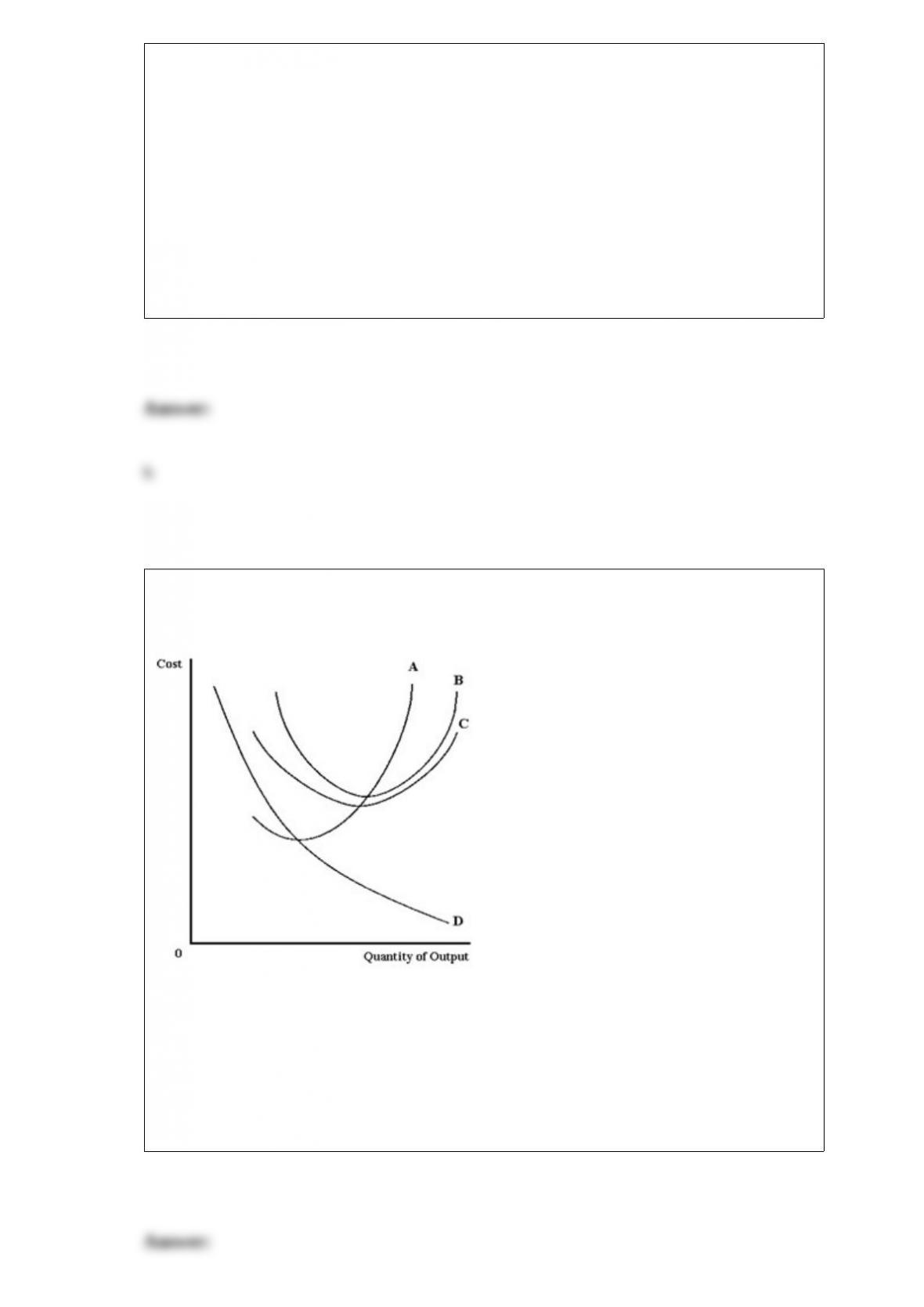
Refer to Exhibit 22-4. Curve C is a(n) __________ cost curve.
Exhibit 22-4
a. marginal
b. average variable
c. average total
d. average fixed

In all cases, microeconomics deals with
a. what is.
b. what should be.
c. relatively small units in the economy.
d. the entire economy.
Which antitrust legislation made price discrimination illegal?
a. the Sherman Act
b. the Clayton Act
c. the Federal Trade Commission Act
d. the Robinson-Patman Act