Exchange rates under the Bretton Woods system were determined by relative supplies
of gold held by countries within the system.
Technological change allows the economy to produce more output with the same
amount of capital and labor.
The main goal of monetary policy for recent Fed Chairmen has been to maintain high
employment in labor markets.
When voluntary exchange takes place, both parties gain from the exchange.
An increase in the price level in the United States will shift the aggregate expenditure
line upward.
When Jack’s income increases by $5,000, he spends an additional $4,000 dollars. This
implies that his marginal propensity to consume is 1.25.
A public good that is a good that is both rival and excludable.
Holding everything else constant, government approval of horizontal mergers is more
likely to be granted if the “market” that firms are in are broadly defined rather than
narrowly defined.

Which of the following is considered expansionary fiscal policy?
A) Congress decreases the income tax rate.
B) Congress increases defense spending.
C) Legislation increases a college tuition deduction from federal income taxes.
D) The Arizona legislature cuts highway spending to balance its budget.
Tastes for products such as beer differ. As a result
A) we see countries specializing completely in the production of beer.
B) consumers of beer have difficulty deciding what type of imported beer to buy.
C) the quality of imported beer is less than it could be.
D) different countries may each have a comparative advantage in producing different
types of beer.
Suppose in 2014, you purchase a house built in 2003. Which of the following would be
included in the gross domestic product for 2014?
A) the value of the house in 2014
B) the value of the house in 2003
C) the value of the house in 2014 minus depreciation
D) the value of the services of the real estate agent
If the purchasing power of a dollar is less than the purchasing power of the euro,
purchasing power parity would predict that
A) in the short run, exchange rates will move to equalize the purchasing power of the
dollar and the euro.
B) in the long run, exchange rates will move to equalize the purchasing power of the
dollar and the euro.
C) in the long run, interest rates will move to equalize the purchasing power of the
dollar and the euro.
D) in the short run, interest rates will move to equalize the purchasing power of the
dollar and the euro.
Figure 3-1
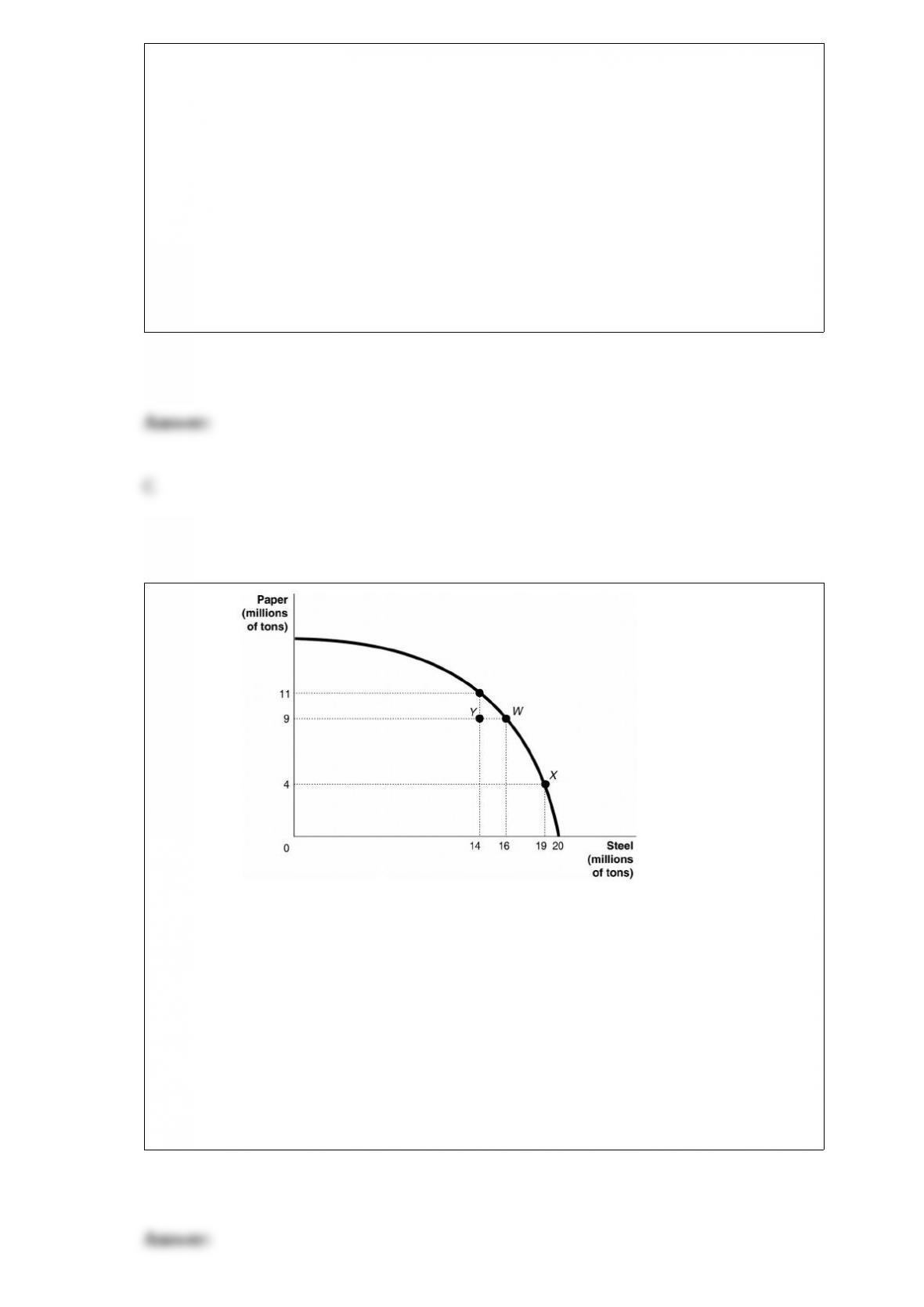
An increase in the expected future price of the product would be represented by a
movement from
A) A to B.
B) B to A.
C) D1 to D2.
D) D2 to D1.
Figure 2-5
If the economy is currently producing at point W, what is the opportunity cost of
moving to point Y?
A) 2 million tons of steel
B) 14 million tons of steel
C) 2 million tons of paper
D) 9 million tons of paper

Increasing the amount of consumption spending and reducing the amount of savings
________ investment expenditures, and ________ long-run economic growth in the
economy.
A) increases; increases
B) increases; decreases
C) decreases; increases
D) decreases; decreases
Expansionary monetary policy will have what effect on the components of aggregate
demand?
A) Consumption, investment, and net exports will rise.
B) Consumption and investment will rise, but net exports will fall.
C) Consumption will rise, but investment and net exports will fall.
D) Consumption will fall, but investment and net exports will rise.
Article Summary. Concerned about slow economic growth, the Fed announced in

September 2013 that it would postpone winding down its $85 billion a month bond
purchasing program which has been a key component of its monetary stimulus
package. Fed Chairman Ben Bernanke would not commit to a timeline for
reducing the bond purchases, stating that the program was “not on a preset
course.” The Fed’s forecasts of economic growth have been lowered for 2013 and
2014, and the Fed does not expect to raise interest rates until 2015. Since late 2008,
the Fed has held its benchmark interest rate near zero, while its balance sheet has
tripled to more than $3.6 trillion. The Fed also stated that so long as inflation did
not become a threat, it would not raise interest rates until the unemployment rate
dropped to 6.5 percent. At the time of the announcement, the unemployment rate
was 7.3 percent. Source: Pedro da Costa and Alister Bull, “Fed Surprises, sticks to
stimulus as it cuts growth outlook,” Reuters, September 18, 2013.
The Fed announced that it would postpone winding down its $85 billion per month
bond purchasing program. The Fed’s purchasing of long-term treasury bonds and other
government-backed securities in an effort to keep long-term interest rates low is a
strategy known as
A) securitization.
B) contractionary spending.
C) indirect finance.
D) quantitative easing.
For each pair of items below, determine which product would have the higher price
elasticity of demand (in absolute value).
a. Blood pressure medicine for someone who has high blood pressure and the purchase
of Clairol hair coloring product.
b. A new Ford Fusion or a tank of gas for your current car.
c. A Seiko watch or watches in general.
If net exports are positive,
A) net foreign investment is also positive.
B) capital inflows must be greater than capital outflows.
C) net foreign investment is negative.
D) Both A and B are correct.
Table 8-18
A very simple economy produces three goods: cameras, legal services, and books. The
quantities produced and their corresponding prices for 2008 and 2013 are shown in the
table above.

What is the GDP deflator in 2008 if 2013 is the base year?
A) 187
B) 87
C) 8.7
D) 0.87
If workers and firms know that the Federal Reserve is following an expansionary
monetary policy, workers and firms will expect inflation to ________ and will adjust
wages so that the real wage ________.
A) increase; increases
B) increase; remains unchanged
C) decrease; decreases
D) increase; decreases
Suppose a bank has $100 million in checking account deposits with no excess reserves
and the required reserve ratio is 10 percent. If the Federal Reserve raises the required
reserve ratio to 15 percent, then the bank will now have excess reserves of
A) $0.
B) -$5 million.
C) $5 million.
D) $15 million.
Explain how the aggregate demand and aggregate supply model can be made more
dynamic.
What is an isocost line? What is the slope of an isocost line?
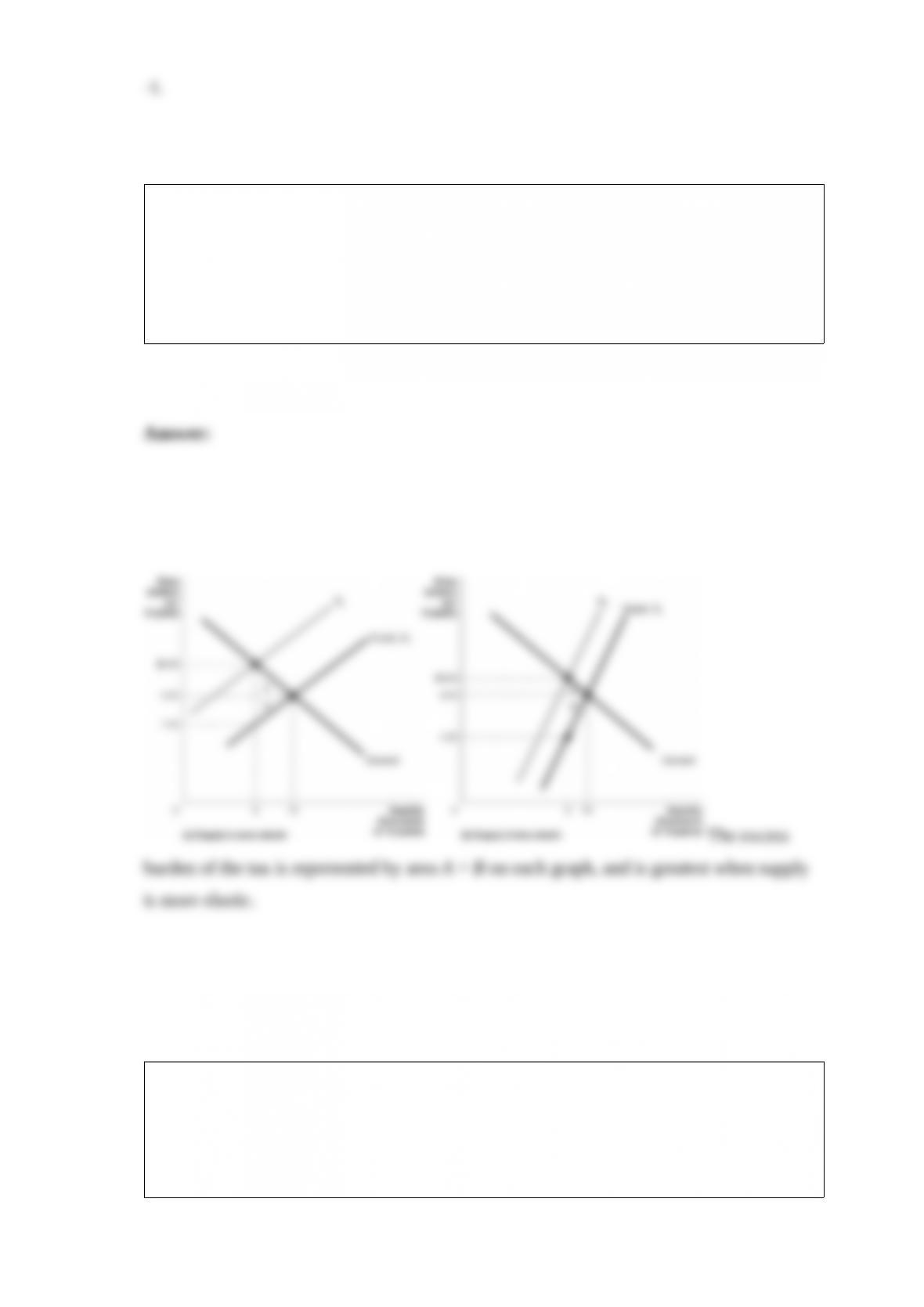
Suppose the equilibrium price and quantity of a 12-pack of Dr. Pepper are $5.00 and
10,000 12-packs, respectively, and the government decides to impose a $1.00 tax on
every 12-pack of carbonated soft drinks. Draw two supply and demand graphs, one
showing the excess burden of the tax when supply is less elastic and the other showing
the excess burden of the tax when supply is more elastic. Identify the excess burden of
the tax on each graph. On which graph is the excess burden the greatest?
“Buy low and sell high is advice given to people who want to make a profit by buying
and selling shares of stock. Arbitrage is defined as buying a product in one market at a
low price and reselling it in another market at a high price. Therefore, when stock
brokers buy and sell stocks to earn a profit they are engaging in arbitrage.” Evaluate this
statement; state whether it is true or false and explain your answer.
How has economist Robert Fogel explained that economic growth is connected to life
expectancy? Based on this connection, in what country would you expect to have a
longer life expectancy, the United States or India? Explain.
Would a change in the price of in-line skates cause a change in the supply of in-line
skates? Why or why not?

What are the advantages of setting up a proprietorship or partnership as opposed to a
corporation?