Assume that the personal computer industry is perfectly competitive. The fact that the
price of personal computers over the last decade has fallen despite increases in demand
signifies that the industry is a decreasing-cost industry.
Stagflation occurs when aggregate supply and aggregate demand both increase.
If aggregate expenditure is more than GDP, then inventories fall and GDP rises.
Scarcity is defined as the situation that exists when the quantity demanded for a good is
greater than the quantity supplied.
If the income effect of a wage increase equals the substitution effect, the labor supply
curve is horizontal at the equilibrium wage.
A monetary policy target is a variable that the Fed can affect directly, which then affects
one or more of the Fed’s policy goals.
If demand for a product is perfectly inelastic, a change in price will not change total
revenue.
Figure 2-14
Figure 2-14 shows the production possibilities frontiers for Costa Rica and Guatemala.
Each country produces two goods, pineapples and coconuts. What is the opportunity
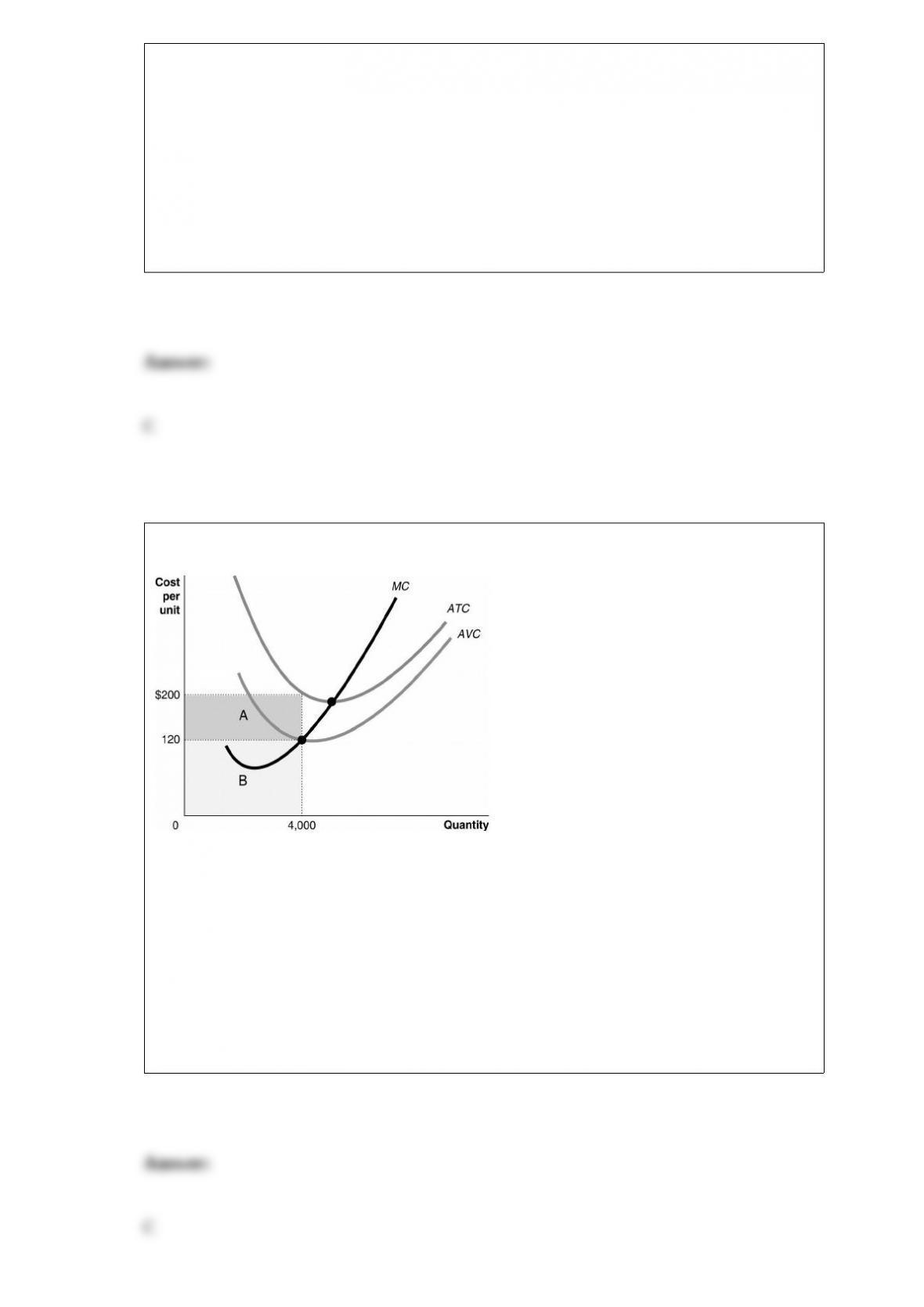
cost of producing 1 ton of pineapples in Guatemala?
A) 1/2 of a ton of coconuts
B) 1 1/3 tons of coconuts
C) 2 tons of coconuts
D) 180 tons of coconuts
Figure 12-8
Suppose the market price is $120. Which of the following is true?
A) The firm earns a profit equal to the area A.
B) The firm earns a profit equal to the area A + B.
C) The firm suffers a loss equal to the area A.
D) The firm will break even.

Changes in ________ do not affect the level of aggregate supply in the long run.
A) technology
B) the number of workers in the economy
C) the price level
D) the amount of accumulated capital equipment
How does a market system prevent people from getting as many goods and services as
they wish?
A) Governments interfere with the market mechanism to influence the allocation of
goods and services.
B) In a market system, firms can charge any price they want, thus preventing poor
people from getting as many goods and services as they wish.
C) The market system allocates goods and services to those who are able to pay for
those products and therefore income is a limiting factor.
D) The government imposes taxes on those who earn beyond a certain amount of
income.
Once an industry becomes established in a certain area firms that locate in that area gain
advantages over firms located elsewhere, leading to lower costs of production.

Economists refer to the lower costs that result from increases in the size of an industry
in a certain area as
A) external economies.
B) positive externalities.
C) strategic advantages.
D) technological change.
Which of the following tax systems would help reduce income inequality the most?
A) a regressive tax system
B) a proportional tax system
C) a progressive tax system
D) a consumption tax system
Which of the following statements about inflation targeting is true?
A) Inflation targeting by the central banks in other countries has not typically lowered
inflation.
B) Inflation targeting would not reduce the flexibility of monetary policy to address
other policy goals.
C) Inflation targeting would not allow the central bank the flexibility to take action

against a severe recession.
D) Inflation targeting would make it easier for households and firms to form accurate
expectations of future inflation, improving their planning and the efficiency of the
economy.
The possibility that the economy may benefit from having market power, rather than
being very competitive, is closely identified with which famous economist?
A) Arnold Harberger
B) Joseph Schumpeter
C) Sergey Brin
D) Donald Turner
Creative destruction means that
A) firms develop new products that replace old products in the economy, thereby
encouraging economic growth.
B) economic growth can only be sustained if capital depreciates rapidly.
C) knowledge capital can be created through a system of government subsidies for
education and research and development.
D) research and development should only be financed if research and development is
incremental (a result of making small changes to existing products).
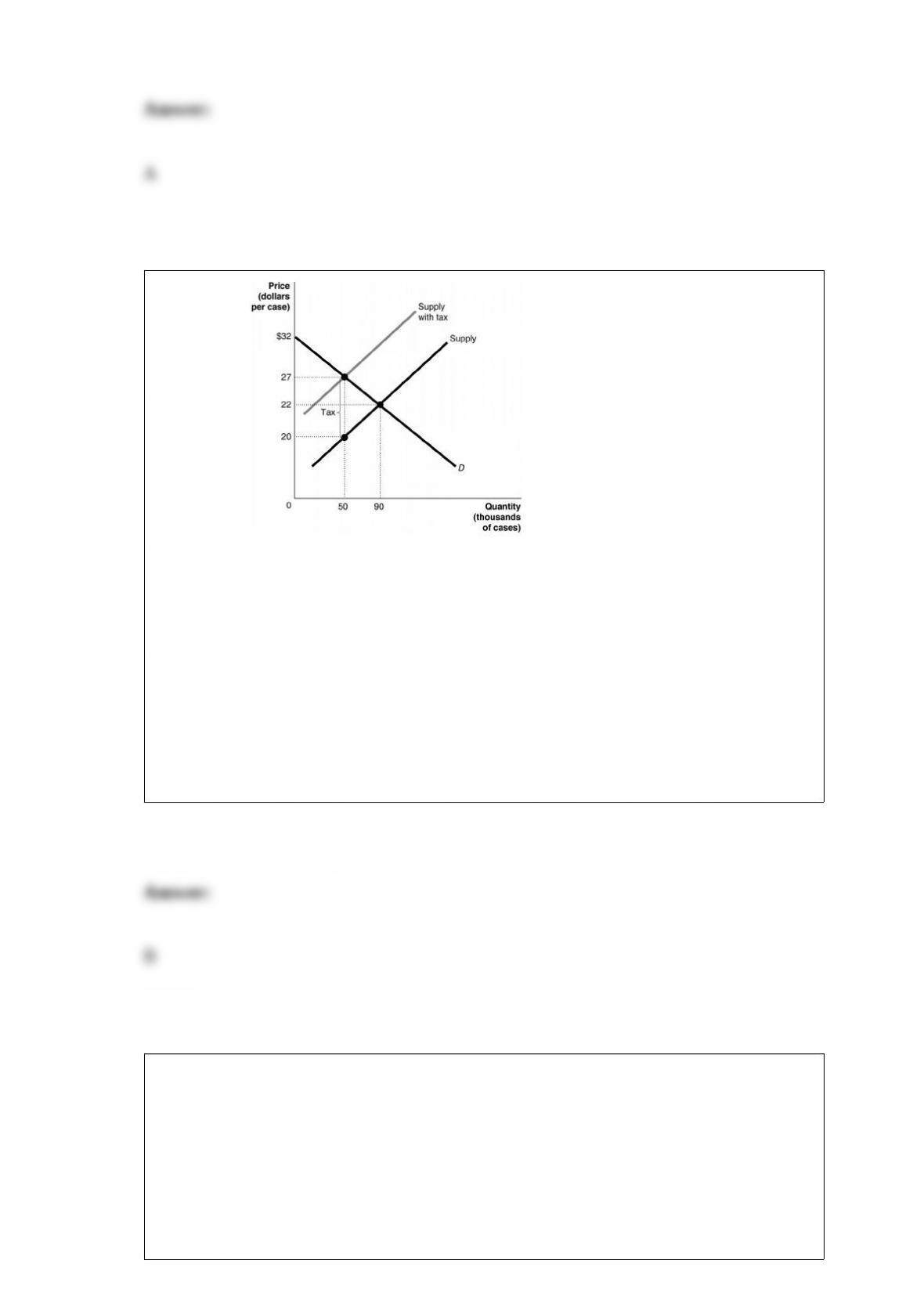
Figure 4-15 Figure 4-15 shows the market for
beer. The government plans to impose a unit tax in this market.
How much of the tax is paid by buyers?
A) $2
B) $5
C) $7
D) $12
Which of the following is a function that money serves?
A) medium of exchange
B) unit of account
C) store of value

D) All of the above are correct.
Productive efficiency is achieved when
A) firms add a low profit margin to the goods and services they produce.
B) firms produce the goods and services that consumers value most.
C) firms produce goods and services at the lowest cost.
D) there are no shortages or surpluses in the market.
If national income increases by $75 million and consumption increases by $15 million,
the marginal propensity to consume is
A) 5.
B) 0.75.
C) 0.20.
D) 0.15.
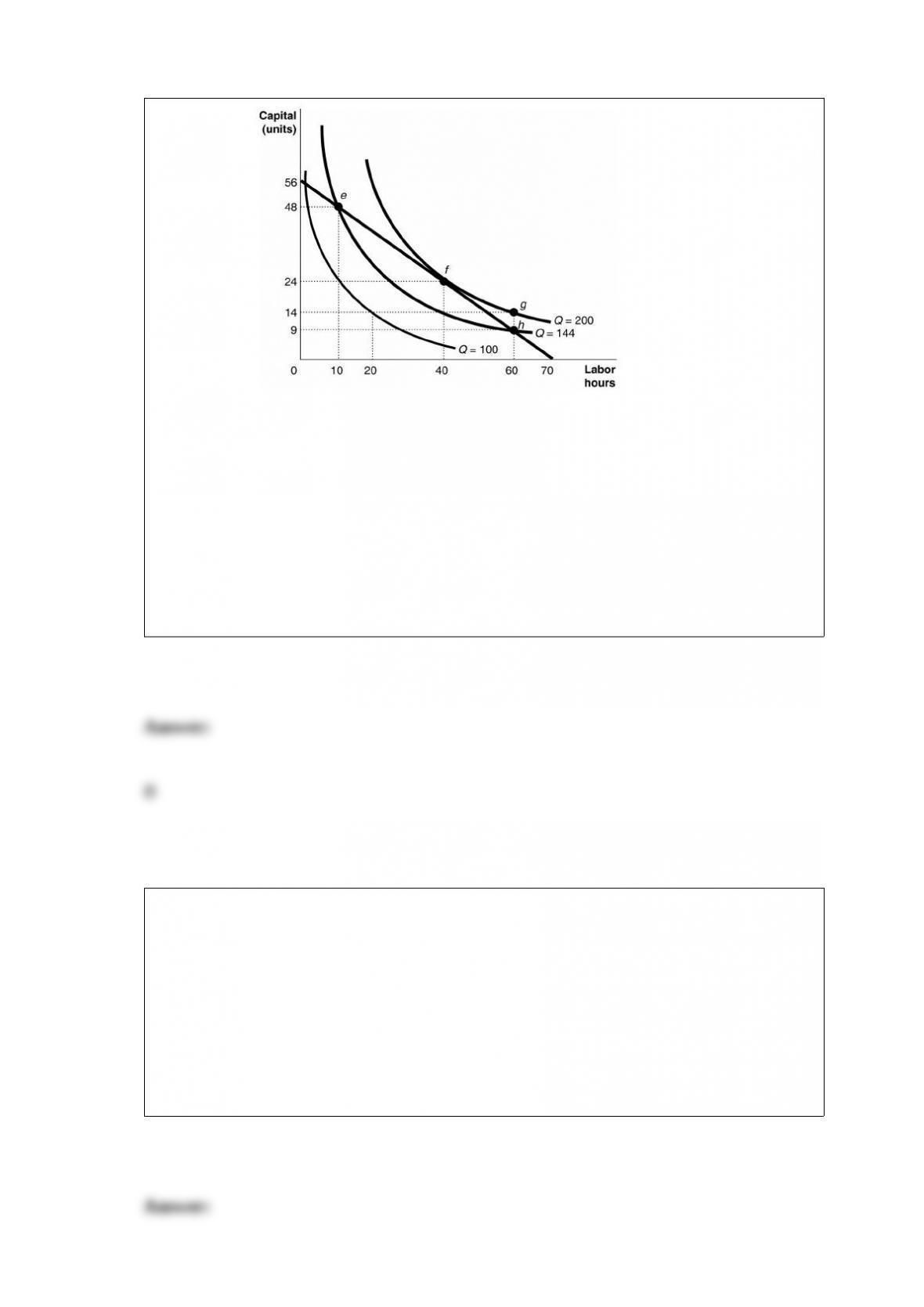
Figure 11-15
What is the combination of inputs that produces 200 gooseberry pies at the lowest cost?
A) combination e: 10 hours of labor and 48 units of capital
B) combination f: 40 hours of labor and 24 units of capital
C) combination g: 60 hours of labor and 14 units of capital
D) combination h: 60 hours of labor and 9 units of capital
A regressive tax is a tax for which people with lower incomes
A) pay a lower percentage of their incomes in tax than do people with higher incomes.
B) pay a higher percentage of their incomes in tax than do people with higher incomes.
C) pay the same percentage of their incomes in tax as do people with higher incomes.
D) do not have to pay unless their incomes exceeds a certain amount.

Before a doctor decides to keep her office open on Saturdays, she should
A) make sure that the marginal cost of doing so will exceed the marginal benefit.
B) only consider the increase in total profit from doing so.
C) weigh the costs and benefits of staying open on Saturdays before deciding if she
should go through with this idea.
D) only look at the marginal benefit of doing so, because marginal cost will not change.
Which of the following is not part of the “regulation of health insurance” provision of
the Patient Protection and Affordable Care Act (ACA)?
A) Individuals with pre-existing medical conditions will be able to acquire health
insurance.
B) All policies must provide coverage for dependant children up to age 26.
C) Lifetime dollar maximums on coverage will be prohibited.
D) Limits on the size of deductibles and on waiting periods before coverage takes effect
will be eliminated.
Between 1950 and 2013 the productivity of wheat farmers in the United States more

than doubled. This means that
A) the amount of land and other resources devoted to wheat production more than
doubled.
B) the incomes of wheat farmers more than doubled.
C) the total amount of wheat produced more than doubled.
D) the amount of wheat produced by the average farmer more than doubled.
Monique buys a new television for $795. She receives consumer surplus of $355 from
the purchase. How much does Monique value her television?
A) $355
B) $440
C) $795
D) $1150
Suppose you see a 2006 Scion xB Sport Wagon advertised in the local newspaper for
$8,500. If you knew the car was reliable, you would be willing to pay $10,000 for it. If
you knew the car was unreliable, you would only be willing to pay $5,500 for it. Under
what circumstances should you buy the car?
What is the difference between the poverty line and the poverty rate?
Workers and firms are currently expecting the price level to increase from 110 to 114.
The Federal Reserve then announces that it will be reducing the growth rate of the
money supply. If the Fed’s announcement is credible, and firms and workers have
rational expectations, describe how the expectations of firms and workers will be
affected and how the change in expectations will affect the unemployment rate.
Why do many film processing companies have a policy of printing every picture on a
roll of film or a memory card, even if the picture is very fuzzy and customers are
allowed to ask for refunds on any pictures they do not like?
Using equations for public and private saving, show that saving must equal investment
in a closed economy. Begin with the expression for total saving in the economy.
If the price of a product is above equilibrium, what forces it down?