
Profit center managers are allocated decision rights for:
A. input mix, product mix, and selling prices.
B. selling prices and capital expenditures.
C. product mix and selling price only.
D. input mix and product mix only.
When a firm purchases a part of its supplies from any one of a large number of potential
suppliers at the current market price without long-term commitments, it is:
A. making a spot market purchase.
B. practicing arbitrage.
C. integrating upstream.
D. integrating downstream.
Which of these is a subjective evaluation method used for assessing an employee’s
compensation?
A. Output-based system
B. Ratcheting up of standards
C. Across-firm performance benchmarking
D. Goal-based system
Incentive problems are usually:
A. larger when the decision rights are placed higher in the organization.

B. larger when the decision rights are placed lower in the organization.
C. smaller when the decision rights are placed lower in the organization.
D. large regardless of where the decision rights are placed.
Alfred Chandler, the noted business historian, indicated that “the administrative load of
the senior executives increased to such an extent that they were unable to handle their
entrepreneurial responsibilities efficiently.” He was speaking of the:
A. U form of business organization.
B. M form of business organization.
C. matrix form of business organization.
D. mixed design.
In terms of business strategy, managers will attempt to adopt business strategies that
A. maximize transaction costs.
B. stabilize opportunity costs.
C. minimize transaction costs.
D. minimize sunk costs.
Assume that Janet is risk-averse. Which of the following bets is she more likely to
accept, depending on the degree of risk aversion?
A. Win $40 one-fourth of the time, win $10 one-half of the time, and lose $40
one-fourth of the time
B. Win $40 one-fourth of the time, break even one-half of the time, and lose $40

one-fourth of the time
C. Win $20 one-fourth of the time, win $10 one-half of the time, and lose $20
one-fourth of the time
D. Win $20 one-fourth of the time, win $10 one-fourth of the time, and lose $20
one-fourth of the time
BrightLight Ltd. estimates the demand curve for its table lamps to be Q = 1,000 – 4P.
That is, P = 250- .25Q. Which of the following is NOT true?
A. The maximum total revenue BrightLight can obtain is $62,500.
B. The marginal revenue curve for BrightLight’s table lamps is given by MR = 250 – P.
C. The elasticity of demand for BrightLight’s table lamps is equal to 7.5 when their
price is $125.
D. BrightLight maximizes its total revenues when selling 500 lamps.
If a firm with monopoly pricing power in the market faces a demand curve of P = 2,000
– 2Q and marginal cost of MC = 1,100 + 2Q, then the firm will produce
A. 542 units.
B. 150 units.
C. 200 units.
D. 900 units.
As GMB moves to select a new passive restraint safety system for its buses, it finds that
its competitor, VolgaBus, opposes the move with an alternative technology. GMB must

now evaluate its strategy and determine whether
A. VolgaBus’s alternative is credible.
B. GMB used the circle technique to arrive at its decision.
C. the secure strategy is the best alternative.
D. VolgaBus should really be the first mover.
If the demand for movie tickets is elastic, then
A. Ed > 1.
B. Ed < 1.
C. Ed = 1.
D. Ed = 0.
The profit earned by an industry is likely to be low if the
A. industry has only a few large customers.
B. industry has many customers.
C. product produced in the industry has only a few substitutes.
D. degree of rivalry among industries is low.
In the basic competitive model of labor markets, we see that:
A. individual firms and workers can exert a lot of influence over the wage rate.
B. there are only long-term contracts.
C. jobs are not identical to each other.

D. individual firms and workers have no control over the wage rate paid and received.
Higher discount rates imply that
A. present payoffs are equal to the past payoffs.
B. both present and future payoffs are equally unimportant.
C. future payoffs are more important than present payoffs.
D. present payoffs are more important than future payoffs.
Advancement opportunities for high level executives through tournament-type
processes (“horse races”):
A. motivate greater executive effort.
B. encourage cooperation among executives.
C. provide benefits that outweigh their incentive costs.
D. thwart innovative activities.
To motivate the employees of a company to change and follow a new mission, it is
important to:
A. move overseas for most of the production.
B. outsource marketing and advertising.
C. change the company’s organizational architecture.
D. rely on standard U-form organizational structures.

If a prospective employee is not offered his/her reservation utility or reservation wage,
then he/she will:
A. tend to look for another job or withdraw from the labor market.
B. seek a larger fringe benefit package.
C. use the job as the basis for a career, assuming that wages will increase beyond the
marginal revenue product over time.
D. accept the job because a wage below the reservation utility is very attractive.
Identify a characteristic of the corporate form of organization.
A. The top management of such an organization has unlimited liability.
B. It does not have the discretion and authority to issue stock.
C. It has the legal standing of an individual and can participate in law-suits.
D. It is run by a board of directors elected by the government.
The marginal product curve of input Y shows
A. how the quantity of output produced changes for each amount of input Y, whether or
not all other inputs are held constant.
B. how the quantity of output produced changes for each amount of input Y, holding all
other inputs constant.
C. how the average quantity of output produced varies with input Y, whether or not all
other inputs are held constant.
D. how the average quantity of output produced varies with input Y, holding all other
inputs constant.

Kevin Freeman is the head of a team developing plastic knee replacements. Each
member of the team brings specialized knowledge to the innovation process. Kevin
noticed that the specialist on bone and artificial materials compatibility is always late to
meetings and contributes little. This is an example of the:
A. benefits of the use of dispersed specific knowledge.
B. costs of employee buy-in.
C. costs of collective-action problems.
D. free-rider problem.
Assume the demand function for basketballs is given by QD = 150 −3P + 0.1I, where P
= price of a basketball, and I = average income of consumers. Also, assume the supply
of basketballs is given by QS = 2P. If the market for basketballs is perfectly competitive,
and the average income is equal to $1,500, what is the equilibrium price and quantity?
What if a 20 percent income tax is introduced?
A. Before the tax, the equilibrium price was $60, and 120 basketballs were traded. The
introduction of an income tax would have no effect on the equilibrium price and
quantity.
B. Before the tax, the equilibrium price was $60, and 120 basketballs were traded. Once
the income tax is introduced, the price would decrease by $6, and only 108 basketballs
would be traded.
C. Before the tax, the equilibrium price was $60, and 120 basketballs were traded. Once
the income tax is introduced, the price would decrease by $6, which would cause the
quantity of basketballs traded to increase.
D. Before the tax, the equilibrium price was $60, and 108 basketballs were traded. Once
the income tax is introduced, the price would decrease by $6, and only 120 basketballs
would be traded.

A competitive equilibrium price guarantees that
A. consumers who want to buy the product at the market price are satisfied.
B. producers can hoard the quantity they want at the current market price.
C. gains from trade are maximized only by the producers.
D. revenues generated are equal to the cost of production.
Which of the following should not be on a list of things you should do to get an honest
evaluation?
A. Have a list of creative solutions to problems that you have encountered.
B. Show how your output influenced the profitability of your division.
C. Illustrate how your actions will improve the company next year.
D. Take your manager to dinner the night before evaluations are due.
The Japanese keiretsu is an example of a(n) ______.
A. U form of organization
B. M form of organization
C. mixed design
D. network organization
Refer to Figure 5.2. On the graph that shows total costs, what is the level of variable
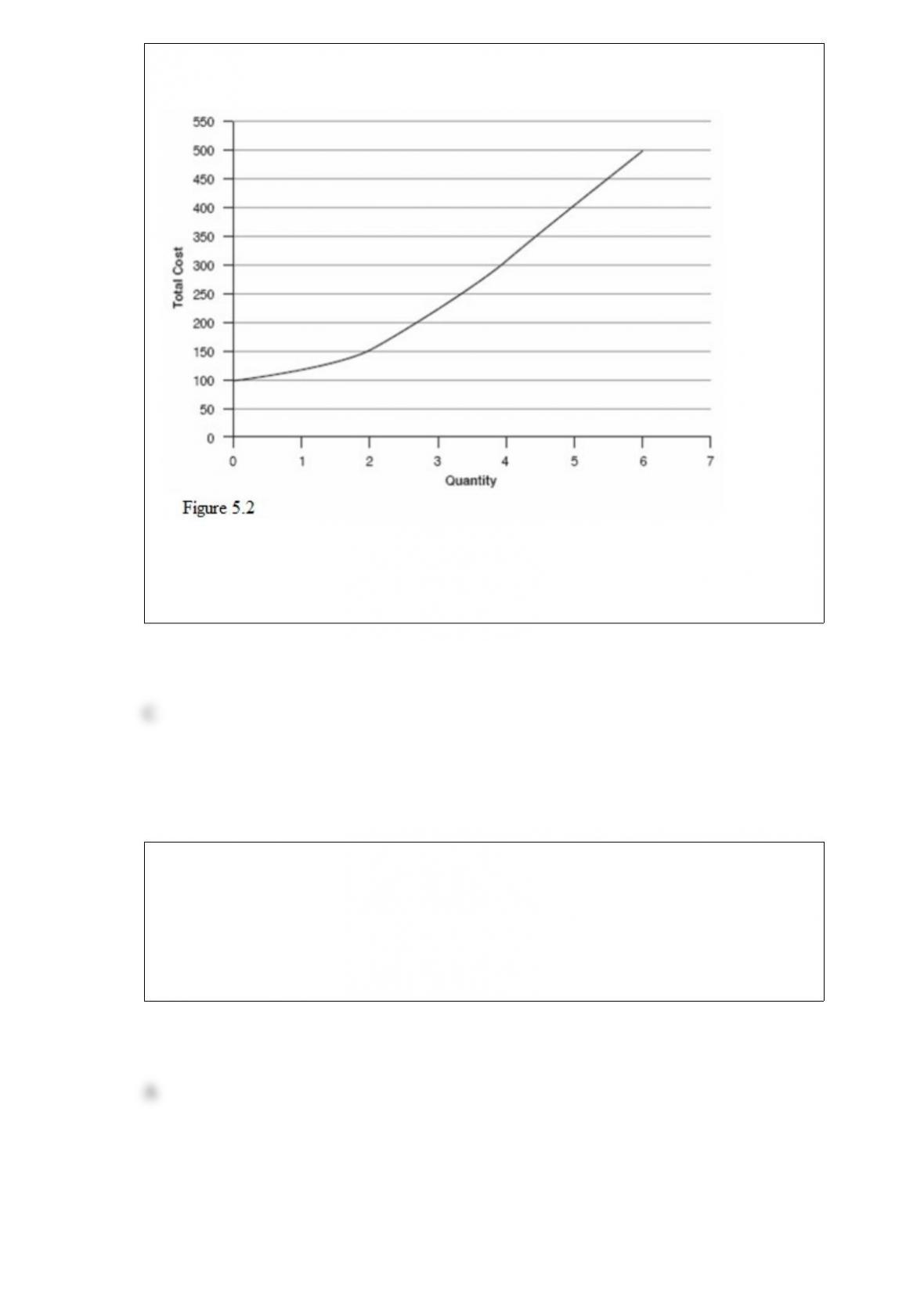
costs when 6 units are produced?
A. $50
B. $100
C. $400
D. $500
According to Ronald Coase, for a free-market economy to work efficiently, there needs
to be
A. allocation of private property rights with low transactions cost.
B. allocation of private property rights with high transactions cost.
C. a well-developed tax code.
D. an autocratic form of government in the country.

The process of looking at the final outcome and then reasoning back to initial decisions
is called
A. managerial decision making.
B. simultaneous decision making.
C. forward induction.
D. backward induction.
Using cost plus pricing, what is the price if ATC = $14.50 and the target rate of return is
4 percent?
A. $15.10
B. $49.34
C. $14.5
D. $22.10
A key to motivating people in a business entity is to remember that each person:
A. tends to be very lazy.
B. tends to act in his/her own self-interest.
C. follows the rules of ethics popularized by their professional societies.
D. tends to follow orders unless a strong reason is given to behave otherwise.
Which of the following is a possible reason for diversification?
A. To promote the supply of complementary products
B. To promote the supply of substitute products

C. To increase social benefits
D. To internalize negative externalities
Currently, a monopolist’s MR = $5 and its MC = $10 and it serves 10 consumers. An
11th consumer walks in. Should the company provide service to the additional
customer?
A. Yes, MC is equal to the number of customers, so it should provide service to the
additional customer.
B. Yes, MR < MC, so it should provide service to the additional customer.
C. No, MR is less than the number of customers, so it should not provide service to the
additional customer.
D. No, MR < MC, so it should not provide service to the additional customer.
Ralph Nader has long argued that large corporations in oligopolistic markets should use
their vast productive powers to redress social ills. Implementing this policy may put
companies:
A. in conflict with the government.
B. in conflict with its trade unions.
C. in conflict with the process of wealth maximization.
D. in conflict with their international policies.
Economists often remark that accounting data are purely historical and at an aggregate
level and do not provide information on incremental changes. So why is it the key data
source for decision control and important in decision management?
Many manufacturers attempt to build fairly close relationships with the firms that
supply their packaging and boxes. Why?
Jim Range has to choose between buying more soda or more pasta for the week. He has
a fixed income and he knows the prices of both products. Using indifference curves and
budget constraints, illustrate the amount of soda and pasta that Jim will purchase. When
he gets to the store, he finds that the price of soda has fallen dramatically. How does
this change his optimal purchase? Can a general rule of human behavior be developed
from this graphical example?
A firm is a focal point for a set of contracts. Explain the problems that (1) agency
relationships, (2) asymmetric information, and (3) adverse selection can introduce to
building a successful contract between two people.
In the small town of Springfield, Duffman observes that the price of beer has fallen.
Duffman concludes that the total amount of money spent buying beer has to fall since
the price of beer is lower now. Is he correct? Why or why not? Clearly explain your
answer.
Some industrial psychologists suggest that, “pay is not a motivator”. How do they
support the argument and what are the limitations of that argument?
FedEx employees use the motto “Absolutely, Positively” to express their commitment
to their customers. What should be the attitude of someone who studies economics
toward this sort of company ritual?
Contrast the good-citizen model with the economic model to explain the reason why
people engage in charitable behavior.
What happens to producer surplus and consumer surplus if transaction costs are
reduced?
A business manager has to decide whether to buy supplies from the marketplace or
whether to build them inside the company. What do “information” and “contracting”
have to do with this decision?
Enhanced Computers specializes in rebuilding computers. Recently reorganized into
geographic divisions, the Southern division headed by Dan Unowsky is outperforming
the other divisions in sales and profits. However, corporate executives have noticed that
Unowsky no longer sends refurbished computers to other divisions, and he has
instituted special warranties and pricing systems unavailable in the rest of the company.
Should Unowsky be promoted or fired?
Enron was clearly a company riddled with fraud and its conduct drove it to bankruptcy.
The text argues that individual behavior was not the core of Enron’s problems. What
were the problems with this corporation from an organizational architecture point of
view?
Always Round Tire has a production function of Q = 300 L.75 K.5. In the short run, if L
= 250 and K = 25, what is the quantity of tires supplied? What happens to the output of
tires if L jumps to 300 and then 350? What law does this illustrate?
Draw supply and demand curves. Show the impact of an increase in demand on the
price and quantity exchanged in the market. Show the impact of a decrease in demand
on the price and quantity exchanged in the market.
Wanda Weeks has decided to stay in a lower-paying position with a local electric
company rather than accept a much higher-paying job with a new information

technology company. Use a risk model to explain her decision.