What must you know to develop a binomial probability distribution?
A. The probability of success
B. The probability of success and the number of trials
C. The probability of success and the number of successes
D. The number of trials and the number of successes
The weekly incomes of a large group of executives are normally distributed with a
mean of $2,000 and a standard deviation of $100. What is the z-score for an income of
$2,100?
A. 1.00
B. 2.00
C. 1.683
D. -0.90
The monthly salaries of a sample of 100 employees were rounded to the nearest $10.
They ranged from a low of $1,040 to a high of $1,720. If we want to condense the data
into seven classes, what is the most convenient class interval?
A. $50
B. $100
C. $150
D. $200
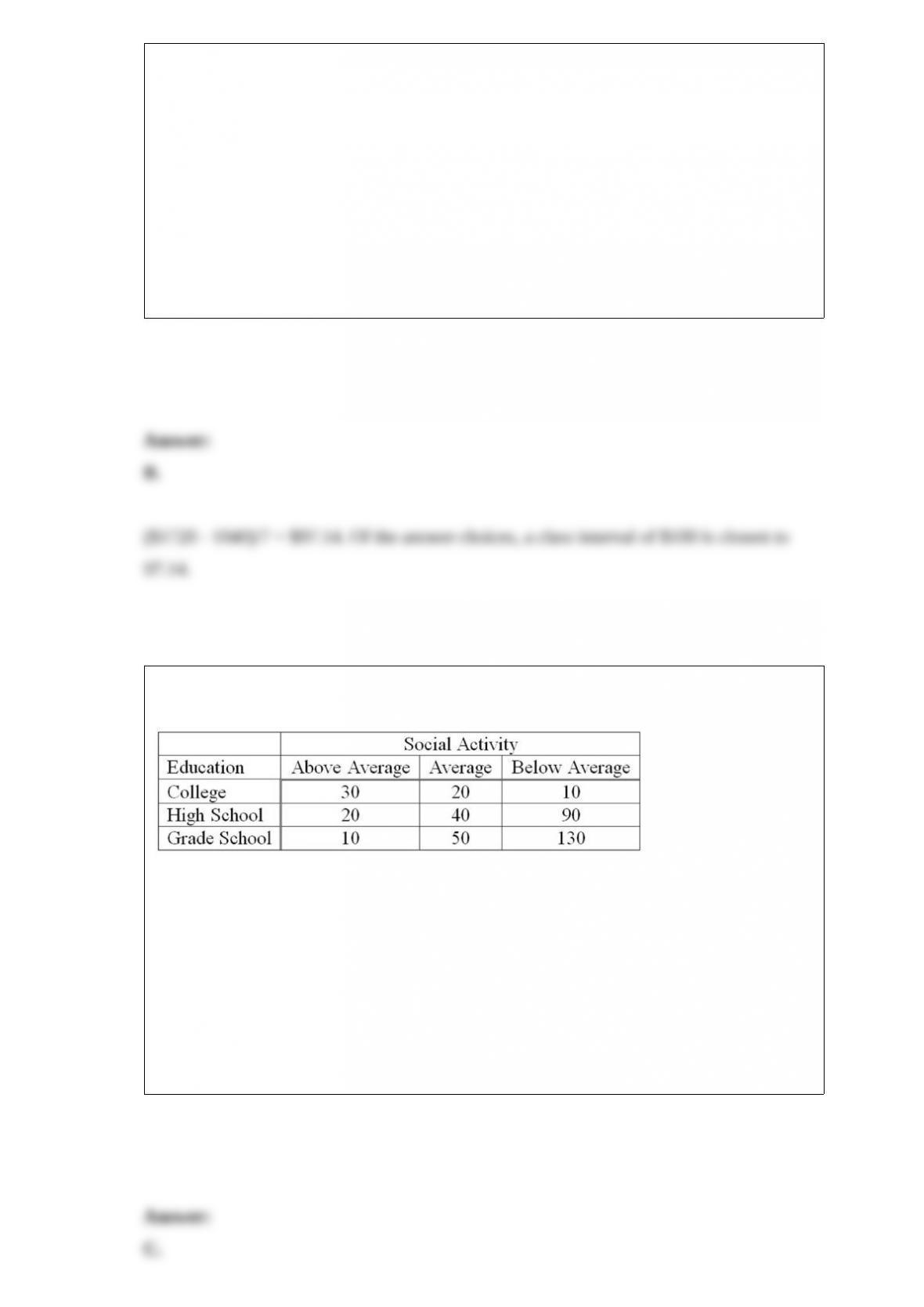
A recent study of the relationship between social activity and education for a sample of
corporate executives showed the following results.
The appropriate test statistic for the analysis is a(n) __________.
A. F-statistic
B. t-statistic
C. Chi-square statistic
D. z-statistic
Knowing the population standard deviation, a 95% confidence interval infers that the
population mean ___________.
A. Is between 0 and 100%
B. Is within 1.96 standard deviations of the sample mean
C. Is within 1.96 standard errors of the sample mean
D. Is too large
In a Poisson distribution, the variance is equal to ___________.
A. nπ
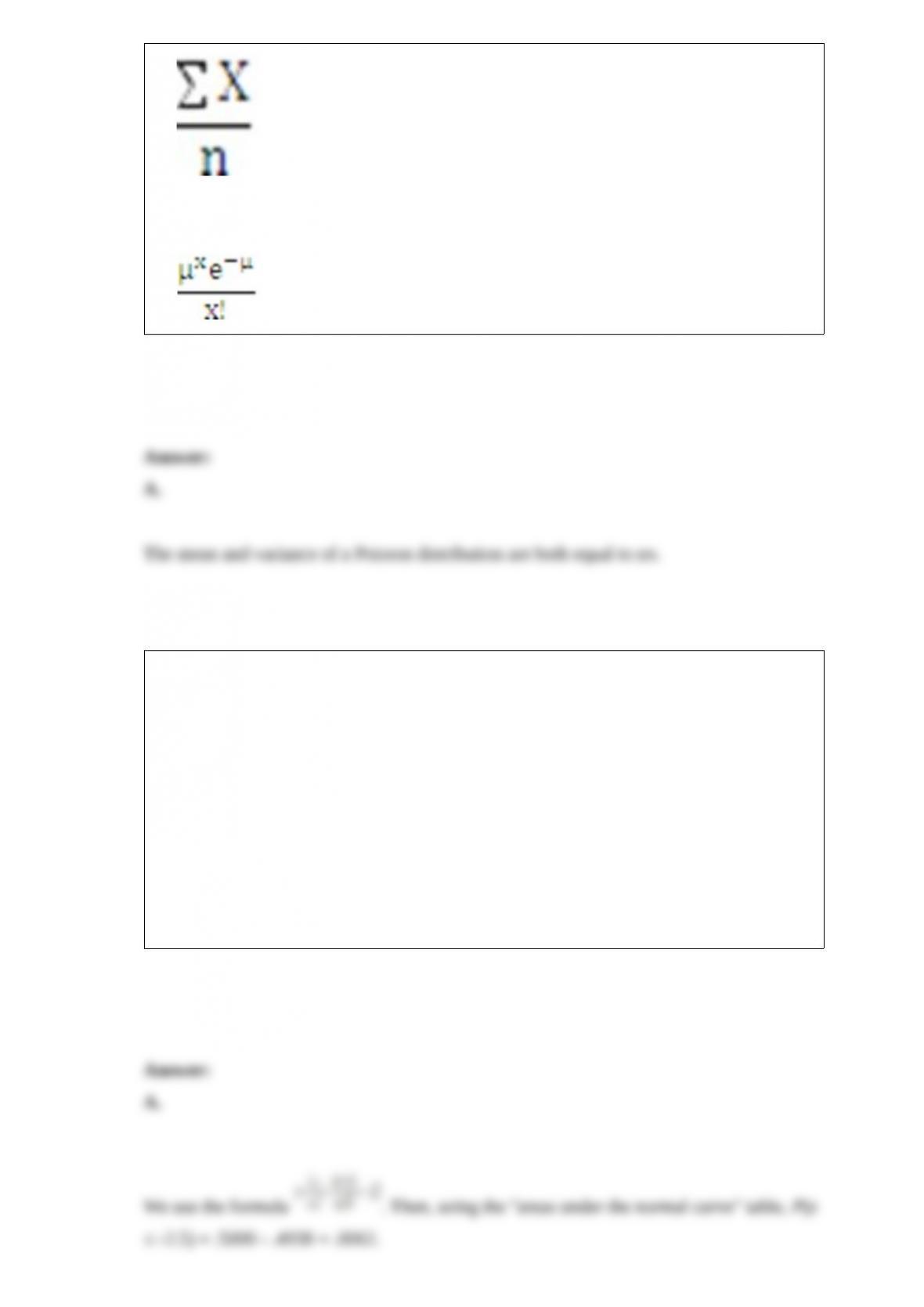
B.
C. e-x
D.
The weight of trucks traveling on a particular section of I-475 has a population mean of
15.8 tons and a population standard deviation of 4.2 tons. What is the probability a state
highway inspector could select a sample of 49 trucks and find the sample mean to be
14.3 tons or less?
A. 0.0062
B. 0.3632
C. 0.1368
D. 0.4938
In a goodness-of-fit test, the null hypothesis (no difference between sets of observed
and expected frequencies) is rejected when the ________________.
A. Computed chi-square is less than the critical value
B. Difference between the observed and expected frequencies is significantly large
C. Difference between the observed and expected frequencies is small
D. Difference between the observed and expected frequencies occurs by chance
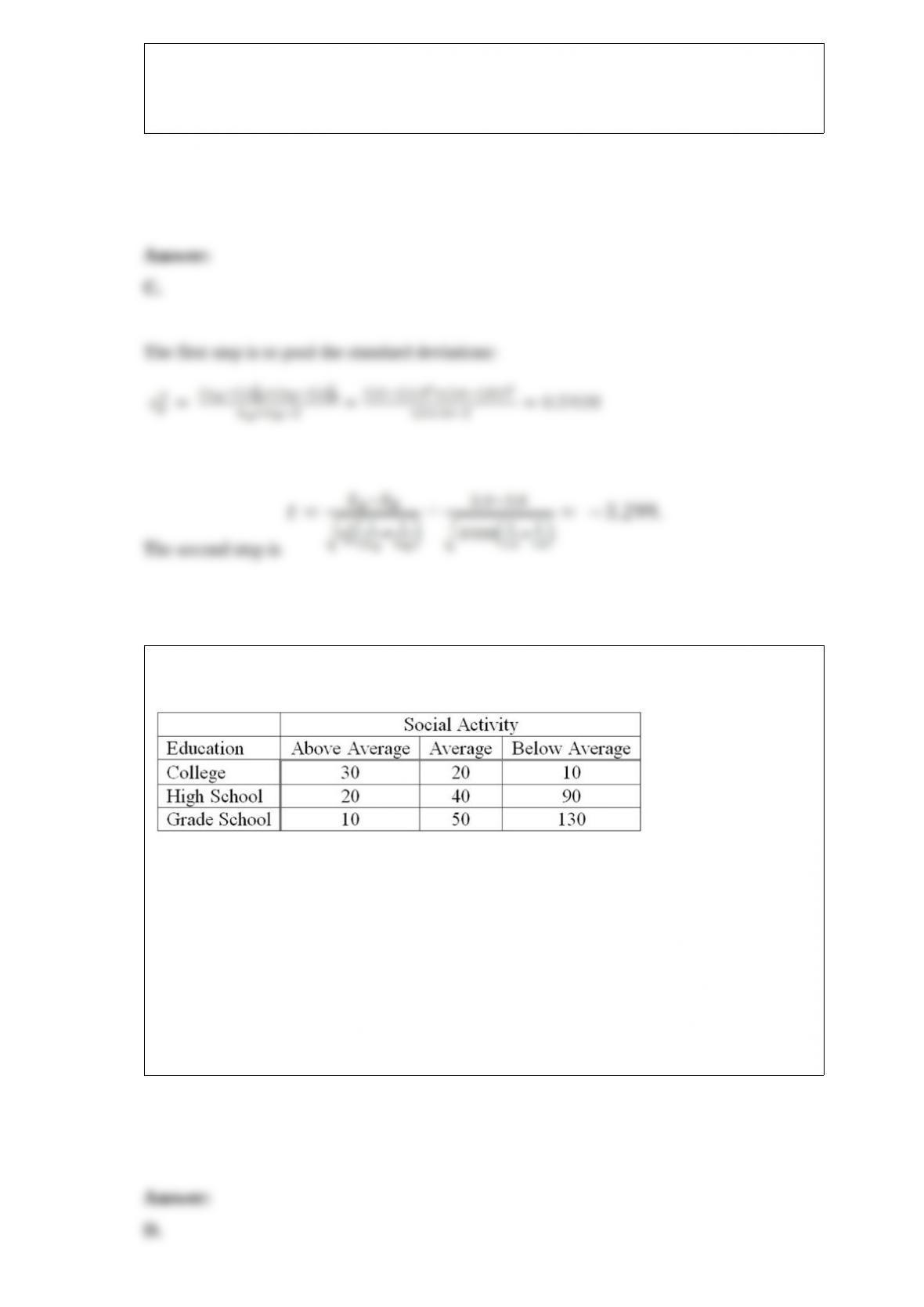
A national manufacturer of ball bearings is experimenting with two different processes
for producing precision ball bearings. It is important that the diameters be as close as
possible to an industry standard. The output from each process is sampled and the
average error from the industry standard is measured in millimeters. The results are
presented next.
The researcher is interested in determining whether there is evidence that the two
processes yield different average errors. The population standard deviations are
unknown but are assumed equal. What is the computed value of t?
A. +2.797
B. -1.000
C. -3.299
D. 0.5938
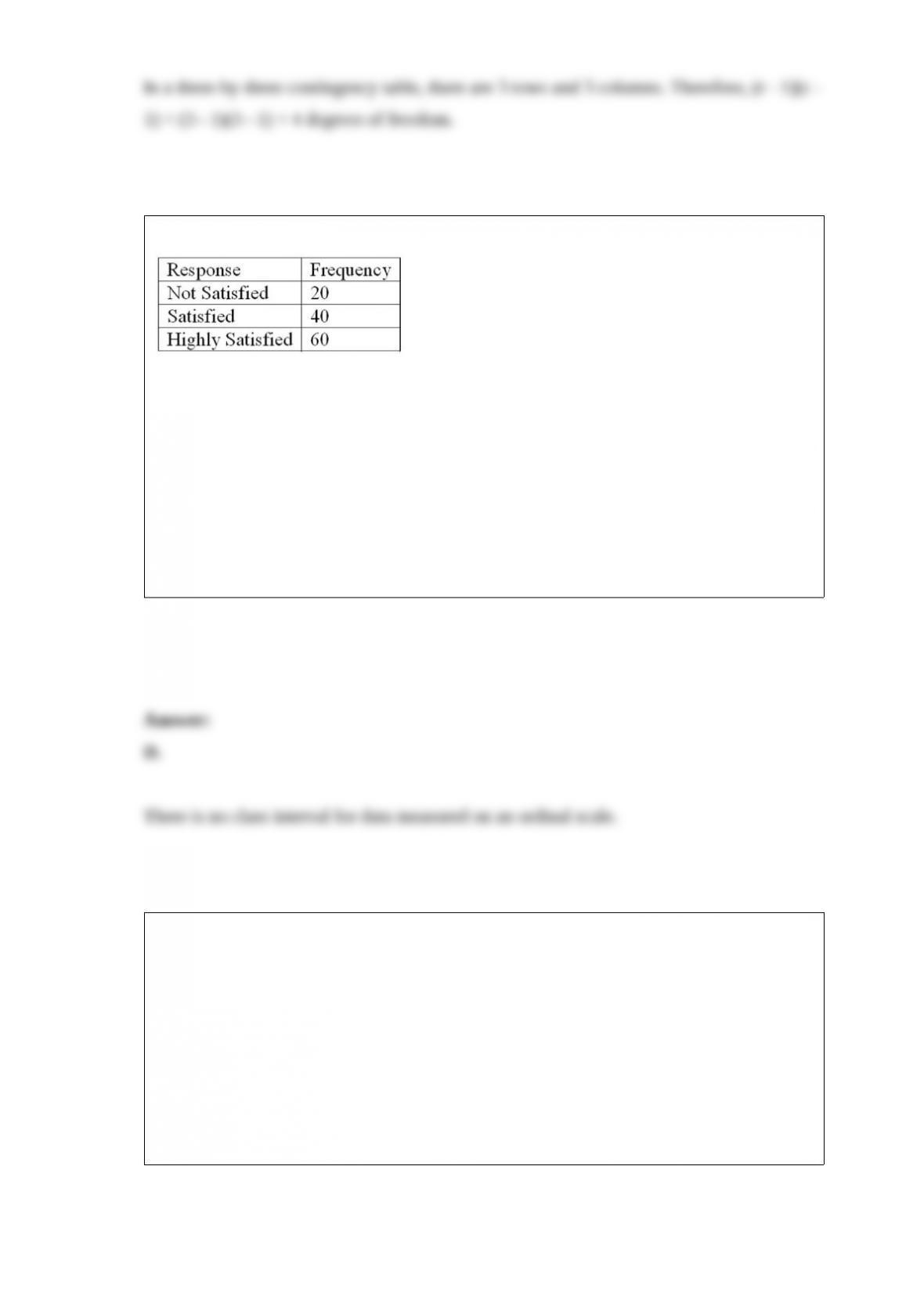
A recent study of the relationship between social activity and education for a sample of
corporate executives showed the following results.
The degrees of freedom for the analysis are __________.
A. 1
B. 2
C. 3
D. 4
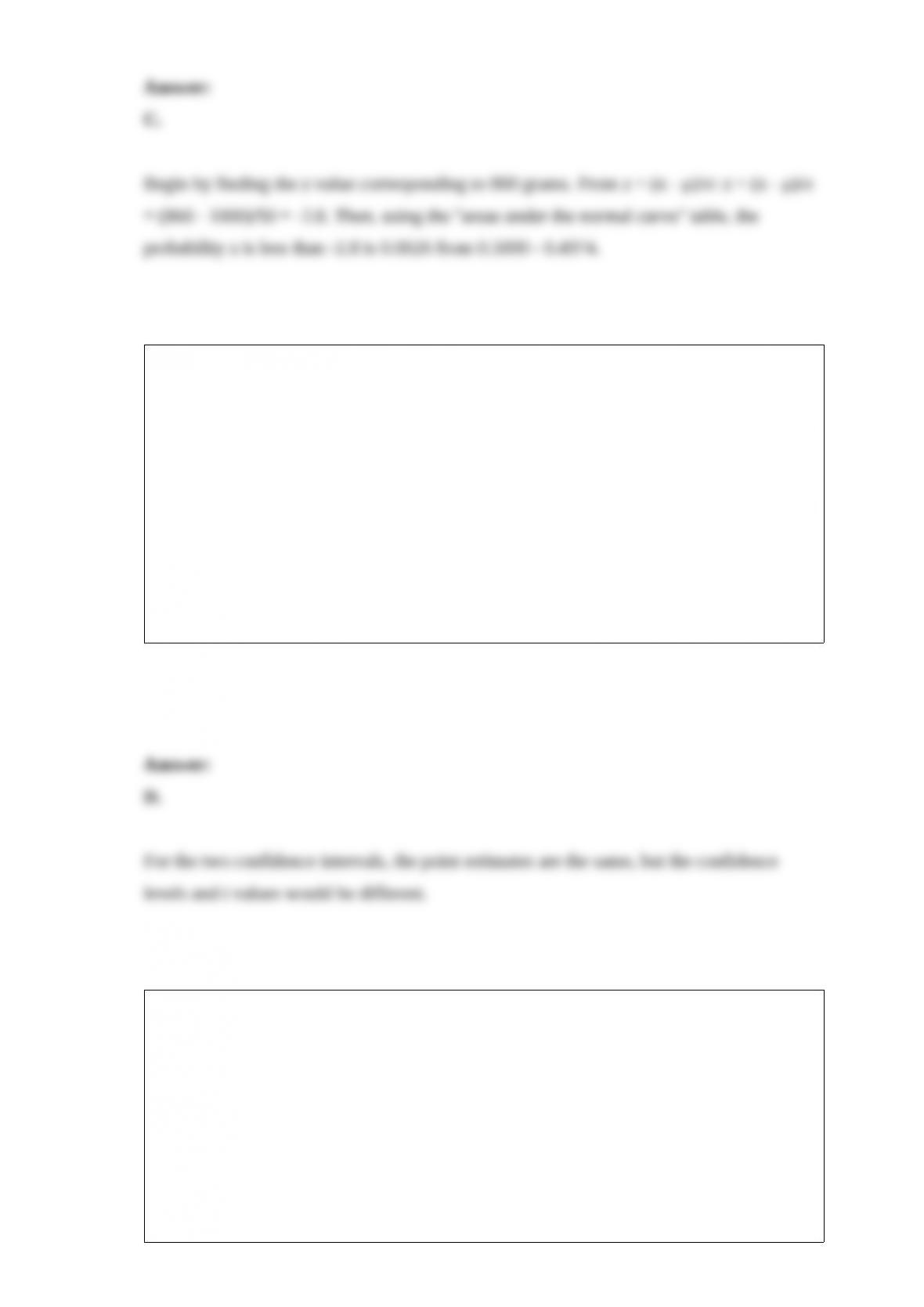
Refer to the following breakdown of responses to a survey of room service in a hotel.
What is the class interval for the frequency table above?
A. 10
B. 20
C. 40
D. None Apply
The weight of cans of fruit is normally distributed with a mean of 1,000 grams and a
standard deviation of 50 grams. What percent of the cans weigh 860 grams or less?
A. 0.0100
B. 0.8400
C. 0.0026
D. 0.0001
A survey of 50 retail stores revealed that the average price of a microwave was $375,
with a sample standard deviation of $20. If 90% and 95% confidence intervals were
developed to estimate the true cost of the microwave, what similarities would they
have?
A. Both have the same confidence level
B. Both use the same t statistic
C. Both use the same z statistic
D. Both use the same point estimate of the population mean
Twenty randomly selected statistics students were given 15 multiple-choice questions
and 15 open-ended questions, all on the same material. The professor was interested in
determining if students scored higher on the multiple-choice questions. This experiment
is an example of ________________.
A. A one-sample test of means
B. A two-sample test of means
C. A paired t-test
D. A test of proportions
In a management trainee program, 80% of the trainees are female, 20% male. A total of
90% of the females attended college, while 78% of the males attended college. A
management trainee is selected at random. What is the probability that the person
selected is a female who did NOT attend college?
A. 0.20
B. 0.08
C. 0.25
D. 0.80
The incomes of 50 loan applicants are obtained. Which level of measurement is
income?
A. Nominal
B. Ordinal
C. Interval
D. Ratio
The Office of Student Services at a large western state university maintains information
on the study habits of its full-time students. Their studies indicate that the mean amount
of time undergraduate students study per week is 20 hours. The hours studied follows
the normal distribution with a standard deviation of six hours. Suppose we select a
random sample of 144 current students. What is the probability that the mean of this
sample is less than 19.25 hours?
A. 0.4332
B. 0.8664
C. 0.0668
D. 0.0181
What is the relationship between the variance and the standard deviation?
A. Variance is the square root of the standard deviation.
B. Variance is the square of the standard deviation.
C. Variance is twice the standard deviation.
D. There is no constant relationship between the variance and the standard deviation.
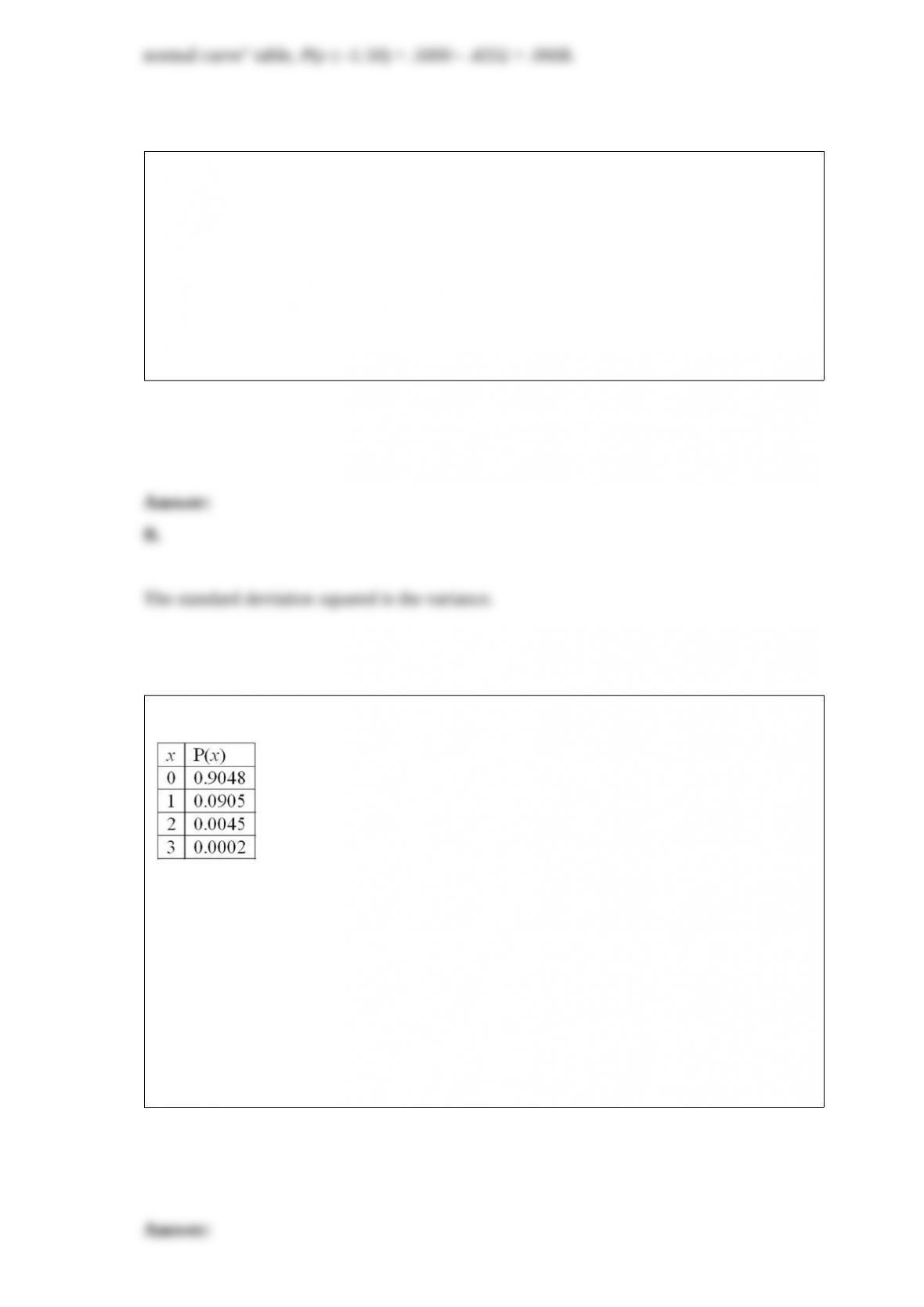
The following is a Poisson probability distribution with = 0.1.
The variance of the distribution is ______.
A. 1.0
B. 0.9046
C. 3.0
D. 0.1
A student wanted to construct a 95% confidence interval for the mean age of students in
her statistics class. She randomly selected nine students. Their mean age was 19.1 years
with a sample standard deviation of 1.5 years. What is the 99% confidence interval for
the population mean?
A. [17.42, 20.78]
B. [17.48, 20.72]
C. [14.23, 23.98]
D. [0.44, 3.80]
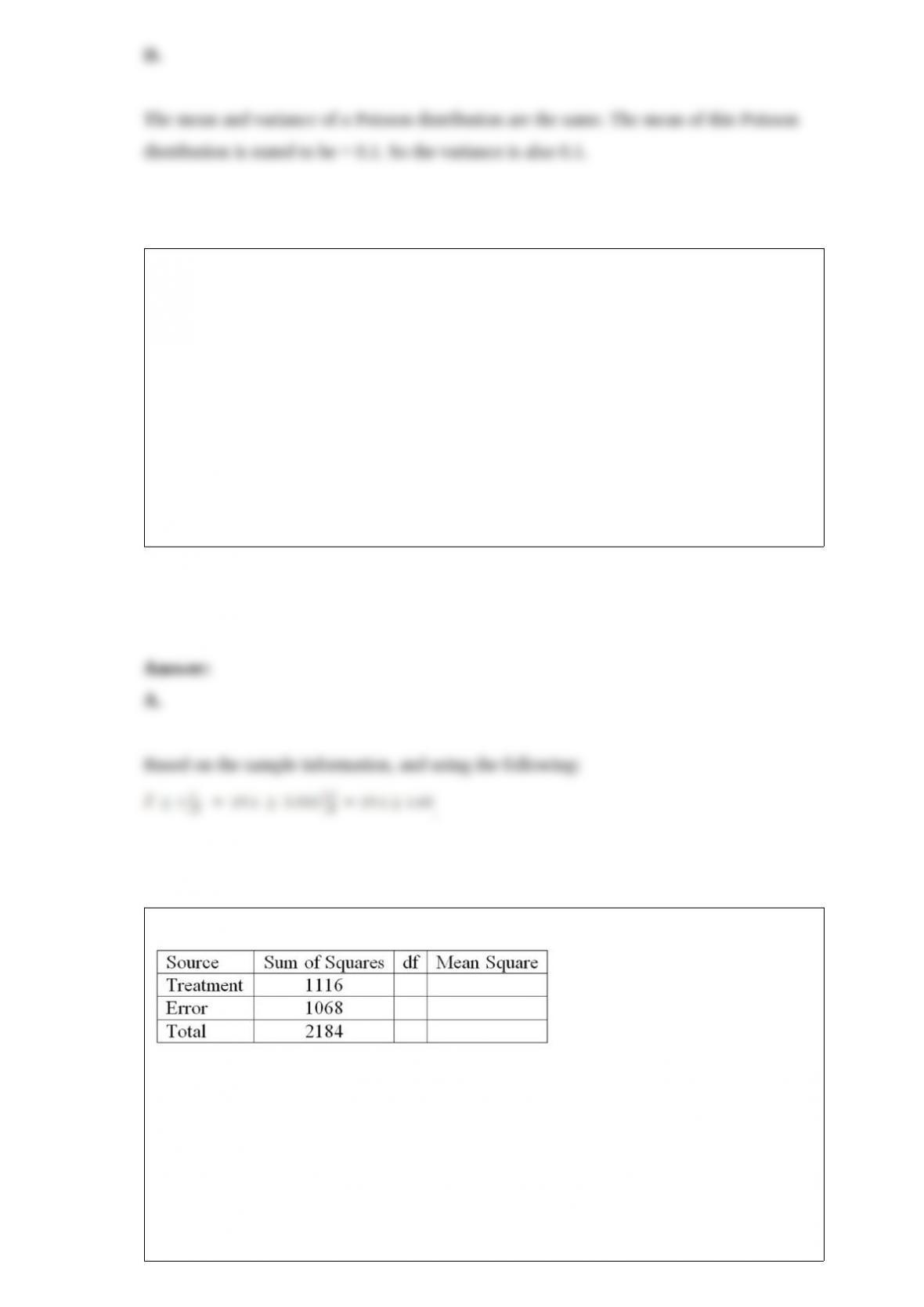
Given the following ANOVA table for three treatments each with six observations:
What is the decision regarding the null hypothesis?
A. Reject H0there is a difference in treatment means.
B. Fail to reject H0there is a difference in treatment means.
C. Reject H0there is a difference in errors.
D. Fail to reject H0there is a difference in errors.
Using a 5% level of significance and a sample size of 25, what is the critical t value for
a null hypothesis, H0: ≤ 100?
A. 1.708
B. 1.711
C. 2.060
D. 2.064
A hypothesis regarding the weight of newborn infants at a community hospital is that
the mean is 6.6 pounds. A sample of seven infants is randomly selected and their
weights at birth are recorded as 9.0, 7.3, 6.0, 8.8, 6.8, 8.4, and 6.6 pounds. What is the
sample standard deviation?
A. 1.177
B. 1.188
C. 1.386
D. 1.090
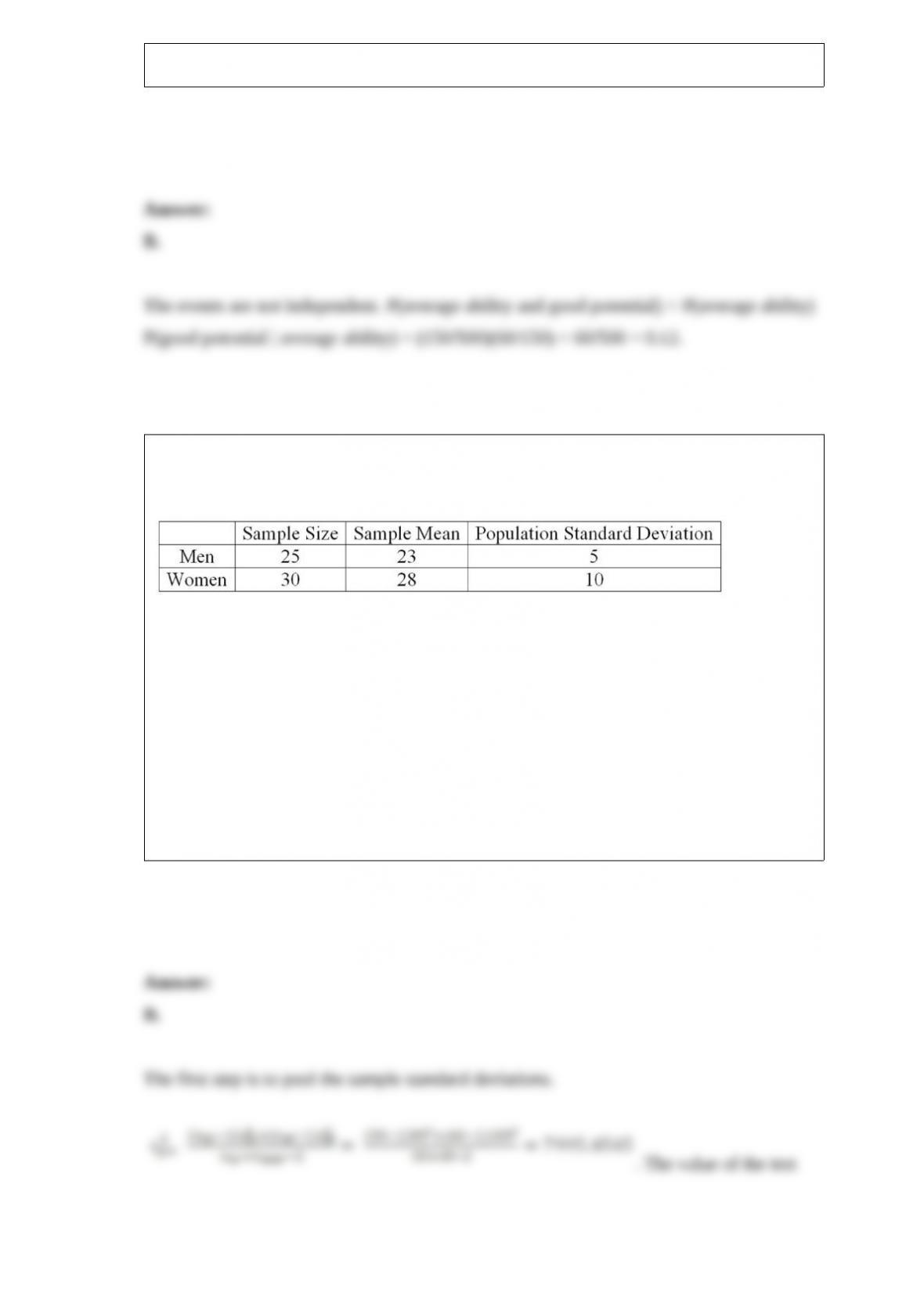
Each salesperson in a large department store chain is rated on their sales ability and
their potential for advancement. The data for the 500 sampled salespeople are
summarized in the following table.
What is the probability that a salesperson selected at random will have average sales
ability and good potential for advancement?
A. 0.09
B. 0.12
C. 0.30
D. 0.525
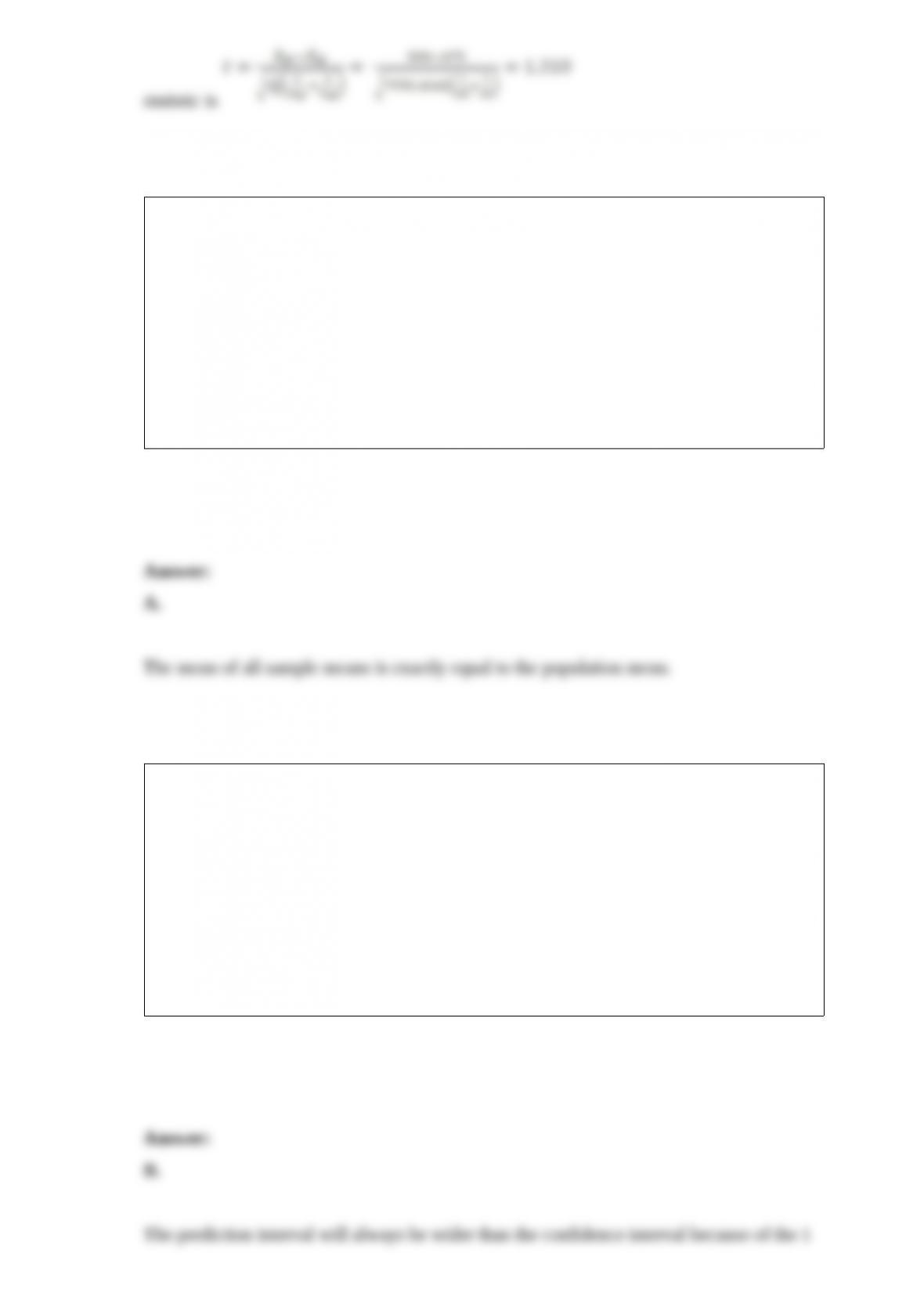
A recent study focused on the amount of money single men and women save monthly.
The information is summarized next. Assume that the population standard deviations
are equal.
At the .01 significance level, do women save more money than men? What is the value
of the test statistic for this hypothesis test?
A. +6.213
B. +1.318
C. +2.632
D. +2.40
All possible samples of size n are selected from a population and the mean of each
sample is determined. What is the mean of the sample means?
A. The population mean.
B. It is larger than the population mean.
C. It is smaller than the population mean.
D. It cannot be estimated in advance.
When comparing the 95% confidence and prediction intervals for a given regression
analysis ______________.
A. The confidence interval is wider than a prediction interval
B. The confidence interval is narrower than a prediction interval
C. There is no difference between confidence and prediction intervals
D. The prediction interval has a higher level of confidence
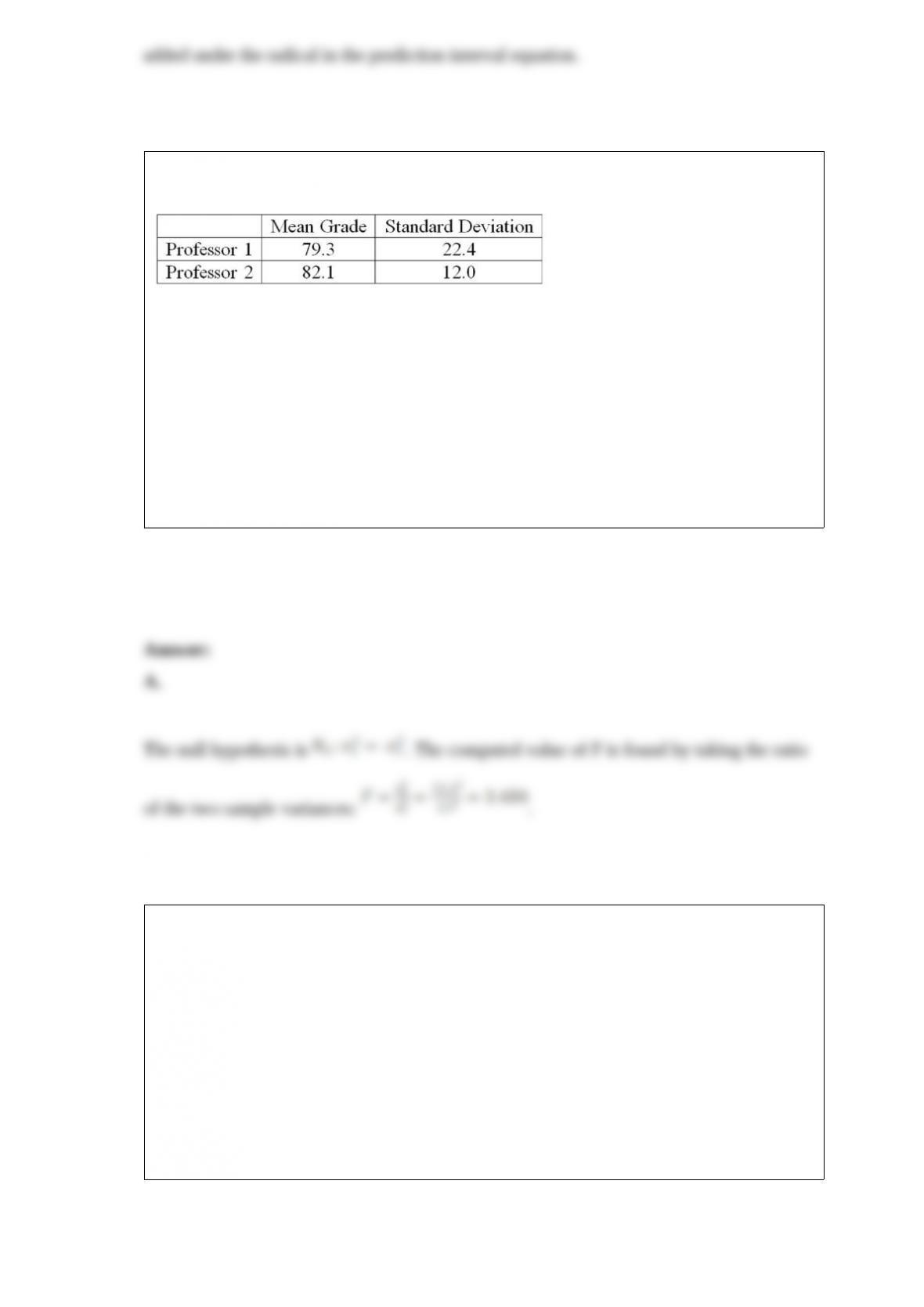
Two accounting professors decided to compare the variance of their grading procedures.
To accomplish this, they each graded the same 10 exams, with the following results:
The calculated F ratio is ______.
A. 3.484
B. 1.867
C. 3.18
D. 5.35
A survey item asked students to indicate their class in college: freshman, sophomore,
junior, or senior. Which measure(s) of central location would be appropriate for the data
generated by that questionnaire item?
A. Mean and median
B. Mean and mode
C. Mode and median
D. Mode only
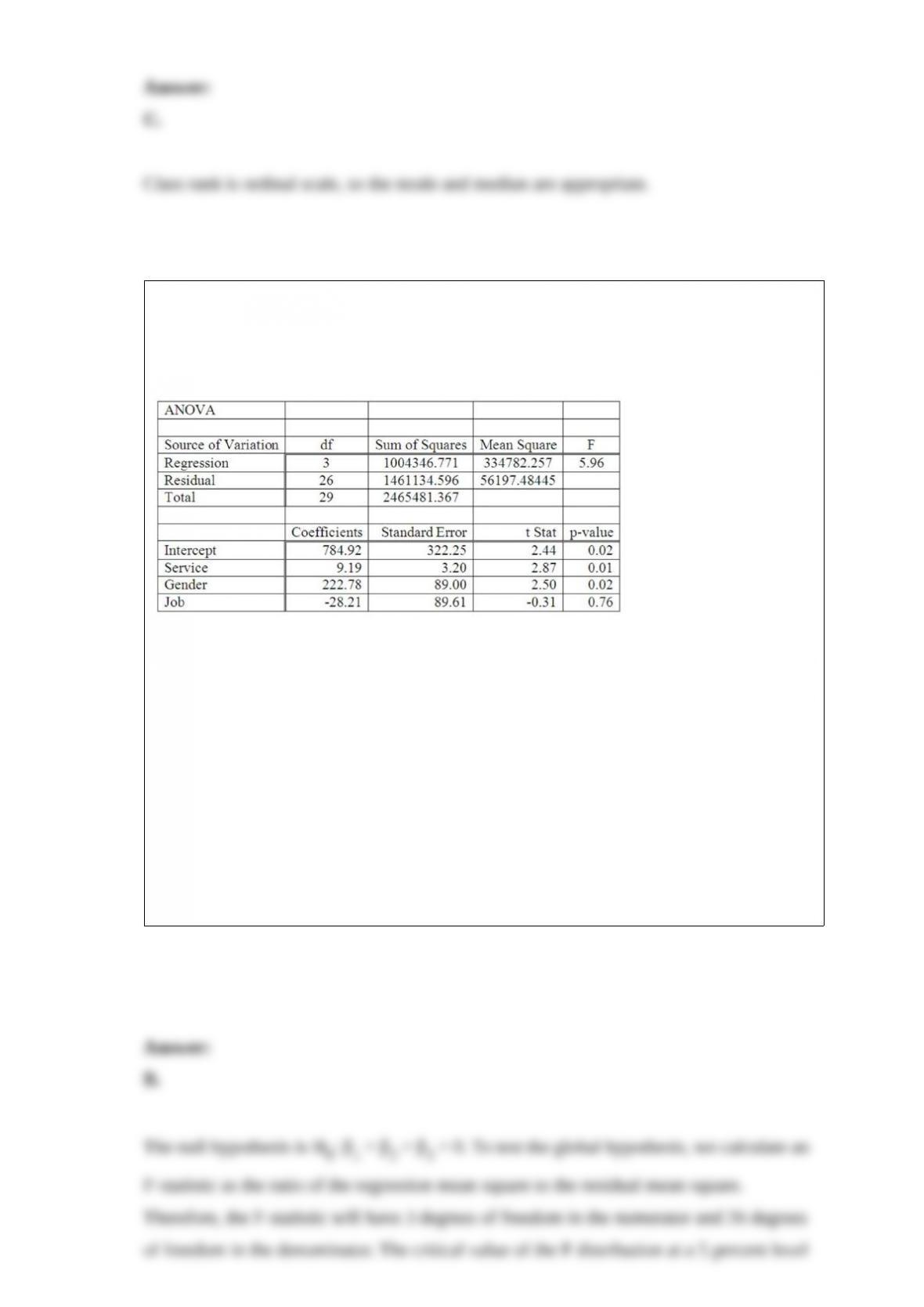
A manager at a local bank analyzed the relationship between monthly salary and three
independent variables: length of service (measured in months), gender (0 = female, 1 =
male), and job type (0 = clerical, 1 = technical). The following ANOVA summarizes the
regression results:
Based on the ANOVA and a 0.05 significance level, the global null hypothesis test of
the multiple regression model ___________.
A. Will be rejected and conclude that monthly salary is related to all of the independent
variables
B. Will be rejected and conclude that monthly salary is related to at least one of the
independent variables
C. Will not be rejected
D. Will show a high multiple coefficient of determination
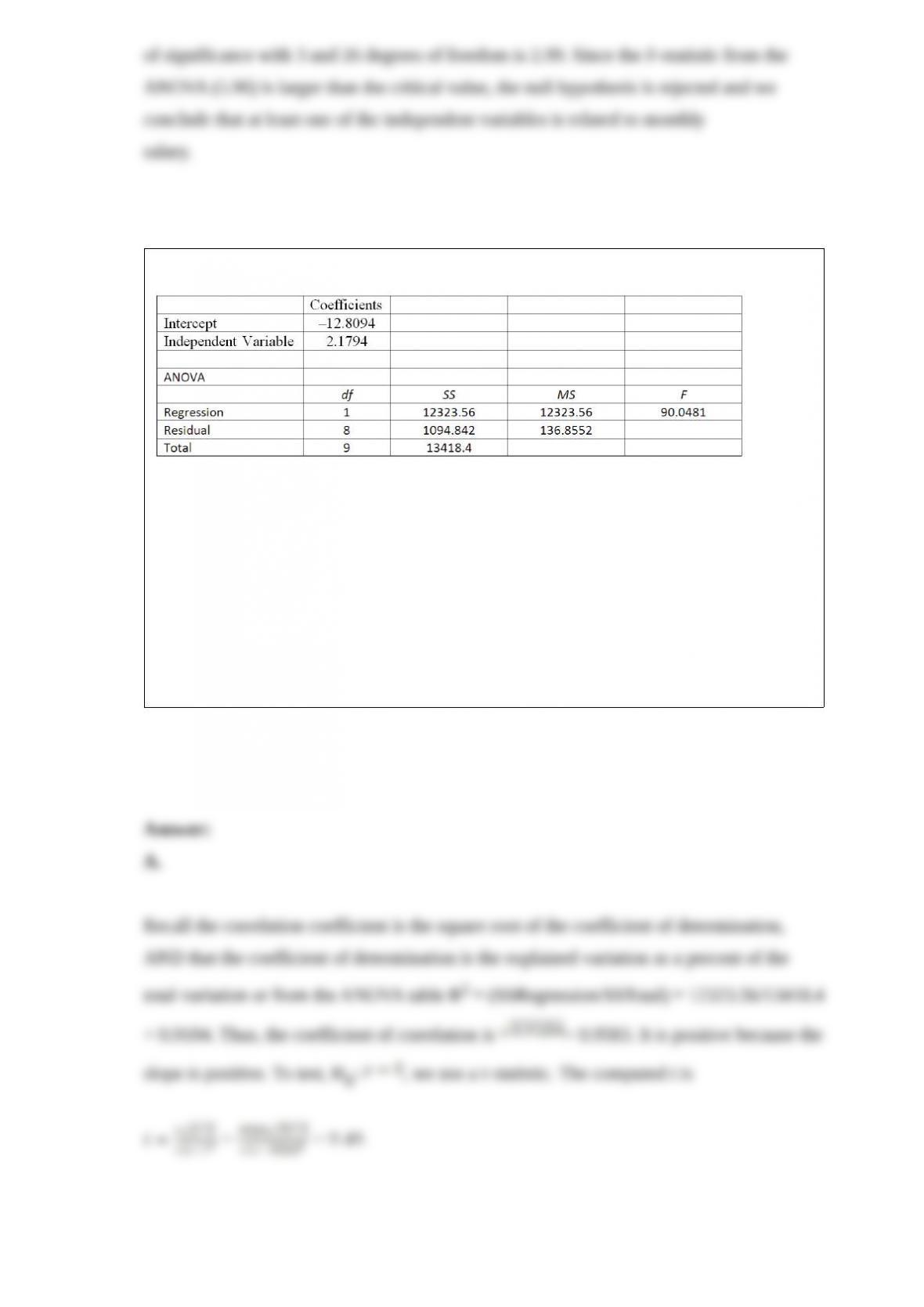
Using the following information:
If testing the hypothesis: H0: ρ = 0, the computed t-statistic is __________.
A. 9.49
B. 8.84
C. 8.18
D. Cannot be computed
A national manufacturer of unattached garages discovered that the distribution of the
time for two construction workers to erect the Red Barn model is normally distributed
with a mean of 32 hours and a standard deviation of 2 hours. What percent of the
garages take between 32 and 34 hours to erect?
A. 16.29%
B. 76.71%
C. 3.14%
D. 34.13%
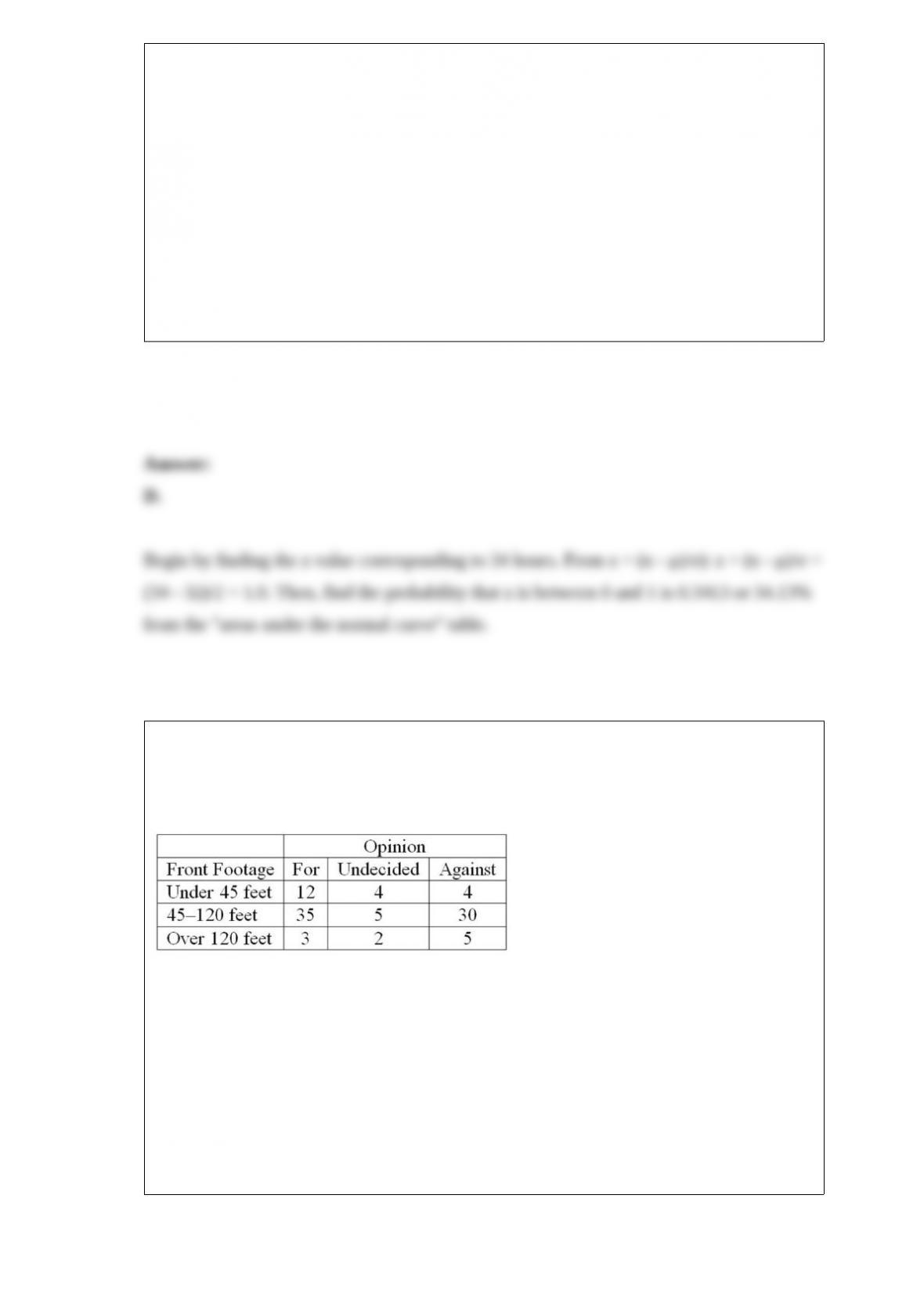
A survey of property owners’ opinions about a street-widening project was taken to
determine if owners’ opinions were related to the distance between their home and the
street. A randomly selected sample of 100 property owners was contacted and the
results are shown next.
What is the critical value at the 10% level of significance?
A. 7.779
B. 9.236
C. 9.488
D. 11.070
In multiple regression analysis, a dummy variable is coded as a _______.
A major credit card company has determined that customers charge between $100 and
$1,100 per month. If the average monthly amount charged is uniformly distributed, the
third quartile of the distribution would be _______.
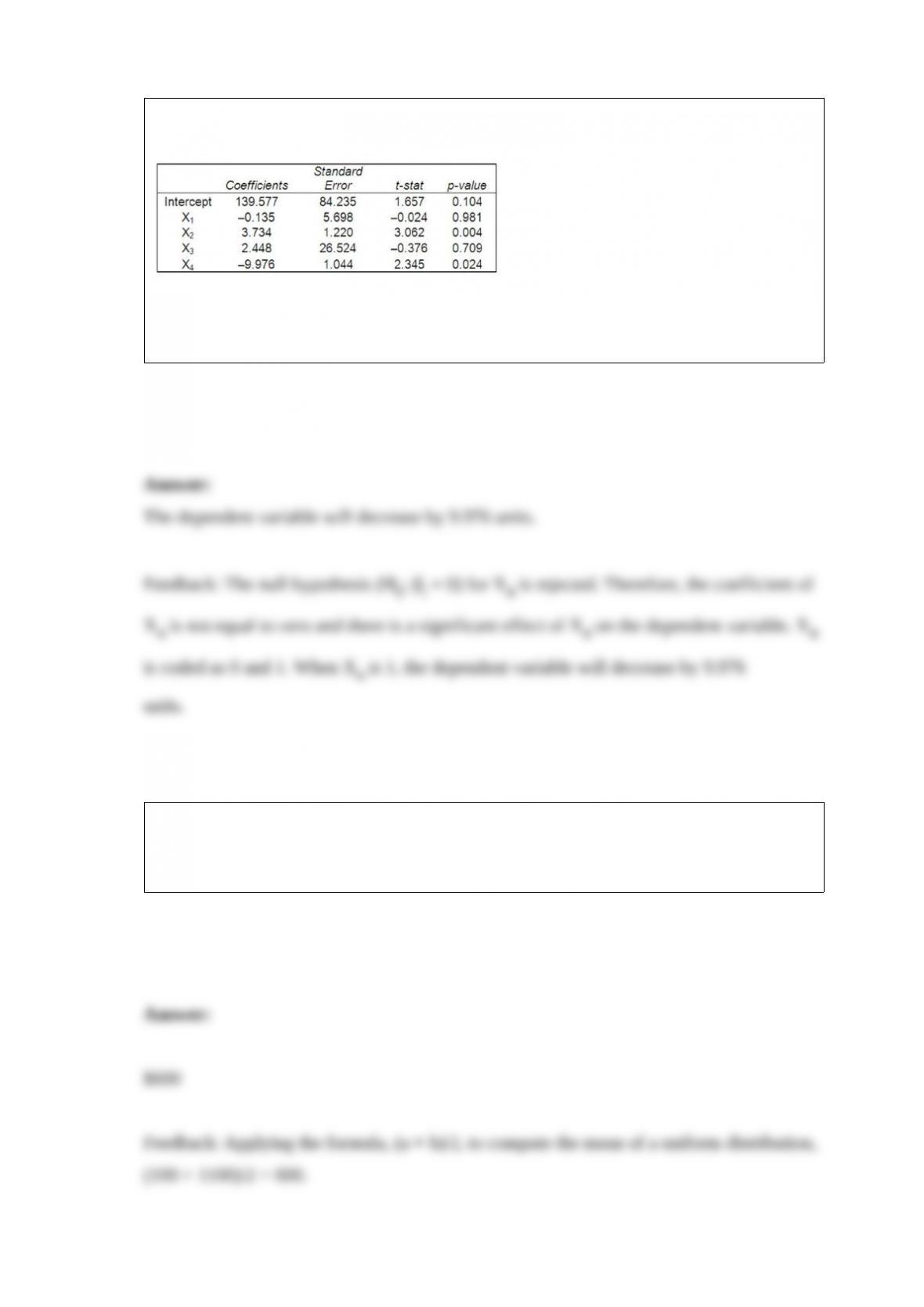
A multiple regression analysis showed the following results of the individual
independent variables.
X4 is a qualitative variable. If X4 is equal to one, what is the variable’s effect on the
dependent variable?
A major credit card company has determined that customers charge between $100 and
$1,100 per month. If the monthly amount charged is uniformly distributed, the average
charge would be ______.
A scatter diagram shows the ____________ between two interval or ratio variables.
To construct a pie chart, the class frequencies are converted to __________.
The ___________ sampling method is best to use if the population can be divided into
two or more homogeneous subgroups.
In the sampling distribution of the sample means, the standard error of the mean will
vary according to the size of the sample. As the sample size n gets larger, the variability
of the sampling distribution of the means gets _____________.
If the number of observations is 124, calculate the suggested number of classes using
the “2 to the k rule.”
The mean of a binomial distribution is calculated using ____.
A major credit card company has determined that customers charge between $100 and
$1100 per month. If the monthly amount charged is uniformly distributed, the standard
deviation of the monthly amount charged would be ________.
A random sample of 15 recent home sales was selected to test the hypothesis that the
area of a home, in square feet, and the selling price are positively correlated. The
rejection region will fall in the ________ tail of a t distribution.
A population consists of 14 values. How many samples of size five are possible?
The first three class marks for a frequency distribution of “weights of college men”
recorded to the nearest pound are 105, 115, and 125.
What is the upper limit for the third class?