
Which of the following is not an impediment to imitation?
a) Legal restrictions
b) Superior access to inputs or customers
c) Scale diseconomies
d) Market size economies
e) Intangible barriers: casual ambiguity, dependence on historical circumstances, and
social complexity
Which of the following issues makes it difficult for to managers to reign in dedicated
“cost centers” in a firm?
a) Cost centers have no dedicated “customer”
b) Cost centers are easy to judge against market counterparts performing similar
functions
c) Firms are unwilling to endure the ill will generated by firing unproductive elements
in an organization
d) Firms are always looking to cut costs when they retain an advantage insulting it from
the market
e) Managers of costs centers have significant latitude to complete their jobs

What term best describes a targeting strategy in which the firm offers a variety or
related products to a particular class of customers?
a) Broad-coverage strategy
b) Focus Strategy
c) Geographic specialization
d) Product specialization
e) Customer specialization
What term best refers to interrelated beliefs, values, material practices, and norms of
behavior that exist in an industry at any given time?
a) Institutional elements
b) Institutional standards
c) Institutional influences
d) Institutional logics
e) Institutional ideas
The following figure plots Short Run Average Cost functions for small, medium, and
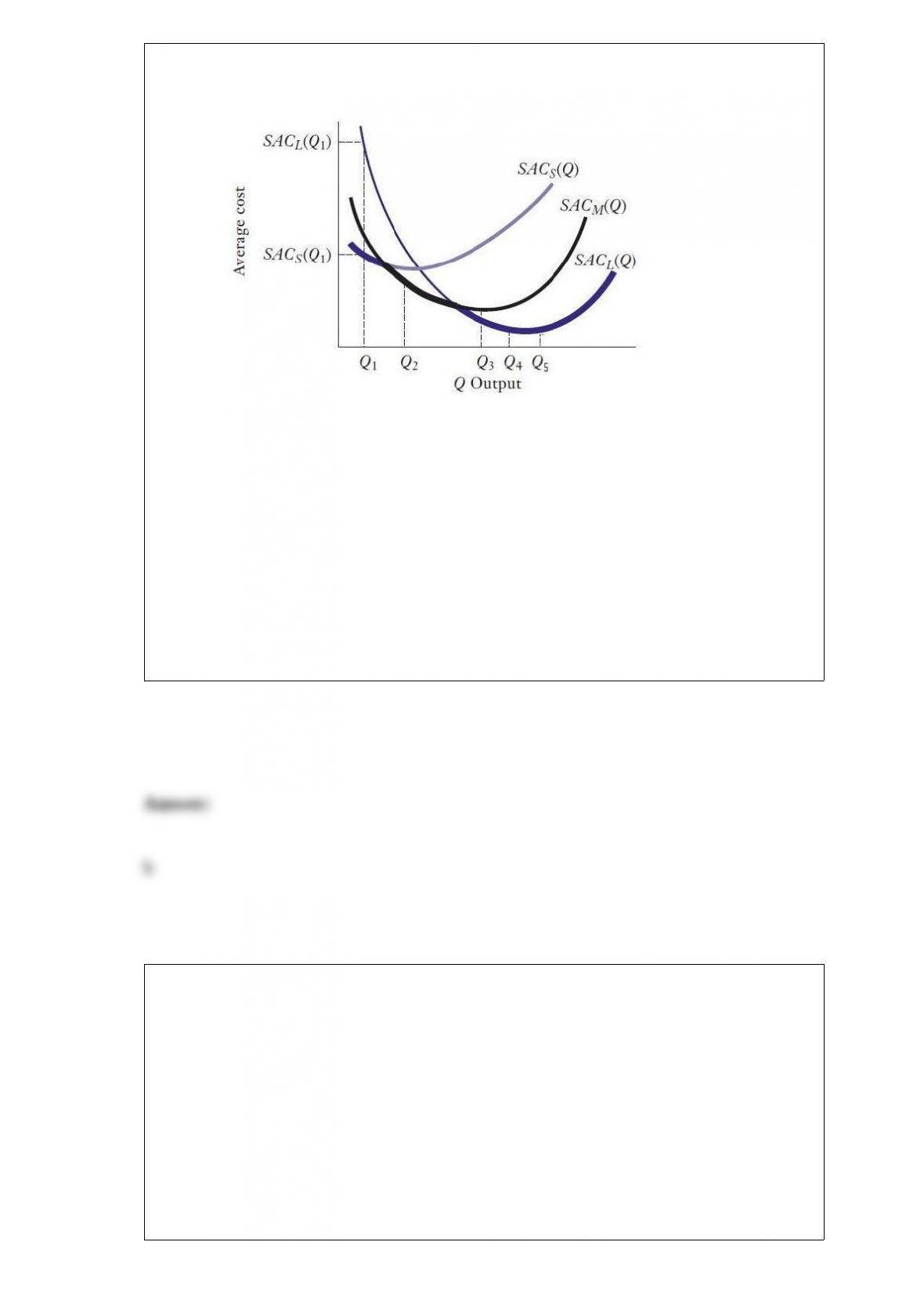
large plants. Based on the figure and plots provided, for which quantity level is a
medium plant the best choice?
a) Q1
b) Q2
c) Q3
d) Q4
e) Q5
What term best describes firm-specific assets such as patents and trademarks,
brand-name reputation, installed base, and organizational culture?
a) Competitive advantage
b) Capabilities
c) Resources
d) Threats to sustainability

e) Strategic firm assets
In which of the following ways can entry erode incumbents’ profits?
a) Entrants divide market demand among fewer sellers
b) Entrants decrease market concentration
c) Entrants usually grow the market for all parties
d) Entrants increase market concentration
e) Entrants reduce internal rivalry
The steepness (slope) of an indifference curve indicates which of the following?
a) The tradeoff a consumer is willing to make between price and quality
b) The change in price holding product benefit constant
c) The change in benefit holding price constant
d) The tradeoff between consumer surplus and producer surplus
e) None of the above

Which of the following terms best describes an individual actor’s ability to accomplish
his or her goals by using resources obtained through non-contractual exchange
relationships?
a) Power
b) Authority
c) Culture
d) Influence
e) Contracts
How does a centralized organization solve coordination problems?
a) Allows for face to face communication
b) Creates a smaller organization
c) Reduces the costs of business
d) Concentrates decision making authority in a one or a small group of people
e) Information can take more time to trickle down

What term best characterizes the battle between firms to innovate first?
a) Market for new ideas
b) New product competition
c) R&D race
d) Innovation competition
e) Patent race
Why do consumers tend to gravitate towards non-profit firms when evaluating credence
goods?
a) Consumers like giving to charities
b) Non-profit firms charge lower prices
c) Consumers can deduct some or all of the purchase price for tax purposes
d) Non-profit firms offer goods and services not offered by for profit firms
e) Consumers believe non-profit sllers will be less likely to skimp on quality for profit.

What type of strategic alliance involves two or more firms creating and together owning
a new independent organization?
a) Partnership
b) Tapered integration
c) Close-knit semi-formal relationship
d) Mutual agreement
e) Joint venture
What measure, that depends on how much of a firm’s revenues are attributable to
product market activities that have shared technological characteristics, production
characteristics, or distribution channels, is used to determine how diversified a firm is at
a given time?
a) Integration level
b) Rumelt score
c) Conglomerate level
d) Activity share
e) Relatedness

Which of the following terms is not the exercise or use of power by an individual?
a) Control
b) Influence
c) Culture
d) a and b
e) a and c
Which of the following modes of task interdependence exists between two or more
workers, positions, or groups when one depends on the outcome of others, but not vice
versa?
a) Technology interdependence
b) Environment interdependence
c) Reciprocal interdependence
d) Sequential interdependence
e) Pooled interdependence

What type of organizational structure is one in which there is a single department
responsible for each of the basic business functions within the firm?
a) Unitary functional structure
b) Multidivisional structure
c) Matrix structure
d) Network structure
e) Individual structure
Which of the following is a Legal Restriction?
a) Operational processes
b) Secret formulas or recipes
c) Employee job descriptions
d) Intellectual property
e) Operating rights
What type of option exists when a decision maker has the opportunity to tailor a
decision to information that will be received in the future?

a) Real option
b) Commitment option
c) Project option
d) Decision option
e) Future option
Which of the following is a source of diseconomies of scale at a large firm?
a) Labor costs
b) Spreading specialized resources too thin
c) Conflicts of interest
d) Incentive processes
e) All of the above
Why would a report card that measures inputs possibly lead to multitasking?
a) Sellers would raise the price of goods with low quality inputs

b) Consumers would only know the “ingredients” in a production process
c) The cost of the report card would be passed on in lower product quality
d) Sellers may invest only in reported inputs but scale back on unreported inputs
e) Firms will not disclose poor report card scores
Why might a large firm actually be at an advantage over a smaller firm with respect to
labor?
a) Large generally pay a compensating differential to attract workers
b) Worker turnover is generally lower
c) Large firms enjoy better scale economies when negotiating with health insurance
companies for health benefits
d) Large firms are generally less attractive to qualified, upward mobile workers
e) Large firms often have to draw workers from a greater distance to fill their ranks
Why are the current health care systems on the rise being built around the integration of
clinical information technology and disease management systems?
a) They both have high costs

b) They both are new trends in health care
c) They are easy to integrate
d) They do not require a significant investment to integrate
e) They both require asset specificity and coordination
Which of the following is generally thought of as a buyer in the hospital industry?
a) Pharmaceutical drug houses
b) Medical equipment companies
c) Technician
d) Patients
e) Nurse
Which of the following is a complement to professional sports?
a) Merchandise sales
b) Gambling
c) Luxury Boxes at stadiums

d) Food and beverage sales
e) None of the above
Which of the following is not a common characteristic of capabilities?
a) They are valuable across multiple products or markets
b) They are tacit
c) They are easy to reduce to simple algorithms or procedure guides
d) They are embedded in what Richard Nelson and Sidney Winter call organizational
routines ” well-honed patterns of performing activities inside an organization
e) They can persist even though individuals leave the organization
Which of the following terms best describes the division of an organization into formal
groupings?
a) Complex hierarchy
b) Coordination
c) Control

d) Hierarchy of authority
e) Departmentalization
The basic law of demand says that all other things being the same,
_______________________.
a) The lower the price of a product, the less of it consumers will purchase
b) The higher the price of a product, the less of it consumers will purchase
c) The lower the price of a product, the more of it consumers will purchase
d) The higher the price of a product, the more of it consumers will purchase
e) The greater the number of units of a product sold in the past, the more of it
consumers will purchase that product in the future
Which of the following statements is true about how the volatility of demand conditions
affects the sustainability of cooperative pricing?
a) Price cutting is easier to detect when demand conditions are volatile
b) Pricing coordination becomes easier in a volatile demand condition because firms are
chasing a moving target
c) Price cutting is harder to detect when demand conditions are stable

d) Demand volatility is an especially serious problem when the production involves
substantial variable costs
e) Demand volatility is an especially serious problem when the production involves
substantial fixed costs
Size, growth, and character of home demand for a firm’s product are examples of what?
a) Factor conditions
b) Demand conditions
c) Supply conditions
d) Related supplier or support industries
e) Strategy, structure, and rivalry
Which of the following conclusions can we make about vertical integration with regard
to product market share and scope?
a) If asset specificity is significant enough, vertical integration will be more profitable
than arm’s-length market purchases, even when production of the input is characterized
by strong scale economies or when the firm’s product market scale is small.
b) A firm gains more from vertical integration when outside market specialists are better

able to take advantage of economies of scale and scope
c) A firm with a larger share of the product market will benefit more from vertical
integration than a firm with a smaller share of the product market
d) The more a firm produces, the greater its input and this ultimately decreases the
likelihood that in-house production can take as much advantage of economies of scale
and scope as an outside market specialist
e) If a firm is considering whether to make or buy an input requiring significant
up-front setup costs, and there is a large market outside the firm for the input, then the
firm should buy the input from outside market specialists
What was one of the first plant/factory types to use the “American System” of
manufacturing?
a) Firearms
b) Steel
c) Oil
d) Automobiles
e) Chemicals
Which of the following terms best describes the extent to which two or more positions

depend on each other to do their own work?
a) Technology interdependence
b) Task interdependence
c) Information processing
d) Environmental contingencies
e) Structure-environment coherence
Products for which consumers can easily obtain the information required to compare
alternatives are called:
a) Experience goods
b) Search goods
c) Retail goods
d) Consumer goods
e) Credence Goods