
The following questions are based on the following information. Country A can produce
either 10,000 barrels of petroleum or 12,000 bushels of wheat with one unit of its
resources. Country B can produce either 7,000 barrels of petroleum or 15,000 bushels
of wheat with one unit of its resources.If each country shifts one unit of resources into
the production of the good in which it is relatively more efficient, world output would
rise by
a. 10,000 bushels of wheat.
b. 17,000 barrels of petroleum.
c. 10,000 barrels of petroleum and 15,000 bushels of wheat.
d. 3,000 barrels of petroleum and 3,000 bushels of wheat.
e. 8,000 bushels of wheat and fall by 2,000 barrels of petroleum.
The interest rate charged by the Fed for loans to commercial banks is called the
a. prime rate.
b. required reserve ratio.
c. discount rate.
d. Q rate.
e. T-bill rate.

A perfectly competitive firm has the following cost schedule:
If the firm is a profit-maximizing firm and it can sell its output for $5 each, it should
produce ________ units.
a. 5,000
b. 6,000
c. 7,000
d. 8,000
e. 9,000
Preceding the Great Crash of 1929, the country enjoyed a period of relative economic
prosperity. This prosperity was largely attributable to
a. stronger growth in agriculture than the country had seen in years.
b. demand for manufactured goods to replace those that were worn or outdated.
c. after-effects of the high production years preceding World War I.
d. government policies that stimulated growth through taxation and investment.
e. the fact that wages and prices were rising exponentially.

If all tariffs were prohibitive
a. all domestic industries would prosper and therefore the general public welfare would
increase.
b. the government would receive no revenue from tariffs.
c. the quantity of imports of the affected goods would increase.
d. exports would increase.
e. government revenues would increase.
The discount rate is
a. the bonus the Fed credits to all banks that borrow from it.
b. a very inflexible policy tool, which the Fed rarely, if ever, uses.
c. the procedure the Fed uses when it issues treasury notes.
d. another name for the prime rate.
e. the interest rate charged by the Fed on its loans to banks.

When Simon Kuznets devised gross national product (GNP), he made the decision to
exclude illegal activities like drug smuggling and gambling from his calculations. He
based this decision mainly on the fact that
a. such activities, at that time, netted little national income.
b. he wanted to focus on activities that were “goods” and not “bads.”
c. he could not obtain accurate information on income generated through such
activities.
d. such activities generated income but few tangible products.
e. such activities were not bought and sold in markets.
When price ceilings on beef were imposed under the Nixon administration, cattle
ranchers generally responded by
a. raising prices anyway.
b. creating a deliberate market shortage.
c. finding ways to hold demand down.
d. boycotting other inputs, like grain.
e. slaughtering their cattle.

In 1996, the government replaced Aid to Families with Dependent Children (once the
most important single program of welfare cash payments) with
a. a system of payments in return for work.
b. food stamps.
c. a negative income tax.
d. Medicare.
e. unemployment compensation.
If intended spending falls short of the total value of final goods and services produced
a. GDP will rise.
b. firms will cut back on their production rates.
c. inventories will be depleted faster than firms desire.
d. the aggregate supply curve must be vertical.
e. depreciation exceeds investment.
An important distinction between corporate and unincorporated businesses is that

a. corporations have unlimited life, while unincorporated businesses are limited to the
life spans of their owners.
b. income earned by corporations is not subject to the double taxation of unincorporated
businesses.
c. corporations are subject to reorganization when major stockholders withdraw.
d. corporations have more trouble raising large sums of money than unincorporated
businesses.
e. corporations issue common stock, while unincorporated businesses issue preferred
stock.
At full employment, the short-run aggregate supply curve
a. slopes downward.
b. becomes vertical.
c. shifts to the right.
d. causes the aggregate demand curve to fluctuate.
e. reflects declining costs of production.
A production function
a. shows the functions of production such as income, welfare, and employment.
b. reflects the technological constraints with which a firm must reckon.

c. shows the output necessary to produce one unit of input.
d. is a theoretical concept having no relevance to real-world production.
e. quantifies the amounts of variable inputs needed to produce fixed inputs.
If the money supply is fixed, increases in the price level reduce
a. interest rates.
b. imports.
c. the rate of inflation.
d. total real output purchased.
e. the average money cost of each transaction.
During the mid-1990s, the short-run Phillips curve seems to have shifted downward and
closer to the origin, providing evidence that suggests
a. increasing short-run unemployment rates.
b. a rising natural rate of unemployment.
c. lower expected rates of inflation.
d. declining rates of labor-force productivity.
e. a reduction in the size of the labor force.

High rates of economic growth are clearly related to high rates of
a. unemployment.
b. consumption.
c. inflation.
d. technological change.
e. taxes on profits.
Under a flexible exchange rate system, if the rate of inflation in the United States
exceeds that in Japan
a. the Japanese yen will appreciate relative to the dollar.
b. the dollar will be devalued.
c. gold will flow from Japan to the United States.
d. the U.S. demand for yen will shift to the left.
e. the exchange rate will remain the same, but exports and imports will fall.

During the past century, the rate of return on investment in new plant equipment in the
United States has
a. fluctuated around a fairly constant level.
b. steadily declined.
c. steadily increased.
d. increased as the marginal product of capital has declined.
e. decreased as the capital-output ratio has decreased.
Individuals who purchase the final goods and services of an economy are called
a. consumers.
b. firms.
c. businesses.
d. markets.
e. entrepreneurs.

In the video, Edwin Mansfield notes that one reason why R&D spending by firms has
declined as a percent of national output is that
a. very little is left to invent, since research was so great in the first half of the twentieth
century.
b. most research goes to enhance military spending, which is no longer as important as
it once was.
c. a firm cannot appropriate all the benefits it creates from R&D, because they spill over
to outsiders, so it tends to underinvest in this area.
d. R&D rarely results in marketable products, so increasingly it is being performed in
government research facilities.
e. stagflation has made R&D unprofitable for the smaller firms that carry out the largest
share of this activity.
If the money supply is fixed, increases in the price level
a. raise the purchasing power of the money supply and increase the amount people
spend.
b. reduce the average money cost of each transaction, thus lowering total spending.
c. reduce interest rates; thus, the cost of borrowing money falls, leading to more
consumption and investment.
d. raise the incentive for people to spend on big-ticket items such as appliances,
automobiles, and houses.
e. increase the size of the money balances people want in order to maintain the real
value of their purchases, thus causing interest rates to rise.

The standard assumption in economic analysis is that firms attempt to maximize
a. sales.
b. profits.
c. costs.
d. reliability.
e. production.
A production possibilities curve is least helpful when it comes to analyzing which of the
basic tasks facing an economic system?
a. determining what is produced
b. determining how goods are produced
c. determining how society’s output is distributed
d. determining society’s rate of growth
e. all the basic economic tasks facing an economic system

When the equilibrium level of output in an economy is above its potential output
a. the government should raise its spending.
b. there is an inflationary gap.
c. the long-run aggregate supply curve is horizontal.
d. unemployment rates are high.
e. wages and prices must be rapidly falling.
One of the first economists to understand and explain the notion that specialization and
trade depend on comparative and NOT absolute advantage was
a. Adam Smith.
b. Edwin Mansfield.
c. John Maynard Keynes.
d. Thomas Malthus.
e. David Ricardo.

The ways the federal government can finance its expenditures
a. require selling the Treasury’s gold holdings.
b. number only two: raising and lowering taxes.
c. are raising taxes, borrowing, and creating new money.
d. require exporting more than it imports.
e. all lead to an increase in the national debt.
Natural monopoly is common in the ________ industry.
a. trucking
b. agricultural
c. electric power
d. automobile
e. health care
If a surge of new inventions results in many profitable investment opportunities, the
demand for loanable funds will
a. shift to the left, causing the interest rate to fall.
b. shift to the left, causing the interest rate to rise.
c. shift to the right, causing the interest rate to rise.
d. shift to the right, causing the interest rate to fall.
e. be unaffected, but the supply of loanable funds will rise.
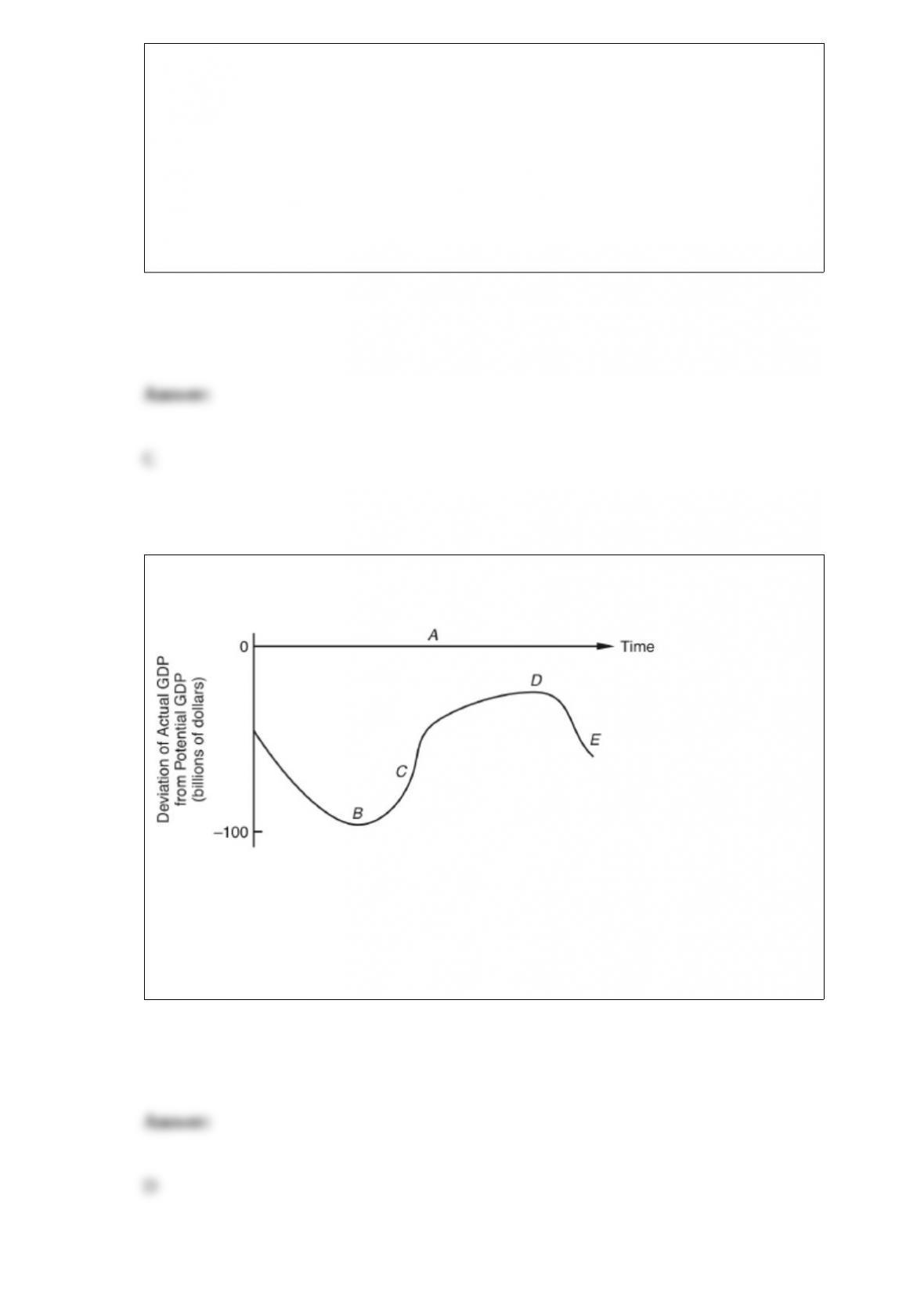
The following questions are based on the following diagram:
The peak of the cycle is best characterized by letter
a. A.
b. B.
c. C.
d. D.
e. E.

Under which of the following price elasticities will a decrease in price lead to the
greatest increase in expenditures by consumers?
a. 0
b. 0.3
c. 1.0
d. 1.8
e. 2.3