Ceteris paribus, when households spend less but do not supply of all their additional
saving to the loanable funds market,
a. total spending will exceed below total income, satisfying Say’s law.
b. total spending will drop below total income, violating Say’s law.
c. total spending will drop below total income, thereby satisfying Say’s law.
d. total spending will equal total income, violating Say’s law.
e. this will contribute to an economic expansion.
Which of the following must be true in an oligopoly?
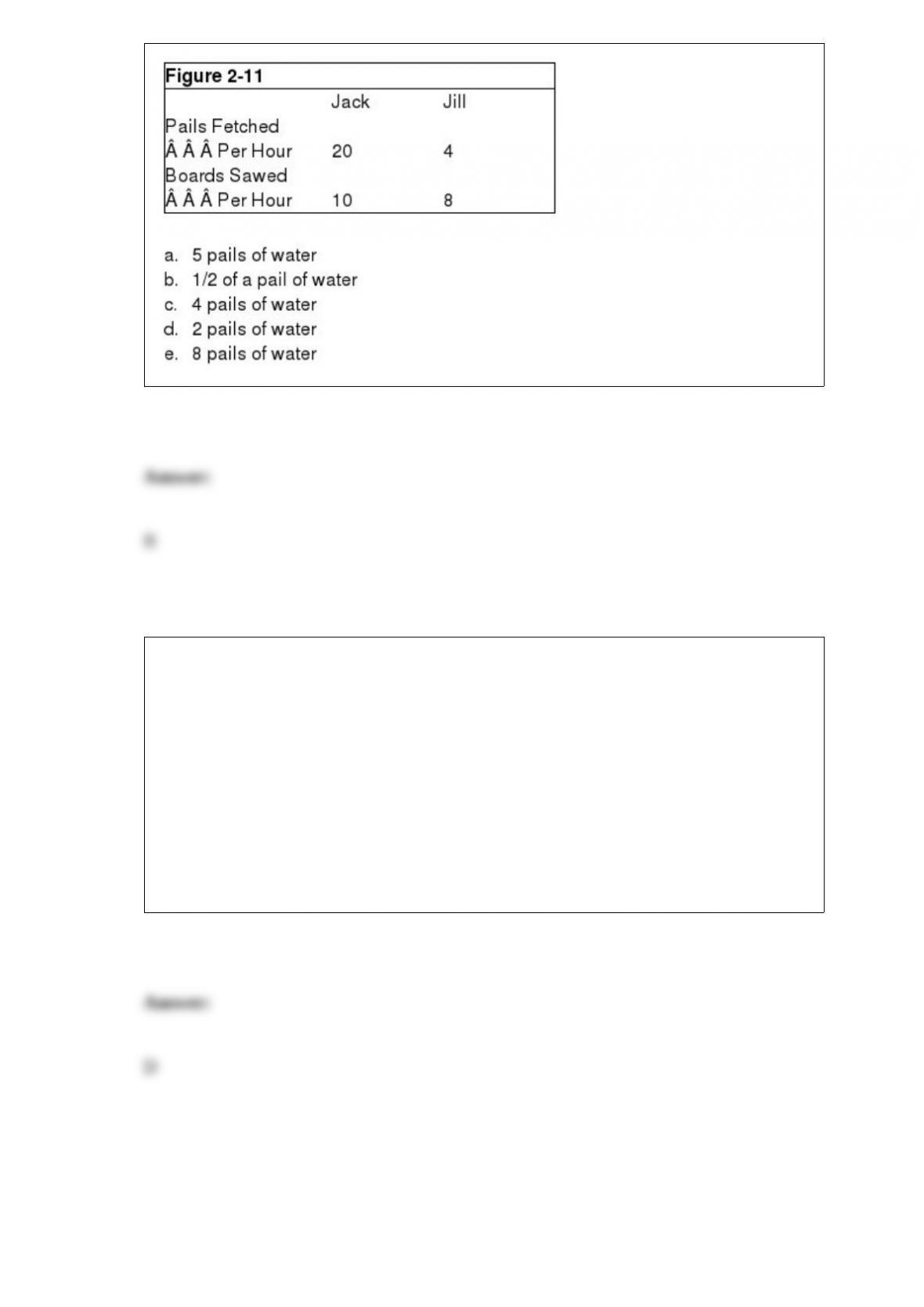
According to the information in Figure 2-11, Jill’s opportunity cost of sawing a board is
Which of the following shocks could trigger an expansion?
a. A large cut-back in military spending.
b. A large increase in the price of oil.
c. A sudden decrease in consumption.
d. A large military buildup.
e. A sudden decrease in investment.
In a traditional economy, decisions about what to produce, how to produce, and who
should get society’s output are made by
What do all expansions and recessions since 1950 have in common?
a. Changes in oil prices.
b. Changes in interest rates.
c. Changes in spending.
d. Changes in productivity.
e. None of the above.
If a war interrupted oil production, which of the following would most likely happen in
the short run?
a. Unit costs would decrease and there would be an upward movement along the
aggregate supply curve.

b. Unit costs would increase and the aggregate supply curve would shift upward.
c. Unit costs would increase and the aggregate supply curve would shift downward.
d. Unit costs would decrease and the aggregate supply curve would shift upward.
e. Unit costs would increase and there would be movement along the aggregate supply
curve.
A key assumption of the classical model is that
a. government intervention is important to get markets to clear
b. prices adjust until quantity supplied equals quantity demanded
c. markets never clear in the long run
d. demand adjusts in order to meet supply
e. prices remain constant and supply and demand adjust
Which of the following markets must clear if injections from the income-spending
stream are to equal leakages from the stream?
a. The resource market
b. The labor market
c. The goods market
d. The aggregate market
e. The loanable funds market
Barriers to entry into a market could include all of the following, except one. Which is
the exception?
As of 2008, approximately what fraction of U.S. GDP does government purchases now
represent?
a. One-half
b. Three-quarters
c. None; it is not included in GDP

d. Two-thirds
e. One-fifth
Which of the following is an accurate description of the aggregate demand curve?
a. It is the sum of all individual demand curves for all products
b. It shows all price levels at which firms’ unit costs equal their percent markups.
c. It is the curve decided upon by the voters.
d. It shows the relationship between firms’ unit costs and their percentage markups.
e. It shows the equilibrium level of GDP associated with price level.
An excess supply of money implies an excess
a. supply of corporate stock
b. demand for bonds
c. supply of bonds
d. demand for corporate stock
e. demand for goods and services