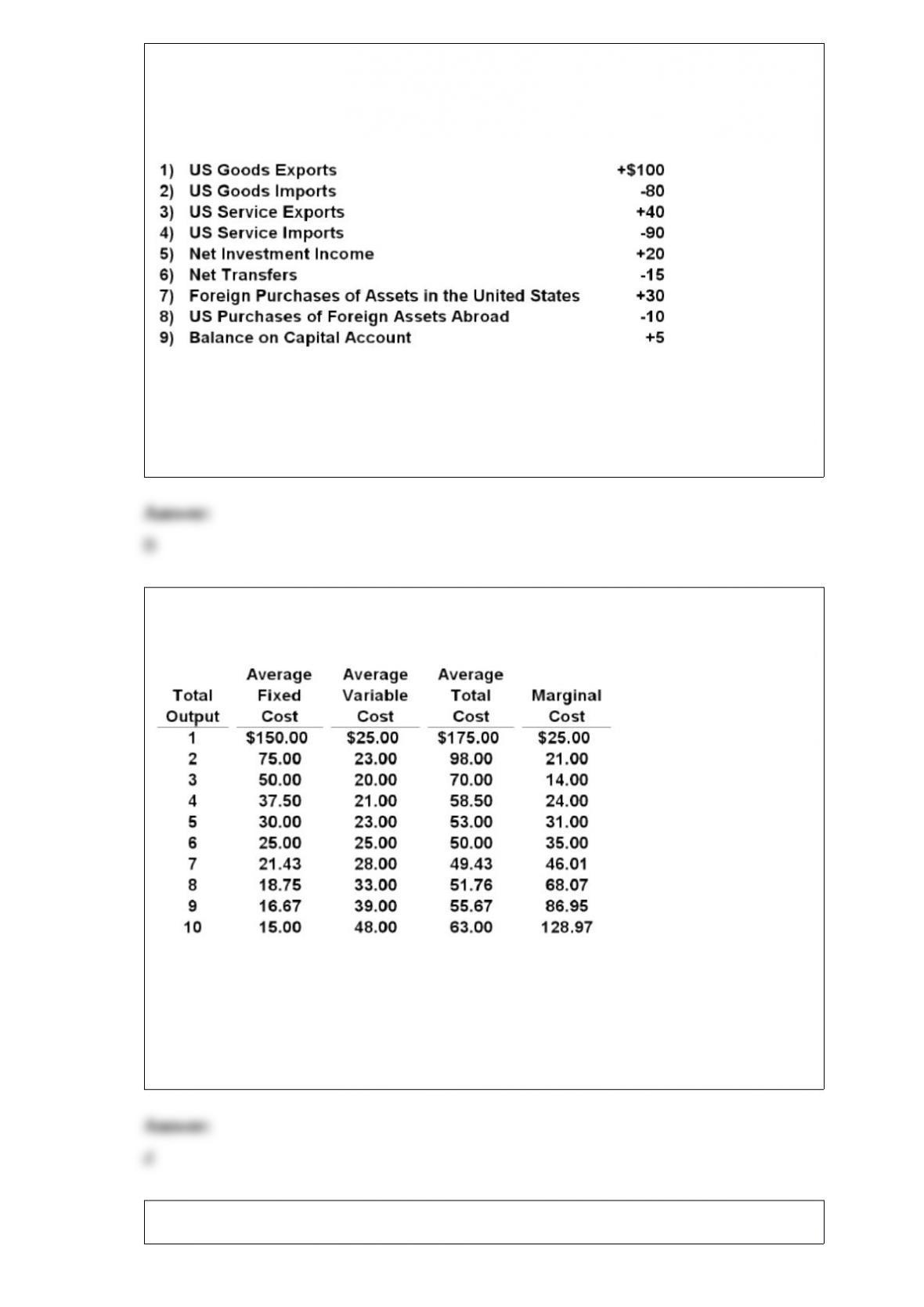
1) The following table contains hypothetical data for the 2010 U.S. balance of
payments. Answer the next question(s) on the basis of this information. All figures are
in billions of dollars.
Refer to the above data. The U.S. balance on current account is a:
A.$40 billion surplus.
B.$25 billion deficit.
C.$25 billion surplus.
D.$30 billion deficit.
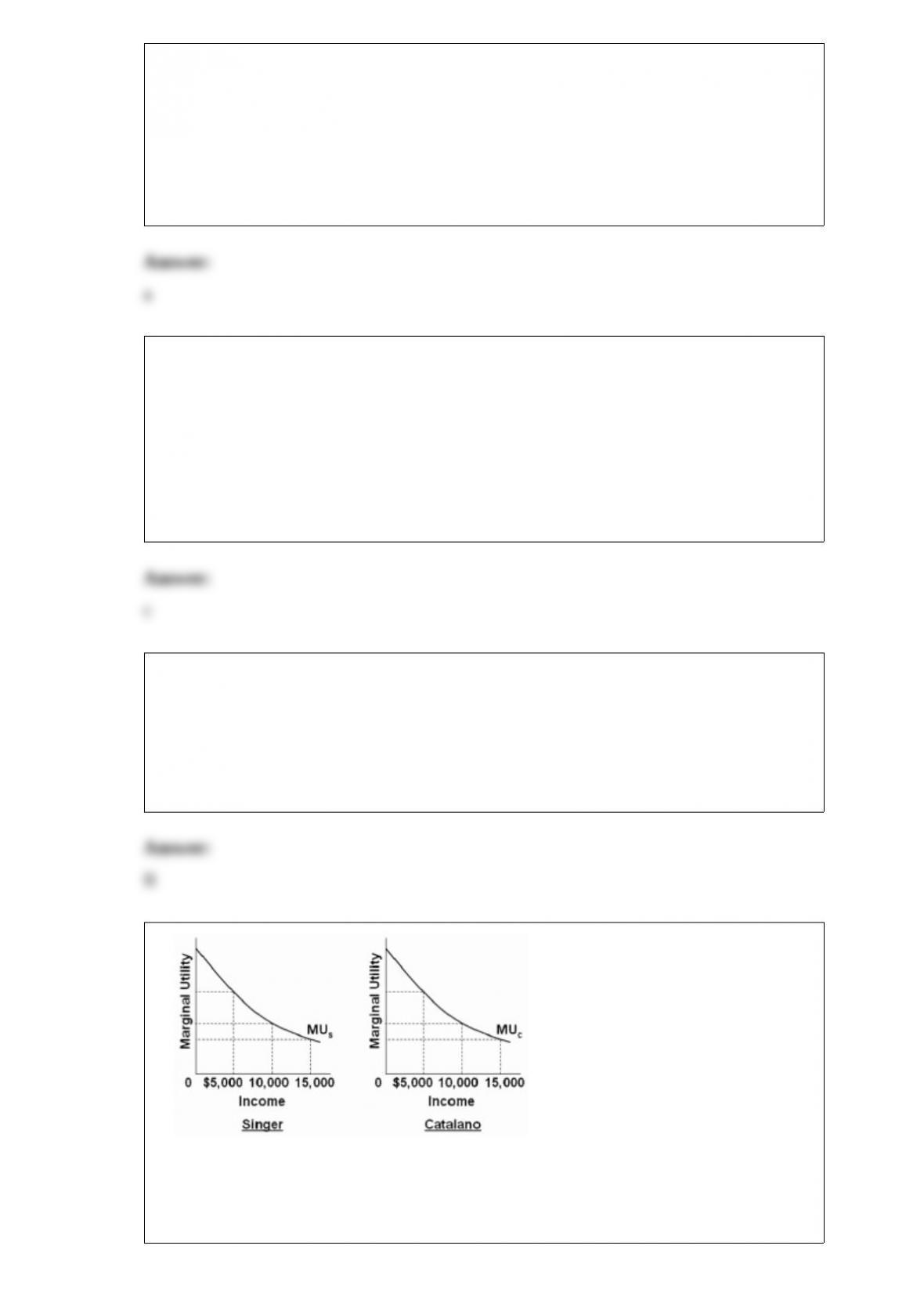
2) the following cost data for a firm that is selling in a purely competitive market.
refer to the above data. if the market price for this firm’s product is $68.07, it will
produce:
a.8 units at an economic profit of zero.
b.6 units at a loss of $90.
c.9 units at an economic profit of $281.52.
d.8 units at an economic profit of $130.48.
3) a fundamental difference between the command system and the market system is
that, in command systems:
a.the division of output is decided by central planning rather than by individuals
operating freely through markets.
b.all economic decisions are made by the government, whereas there is no government
in a market system.
c.scarcity does not exist, as it does in a market system.
d.money is not used, whereas it is in a market system.
4) producer surplus:
a.is the difference between the maximum prices consumers are willing to pay for a
product and the lower equilibrium price.
b.rises as equilibrium price falls.
c.is the difference between the minimum prices producers are willing to accept for a
product and the higher equilibrium price.
d.is the difference between the maximum prices consumers are willing to pay for a
product and the minimum prices producers are willing to accept.
5) Which of the following will generate a demand for country X’s currency in the
foreign exchange market?
A.travel by citizens of country X in other countries
B.the desire of foreigners to buy stocks and bonds of firms in country X
C.the imports of country X
D.charitable contributions by country X’s citizens to citizens of developing nations
6)
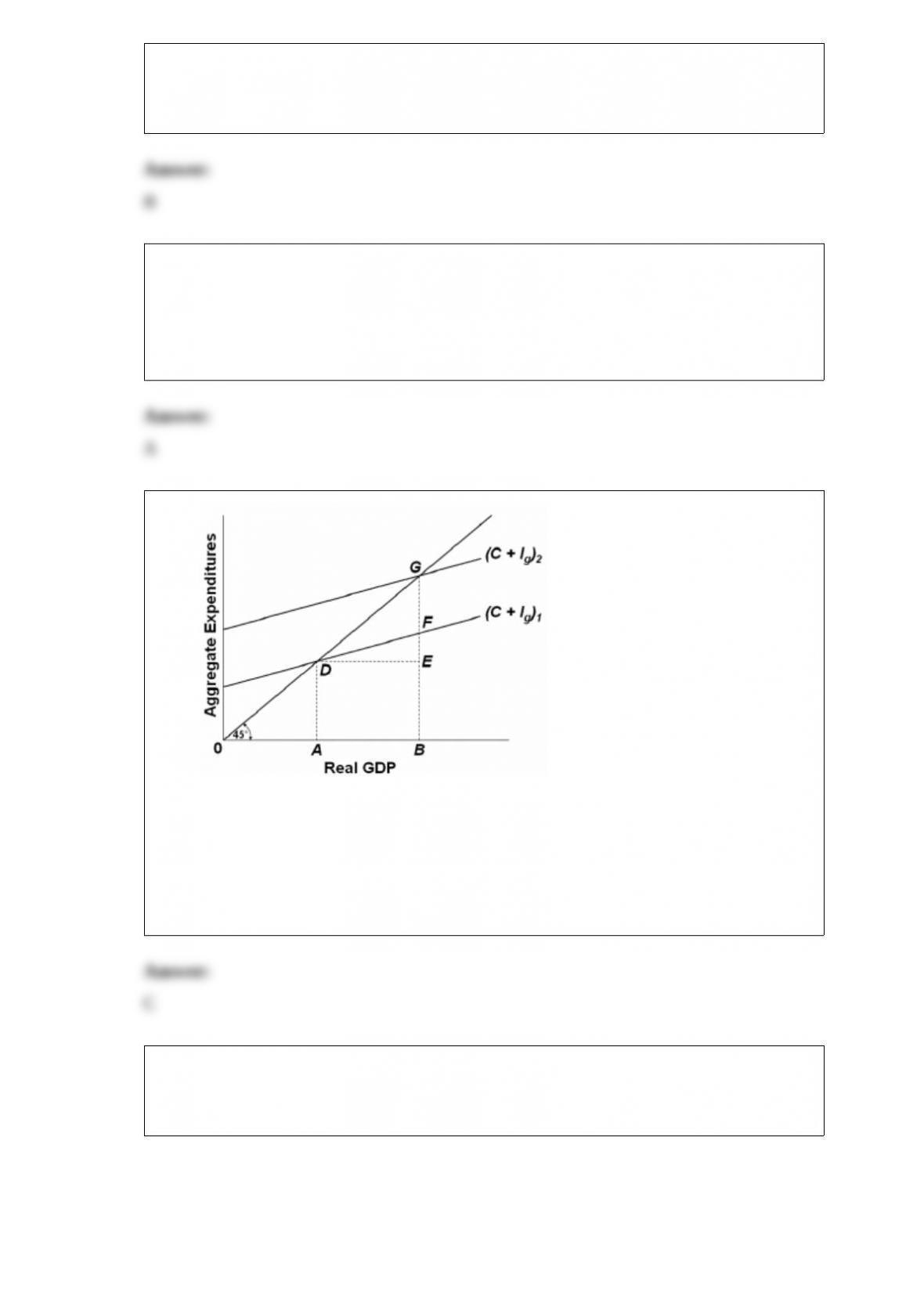
Refer to the above diagrams that show identical marginal utility from income curves for
Singer and Catalano. The marginal utility from income curves are drawn on the
assumption that:
A.Singer buys more inferior goods than does Catalano.
B.Singer and Catalano have identical capacities to enjoy income.
C.Catalano has a greater capacity to enjoy income than does Singer.
D.Singer has a greater capacity to enjoy income than does Catalano.
7) What do investment and government expenditures have in common?
A.both represent injections to the circular flow
B.both represent leakages from the circular flow
C.neither is subject to the multiplier effect
D.both represent a decline in indebtedness
8)
Refer to the above diagram for a private closed economy. The marginal propensity to
consume is:
A.GF/GB.
B.DA/GB.
C.FE/DE.
D.FB/0B.
9) The following consolidated balance sheet for the commercial banking system.
Assume the required reserve ratio is 10 percent. All figures are in billions.
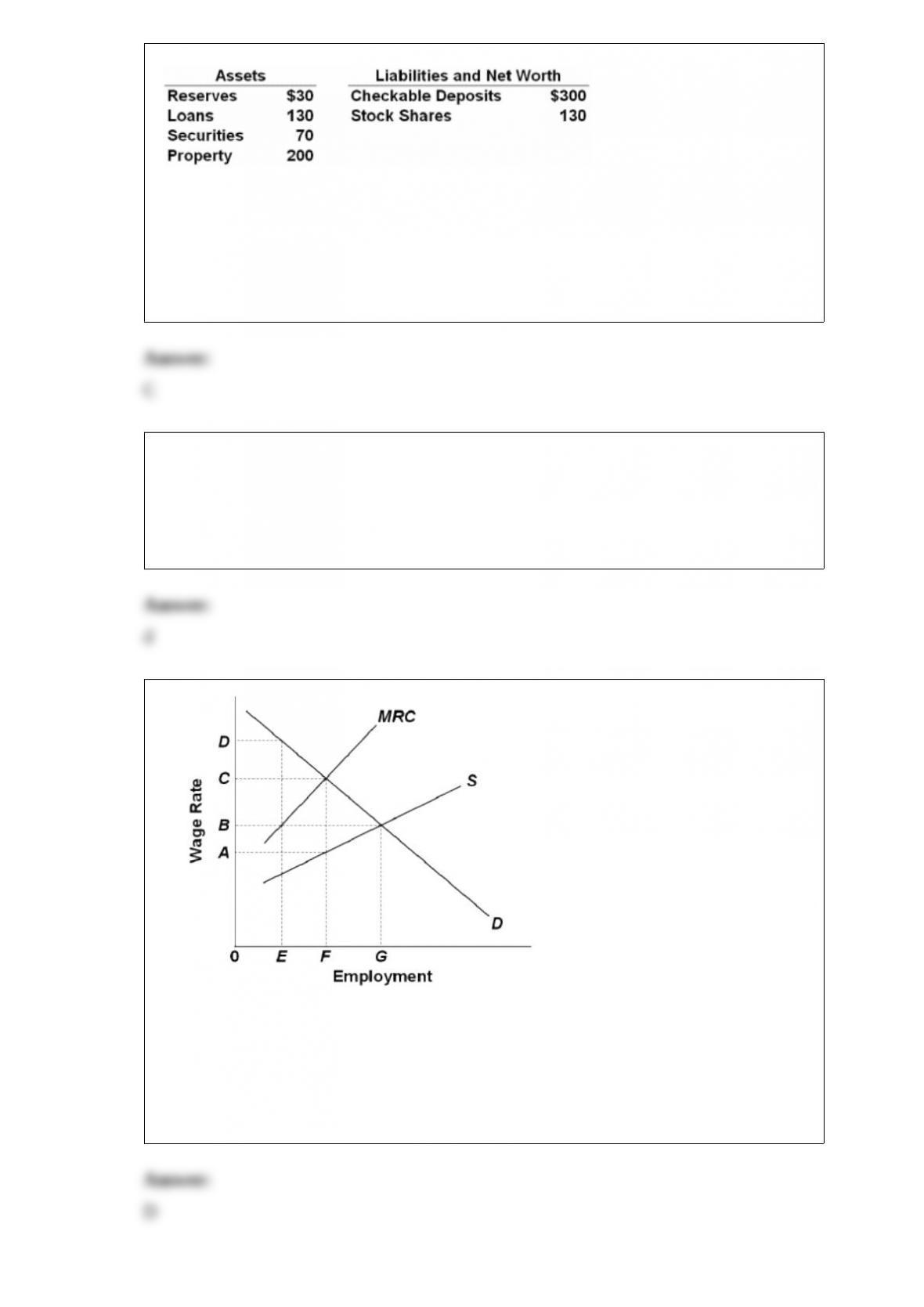
Refer to the above data. After a deposit of $10 billion of new currency into a checking
account in the banking system, excess reserves will increase by:
A.$0 billion.
B.$7 billion.
C.$9 billion.
D.$10 billion.
10) which of the following is characteristic of a pure monopolist’s demand curve?
a.average revenue is less than price.
b.its elasticity coefficient is 1 at all levels of output.
c.price and marginal revenue are equal at all levels of output.
d.it is the same as the market demand curve.
11)
Refer to the above diagram. If this labor market is monopsonistic, the wage rate and
level of employment respectively will be:
A.D and E.
B.C and F.
C.B and F.
D.A and F.

12) The idea that freely floating exchange rates equate the purchasing power of national
currencies is called:
A.the equation of exchange.
B.the balance of payments.
C.Say’s Law.
D.the purchasing power parity theory.
13) u.s. immigrants (legal and illegal) have:
a.higher prison rates and crime rates than the native-born population.
b.lower prison rates and crime rates than the native-born population.
c.lower prison rates, but illegal immigrants have higher crime rates than the native-born
population.
d.higher prison rates, but lower crime rates, than the native-born population.
14)
In long-run equilibrium there will be no economic profit in a purely competitive static
economy because:
A.barriers to entry will prevent profit from arising.
B.there will be no uncertainty, no innovations, and no monopoly.
C.there will be no need for professional managers and therefore no profit rewards will
be needed.
D.the marginal revenue product of capital will be zero.
15) Monetary policy is thought to be:
A.equally effective in moving the economy out of a depression as in controlling
demand-pull inflation.
B.more effective in moving the economy out of a depression than in controlling
demand-pull inflation.
C.more effective in controlling demand-pull inflation than in moving the economy out
of a depression.
D.only effective in moving the economy out of a depression.
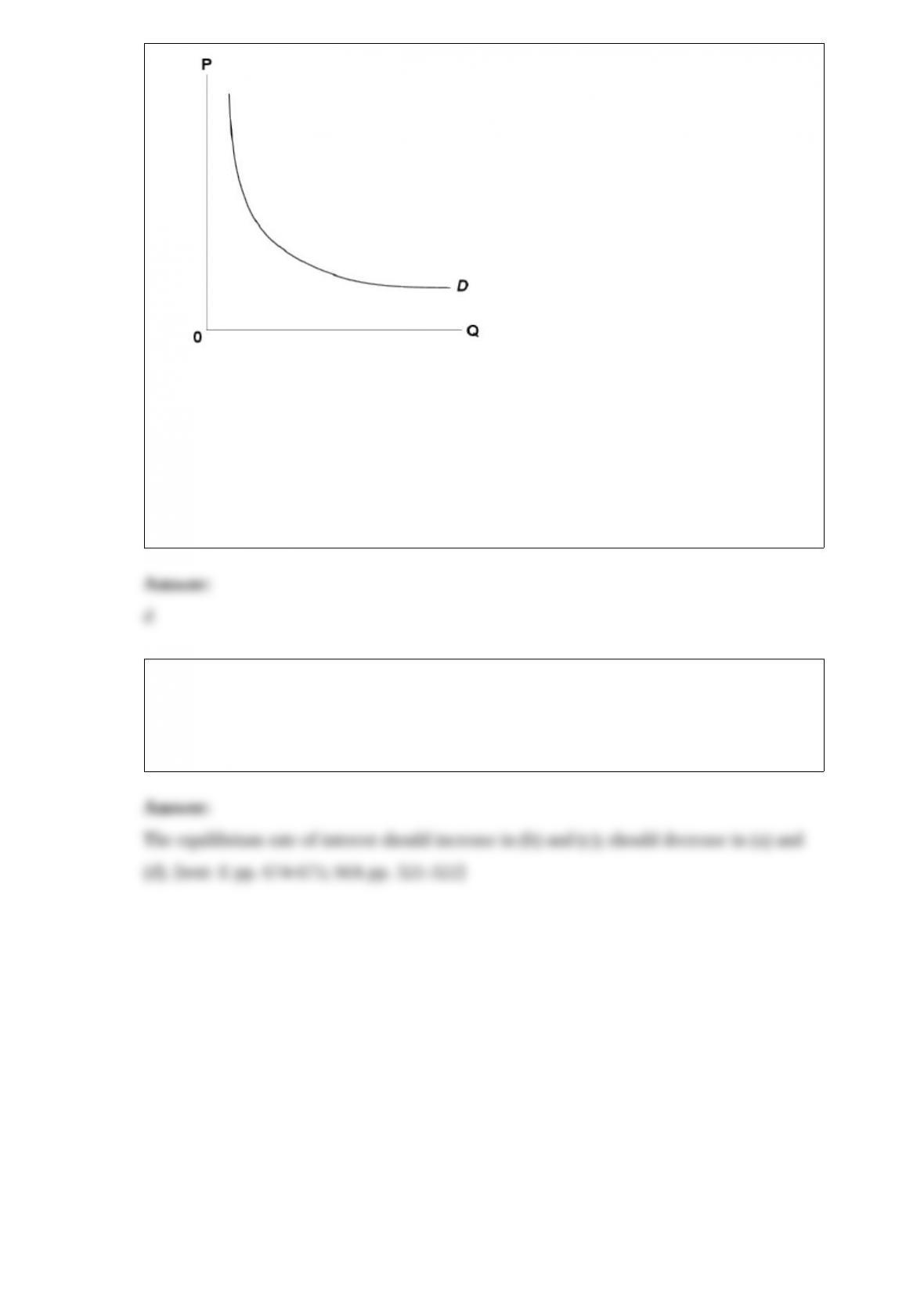
16)
refer to the above diagram which is a rectangular hyperbola, that is, a curve such that
each rectangle drawn from any point on the curve will be of identical area. in
comparing the price elasticity and the slope of this demand curve we can conclude that
the:
a.slope of a demand curve measures its elasticity.
b.elasticity of a demand curve measures its slope.
c.slope and elasticity of the curve are both constant throughout.
d.slope of the curve varies, but its elasticity is constant.
17) Other things being equal, what effect will each of the following have on the
equilibrium rate of interest? (a) an increase in the supply of money; (b) an increase in
the equilibrium level of national income; (c) a decrease in the supply of money; (d) a
leftward shift of the asset demand for money.
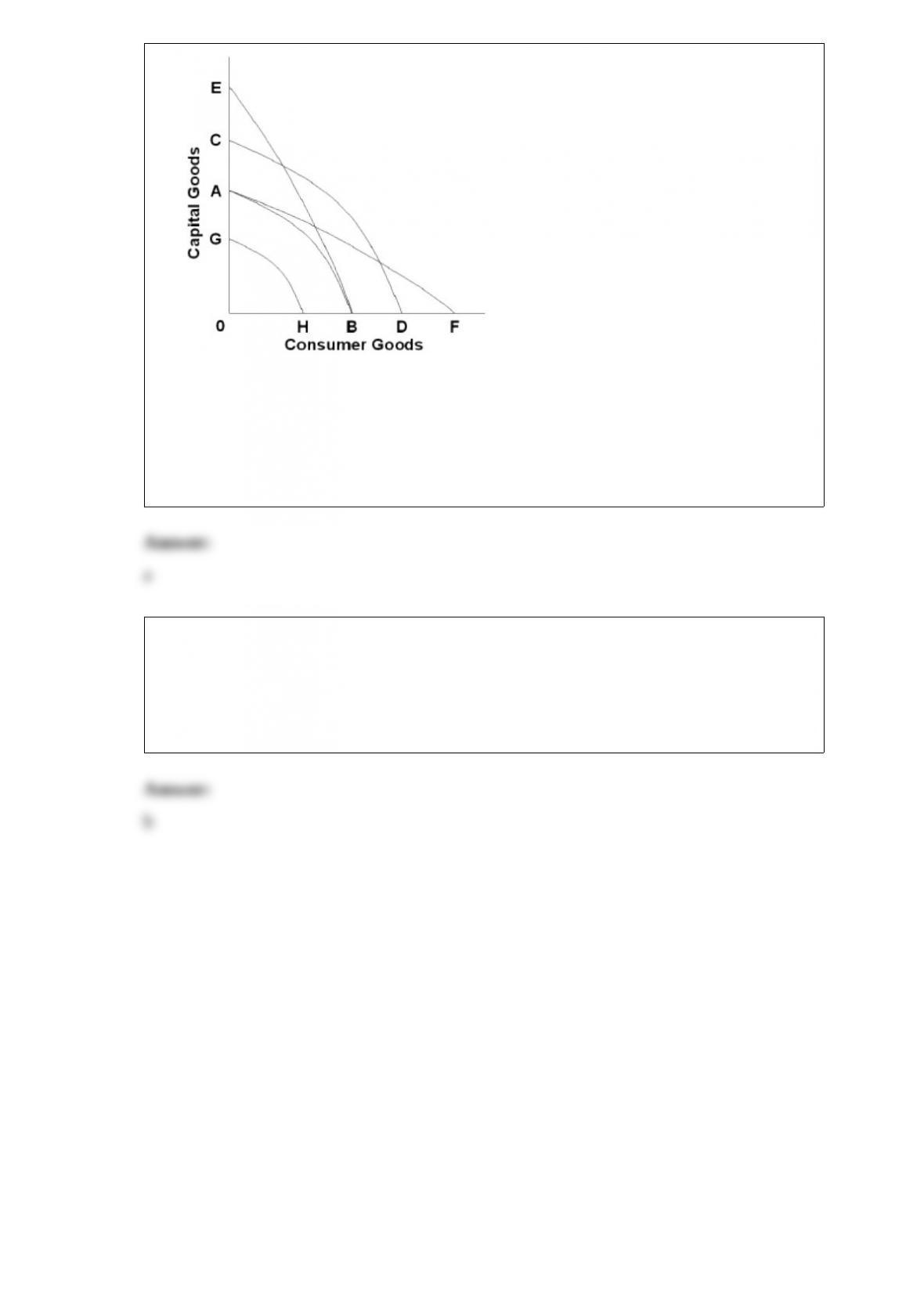
18)
refer to the above diagram. technological advance in producing both capital goods and
consumer goods is shown by the shift of the production possibilities curve from ab to:
a.cd.
b.eb.
c.af.
d.gh.
19) as a percentage of gdp (total output), u.s. exports are:
a.about 20 percent.
b.lower than in some other industrial countries, including germany and canada.
c.less today than they were in the 1970s.
d.the highest in the world.