1) value added can be determined by:
a.summing the profits of all enterprises in the economy.
b.subtracting the purchase of intermediate products from the value of the sales of final
products.
c.calculating the year-to-year changes in real gdp.
d.deflating nominal gdp.
2) Government can promote workplace safety by:
A.breaking up concentrations of monopoly power.
B.reducing monopsony power.
C.promoting the use of recycled inputs.
D.providing workers information about workplace hazards.
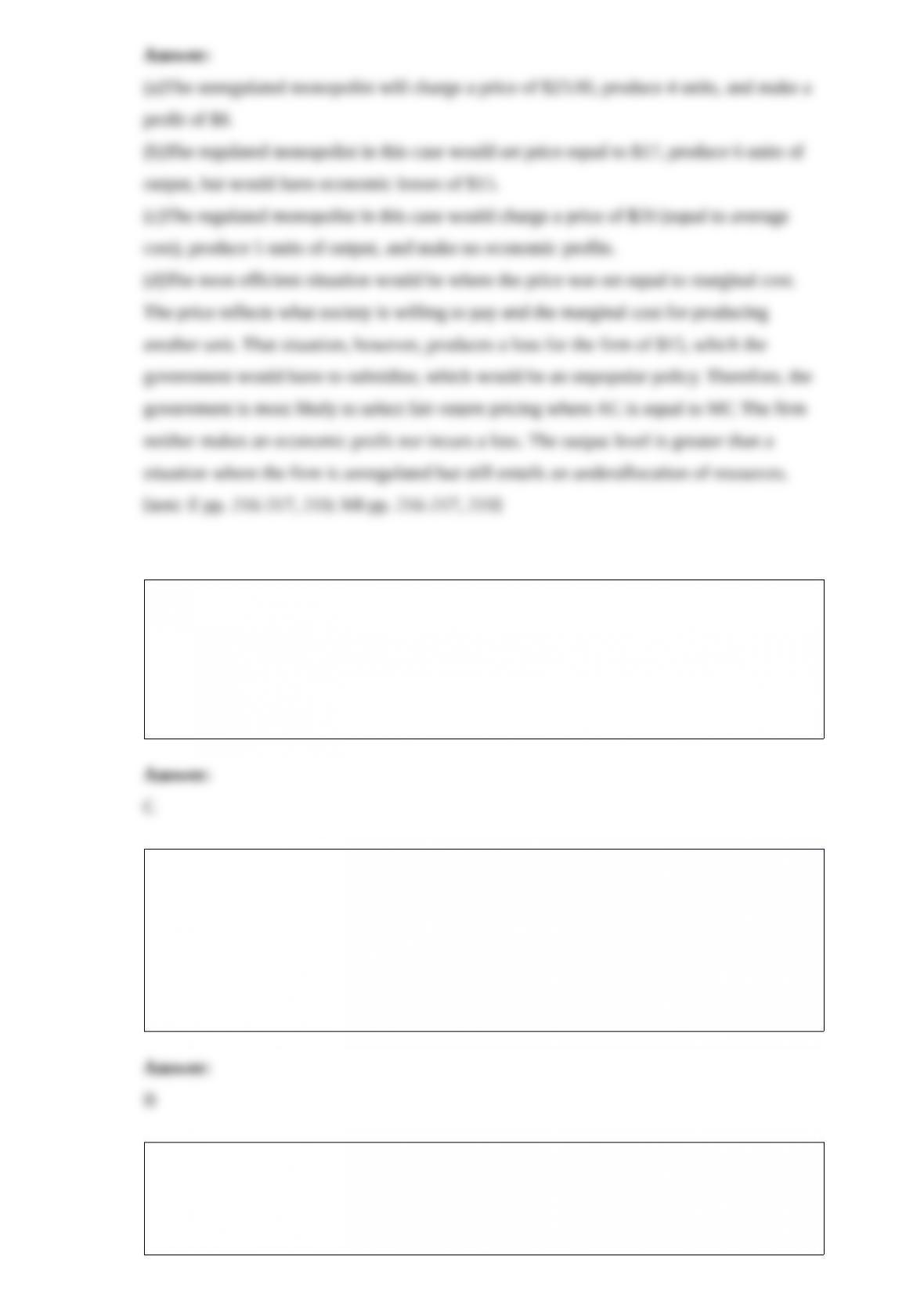
3) In the table below are cost and demand data for a pure monopolist.
(a)What is the level of price, output, and amount of profit for an unregulated
monopolist?
(b)Using the data in the table, what are the price, output, and profit for a regulated
monopolist that sets price equal to marginal cost compared with an unregulated
monopolist?
(c)Using the data in the table, what are the price, output, and profit for a regulated
monopolist that charges a fair-return price compared with an unregulated monopolist?
(d)Analyze the effect of regulation on the allocation of resources. Which situation is
most efficient? Which situation is most likely to be chosen by government? Why?
4) In defining money as M1, economists exclude time deposits because:
A.the intrinsic value of time deposits is nil.
B.the purchasing power of time deposits is much less stable than that of checkable
deposits and currency.
C.they are not directly or immediately a medium of exchange.
D.they are not recognized by the Federal government as legal tender.
5) On January 1, 2008, Alex deposited $5000 into a savings account that pays interest
of 5 percent, compounded annually. If he makes no further deposits or withdrawals,
how much will Alex have in his account on December 31, 2010 (3 years later)?
A.$5,750
B.$5,788
C.$5,813
D.$5,825
6) In 2001, the United States Senate:
A.voted 95-0 to approve the Kyoto agreement.
B.opposed the Kyoto agreement 95-0, concluding that climate change was not a
credible threat.
C.opposed the Kyoto agreement 95-0, concluding that complying with treaty provisions
would seriously harm the U.S. economy.
D.voted to override President Bush’s veto of the Kyoto agreement.
7) the following demand schedule:
refer to the above data. the price elasticity of demand is unity:
a.throughout the entire price range because the slope of the demand curve is constant.
b.in the $4-$3 price range only.
c.over the entire $3-$1 price range.
d.over the entire $6-$4 price range.
8) which of the following is characteristic of a purely competitive seller’s demand
curve?
a.price and marginal revenue are equal at all levels of output.
b.average revenue is less than price.
c.its elasticity coefficient is 1 at all levels of output.
d.it is the same as the market demand curve.
9) implicit costs are:
a.regarded as costs by accountants but not by economists.
b.payments that a firm makes to other firms or individuals who supply resources to it.
c.non-expenditure costs.
d.costs that vary proportionately with output.
10) According to monetarists, an expansionary fiscal policy:
A.will be ineffective because the interest rate will rise and crowd out private investment
spending.
B.should not be permitted so long as a public debt exists.
C.should be used only when unemployment exceeds 6 percent of the labor force.
D.will be effective, provided the money supply is held constant.
11) the location of the product supply curve depends on:
a.production technology.
b.the number of buyers in the market.
c.the tastes of buyers.
d.the location of the demand curve.
12) Assume the MPC is .8. If government were to impose $50 billion of new taxes on
household income, consumption spending would initially decrease by:
A.$100 billion.
B.$90 billion.
C.$40 billion.
D.$50 billion.
13) the sunshine corporation finds that its costs are $40 when it produces no output. its
total variable costs (tvc) change with output as shown in the accompanying table. use
this information to answer the following question(s).
refer to the above information. the average fixed cost of 3 units of output is:
a.$13.33.
b.$12.50.
c.$40.
d.$18.50.
14)
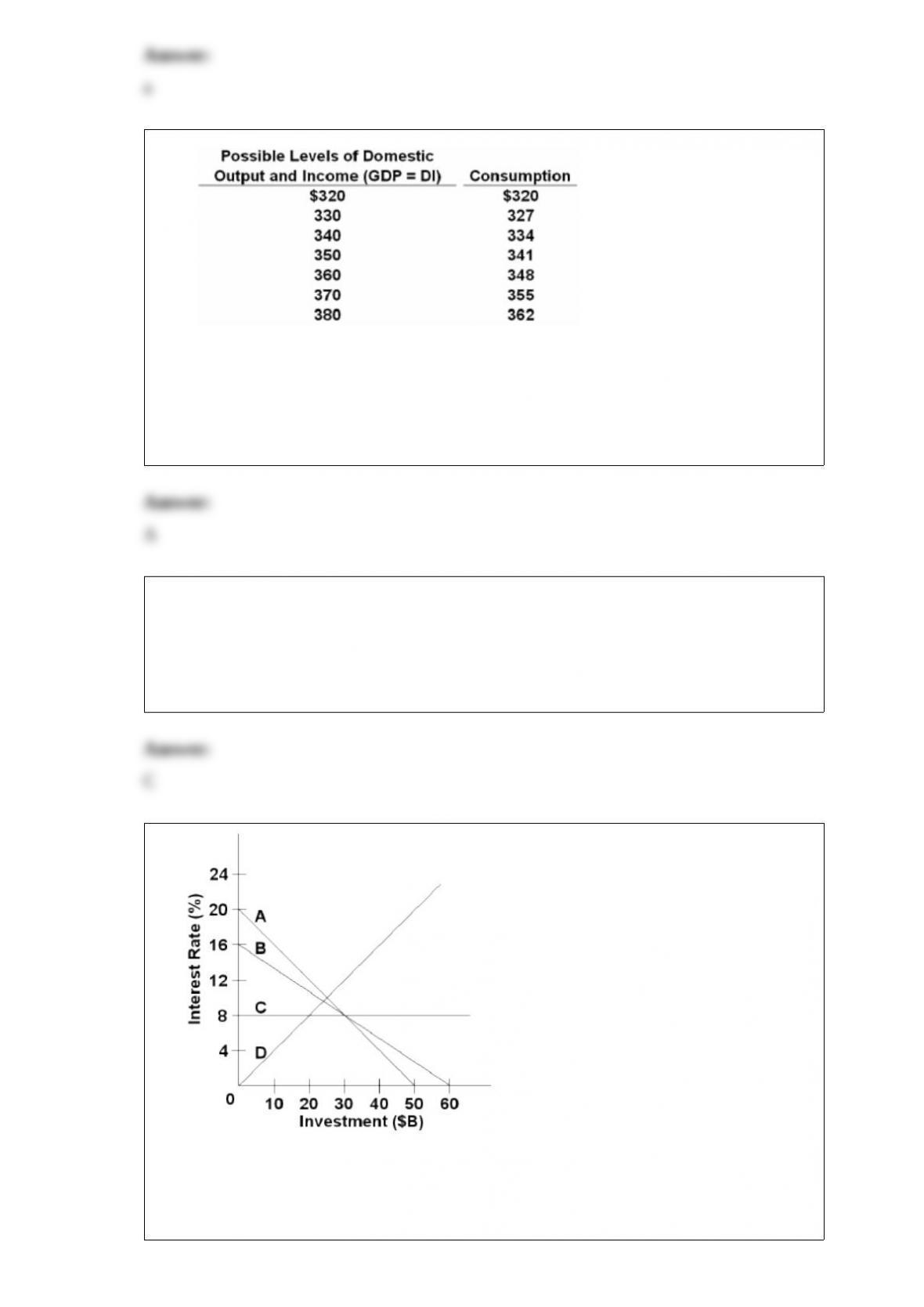
Refer to the above data. At the $370 billion level of DI the APS is approximately:
A.4 percent.
B.7 percent.
C.1 percent.
D.16 percent.
15) The elasticity of resource demand will be greater the:
A.smaller the portion of the product’s total costs accounted for by the resource.
B.less the elasticity of demand for the product it is producing.
C.easier it is to substitute resources that are available.
D.less the elasticity of resource supply.
16)
assume that if the interest rate that businesses must pay to borrow funds were 20
percent, it would be unprofitable for businesses to invest in new machinery and
equipment so that investment would be zero. but if the interest rate were 16 percent,
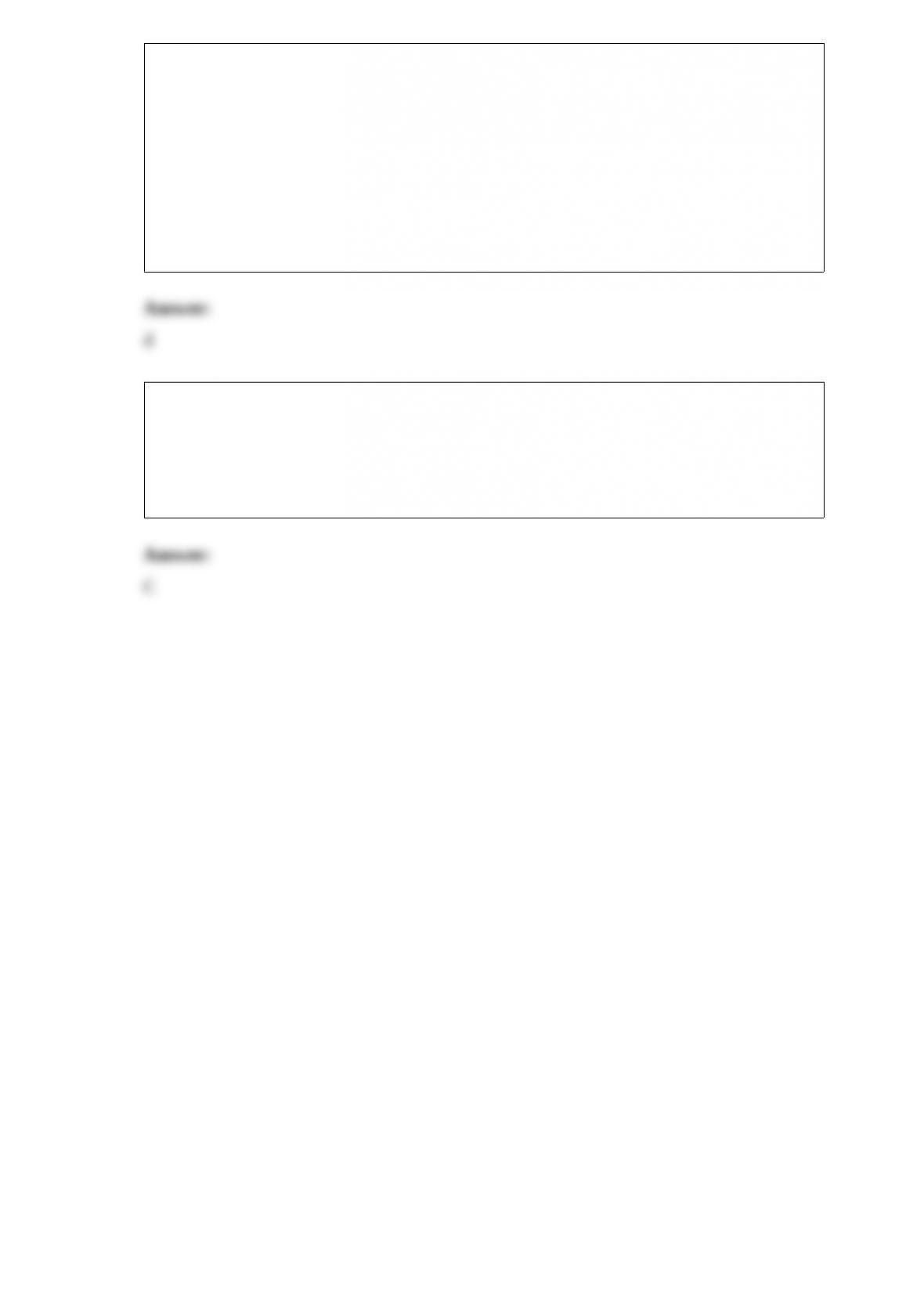
businesses will find it profitable to invest $10 billion. if the interest rate were 12
percent, $20 billion would be invested. assume that total investment continues to
increase by $10 billion for each successive 4 percentage point decline in the interest
rate. refer to the above graph. which of the following is the correct graphical
presentation of the indicated relationship?
a.line d
b.line c
c.line b
d.line a
17) A lower equilibrium interest rate:
A.increases saving, reduces total spending, and increases total output.
B.decreases saving, increases total spending, and decreases total output.
C.increases investment, increases total spending, and increases total output.
D.decreases investment, decreases total spending, and increases total output.