
Which of the following statements is true?
A) Offensive strategic market plans require investment for growth, which limits
long-run profit performance, but does not limit sales revenue.
B) Defensive strategic market plans promote short-run profit performance but are not
that effective in growing sales revenue.
C) In the long run, all market strategy will shift from an offensive strategic market plan
to a growth-oriented plan.
D) Offensive strategic market plans are geared to deliver above-average performance in
the areas of sales growth, share position, and improved short-run profits.
E) Defensive strategic market plans are not geared towards the protection of market
share.
Which of the following factors determines that a marketing channel is an indirect
channel rather than a direct channel?
A) The products are complex and require extensive after-sales service.
B) The products are intended for business-to-business markets rather than consumer
markets.
C) At least one marketing intermediary takes ownership of the products and controls
distribution.
D) Telemarketing and digital marketing are an integral part of the distribution system.
E) The marketing channel uses one or more intermediaries who are a part of the
company.
Which of the following terms refers to highly knowledgeable and skilled users who
often extend the boundaries of a product’s application to achieve a more desired
customer solution?
A) mainstream users
B) captive users
C) lead users
D) spinners
E) laggards
Which of the following is used to determine a segment’s marketing profitability?
A) customer retention index
B) net profit (after taxes)
C) gross profit
D) net marketing contribution
E) gross revenue
Delta Motors, an American multinational automaker, was the first company to develop
an affordable electric car. Delta Motors aimed to diversify its growth by launching an
environment-friendly, affordable electric car. Which of the following offensive
strategies is Delta Motors pursuing?
A) enter related new market segments
B) harvest for cash flow
C) divest for cash flow
D) enter unrelated new market segments
E) improve customer loyalty

________ are most likely to recommend a company’s product to others.
A) Loyal customers
B) Captive customers
C) New customers
D) Repeat customers
E) Customer terrorists
When automakers include air bags, cruise control, satellite radio, and GPS systems in
their consumer products, these features are considered to be quality ________.
A) killers
B) drivers
C) enhancers
D) aesthetics
E) determinants
McEwan and Co., a commercial real estate brokerage firm, creates four storyboards,
each of which delineates a different value proposition and segment positioning strategy.
The firm recruits a group of executives from different industries, and assigns them to
one of the four segments. The executives are asked to critique each segment’s
storyboard and select the one that most appeals to them. The firm aims to assess its
understanding of segment needs and its ability to translate that understanding into a
value proposition. In this example, which of the following methods is McEwan and Co.
using?
A) the emphatic method
B) segment attractiveness test
C) marketing mix strategy test
D) mass-market strategy test
E) segment strategy “acid test”
Which of the following refers to a person who is highly devoted to the action plan and
can lead its successful implementation?
A) an entrepreneur
B) a champion
C) an intrapreneur
D) a scapegoat
E) an in-process manager
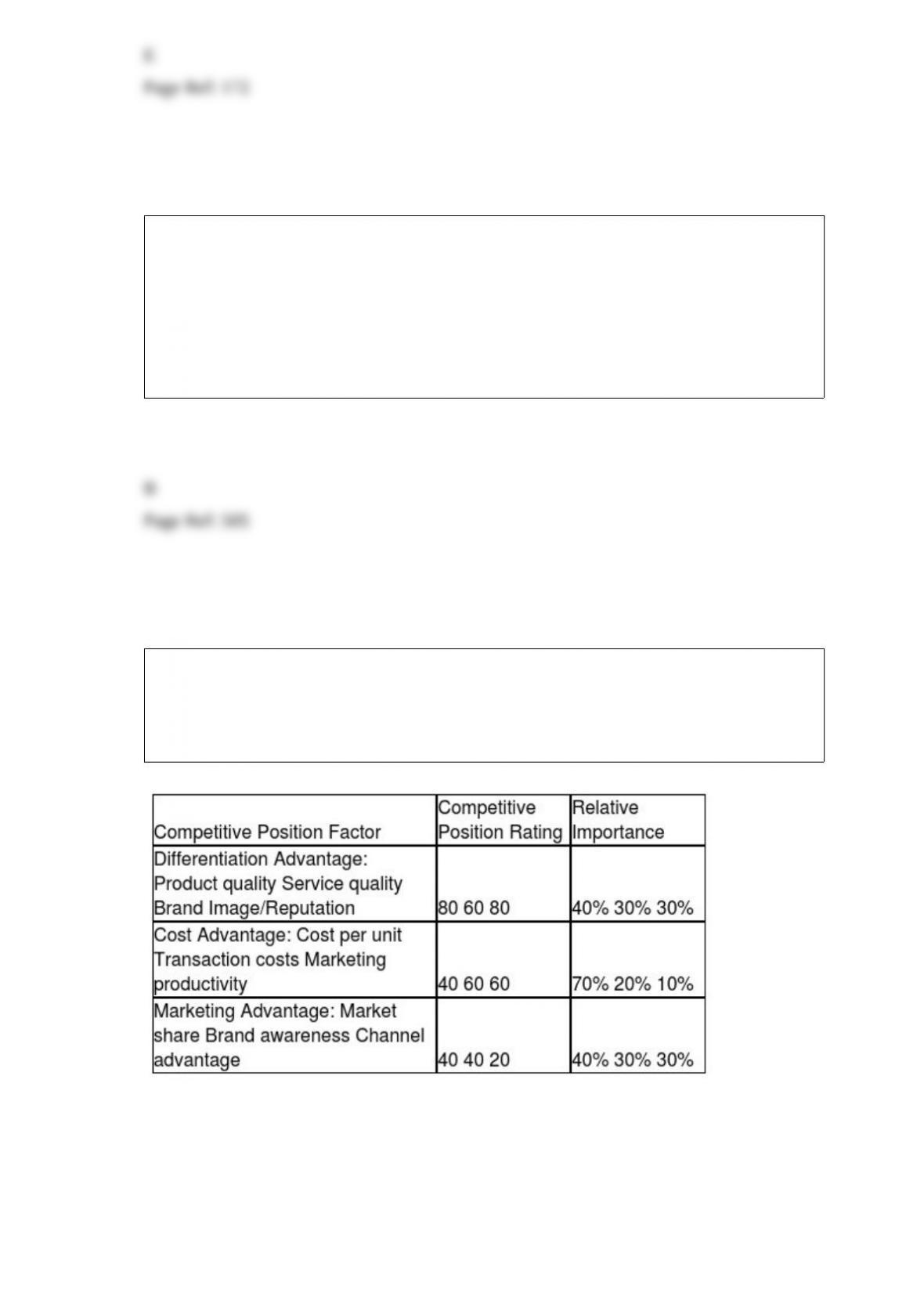
Aster Inc. is an American firm that manufactures and markets cell phones for sale in
discount stores and other retail settings. The firm also sells cell phone accessories. Aster
Inc. conducted an analysis of its competitive advantage for one of its product-markets
and conducted research to learn the following information:
Mini-Case Question. After extensive market research, Aster Inc. decides to enter the
household appliances market. The firm launches a line of consumer electronics products,
such as ovens and coffee grinders. Aster Inc. is most likely to be using which of the
following strategies?
A) a vertical integration strategy

B) a harvest strategy
C) a monetize position strategy
D) a diversification strategy
E) a horizontal integration strategy
An advertising elasticity of 0.35 means that for every one percent change in advertising
expenditures there will be an estimated ________ percent change in volume sold.
A) 0.0035
B) 0.035
C) 0.35
D) 3.5
E) 35
A ________ strategy continues to raise prices slowly with expected decreases in
volume until the business has exited the market.
A) diversify growth
B) harvest price
C) divest market
D) reduce-market-focus
E) monetize cash flow

Which of the following types of customers generally have the lowest customer history?
A) new customers
B) captive customers
C) loyal customers
D) unprofitable customers
E) repeat customers
David has determined that there are meaningful differences in customer needs within
the health supplements market segment in the U.S., that are not being met by the
current segmentation strategy used by the businesses in the sector. What market
segmentation strategy would be appropriate for David to use to capitalize on this
opportunity?
A) mass-market strategy
B) market penetration strategy
C) subsegment strategy
D) large-market strategy
E) undifferentiated strategy
Your brother, Fred, owns ATZ Inc., a company that provides wireless
telecommunications network in several cities in the Midwest region. You are taking a
marketing class in college, and you asked Joe for some information about his business
for a class project. You determined that one of his customers has a long customer
history of 75, an above-average purchase amount of 55, a low repurchase desirability of
20, a weak product preference of 10, and the customer does not recommend ATZ
services to potential customers. The customer is clearly dissatisfied, but since ATZ Inc.
is the only wireless telecommunications network provider in the city he is compelled to
use it.
Mini-Case Question. Based on the customer loyalty index (CLI) for the customer, what
type of customer would you tell Fred that he has?
A) loyal customer
B) repeat customer
C) captive customer
D) new customer
E) unprofitable customer
In the context of brand name development, which of the following is true about an
invented name?
A) It is built from root words and morphemes.
B) It aims to evoke a positive attribute or a feeling.
C) It is associated with an experience.
D) It is based on the names of company founders.
E) It strives to build an association between the brand name and the core function of the
brand.
A(n) ________ includes all the key elements of the situation and the benefits the target
customer is looking for in a given purchase.
A) acid test
B) value proposition
C) storyboard
D) Pareto chart
E) marketing mix strategy

Rondon Inc. has 48 million shares outstanding with an earnings per share of $5.6.
Calculate the net profit it generates.
A) $480 million
B) $268.8 million
C) $634.8 million
D) $345.4 million
E) $196 million
A recent Consumer Reports study analyzed toasters and found that the average
performance rating for all toasters tested was 70 with an average price of $33. Coffers is
a brand of toaster that sells for $32 and received an overall performance rating of 84.
What is Coffers’s relative performance against other toasters tested?
A) 4
B) 38
C) 83.5
D) 98.5
E) 120
Disruptive innovation differs from discontinuous innovation in that disruptive
innovation ________.
A) refers to a major shift from an old technology
B) usually offers new customer benefits
C) refers to change along the technology innovation curve
D) refers to the development of technology and improved products for a given product
market
E) allows for the development of products that are more expensive

Which of the following is true of backward-looking market metrics?
A) They are applied simultaneously with financial performance metrics, normally at the
end of a reporting period.
B) They include relative product and service quality.
C) Their purpose is to track customer perceptions and attitudes that precede actual
changes in customer behavior.
D) They are the indicators of future financial performance.
E) The absence of these metrics can result in customer-dissatisfaction problems being
undetected.
An oblique strategy differs from a reactive strategy in that an oblique strategy
________.
A) requires minimal customer knowledge
B) requires minimal competitor knowledge
C) involves making a direct attack on a competitor’s position
D) refers to making competitive moves from an internal perspective with no real market
knowledge
E) seeks to gain a competitive advantage without direct confrontation
Calculate the total value of owner’s equity of a business if it realizes a net profit of $240
million at a return of 30%.
A) $8 billion
B) $800 million
C) $720 million
D) $7.2 billion
E) $2.4 billion
Which of the following is a part of the second stage of reverse innovation?
A) probing for new insights
B) verifying the size of the opportunities
C) determining new product benefits that address unmet customer needs
D) building a value proposition around the competitive advantages of the product
E) “inventing to order” with continuous customer involvement and feedback
________ is the ratio of the percentage change in volume to the percentage change in
price.
A) Market demand
B) Market share needed
C) Price elasticity
D) Average selling price
E) Volume sold

When the management team noted the increased interest in bikes as a mode of
commuting, bicycle manufacturer Sensta introduced utility bikes aimed at the urban
commuter. In which of the following cases is the company following a
multiple-segment pricing strategy?
A) Sensta entered the market with a bike priced at $2,500, and later, as more
competitors entered the market, reduced the price to $1,000.
B) As the market for bikes in a particular city became saturated, Sensta raised the prices
of its bikes hoping to gain maximum profit before exiting the market.
C) With several competitors with similar product features in the utility bike market,
Sensta concentrated on the sturdiness of its bikes, and raised the price of the basic
model from $500 to $1,000.
D) Sensta manufactures a basic model priced at $500, a bike with more features, priced
at $1,500 and a deluxe model priced at $3,000.
E) When Sensta entered the market, there were already competitors in the
$1,000-$2,000 price range. Sensta introduced three bike models in the $500-$700 price
range in order to capture market share, and later raised the prices of its products.
What type of customers are most likely known as “customer terrorists”?
A) customers who use their bargaining powers to purchase products at a cheaper price
B) customers who engage in shoplifting
C) customers who verbally communicate their bad experiences to others
D) customers who show a false sense of loyalty to a particular brand
E) customers who only buy the product if it is offered at an attractive price or with a
promotional incentive
Which of the following terms is used to describe the success of many Japanese
marketing plans because of the Japanese management’s ability to adapt when a
marketing plan is not working and to stick with the plan?
A) vertical integration
B) adaptive persistence
C) horizontal integration
D) decentralization
E) standardization
Which of the following allows a business the potential to own the market until other
competitors venture to enter?
A) a decentralization strategy
B) the cluster effect
C) a low barrier to entry
D) a first-mover advantage
E) a network effect
Which of the following communication strategies refers to customer-directed marketing
communications?
A) push communication
B) pull communication
C) channel communication
D) centralized communication
E) lateral communication