In 1962, Michael Harrington argued in The Other America that there was chronic,
severe poverty in America.
a. True
b. False
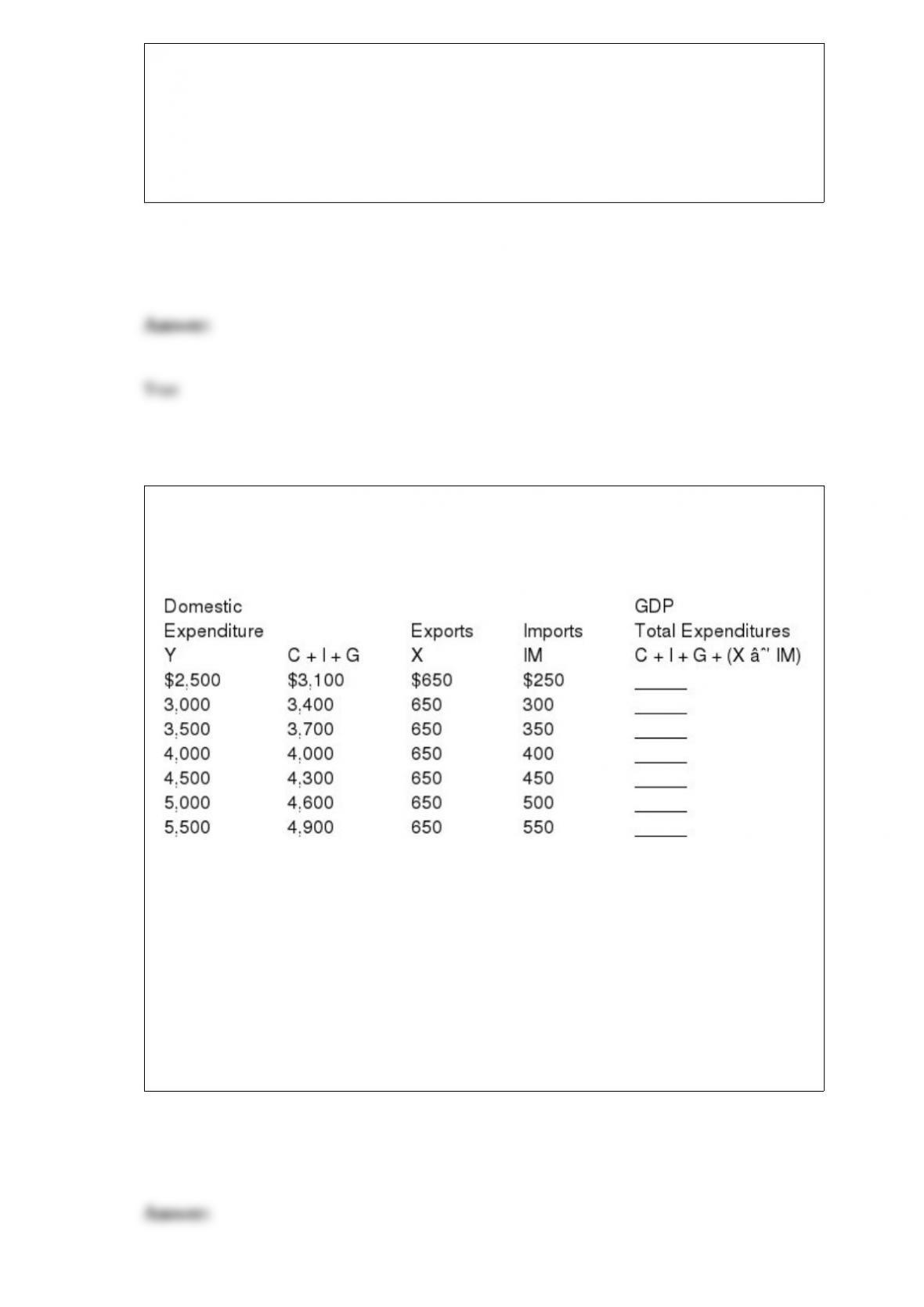
Table 20-2
In Table 20-2, what are net exports when GDP = 3,500?
a. 400
b. 300
c. 200
d. 100

Unions can be thought of as constituting
a. a monopoly element in the supply of labor.
b. a monopoly element in the demand for labor.
c. an oligopoly element in the supply of labor.
d. a competitive element in the demand for labor.
A ray through the origin always has a slope of one.
a. True
b. False
Which of the following was NOT a factor in Japan’s post-World War II economic
success?
a. a high rate of investment
b. a well-educated workforce
c. a high rate of natural resource discovery
d. a high rate of technological adoption
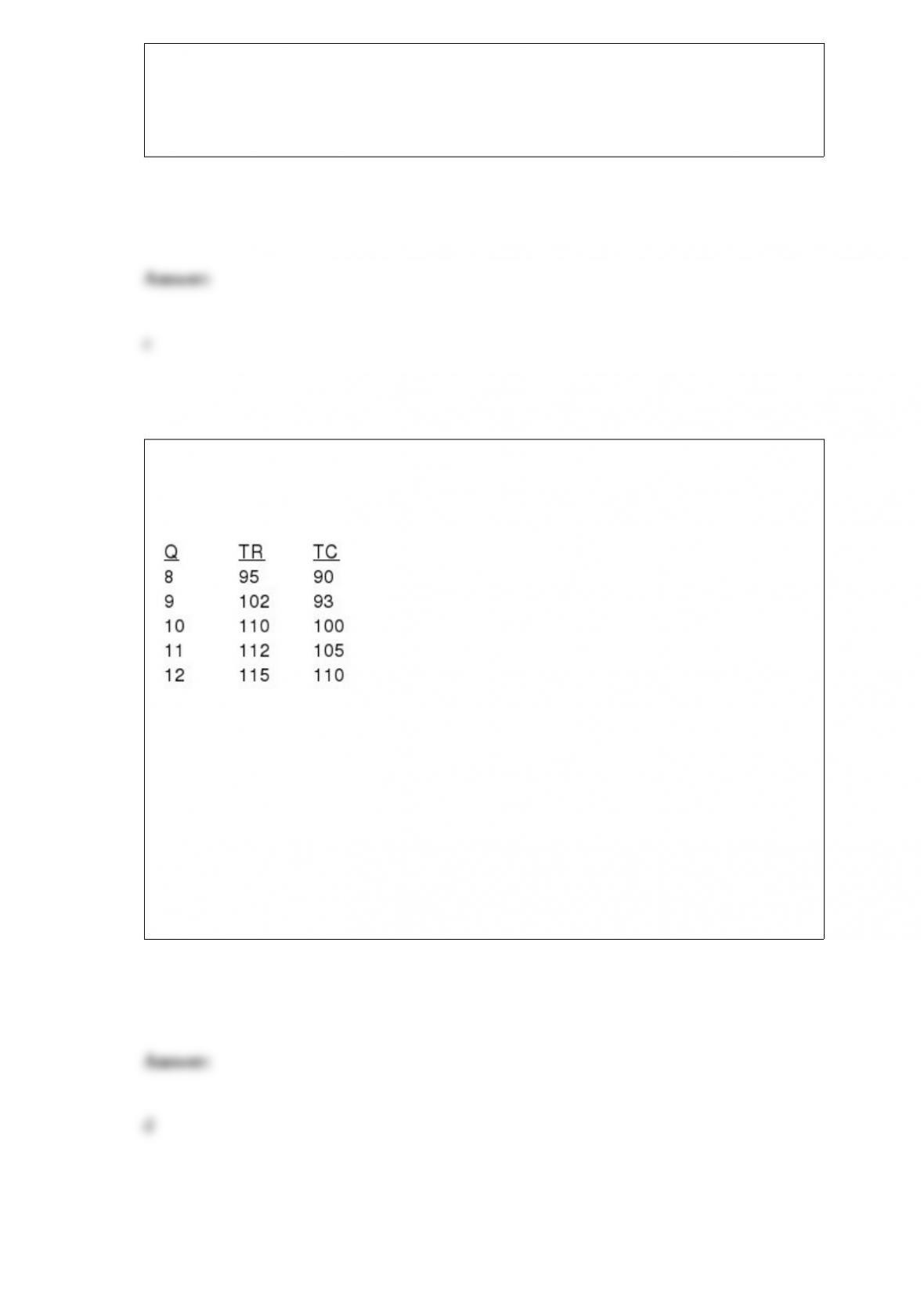
Table 11-2
In Table 11-2, the price at the profit-maximizing output is how much?
a. $15
b. $7
c. $10
d. $11

The “crowding out” effect states that government spending pushes up interest rates and
reduces private investment spending.
a. True
b. False
Specialization of labor makes sense only if there is some means of exchange.
a. True
b. False
Following the economic crisis in 1994-1995, the Mexican peso fell sharply in value.
What will be the main economic effects in Mexico of such an exchange rate change?
a. It will decrease aggregate demand and aggregate supply, so that output will certainly
fall, and prices may fall as well.
b. It will increase aggregate demand and aggregate supply, so that output will certainly
rise, and prices may rise as well.
c. It will increase aggregate demand and decrease aggregate supply, so that prices will
certainly rise and output may rise as well.
d. It will decrease aggregate demand and increase aggregate supply, so that prices will
certainly fall and output may fall as well.

An economy can increase its total output of goods and services if it
a. increases the hours of work or output per hour.
b. increases the hours of work or decreases output per hour.
c. decreases hours of work or decreases output per hour.
d. decreases hours of work and decreases output per hour.
The “free rider” problem occurs when a good is
a. not available.
b. not excludable.
c. not depletable.
d. not sold in free markets.

The antitrust laws are sometimes used by companies to reduce competition in their
markets rather than enhance it.
a. True
b. False
Payments to Social Security recipients would decline if the retirement age were
lowered.
a. True
b. False
Government stabilization policy would be unnecessary if the economy automatically
gravitated toward
a. full inflation.
b. full employment.
c. full recession.
d. an inflationary gap.

The most heavily traded American stocks are traded on the
a. New York Stock Exchange.
b. American Stock Exchange.
c. regional stock markets.
d. “third market.”
When a lender underestimates the rate of inflation,
a. purchasing power is redistributed to the lender.
b. purchasing power is redistributed to the borrower.
c. the real rate of interest will be higher than expected.
d. the nominal interest rate was set too low.

In Poland’s free market, Felix Siemienas is making a fortune in cold cuts. Prices are
much higher than formerly. Siemienas says, “Yes, my prices are high. If nobody buys, I
bring my prices down. That is the market rule.” This “rule” best describes
a. the law of diminishing returns.
b. opportunity cost.
c. the law of increasing costs.
d. the law of demand.
The productivity speed-up in the United States began in the
a. mid 1970s.
b. mid 1980s.
c. mid 1990s.
d. beginning of 2001.
To avoid a coordination failure, the intentions of savers and investors must be both
a. increasing.

b. at their planned levels.
c. more than full employment GDP.
d. at levels set by the government.
Economic theory of market forms between pure monopoly and perfect competition was
largely nonexistent until the work of
a. Joan Robinson and Edward Chamberlin.
b. Adam Smith and David Ricardo.
c. Alfred Marshall and Francis Edgeworth.
d. Wassily Leontief and Joseph Schumpeter.
The major objective of the 1986 tax reform was to: (i) enhance efficiency by lowering
marginal tax rates; (ii) enhance equity by closing “loopholes.”
a. i and ii
b. i but not ii
c. ii but not i
d. neither i nor ii
Define the following terms and explain their importance to the study of economics.
a. pure monopoly
b. barriers to entry
c. patent
d. natural monopoly
e. sunk costs
The Fed’s principal objective is to
a. make profits to pay into the U.S. Treasury.
b. collect tax revenues.
c. supervise the business decisions of banks.
d. manage the money supply and interest rates.
Which furniture production process would have the highest furniture prices?
a. furniture made by handsaw and hammer
b. furniture made with power equipment
c. furniture made by grade school-educated workers
d. furniture made in an automated furniture factory

Velocity can be calculated as the ratio of the value of transactions to
a. the price level.
b. level of real GDP.
c. the money stock.
d. the inflation rate.
The Phillips curve is a statistical relationship that was misrepresented as showing
a. disequilibrium outcomes of uncoordinated policy.
b. alternative equilibrium points that the economy could achieve.
c. the unemployment rates necessary to close a recessionary gap.
d. the increases in interest rates from different inflation rates.

If an economy is experiencing deflation, a decrease in the price level, then the most
advantageous actions would be
a. borrowing money at a fixed interest rate and buying a house.
b. borrowing money at a fixed interest rate and buying land.
c. keeping money in a checking account.
d. keeping your wealth in gold and other precious metals.
Which of the following observations is true?
a. A market produced with allocative efficiency if a monopoly exists.
b. A market can provide “public goods.”
c. A market makes public and personal services inexpensive.
d. A market distributes income equally.
If a resource is in fact becoming scarcer, then one should expect
a. the price of the resource to rise.
b. less demand for the resource as people try to conserve.

c. greater supply as people reduce inventories before it is all gone.
d. all of the above.
A pollution tax penalizes inefficient firms.
a. True
b. False
What would the Herfindahl-Hirschman Index equal for an industry consisting of six
firms with market shares of 5%, 10%, 15%, 20%, 25%, and 25%?
a. 100
b. 1,350
c. 1,375
d. 2,000

The costs of unemployment to an individual out of work are larger now than in the
1930s.
a. True
b. False