
The market demand curve for a popular teen magazine is given by Q = 80 – 10P where
P is the magazine price in dollars per issue and Q is the weekly magazine circulation in
units of 10,000. If the circulation is 400,000 per week at the current price, what is the
consumer surplus for a teen reader with maximum willingness to pay of $3 per issue?
A) $2.00
B) $1.00
C) Zero
D) -$1.00
Which of the following is NOT an example of a common property resource?
A) Water in underground aquifers
B) Public highways in large cities
C) Fish stocks in open waters
D) Outdoor concerts
Scenario 12.2:
You are studying a market for which the kinked demand curve model applies. The
kinked demand curve is as follows:
Q = 1200 – 5P for 0 Q < 150
Q = 360 – P for 150 Q
The marginal cost is given as:
MC = Q
Refer to Scenario 12.2. Suppose that the marginal cost increases such that:
MC = Q + 10
What is the profit maximizing price?
A) 72
B) 240
C) 210
D) all of the above
E) none of the above
Scenario 5.4:
Suppose an individual is considering an investment in which there are exactly three
possible outcomes, whose probabilities and pay-offs are given below:

The expected value of the investment is $25. Although all the information is correct,
information is missing.
Refer to Scenario 5.4. What is the probability of outcome B?
A) 0
B) -0.5
C) 0.5
D) 0.4
E) 0.2
Consider the following information:
StowUrStuff Storage is located slightly below sea level in a coastal town. It could build
and maintain a flood control system around its property at an annual cost of $1000, and
if it did so, the probability of a flood’s doing $1,000,000 in damage during the year
would be .005. With no flood control system, the probability of such a flood would be .
01.
Moral hazard arises in this situation because once the firm
A) pays the premium that is based on the .005 probability, it has no incentive to spend
the additional $1000 for the flood control system, so the true probability of loss is no
longer .005.
B) pays the premium that is based on the .01 probability, it has no incentive to spend the
additional $1000 for the flood control system, so the true probability of loss is no longer
.01.
C) provides for flood control, it has less incentive to spend $5000 on premiums, leaving
itself underinsured.
D) provides for flood control, it has less incentive to spend $10,000 on premiums,
leaving itself underinsured.

E) provides for flood control, it will consider that a substitute for insurance and not be
able to deal with the loss from a flood should it occur.
What condition may provide for a relatively small degree of inefficiency under
monopolistic competition?
A) There is a single seller and no product differentiation.
B) The marginal cost of production is less than the market price.
C) The demand curve is relatively elastic so that the price is near the long-run minimum
average cost.
D) There is only one buyer in the market.
The optimum level of pollution emissions
A) is zero.
B) occurs where the marginal external benefit is zero.
C) occurs where no damage to the environment is being done.
D) occurs where the marginal external benefit equals the marginal external cost.
E) occurs where the marginal external cost equals the marginal cost of abatement.

The Acme Company is a perfect competitor in its input markets and its output market.
Its average product of labor is 30, the marginal product of labor is 20, the price of labor
is $20, and the price of the output is $5. For Acme Company, the marginal revenue
product of labor
A) is $100.
B) is $150.
C) is $400.
D) is $600.
E) cannot be determined with the information provided.
Scenario 14.4:
John’s firm is a competitor in your product market and a monopsonist in the labor
market. The current market price of the product that your firm produces is $2. The total
product and marginal product of labor are given as:
TP = 100L – 0.125L2 MP = 100 – 0.25L
where L is the amount of labor employed. The supply curve for labor and the marginal
expenditure curve for labor are given as follows:
L = PL -5 MEL = 2L + 5

Refer to Scenario 14.4. Suppose that the price of the product rises to $5, the price of
labor
A) will decrease.
B) will increase.
C) will not change.
D) will change in an indeterminate fashion.
Common property rights
A) increase efficiency over individual property rights.
B) enable the Coase theorem to work.
C) are responsible for the increasing success of preservation of African elephants.
D) are responsible for the increasing success of preservation of worldwide fishing
resources.
E) result in faster depletion of resources than do individual property rights.
Calloway Shirt Manufacturers sells knit shirts in two sub-markets. In one sub-market,
the shirts carry Calloway’s popular label and breast logo and receive a substantial price
premium. The other sub-market is targeted toward more price conscious consumers
who buy the shirts without a breast logo, and the shirts are labeled with the name
Archwood. The retail price of the shirts carrying the Calloway label is $42.00 while the
Archwood shirts sell for $25. Calloway’s market research indicates a price elasticity of
demand for the higher priced shirt of -2.0, and the elasticity of demand for the
Archwood shirts is -4.0. Moreover, the research suggests that both elasticities are
constant over broad ranges of output.
a. Are Calloway’s current prices optimal?
b. Management considers the $25 price to be optimal and necessary to meet the
competition. What price should the firm set for the Calloway label to achieve an
optimal price ratio?
The textbook for your class was not produced in a perfectly competitive industry
because
A) there are so few firms in the industry that market shares are not small, and firms’
decisions have an impact on market price.
B) upper-division microeconomics texts are not all alike.
C) it is not costless to enter or exit the textbook industry.
D) of all of the above reasons.
Use the following statements to answer this question:
I. A positive deadweight loss necessarily occurs in labor markets that have one seller
(e.g., labor union).

II. The deadweight loss in a labor market with one seller (e.g., labor union) is smaller if
the union maximizes the total wages earned by union members than if the union
maximizes total economic rents.
A) I and II are true.
B) I is true and II is false.
C) II is true and I is false.
D) I and II are false.
The demand curve facing a perfectly competitive firm is
A) the same as its average revenue curve, but not the same as its marginal revenue
curve.
B) the same as its average revenue curve and its marginal revenue curve.
C) the same as its marginal revenue curve, but not its average revenue curve.
D) not the same as either its marginal revenue curve or its average revenue curve.
E) not defined in terms of average or marginal revenue.
Under perfect price discrimination, consumer surplus

A) is less than zero.
B) is greater than zero.
C) equals zero.
D) is maximized.
What does it mean when the CPI is higher this year than last?
A) The rate of inflation has increased.
B) There has been inflation since last year.
C) Real prices have increased.
D) Real prices have decreased.
What form of irrational behavior can cause asset price bubbles?
A) People do not based their investment decision on the fundamental value of the asset
but only on the belief that the asset price will continue to increase.
B) People accidentally buy assets that they did not want, and this drives up the asset
price.
C) Asset owners panic and begin to sell their assets as quickly as possible.
D) People throw darts at a list of stocks and buy whatever the dart lands on without
thinking about the reasons.
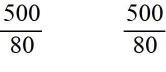
Midcontinent Plastics makes 80 fiberglass truck hoods per day for large truck
manufacturers. Each hood sells for $500.00. Midcontinent sells all of its product to the
large truck manufacturers. Suppose the own price elasticity of demand for hoods is 0.4
and the price elasticity of supply is 1.5.
a. Compute the slope and intercept coefficients for the linear supply and demand
equations.
b. If the local county government imposed a per unit tax of $25.00 per hood
manufactured, what would be the new equilibrium price of hoods to the truck
manufacturer?
c. Would a per unit tax on hoods change the revenue received by Midcontinent?

Scenario 2:
Sam and Sally are the only consumers in an economy where tee shirts and candy are the
only commodities that are consumed. The marginal utility schedule for each appears
below.
Sam tee shirts MU(tee shirts) Candy MU(Candy)
1 10 1 6
2 9 2 5
3 8 3 4
4 7 4 5
5 6 5 4
Sally tee shirts MU(tee shirts) Candy MU(Candy)
1 24 1 12
2 19 2 9
3 18 3 8
4 14 4 7
5 10 5 3
There are 7 candies and 7 tee shirts total in the economy.
Consider the case when the goods are redistributed such that Sam has 3 tee shirts and 3
candies. Sally has 4 tee shirts and 4 candies.
What is Sam’s marginal rate of substitution of tee shirts for candy at the current
distribution?
A)3

B)2
C) 1/4.
D) It is impossible to determine without the prices of each commodity.
When firms participate in group health insurance for all employees, it
A) raises rates for everyone, because it brings unhealthy people into the pool.
B) raises rates for unhealthy people.
C) may lower rates for all people to the extent that it keeps healthy people in the pool.
D) prevents unhealthy people from ‘selecting out,” to the detriment of healthy people.
E) increases the amount of information available to insurers about the population.
Some grocery stores are now offering customers coupons which entitle them to a
discount on certain items on their next visit when they go through the check-out line.
This practice is an example of:
A) intertemporal price discrimination.
B) third-degree price discrimination.
C) a two-part tariff.

D) bundling.
E) none of the above
The substitution effect of a decrease in the wage will
A) decrease leisure, regardless of whether leisure is a normal or inferior good.
B) increase leisure, regardless of whether leisure is a normal or inferior good.
C) increase leisure only if leisure is a normal good.
D) decrease leisure only if leisure is a normal good.
Scenario 3:
Consider the following information.
Melissa Qwerty was killed in a freak typewriter accident. Her family sued the
typewriter company for the value of the income loss her death represented. The family
demanded $X in compensation.
Which of the following would raise $X?
A) Lower current income
B) Lower expected growth in income
C) Lower mortality rates
D) Lower interest rates
E) Higher age at time of death
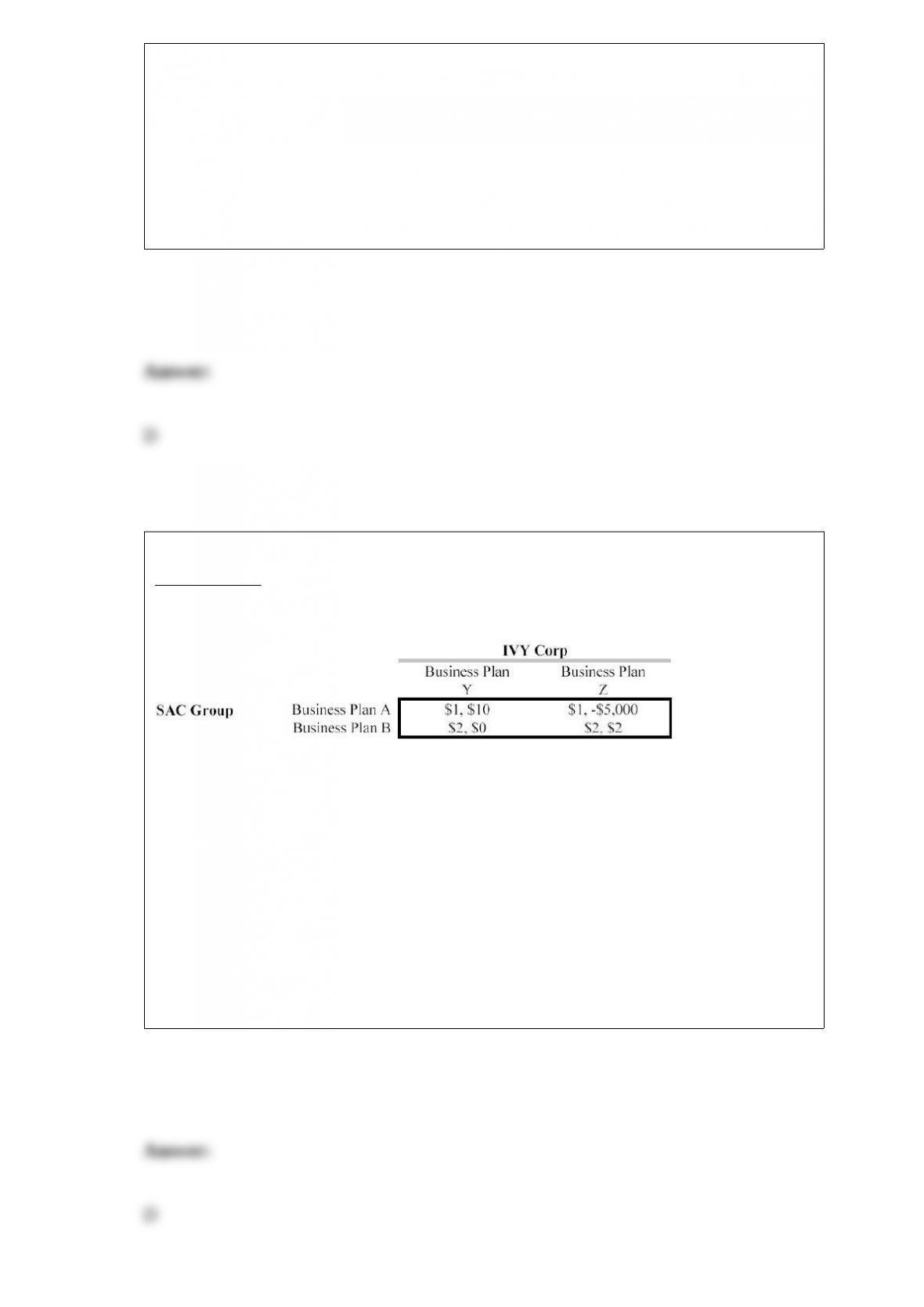
Scenario 13.8
Consider the following game:
In game in Scenario 13.8, what is the Nash equilibrium?
A) The strategy pair associated with $1, $10.
B) The strategy pair associated with $2, $0.
C) The strategy pair associated with $1, -$5000.
D) The strategy pair associated with $2, $2.
E) There is no Nash equilibrium in pure strategies.
Consider the demand curve of the form Q = a – bP. If a is a positive real number, and b
= 0, then demand is
A) completely inelastic.
B) inelastic, but not completely.
C) unit elastic.
D) elastic, but not infinitely.
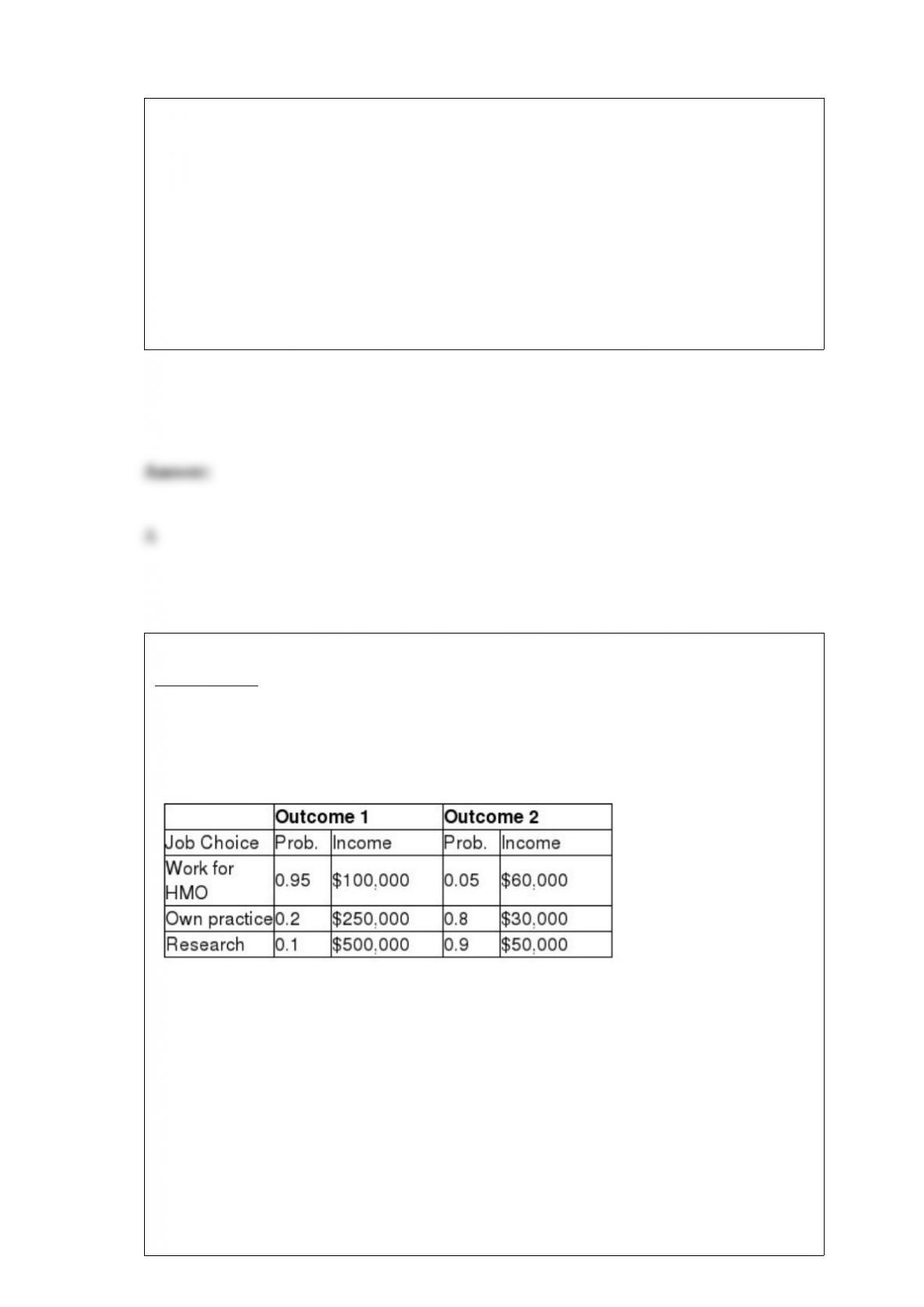
Scenario 5.6:
Consider the information in the table below, describing choices for a new doctor. The
outcomes represent different macroeconomic environments, which the individual
cannot predict.
Refer to Scenario 5.6. The expected utility of income from research is
A) u($275,000).
B) u($95,000).
C) [u($500,000) + u($50,000)]/2.
D) .1 u($500,000) + .9 u($50,000).
E) dependent on which outcome actually occurs.

Which of the following is true about the indifference curve where one commodity (such
as pollution) is “bad”?
A) It has a negative slope.
B) It has a positive slope.
C) It is horizontal.
D) It is vertical.
One difficulty in managing common property resources is that
A) the monopoly firm that owns such a resource typically has great economic power, so
that breaking it up into smaller firms is not practical.
B) the monopoly firm that owns such a resource typically is a natural monopoly, so that
it is undesirable to break it up into smaller firms.
C) many common property resources are so small that management would have to be
done on a micro level, greatly increasing government activity in the economy.
D) many common property resources are so vast that single ownership or management
of them is not practical, especially if they cross international borders.
E) more and more of them come into being as pollution increases.

Your indifference curves for good X (horizontal axis) and good Y (vertical axis) are
vertical lines because you do not gain any satisfaction from consumption of Y. As the
price of X declines, the change in consumption of X is entirely composed of the:
A) income effect.
B) substitution effect.
C) Giffen effect.
D) independent good effect.
A plastics factory emits water pollutants into a nearby river. The marginal private cost
of producing plastics is constant, the marginal external cost of the pollutants increases
with the quantity of plasticis, and the demand for plastics is downward sloping. What
happens to the socially optimal level of output and market price if the marginal external
cost curve shifts upward?
A) Optimal price and quantity decrease
B) Optimal price increases, optimal quantity remains unchanged
C) Optimal price increases, optimal quantity decreases
D) Optimal price and quantity decline

Assume that steak and potatoes are complements. When the price of steak goes up, the
demand curve for potatoes:
A) shifts to the left.
B) shifts to the right.
C) remains constant.
D) shifts to the right initially and then returns to its original position.
For a two-part tariff imposed on two consumers, the entry fee is based on the:
A) consumer surplus of the customer with lower willingness-to-pay.
B) consumer surplus of the customer with higher willingness-to-pay.
C) simple average of the consumer surplus for the two buyers.
D) none of the above

An upward sloping isoquant
A) can be derived from a production function with one input
B) can be derived from a production function that uses more than one input where
reductions in the use of any input always reduces output
C) cannot be derived from a production function when a firm is assumed to maximize
profits
D) can be derived whenever one input to production is available at zero cost to the firm
E) none of the above