
Adjustment costs:
a. are costs incurred by a firm when it has to advertise to hire more workers.
b. are costs incurred by a firm when it decides it needs to layoff workers.
c. result in less employment volatility.
d. result in a firm optimally choosing to reach the cost minimizing level of employment.
e. All of the above are true statements about adjustment costs.
Which of the following would cause a movement along the labor supply curve for the
steel market?
a. The federal government imposes a minimum wage law.
b. The hourly wage in the iron market increases.
c. Hundreds of immigrants enter the area.
d. A smallpox outbreak results in thousands of deaths.
e. Medical malpractice lawsuits cause doctors to have to pay more for insurance, thus
decreasing their wage.
The total workplace injury rate _______ from 1990 to 2000 and _______ from 2000

onward.
a. rose; rose
b. rose; fell
c. fell; rose
d. fell; fell
e. was constant; fell
Which of the following is not true about a monopolist?
a. A monopolist earns economic rents or supernormal profits.
b. A monopolist’s accounting profits are greater than its normal profits.
c. A monopolist demands less labor than a competitive firm.
d. A monopolist pays its workers more than the competitive wage rate.
e. A monopolist pays its workers the competitive wage rate.
Suppose a risk-neutral firm hires many risk-averse workers for two periodsex ante and
ex post. Half of the workers possess high ability, , and the other half possess low
ability, . Worker ability is revealed ex post. A worker’s lifetime utility is given by
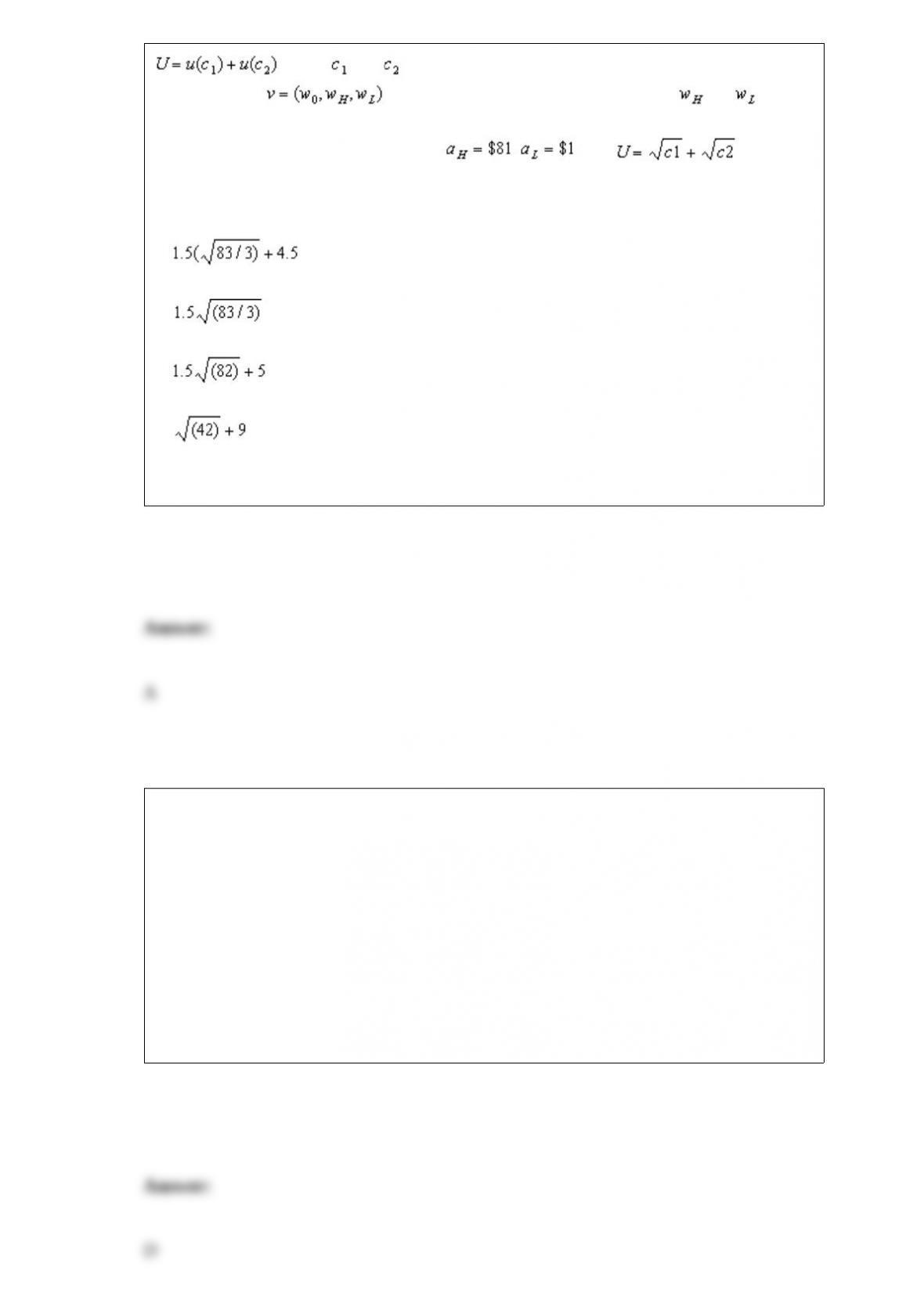
where and are consumption in each of the periods. The firm
offers contract where $w0 is the first period wage and and are the
respective second period wage offers made to high- and low-ability workers. The labor
market is competitive ex ante. Assume , , and . What is
the typical worker’s lifetime approximate utility if the firm comes into direct contact
with the external labor market?
a.
b.
c.
d.
e. 3+42
Suppose the own wage elasticity of labor is 0.75%. What does this imply?
a. The supply of labor is elastic.
b. The supply of labor is inelastic.
c. The demand for labor is elastic.
d. The demand for labor is inelastic.
e. The demand for labor is unitary elastic.

Suppose capital and labor are gross complements. If the supply of capital is relatively
inelastic, then the labor demand elasticity will be
a. high.
b. low.
c. zero.
d. one.
e. positive.
Which of the following is an example of the make-or-buy decision?
a. A textbook maker decides whether to rent an office building or buy an office
building.
b. A shoe salesman decides whether to work at a department store or a local shoe store.
c. A mother decides whether to babysit her own children or send her children to
daycare.
d. A scientist decides whether to hire a new research assistant or give the research
assistant he already has employed more work.
e. A teacher decides whether to teach first or second grade.

If the returns to schooling do not equal the interest rate, then
a. the market is operating efficiently.
b. individuals are not maximizing their utility.
c. firms are not maximizing their profits.
d. the market is in equilibrium.
e. the government can implement policies to increase overall wellbeing.
Which of the following is a true statement about trends in the U.S. labor force between
1950 and 2000?
a. The male labor force participation rate has increased steadily.
b. The unemployment rate peaked during the Carter administration (1976″1980).
c. The female labor force participation rate has declined.
d. The increase in the labor force participation rate was caused by women joining the
labor force.
e. The size of the labor force has not grown much over the past 50 years.

The solution to a utility maximization problem:
a. is located outside the budget constraint.
b. is an interior solution located on the budget line, where the individual chooses to
work.
c. is a corner solution where the individual does not work and lives off her unearned
income, A0.
d. must meet the tangency requirement.
e. answers B or C
Assume that there are two types of workers: safe and risky. At the beginning of the first
period a firm must decide to hire a safe or risky worker. Safe workers have constant
ability worth $200 per period. There is a 50 percent chance a risky worker will have
ability worth $300 per period and a 50 percent chance a risky worker will have ability
worth $100 per period. What is the risky worker’s average productivity?
a. $100
b. $200
c. $300
d. $400
e. $500

In Figure 4.2, the income effect causes her leisure to , implying leisure is a(n) good.
a. decrease, inferior
b. decrease, normal
c. remain the same, normal
d. increase, inferior
e. increase, normal
Which of the following does not help develop human capital?
a. attending college for 4 years
b. the government investing in public schools
c. a firm purchases another computer so two individuals no longer have to share
d. a parent teaching their children about religion
e. a supervisor training a worker in how to use a new machine in the factory
Suppose labor is perfectly competitive and there are only two periods. For which values

of the interest rate, r, costs of training, i, and value added by training, V, is the training
opportunity inefficient?
a. i = $50, V = $150, r = 10%
b. i = $40, V = $100, r = 10%
c. i = $60, V = $125, r = 5%
d. i = $90, V = $125, r = 5%
e. i = $90, V = $100, r = 15%
An economic model examines how a(n) affects a(n) .
a. independent variable, dependent variable
b. endogenous variable, independent variable
c. exogenous variable, independent variable
d. endogenous variable, dependent variable
e. endogenous variable, exogenous variable

Today the federal minimum wage is and it covers almost of workers.
a. 4.25; 50 percent
b. 10.25; 50 percent
c. 7.25; 90 percent
d. 5.25; 90 percent
e. 8.00; 75 percent
In a model of job search with search frictions, it is difficult and time-consuming for
workers and job vacancies to find each other. In this environment, the presence of
prejudiced employers has a effect on minorities’ bargaining positions and a effect on
minorities’ wages.
a. negative; negative
b. negative; positive
c. positive; negative
d. positive; positive
e. neutral; negative

There are two tasks, 1 and 2, and two workers, A and B. The level of output, y, is
governed by the task-based production technology: where and denote
the respective amount of task 1 and task 2 that are carried out during the period. A‘s
ability is (10, 1), which represents the maximum amount of task 1 and task 2 he can
perform if he devotes all of his time to it. B‘s ability is (6, 3). Which worker has a
comparative advantage in task 1? Which worker has a comparative advantage in task 2?
a. A; A
b. A; B
c. B; A
d. B; B
e. neither; A
Which year did the worker have the highest real wages?
a. 1996
b. 1999
c. 2002
d. 2006
e. none of the above

Which of the following is NOT true of the Duncan index of dissimilarity, D?
a. This index is used to compare occupational distributions.
b. The index can be used to compare any number of groups in any number of
occupations.
c. .
d. The dissimilarity between distributions increases with D.
e. Distributions are identical if D is equal to zero.
Which of the following is an advantage of just-in-time production?
a. Productive tools are flexible or lean.
b. Product quality is enhanced because manufacturing defects can be quickly identified
and rectified.
c. This type of production calls for dramatic organizational restructuring.
d. Workers are more efficient because they start work immediately upon entering the
workplace because training takes place on the job.
e. Workers are induced to operate at comparatively higher levels of effort.

General training is:
a. training that raises a worker’s productivity at all firms.
b. training that is only useful for one firm.
c. training that always occurs on site.
d. training that is always planned and off site.
e. training that is always gained through information conversations.
Gainsharing plans suffer from the ______, which stems from the incentives for agents
to others’ work.
a. 1/N problem; sabotage
b. 1/N problem; free ride on
c. N problem; sabotage
d. N problem; free ride on
e. N×N problem; sabotage
Which type of investment results in a steep age-earnings profile?

a. on-the-job training
b. formal training
c. informal training
d. general training
e. specific training
How many chefs will work in the fancy restaurant?
a. 4 workers
b. 8 workers
c. 12 workers
d. 14 workers
e. 16 workers
If the training is general, who will pay for the training?
a. The individual will pay the full $60.
b. The firm will pay the full $60.

c. The firm will pay $40 and the individual will pay $20.
d. The firm will pay $20 and the individual will pay $40.
e. The individual will not receive training because the costs are greater than the
benefits.
An individual will choose the optimal amount of schooling so that the return to an
additional year of school equals:
a. the individual’s total discounted earnings.
b. the marginal cost of an additional year of schooling.
c. the reservation schooling cost.
d. the expected return from investing the money in the bank.
e. B and D
Suppose the government imposes an employment subsidy of $4 per worker per hour.
What is the new equilibrium wage?
a. $8
b. $9

c. $10
d. $13
e. $15
The own wage elasticity
a. is the percentage response in labor supply induced by a 1% impulse in the wage.
b. is the effect of a 1% increase in wage on the decision to participate in the labor force.
c. is always negative.
d. is always positive.
e. is always one.
In a model of job search with search frictions, it is difficult and time-consuming for
workers and job vacancies to find each other. In this environment, the presence of
prejudiced employers has a effect on minorities’ wages. The extent of the wage
discrimination depends on the prejudice of the employer.
a. negative; average
b. negative; marginal

c. positive; average
d. positive; marginal
e. neutral; average