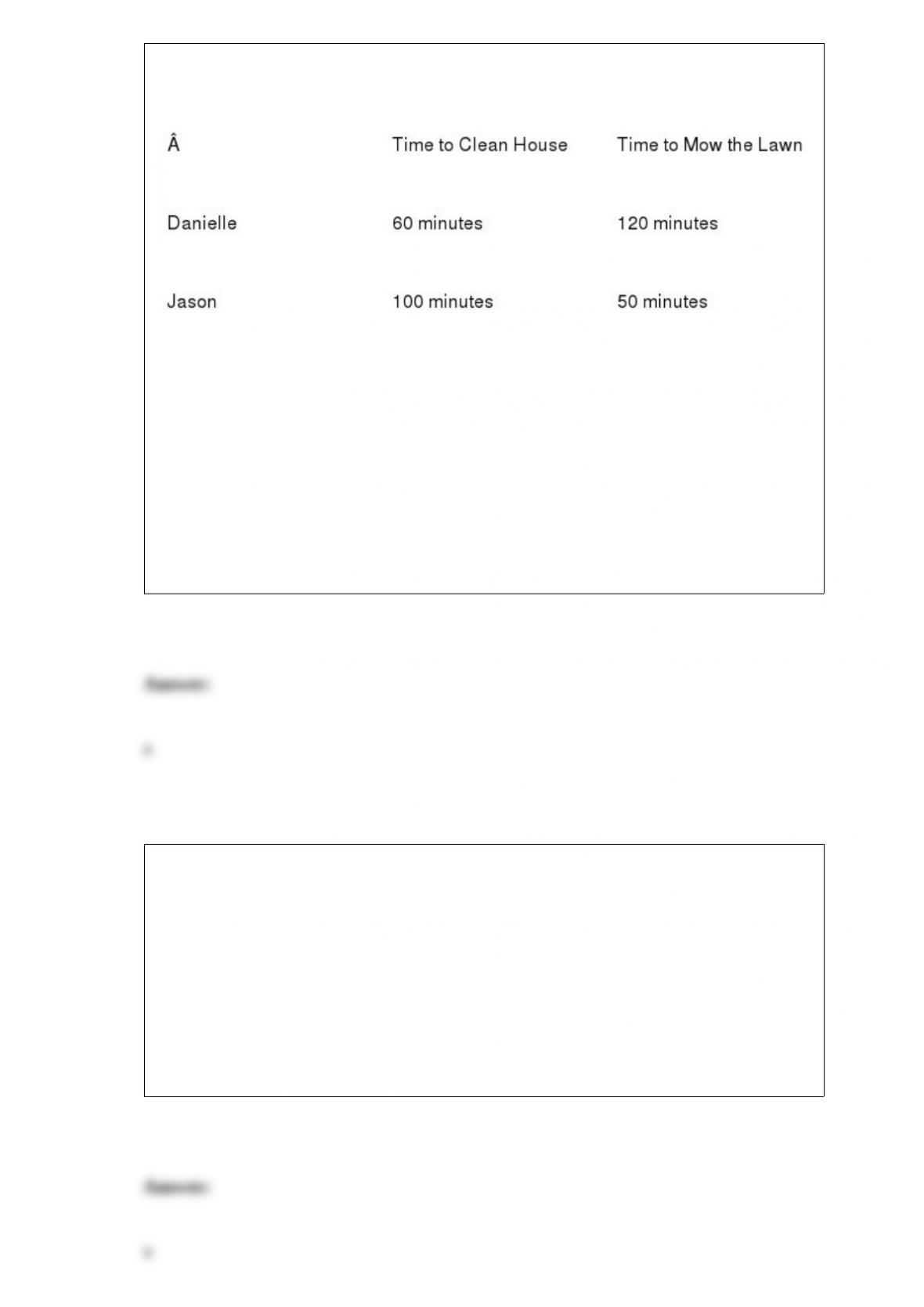
Exhibit 34-10
Danielle’s opportunity cost of cleaning the house is
a. 0.50 mowed lawns.
b. 1.00 mowed lawns.
c. 2.00 mowed lawns.
d. 0.60 mowed lawns.
In a political election, a candidate whose positions are on the left will tend to be labeled
__________ by his or her opponent.
a. too far to the left
b. too far to the right
c. too much of a middle-of-the-roader
d. an unknown quantity

The longer the period of time allowed for the producer of a good to adjust to a change
in the price of the good, the ____________ the price elasticity of supply will be.This
statement assumes that the quantity supplied __________ be altered with time.
a. more elastic; can
b. more elastic; cannot
c. more inelastic; can
d. more inelastic; cannot
Which of the following statements is false?
a. A government with the power to tax can solve the free rider problem.
b. A government with the power to tax can set a tax greater than the MEC when trying
to change the market outcome into the efficient outcome.
c. A government with the power to subsidize can set a subsidy greater than the MEB
when trying to change the market outcome into the efficient outcome.
d. Government can remove individuals from a prisoner€s dilemma setting by changing
the payoffs in the payoff matrix.
e. none of the above
If you were to rank the four market structures in terms of lowest concentration ratio to
highest concentration ratio, which of the following rankings would be correct?
a. oligopoly, monopoly, perfect competition, monopolistic competition
b. monopoly, oligopoly, monopolistic competition, perfect competition
c. perfect competition, monopolistic competition, oligopoly, monopoly
d. monopolistic competition, perfect competition, oligopoly, monopoly
e. monopolistic competition, oligopoly, perfect competition, monopoly
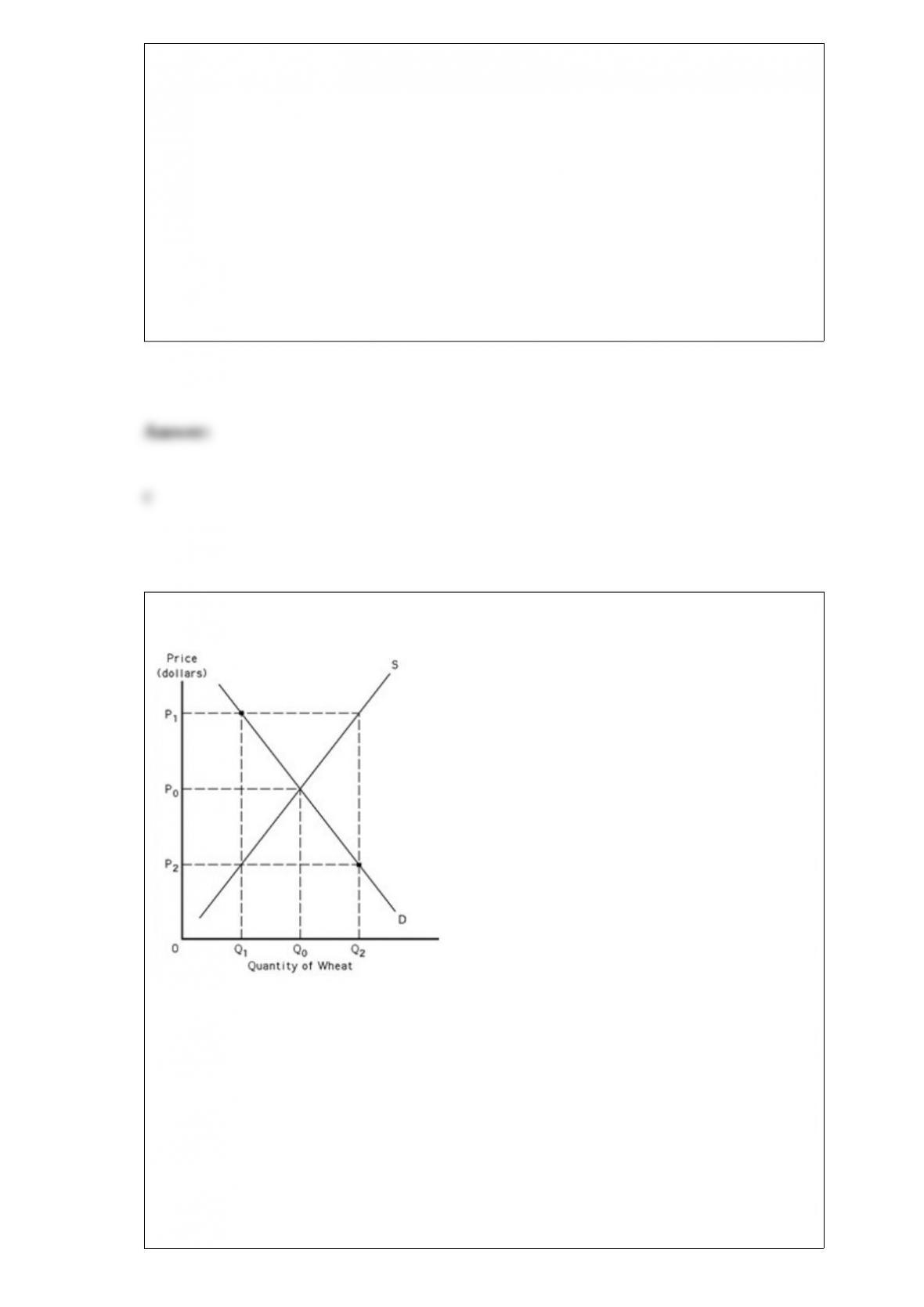
Exhibit 39-2
Given a target price of P1, what price does the consumer pay?
a. P1.
b. P0.
c. P2.
d. a price not shown on the diagram.
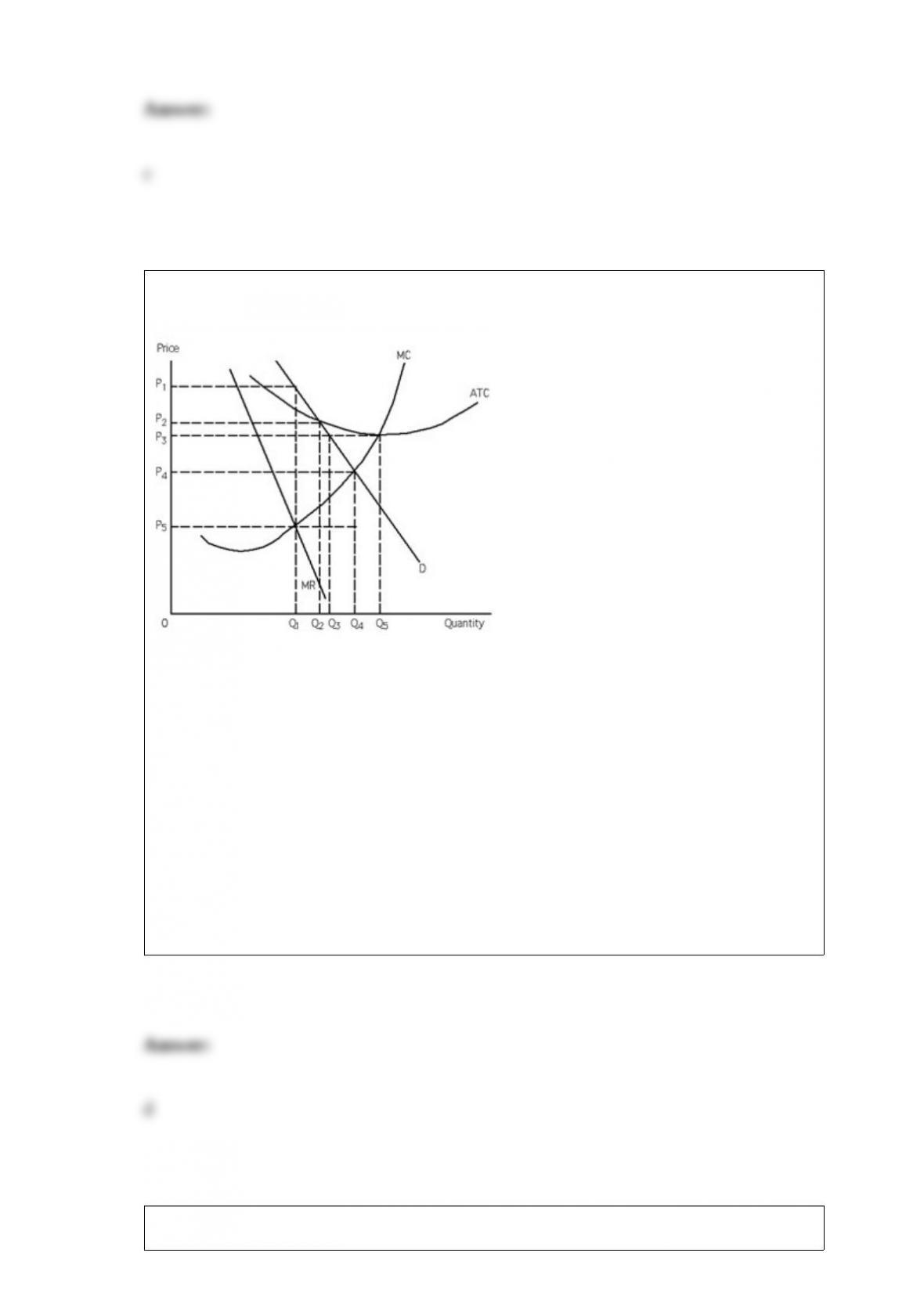
Exhibit 26-4
The resource-allocative efficient level of output is
a. Q1.
b. Q2.
c. Q3.
d. Q4.
e. Q5.
In which of the following settings is an interpersonal utility comparison being made?

a. Brandon says to Jack, “I get a lot more satisfaction out of eating pizza than you do.”
b. Stephanie says, “I don’t know what Taylor is feeling or thinking; I can’t read a
person’s heart or mind.”
c. David says to Maria, “I know you like this course a lot more than I do.”
d. a and c
e. a, b, and c
The capture theory of regulation specifies that
a. a firm will attempt to capture a large share of its market and then force its
competitors out of business.
b. regulators of monopolies capture or control the market behavior of monopolies to
suit the best interests of society.
c. industries or firms can sometimes gain control of the agencies that are attempting to
regulate them.
d. directors of one company often sit on the board of directors of another company in
the same industry and thereby capture control of the industry.
Which of the following is a positive economic statement?
a. We should raise the minimum wage in order to provide a decent wage for more
people.

b. Consumers bought fewer cars when the relative price of cars increased.
c. The budget deficit has been rising in recent years.
d. Federal government spending ought to be curtailed.
e. b and c
The instructors at College A are regularly late for their office hours.Based on a theory
presented in the textbook, we would predict that the gap between the
______________student tuition and ___________equilibrium tuition is ___________
at College A.
a. lower; higher; small
b. higher; lower; small
c. lower; higher; large
d. higher; lower; large
There are two universities, A and B, in a city. Tuition rises at University A and, as a
result, the demand for attending University B rises. It follows that educational services
at the two universities are
a. complements.
b. normal goods.

c. inferior goods.
d. substitutes.
e. none of the above
Economists state that the __________ utility a person receives from a unit of a good,
the __________ the price he or she is willing to pay for it.
a. more; lower
b. more; higher
c. less; higher
d. less; lower
e. b and d
Rent seeking is the actions of
a. individuals and groups who spend resources to influence public policy in the hope of
redistributing income to themselves from others.
b. a subset of the population that hold intense preferences for a particular government
service.
c. some citizens who choose not to acquire information because the costs of acquiring
the information are greater than the benefits.
d. politicians who exchange votes to gain support for their own legislation.
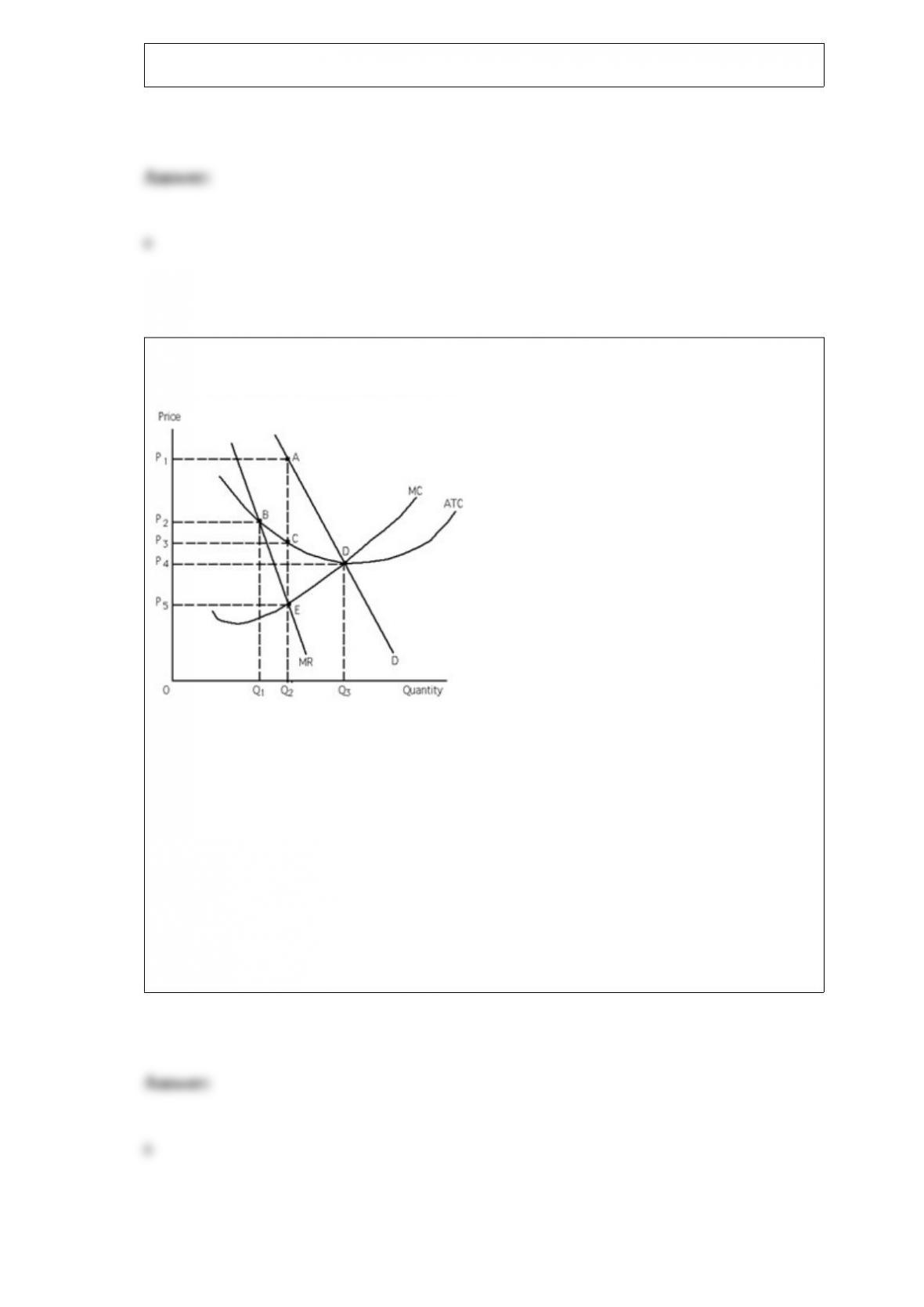
Exhibit 25-3
Total revenue of this profit maximizing monopolistic competitor is represented by the
area
a. 0P1AQ2.
b. 0P5EQ2.
c. P3P1AC.
d. 0P4DQ3.

Which of the following will reduce the cutback in union labor for a given wage
increase?
a. an increase in the number of substitutes for union labor
b. an increase in the elasticity of demand for the product that labor produces
c. a decrease in the elasticity of demand for the product that labor produces
d. an increase in the total revenue for the product that labor produces
e. a decrease in the total revenue for the product that labor produces
In-kind transfer payments are transfer payments that are paid in
a. cash.
b. a specific good or service.
c. stocks and bonds.
d. a and b
e. all of the above
Does the monopolistic competitive firm exhibit resource-allocative efficiency?
a. No, because at its chosen quantity of output, price does not equal the lowest possible
average total cost.

b. Yes, because at its chosen quantity of output, price equals marginal cost.
c. No, because at its chosen quantity of output, price is greater than marginal cost.
d. Yes, because at its chosen quantity of output, price is less than marginal cost.