
A monopsony is a market situation in which there is only one seller.
a. True
b. False
Economists use the term capital to describe that factor of production that includes
human-made resources such as factories, buildings, machinery and tools.
a. True
b. False
An increase in income shifts indifference curves outward.
a. True
b. False

The federal income tax is an example of a
a. progressive tax.
b. regressive tax.
c. proportional tax.
d. value-added tax.
The pricing system has a failure built into it when externalities exist.
a. True
b. False
The slope of an indifference curve represents the maximum amount of one commodity
that a consumer is willing to give up in exchange for one more unit of another
commodity.
a. True
b. False

If you believe that velocity is constant and that the aggregate supply curve is vertical,
then the quantity theory of money would predict that a doubling of the money supply
would cause a doubling of
a. nominal output and real output.
b. nominal output and no change in real output.
c. real output and no change in nominal output.
d. the price level and real output.
Property rights uncertainty will usually cause
a. lower levels of investment spending.
b. lower levels of real interest rates.
c. higher levels of investment spending.
d. higher levels of real interest rates.

Since price tends to equal marginal utility, the price of water is low and the price of
diamonds is high.
a. True
b. False
An economist is told that concentration in the cement industry has increased. He can
safely conclude that
a. cement production must have fallen in the industry.
b. competition in the cement industry has decreased.
c. there are fewer cement producers than before.
d. All of the above are correct.
If in some range of production average cost is falling, the firm is experiencing
a. increasing returns to scale.
b. decreasing returns to scale.
c. constant returns to scale.

d. increasing costs per unit of output.
The dramatic increase in the standard of living since the Industrial Revolution
a. means that societies and individuals face no constraints.
b. has not meant unlimited abundance for societies or persons.
c. means that “opportunity cost” is a meaningless concept.
d. has reduced the choices open to persons.
e. has made economics less useful to persons.
Figure 21-1
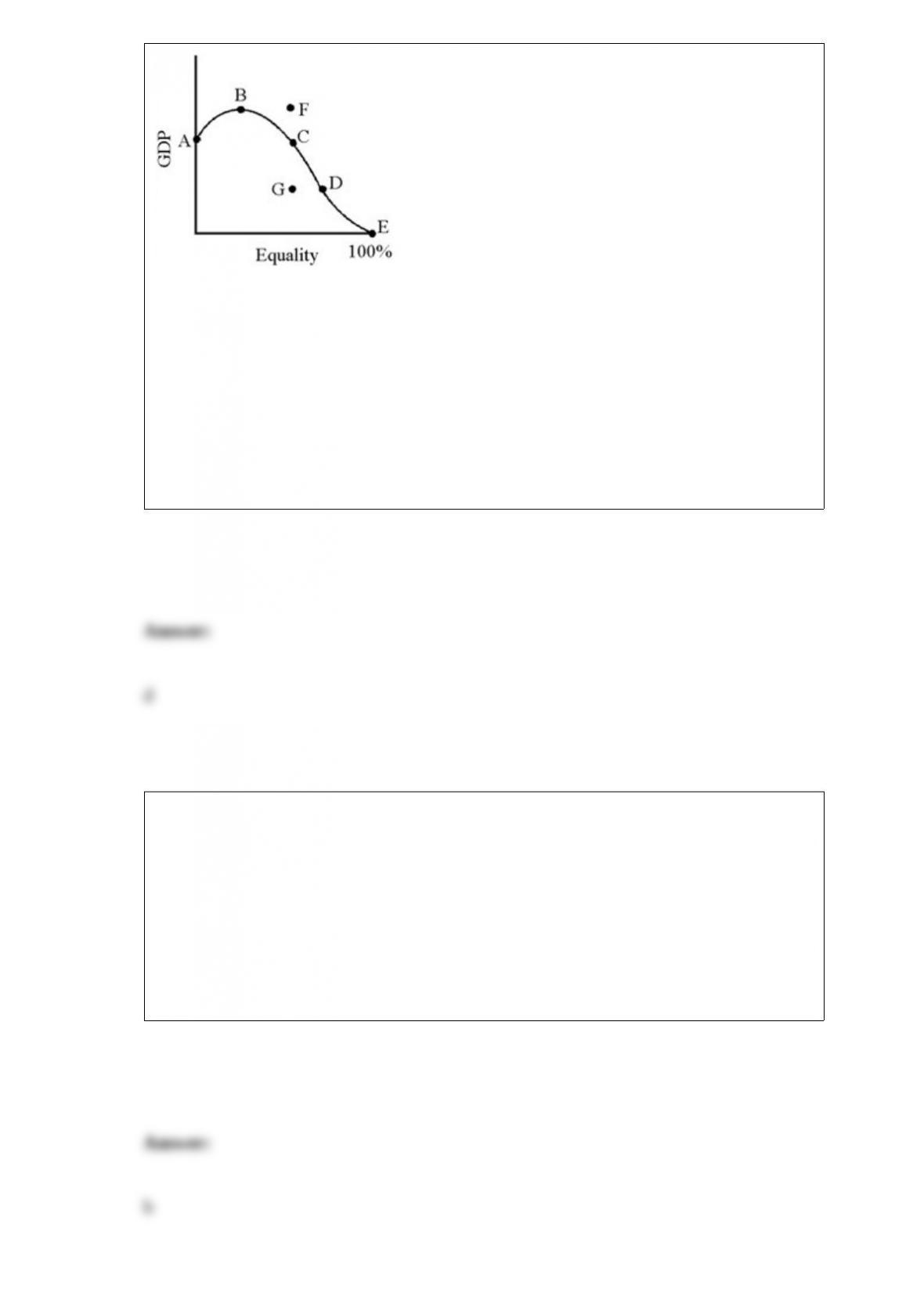
In Figure 21-1, the optimal amount of equality lies only between which points?
a. A and B
b. C and D
c. D and E
d. B and E
In fiscal year 2014, the U.S. federal budget deficit amounted to about:
a. 1.2% of GDP
b. 3.7% of GDP
c. 4.5% of GDP
d. 10% of GDP

Taxes on sales of liquor, tobacco, and tires are examples of
a. direct taxes.
b. excise taxes.
c. progressive taxation.
d. loopholes.
The Great Depression of the 1930s
a. confirmed the value of a “hands off” policy for governments.
b. was exacerbated by an expansionary monetary policy.
c. was a worldwide event.
d. continued throughout the 1940s without any interruption.
The principal factor determining velocity is the
a. level of income.
b. frequency with which paychecks are distributed.

c. frequency with which taxes are paid.
d. growth rate of real output.
A graph’s origin is the point of intersection of all lines or curves in the graph.
a. True
b. False
If a larger percentage of Americans attended college, the wage premium would
probably
a. continue rising.
b. continue falling.
c. rise.
d. fall.
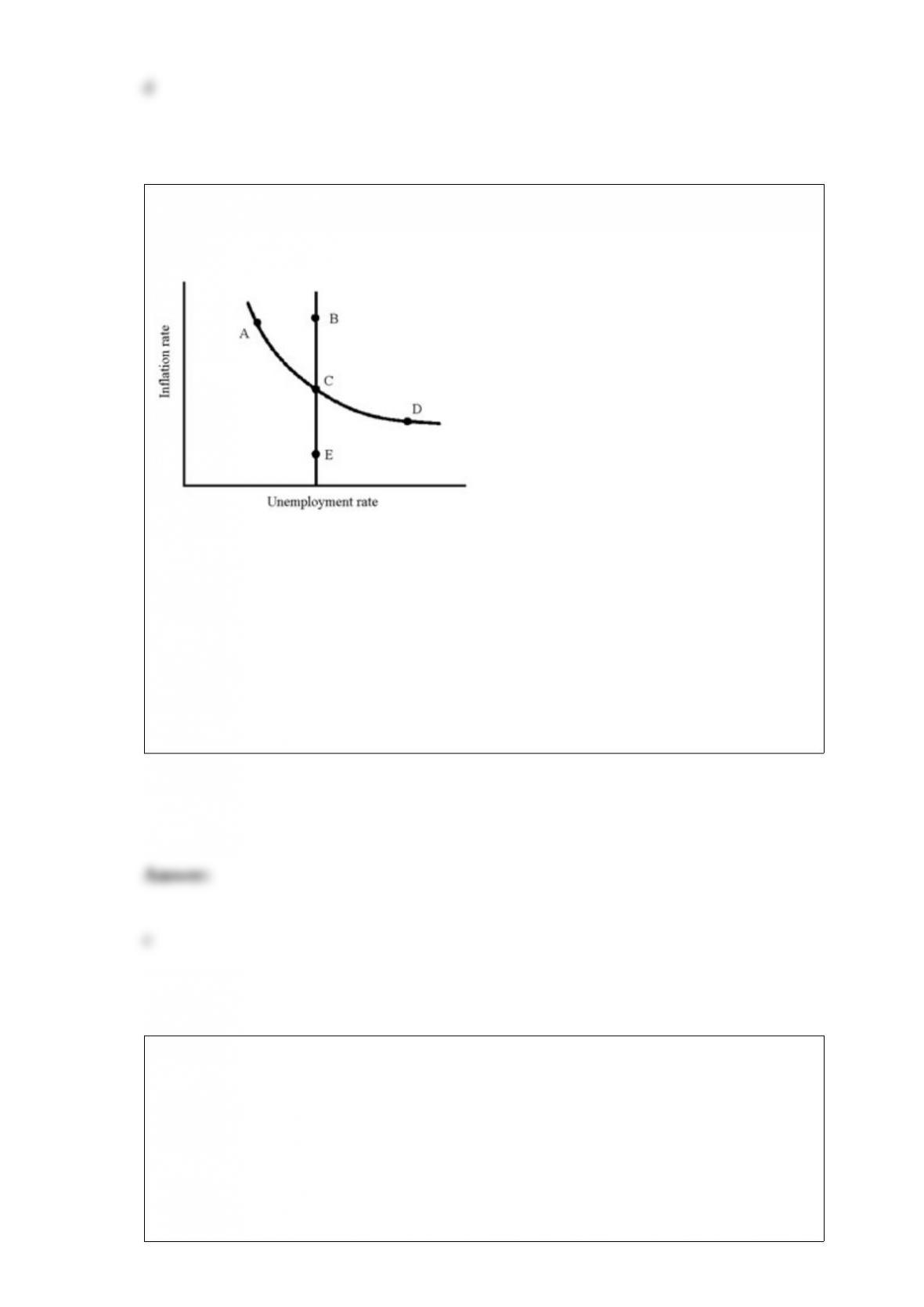
Figure 17-8
In Figure 17-8, the aggregate supply curve is shifting inward as we move from
a. A to C.
b. C to E.
c. A to B.
d. D to C.
A point lying inside (under) a production possibilities curve indicates that
a. the economy is saving money.
b. there are no associated opportunity costs.
c. more output could be produced with existing resources.

d. technology limits production.
Adding depreciation to net national product yields
a. disposable income (DI).
b. personal income (PI).
c. net national product (NNP).
d. gross domestic product (GDP).
In its original role as “lender of last resort” the Fed was supposed to
a. lend money to people in regions without banks.
b. lend money to developing nations.
c. keep the money supply from drying up during financial panics.
d. provide mortgage lending to returning soldiers.

Taxing pollution will encourage firms to reduce pollutants dumped in the atmosphere or
in streams.
a. True
b. False
Historical data depicted on a scatter diagram show that consumer spending and
disposable income
a. converge as income grows.
b. generally move together.
c. diverge as income grows.
d. show no clear relationship.
Assume a new technology further reduces the cost of producing calculators. Also
assume that consumers have cut back on their scheduled purchases in anticipation of
even more cost-saving developments. As a result, we can expect

a. a decrease in price but no predictable change in output.
b. a decrease in output but no predictable change in price.
c. an increase in output but no predictable change in price.
d. a predictable decrease in both output and price.
The excess capacity theorem states that
a. society is worse off with fewer monopolistic competitors.
b. costs of production under monopolistic competition can be lowered by reducing the
number of producers.
c. lack of excess capacity leads to shortages during periods of unexpected growth in
demand for goods produced by monopolistic competition.
d. there is too much choice in our economy.
Banks try to keep their level of excess reserves low because
a. the Fed charges a penalty for holdings of excess reserves.
b. they are concerned that the money multiplier will become too large.
c. they wish to maximize profits.
d. bank regulators levy fines on the amount of excess reserves.
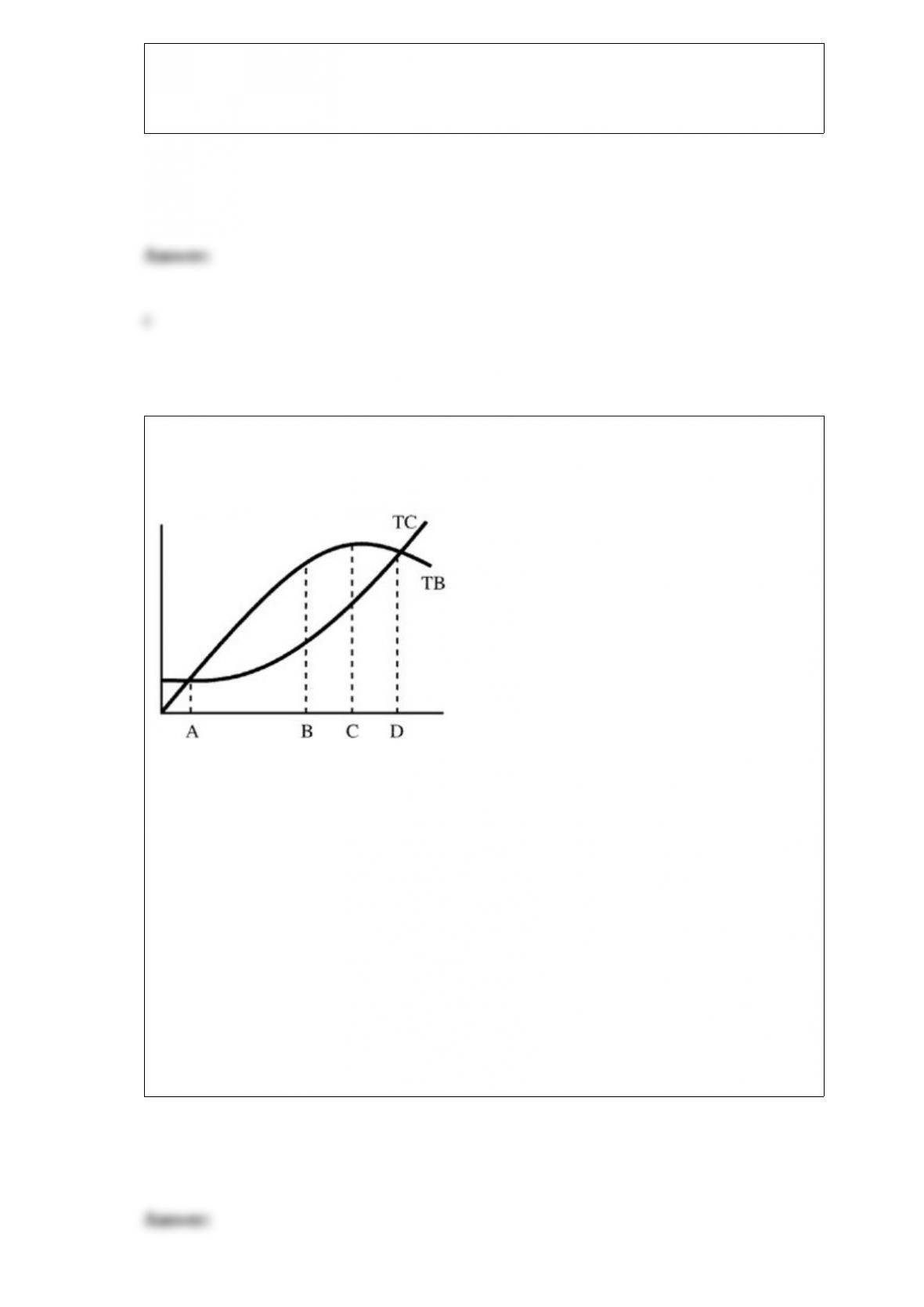
Figure 7-3
Government provides many goods and services to the public because they are not
provided by free markets. Some economists believe bureaucrats who manage the
programs have no interest in maximizing net benefits (profits) but instead maximize the
size of a program constrained only by the need to have total benefits exceed total costs.
Figure 7-3 shows total benefits and cost curves for a program. What point is the
efficient point, and what point will the bureaucrat choose?
a. A and B, respectively
b. B and D, respectively
c. D and C, respectively
d. D and A, respectively

Shortages normally accompany an effective price floor.
a. True
b. False
An economic boom in the United States will tend to cause booms in other countries
because as U.S. GDP rises, U.S.
a. tariffs will automatically fall.
b. exports will rise.
c. imports will rise.
d. exports will fall.
Price and output decisions are two aspects of the same choice.
a. True
b. False

Stock markets deal
a. almost exclusively in newly issued stocks.
b. in previously issued stocks.
c. in both newly issued and previously issued stocks, but they do not deal in bonds.
d. in large amounts of both newly issued and previously issued stocks and bonds.
The goal of all regulation is the creation of perfectly competitive markets.
a. True
b. False