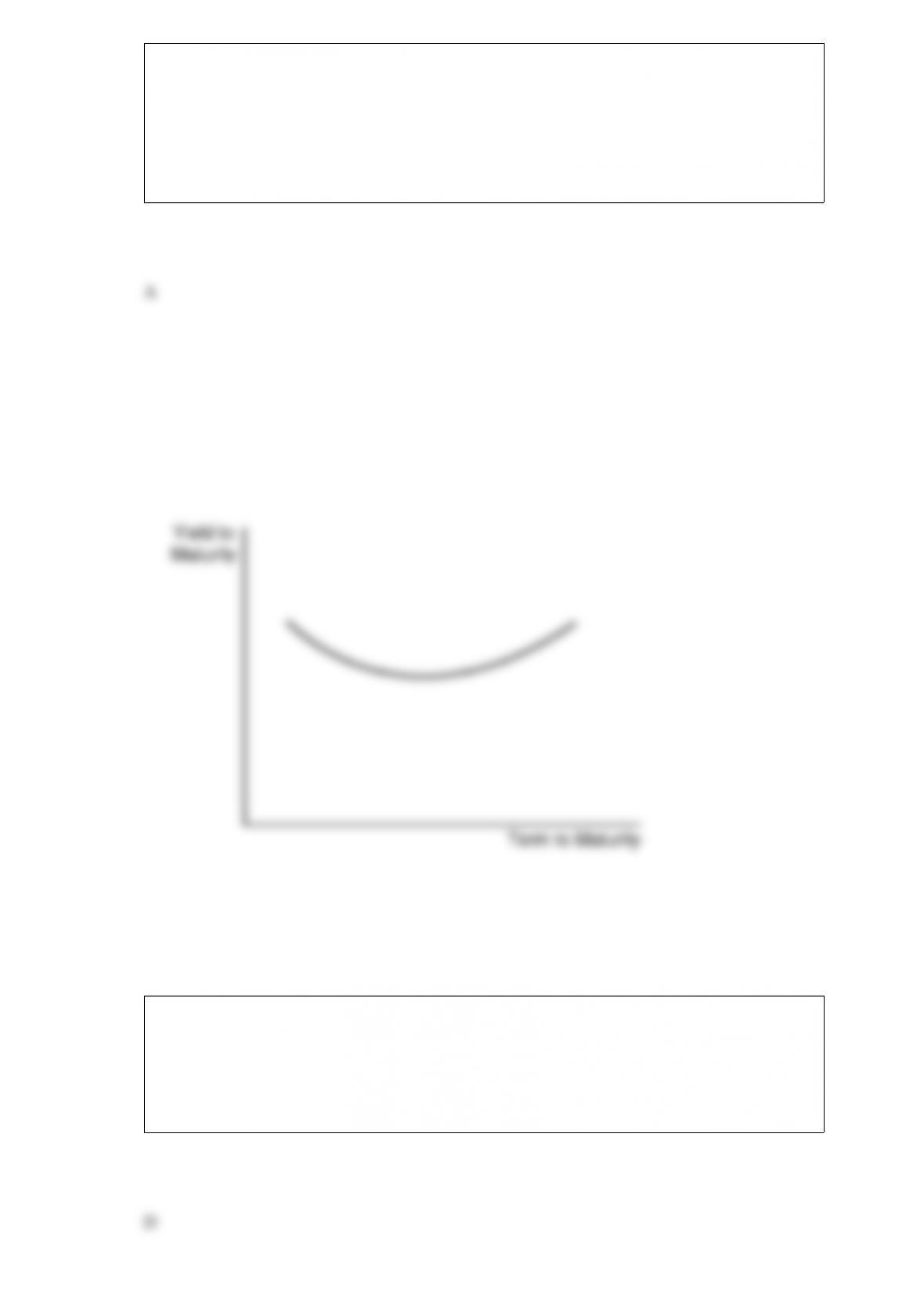
The steeply upward sloping yield curve in the figure above indicates that ________
interest rates are expected to ________ in the future.
A) short-term; rise
B) short-term; fall moderately
C) short-term; remain unchanged
D) long-term; fall moderately
The term structure of interest rates is
A) the relationship among interest rates of different bonds with the same maturity.
B) the structure of how interest rates move over time.
C) the relationship among the term to maturity of different bonds.
D) the relationship among interest rates on bonds with different maturities.

As “haircuts” increased during 2007-2009, financial institutions found that to borrow
the same loan amount now required ________ collateral.
A) less
B) no
C) more
D) default-free
A swap that involves the exchange of one set of interest payments for another set of
interest payments is called
A) an interest rate swap.
B) a currency swap.
C) a swaption.
D) an international swap.
Suppose the economy is producing at the natural rate of output. An open market
purchase of bonds by the Fed will cause ________ in real GDP the the short run and
________ in inflation in the short run, everything else held constant.
A) an increase; an increase
B) a decrease; a decrease
C) no change; an increase
D) no change; a decrease

Which of the following insurance practices attempts to minimize the adverse selection
problem insurance companies face?
A) prevention of fraud
B) risk-based premiums
C) restrictive provisions
D) deductibles
Everything else held constant, if workers expect an increase in inflation, ________
aggregate supply ________.
A) long-run; increases
B) long-run; decreases
C) short-run; decreases
D) short-run; increases
Higher government deficits ________ the supply of bonds and shift the supply curve to
the ________, everything else held constant.
A) increase; left
B) increase; right
C) decrease; left
D) decrease; right
Tobin’s q theory suggests that monetary policy may affect investment spending through
its impact on

A) stock prices.
B) interest rates.
C) bond prices.
D) cash flow.
During the 2007-2009 financial crisis the excess reserve ratio
A) increased sharply.
B) decreased sharply.
C) increased slightly.
D) decreased slightly.
The data lag is
A) the time it takes for policy makers to obtain data indicating what is happening in the
economy.
B) the time it takes for policy makers to be sure of what the data are signaling about the
future course of the economy.
C) the time it takes to pass legislation to implement a particular policy.
D) the time it takes for policy makers to change policy instruments once they have
decided on the new policy.
E) the time it takes for the policy actually to have an impact on the economy.
The Basel Accord, an international agreement, requires banks to hold capital based on
A) risk-weighted assets.

B) the total value of assets.
C) liabilities.
D) deposits.
Uncertainty about interest-rate movements and returns is called
A) market potential.
B) interest-rate irregularities.
C) interest-rate risk.
D) financial creativity.
Life insurance companies are regulated by state governments because
A) they have never experienced bankruptcy.
B) they have never experienced profitability.
C) they have never experienced widespread failures.
D) they hold only highly liquid assets.
Everything else held constant, an increase in marginal tax rates would likely have the
effect of ________ the demand for municipal bonds, and ________ the demand for
U.S. government bonds.
A) increasing; increasing
B) increasing; decreasing
C) decreasing; increasing
D) decreasing; decreasing

A call option gives the owner the
A) right to sell the underlying security.
B) obligation to sell the underlying security.
C) right to buy the underlying security.
D) obligation to buy the underlying security.
Everything else held constant, when the current value of the domestic exchange rate
increases, the ________ of domestic assets ________.
A) quantity supplied; does not change
B) supply; decreases
C) quantity supplied; increases
D) supply; increases
All of the following are operating expenses for a bank EXCEPT
A) service charges on deposit accounts.
B) salaries and employee benefits.
C) rent on buildings.
D) servicing costs of equipment such as computers.

Which of the following is NOT an advantage of a correctly specified structural model?
A) Structural models may help us to more accurately predict the effect that monetary
policy has on economic activity.
B) A structural model provides more pieces of evidence about monetary policy’s effect
on economic activity.
C) Structural models may allow economists to more accurately predict the impact
institutional changes have on the link between monetary policy and income.
D) A structural model imposes no restrictions on the way monetary policy affects the
economy.
Financial instruments whose payoffs are linked to previously issued securities are called
A) grandfathered bonds.
B) financial derivatives.
C) hedge securities.
D) reversible bonds.
Agreements such as the ________ are attempts to standardize international banking
regulations.
A) Basel Accord
B) UN Bank Accord
C) GATT Accord
D) WTO Accord

An emerging market country that successfully used exchange-rate targeting to lower its
inflation from above 100 percent in 1988 to below 10 percent in 1994 (before
devaluation) was
A) Thailand.
B) Mexico.
C) The Philippines.
D) Indonesia.
A plot of the interest rates on default-free government bonds with different terms to
maturity is called
A) a risk-structure curve.
B) a default-free curve.
C) a yield curve.
D) an interest-rate curve.
The global financial crisis showed the need for increased financial regulation, however,
too much or poorly designed regulation could
A) choke off financial innovation.
B) increase the efficiency of the financial system.
C) increase economic growth.
D) increase international financial integration.
Which of the following is an advantage to money targeting?

A) There is an immediate signal on the achievement of the target.
B) It does not rely on a stable money-inflation relationship.
C) It implies lack of transparency.
D) It implies smaller output fluctuations.
Factors that led to worsening financial market conditions in East Asia in 1997-1998
include
A) weak supervision by bank regulators.
B) a rise in interest rates abroad.
C) unanticipated increases in the price level.
D) increased uncertainty from political shocks.
In the long-run ISLM model and with everything else held constant, the long-run effect
of a tax cut is to ________ real output and ________ the interest rate.
A) increase; increase
B) increase; not change
C) not change; increase
D) not change; decrease
When the European System of Central Banks uses main refinancing operations, it is
similar to the Federal Reserve using
A) dynamic open market operations.
B) defensive open market operations.

C) discount policy.
D) reserve requirements.
The steepest increase in the currency ratio since 1892 occurred during
A) World War II.
B) the Great Depression.
C) the interwar years.
D) the past twenty years.
The share of checkable deposits in total bank liabilities has
A) expanded moderately over time.
B) expanded dramatically over time.
C) shrunk over time.
D) remained virtually unchanged since 1960.
The Second Bank of the United States was denied a new charter by
A) President Andrew Jackson.
B) Vice President John Calhoun.
C) President Benjamin Harrison.
D) President John Q. Adams.

By bundling share purchases of many investors together mutual funds can take
advantage of economies of scale and thereby lower
A) adverse selection.
B) moral hazard.
C) transactions costs.
D) diversification.
A advantage of using swaps to hedge interest-rate risk is that swaps
A) are less costly than futures.
B) can be written for long horizons.
C) are not subject to default risk.
D) are more liquid than futures.
Everything else held constant, when real estate prices are expected to decrease
A) the demand curve for bonds shifts to the left and the interest rate rises.
B) the demand curve for bonds shifts to the left and the interest rate falls.
C) the demand curve for bonds shifts to the right and the interest rate falls.
D) the supply curve for bonds shifts to the right and the interest rate falls.

The disruption to financial markets starting in August 2007 that caused both consumer
and business spending to fall
A) shifted the aggregate demand curve to the right.
B) shifted the aggregate demand curve to the left.
C) shifted the aggregate supply curve to the right.
D) shifted the aggregate supply curve to the left.