
Which of the following describes a difference between allocative efficiency and
productive efficiency in a perfectly competitive market?
A) Allocative efficiency is achieved only in the long run. Productive efficiency is
achieved only in the short run.
B) Allocative efficiency is achieved only in the long run. Productive efficiency is
achieved in the short run and the long run.
C) Allocative efficiency is achieved only in the short run. Productive efficiency is
achieved only in the long run.
D) Allocative efficiency is achieved in the short run and the long run. Productive
efficiency is achieved only in the long run.
If there are no externalities, a competitive market achieves economic efficiency. If there
is a negative externality, economic efficiency will not be achieved because
A) too little of the good will be produced.
B) too much of the good will be produced.
C) a deadweight loss will occur that is equal to the area under the demand curve for the
good.
D) economic surplus is maximized.
Which of the following contributed to the downfall of the Soviet Union in 1991?
A) government dissatisfaction with high living standards and political freedom

B) an inability to produce low-cost consumer goods that households wanted
C) an overabundance of high-quality goods and services
D) the lack of a strong dictator who can coordinate economic activities
Perfectly competitive firms produce up to the point where the price of the good equals
the marginal cost of producing the last unit. This condition is referred to as
A) productive efficiency.
B) constant returns to scale.
C) allocative efficiency.
D) perfectly competitive efficiency.
Economist Robert Fogel has estimated that by the year 2040, individuals in the United
States will be spending
A) more time in the workforce and more time in leisure activities than they do today.
B) less time in the workforce and less time in leisure activities than they do today.
C) less time in the workforce and more time in leisure activities than they do today.
D) more time in the workforce and less time in leisure activities than they do today.
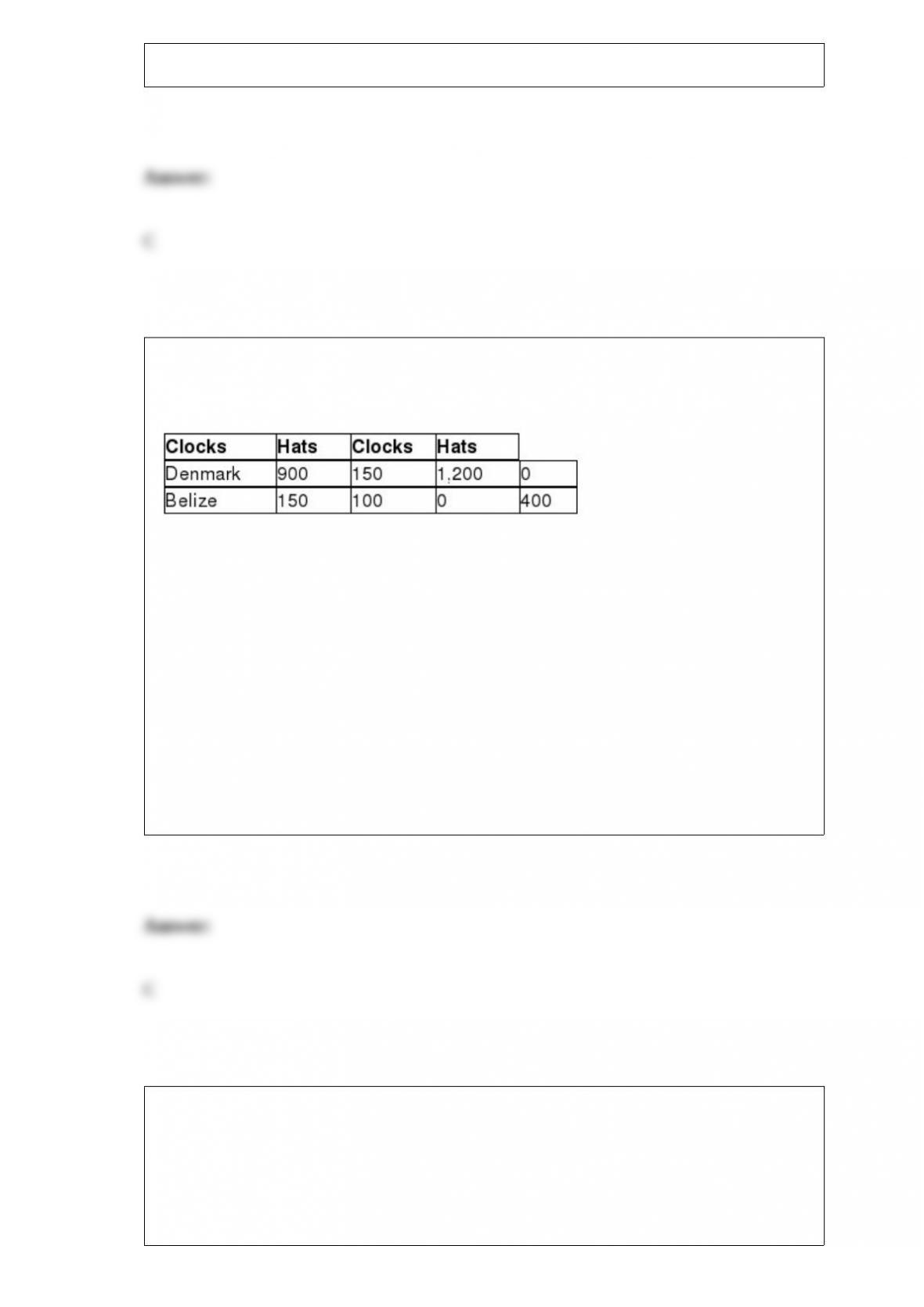
Table 9-11 Production and
Consumption Production
Without Trade With Trade
Denmark and Belize can produce both clocks and hats. Table 9-11 shows the production
and consumption quantities without trade, and the production numbers with trade.
If the actual terms of trade are 1 hat for 1.8 clocks and 150 hats are traded, how many
hats will Belize consume?
A) 100
B) 130
C) 250
D) 400
In general, a “big ticket item” such as a house or new car will
A) tend to have a more elastic demand than a lower priced good.
B) tend to have an inelastic demand because spending on the item takes up a large share
of the average consumer’s budget.

C) tend to have an inelastic demand because it has many substitutes.
D) tend to have a more inelastic demand the more time that passes.
________ is a problem that occurs when one concludes that a change in variable X
caused a change in variable Y when in actual fact, it is a change in variable Y that
caused a change in variable X.
A) The omitted variable
B) The positive-to-negative relationship
C) Reverse causality
D) Nonlinear slope
Poorly timed discretionary policy can do more harm than good. Getting the timing right
with fiscal policy is generally
A) less difficult than with monetary policy.
B) far less difficult than with monetary policy.
C) more difficult than with monetary policy.
D) about the same difficulty as with monetary policy.
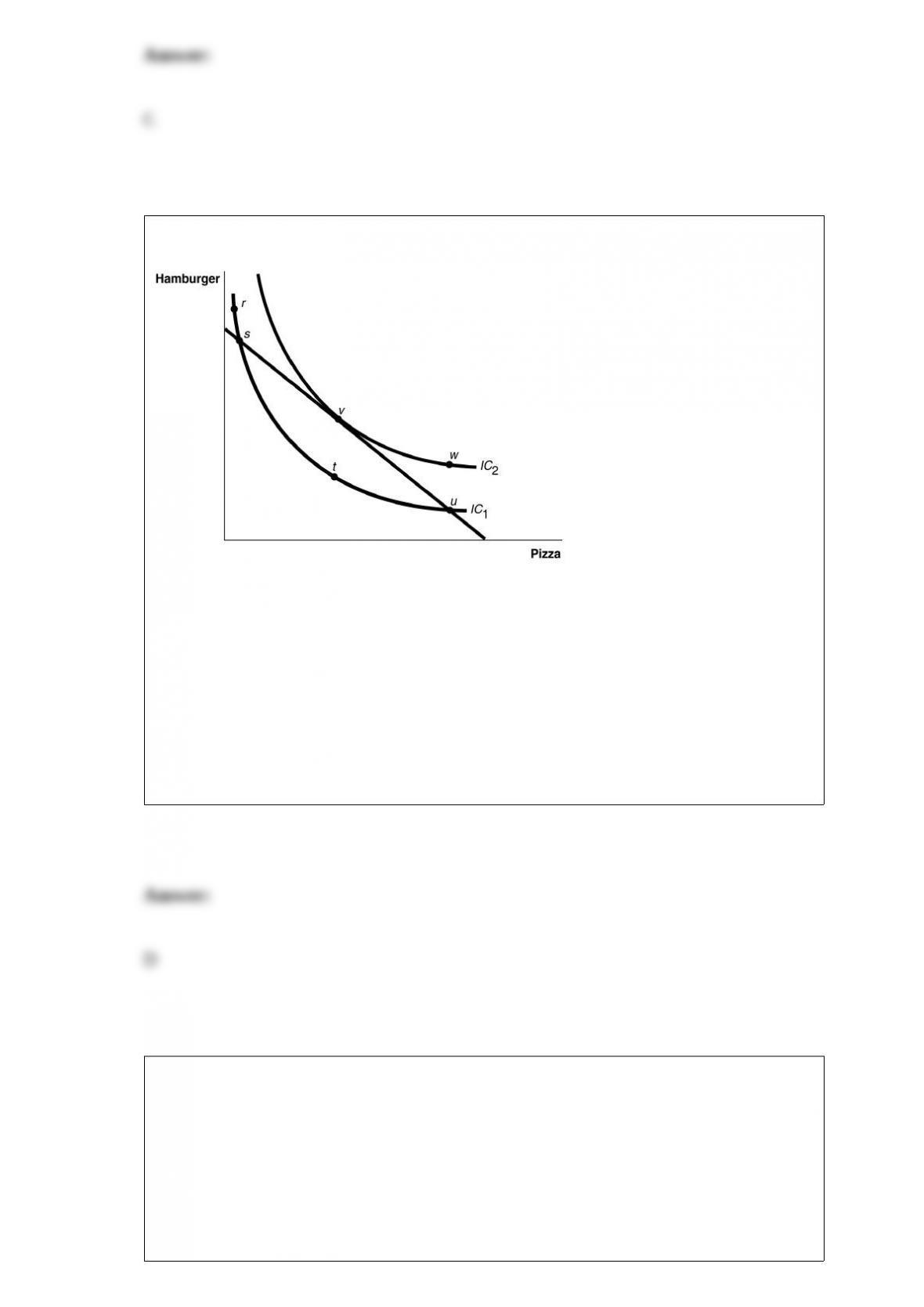
Figure 10-5
The consumer can afford consumption bundles
A) r, s, t and u.
B) r, s, v and u.
C) s, v and u only.
D) s, v, t and u.
The productivity slowdown of the mid-1970s can be explained by which of the
following?
A) excessive use of fiscal policy
B) large increases in research and development
C) a decline in labor quality

D) diminishing marginal returns
In a natural monopoly, throughout the range of market demand
A) marginal cost is above average total cost and pulls average total cost upward.
B) average total cost is above marginal cost and pulls marginal cost upward.
C) marginal cost is below average total cost and pulls average total cost downward.
D) there are diseconomies of scale.
The excess burden of a tax
A) measures the efficiency loss to the economy that results from a tax, causing a
reduction in the quantity of goods and services produced.
B) is measured by the administrative costs required to implement a tax system.
C) is a measure of the hardship imposed on low-income individuals in a society.
D) is a measure of the foregone consumption as a result of having to pay taxes.
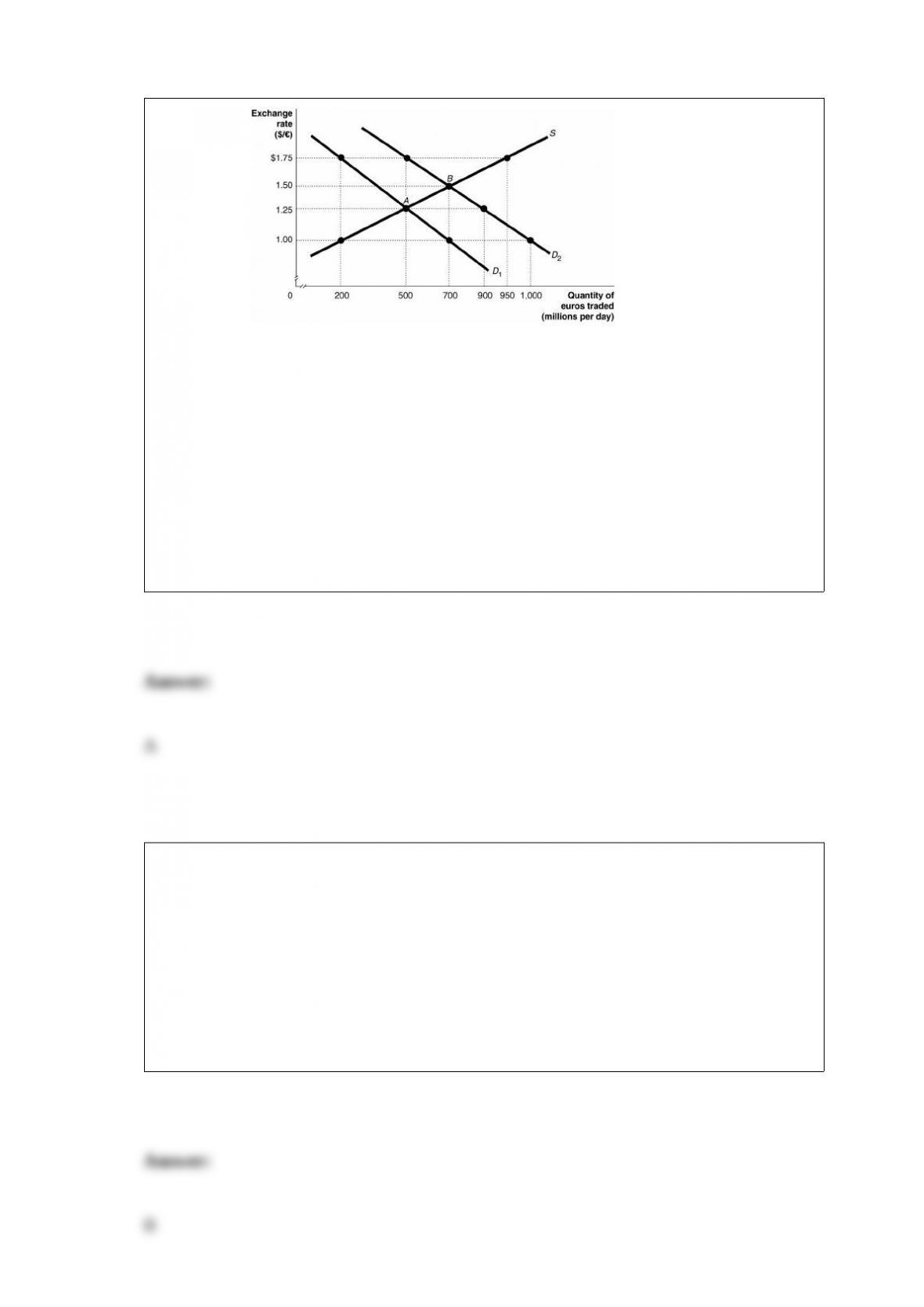
Figure 19-8
The equilibrium exchange rate is at A, $1.25/euro. Suppose the European Central Bank
pegs its currency at $1.00/euro. At the pegged exchange rate,
A) there is a shortage of euro equal to 500 million.
B) there is a surplus of euro equal to 300 million.
C) there is a shortage of euro equal to 200 million.
D) there is a surplus of euro equal to 700 million.
A patent is an example of
A) how ownership of a key input creates a barrier to entry.
B) a government-imposed barrier to entry.
C) occupational licensing.
D) how market failure can lead to oligopoly.

Which component of consumption spending is the greatest in a typical economy?
A) services
B) durable goods
C) nondurable goods
D) new housing
In 2013, the dividend yield on Abercrombie & Fitch (ANF) stock rose from a low of
1.33% in May to 2.24% in October. Which of the following would have generated that
result?
A) The closing price of ANF stock rose.
B) ANF announced an increase in the dividend it would pay per share.
C) The price-earnings ratio fell.
D) ANF issued bonds with a coupon rate equal to 2.24%.