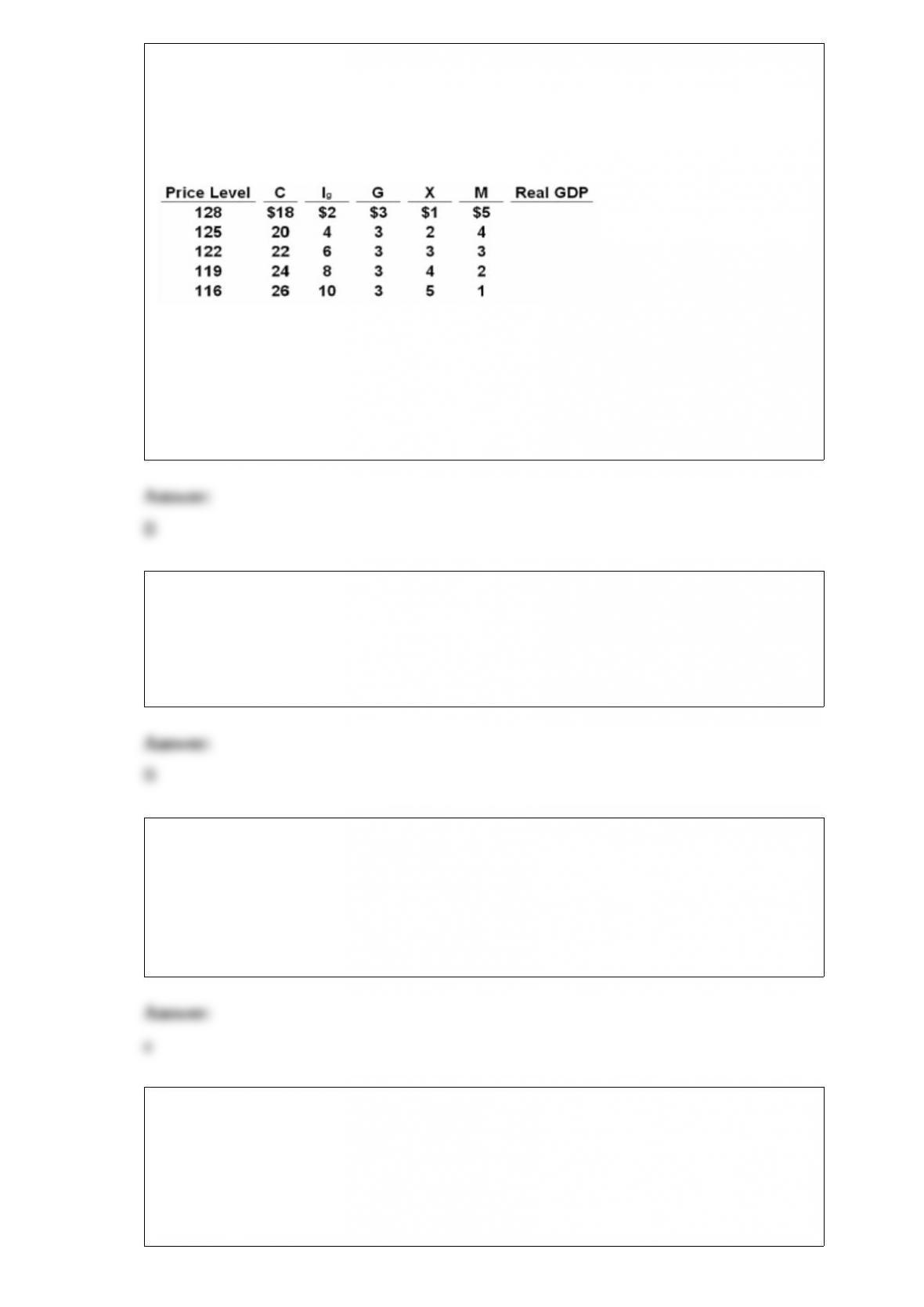
1) Answer the next question(s) on the basis of the following table for a particular
country in which C is consumption expenditures, Ig is gross investment expenditures, G
is government expenditures, X is exports, and M is imports. All figures are in billions of
dollars. Each question is independent of the other questions.
Refer to the above table. If this nation’s equilibrium price level is 125, its net exports
will be:
A.minus $4 billion.
B.minus $2 billion.
C.zero.
D.$2 billion.
2) The equilibrium level of GDP is associated with:
A.an excess of planned investment over saving.
B.no unintended changes in inventories.
C.an unintended decrease in business inventories.
D.an unintended increase in business inventories.
3) which of the following statements is not correct?
a.a reduction in money income will shift the budget line to the right.
b.a reduction in money income accompanied by an increase in product prices will
necessarily shift the budget line to the left.
c.an increase in product prices will shift the budget line to the left.
d.an increase in money income will shift the budget line to the right.
4) Which one of the following topics would be of most interest to a public choice
economist?
A.the theory of comparative advantage
B.the law of increasing opportunity cost
C.inflation and unemployment
D.rent-seeking behavior
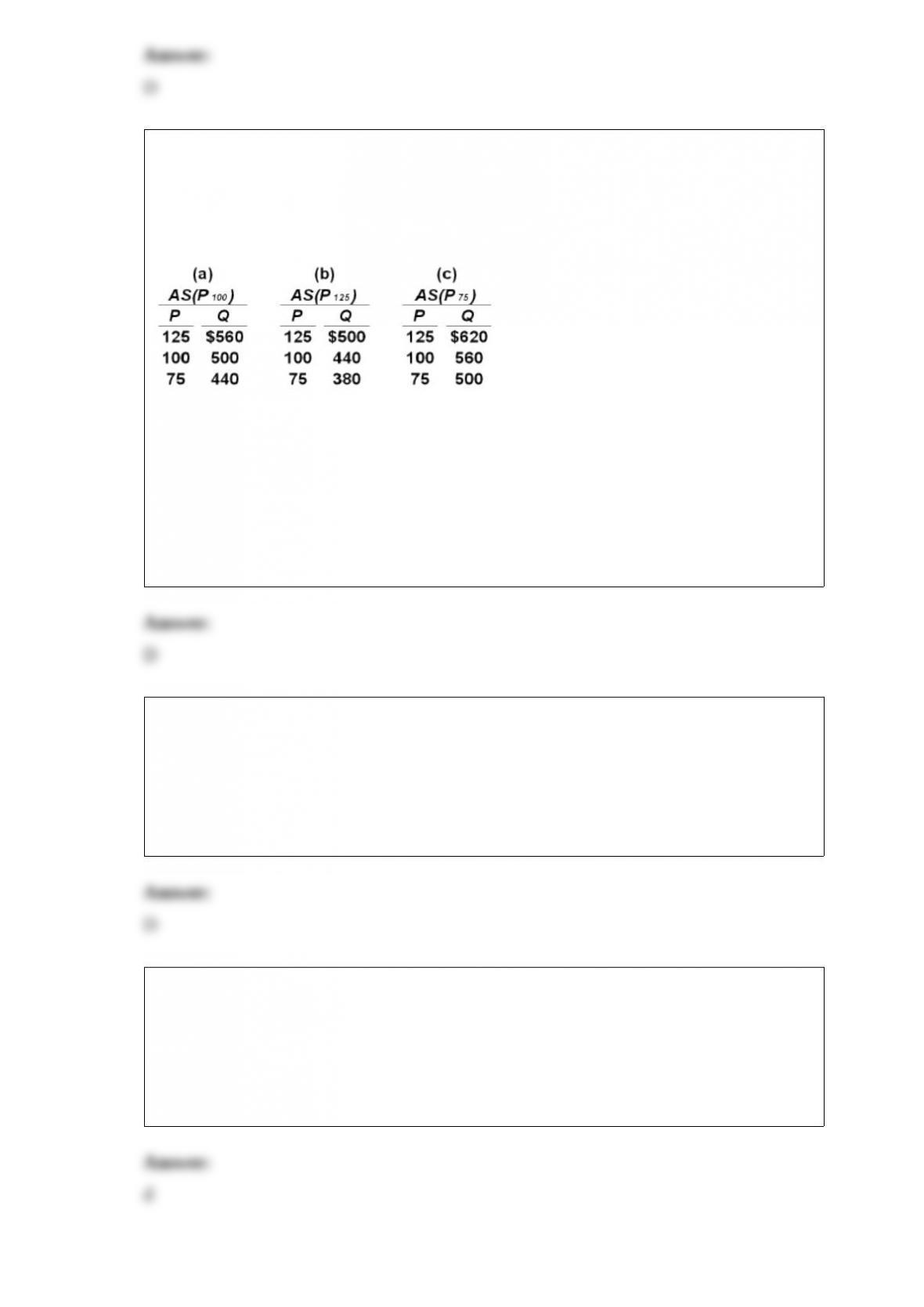
5) Suppose the full employment level of real output (Q) for a hypothetical economy is
$500, the price level (P) initially is 100, and that prices and wages are flexible both
upward and downward. Use the following short-run aggregate supply schedules to
answer the next question(s).
Refer to the information above. In the long run, an increase in the price level from 100
to 125 will:
A.increase real output from $500 to $560.
B.decrease real output from $500 to $440.
C.change the aggregate supply schedule from (a) to (c) and result in an equilibrium
level of real output of $560.
D.change the aggregate supply schedule from (a) to (b) and result in an equilibrium
level of real output of $500.
6) Critics of U.S. farm policy:
A.argue that most of the farm subsidies go to high-income farmers.
B.argue that various components of agricultural policy are contradictory and seek
conflicting goals.
C.argue that the cost of farm policies increased sharply in the past two decades.
D.make all of these arguments.
7) if the long-run average total cost curve of an industry is declining at the point where
it intersects the industry demand curve, we can expect:
a.an overallocation of resources.
b.the industry will be purely competitive.
c.the industry will be monopolistically competitive.
d.the industry will be a natural monopoly.
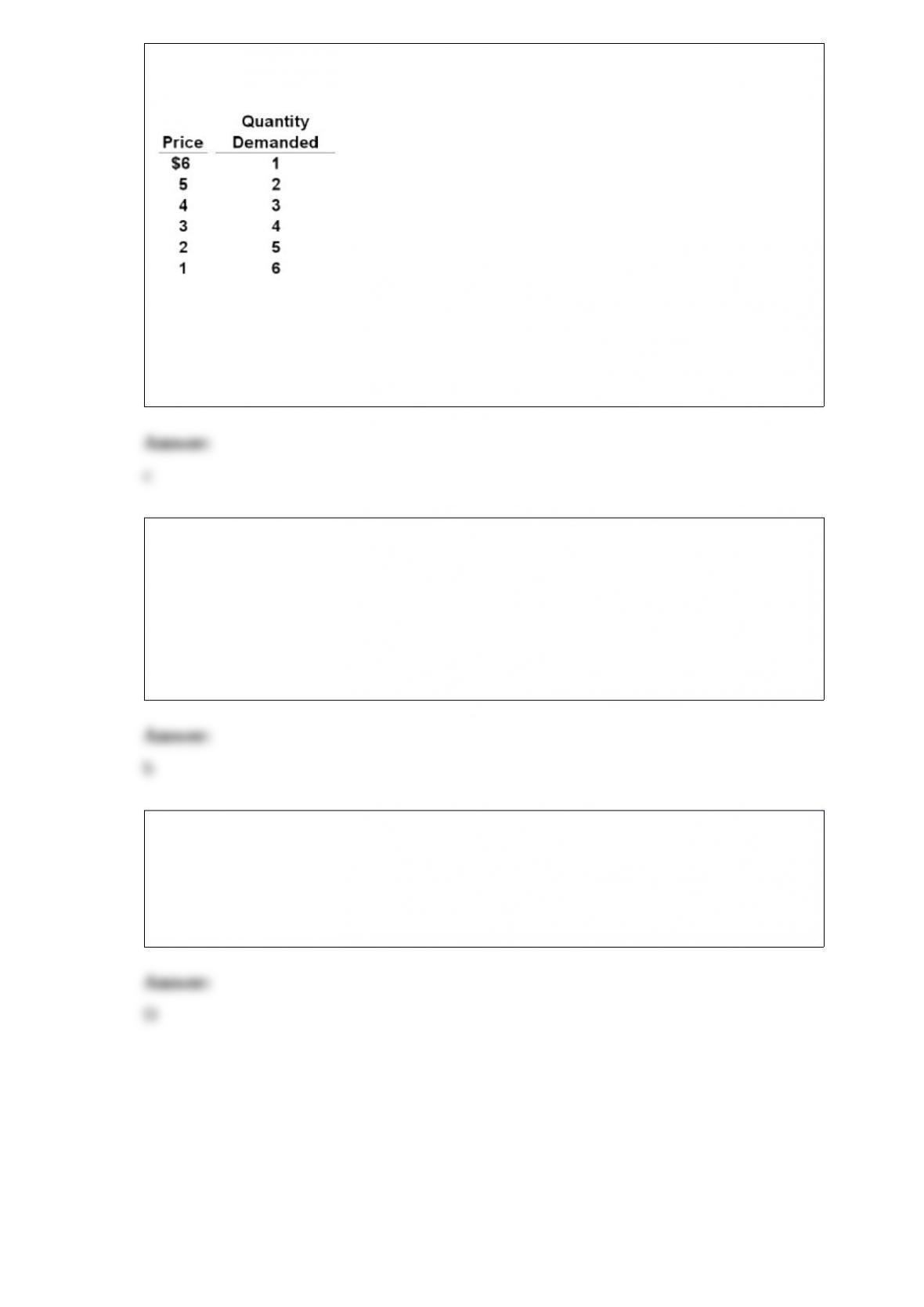
8) the following demand schedule:
refer to the above data. if this demand schedule were graphed, we would find that:
a.its slope diminishes as we move southeast down the curve.
b.its slope diminishes as we move northwest up the curve.
c.its slope is constant throughout.
d.the data is inconsistent with the law of demand.
9) “under central planning, some group has to decide how to get the necessary inputs
produced in the right amounts and delivered to the right places at the right time. this is a
nearly impossible task without markets and profits.” this quotation best identifies the:
a.incentive problem under central planning.
b.coordination problem under central planning.
c.self-sufficiency dilemma under communism.
d.resource overcommitment problem under communism.
10) The foreign purchases effect:
A.shifts the aggregate demand curve rightward.
B.shifts the aggregate demand curve leftward.
C.shifts the aggregate supply curve rightward.
D. moves the economy along a fixed aggregate demand curve.
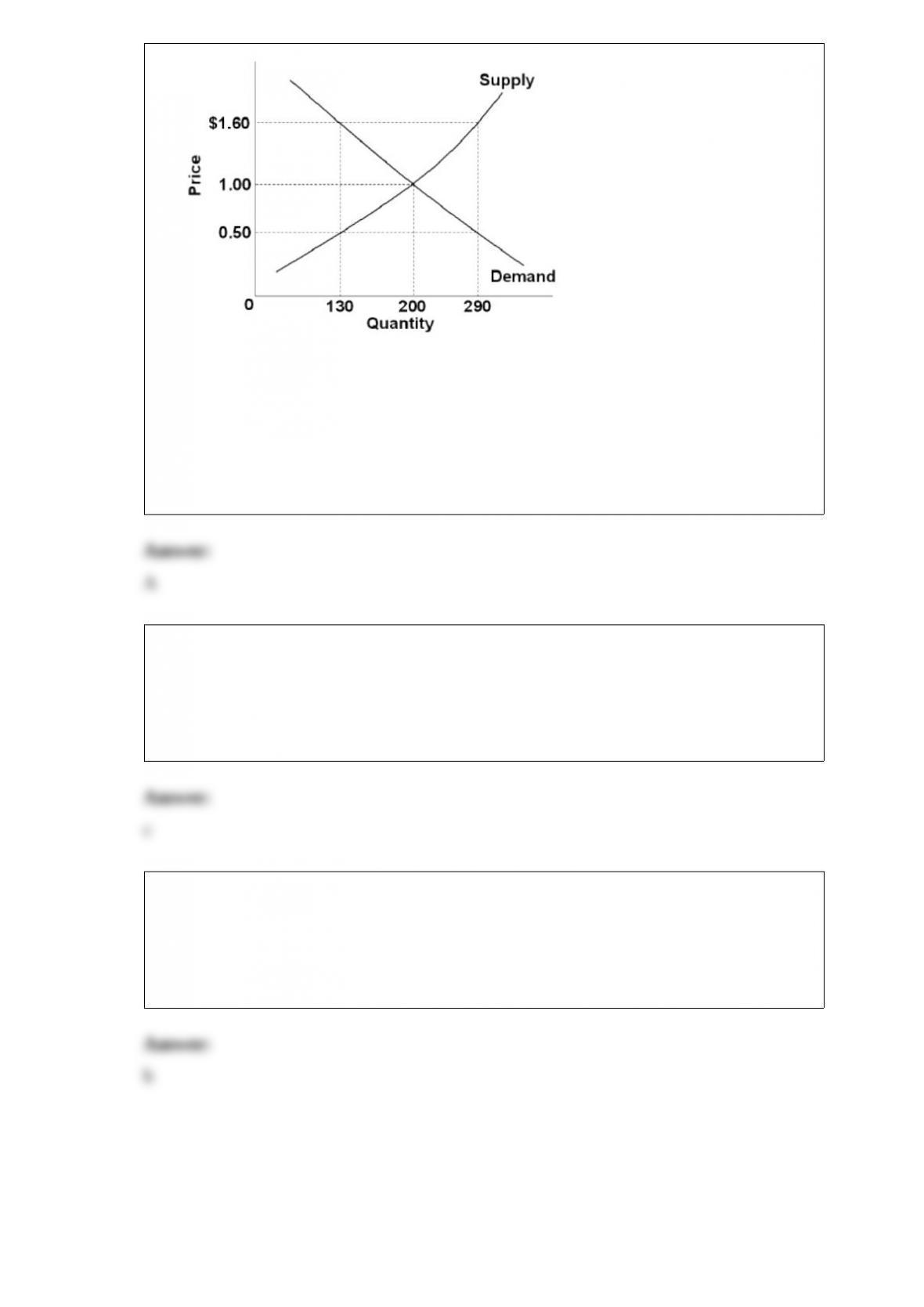
11)
Refer to the above diagram showing the domestic demand and supply curves for a
specific standardized product in a particular nation. If the world price for this product is
$.50, this nation will experience a domestic:
A.shortage of 160 units, which it will meet with 160 units of imports.
B.shortage of 160 units, which will increase the domestic price to $1.60.
C.surplus of 160 units, which it will export.
D.surplus of 160 units, which will reduce the world price to $1.00.
12) if competitive industry y is incurring substantial losses, output will:
a.expand as resources move toward industry y.
b.contract as resources move toward industry y.
c.contract as resources move away from industry y.
d.expand as resources move away from industry y.
13) defensive medicine:
a.solves the moral hazard problem.
b.increases the demand for health care.
c.solves the principal-agent problem.
d.is the same as preventive medicine.