
1) the smaller the number of good substitutes for a product, the greater will be the price
elasticity of demand for it.
2) variable costs are costs that vary directly with output.
3) Expansionary fiscal policy is so-named because it involves an expansion of the
nation’s money supply.
4) The tax cut passed in 2001 by Congress and the Bush administration was
implemented to stop a recession.
5) to fully realize economic growth through the efficiency factor, an economy must
increase its stock of capital goods and improve its technology.
6) Rent performs an incentive function, but no rationing function.
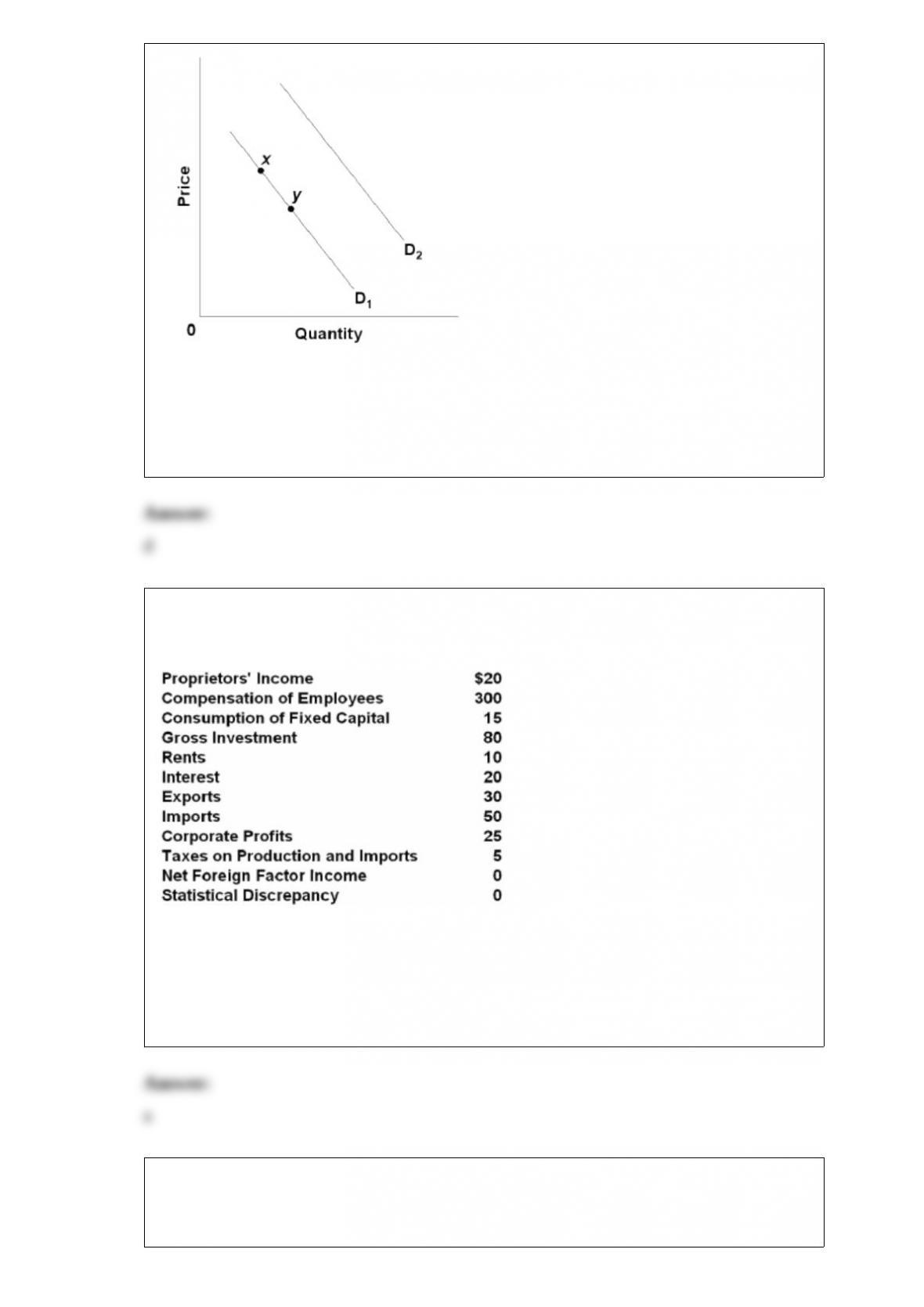
7)
refer to the above diagram. a decrease in quantity demanded is depicted by a:
a.move from point x to point y.
b.shift from d1 to d2.
c.shift from d2 to d1.
d.move from point y to point x.
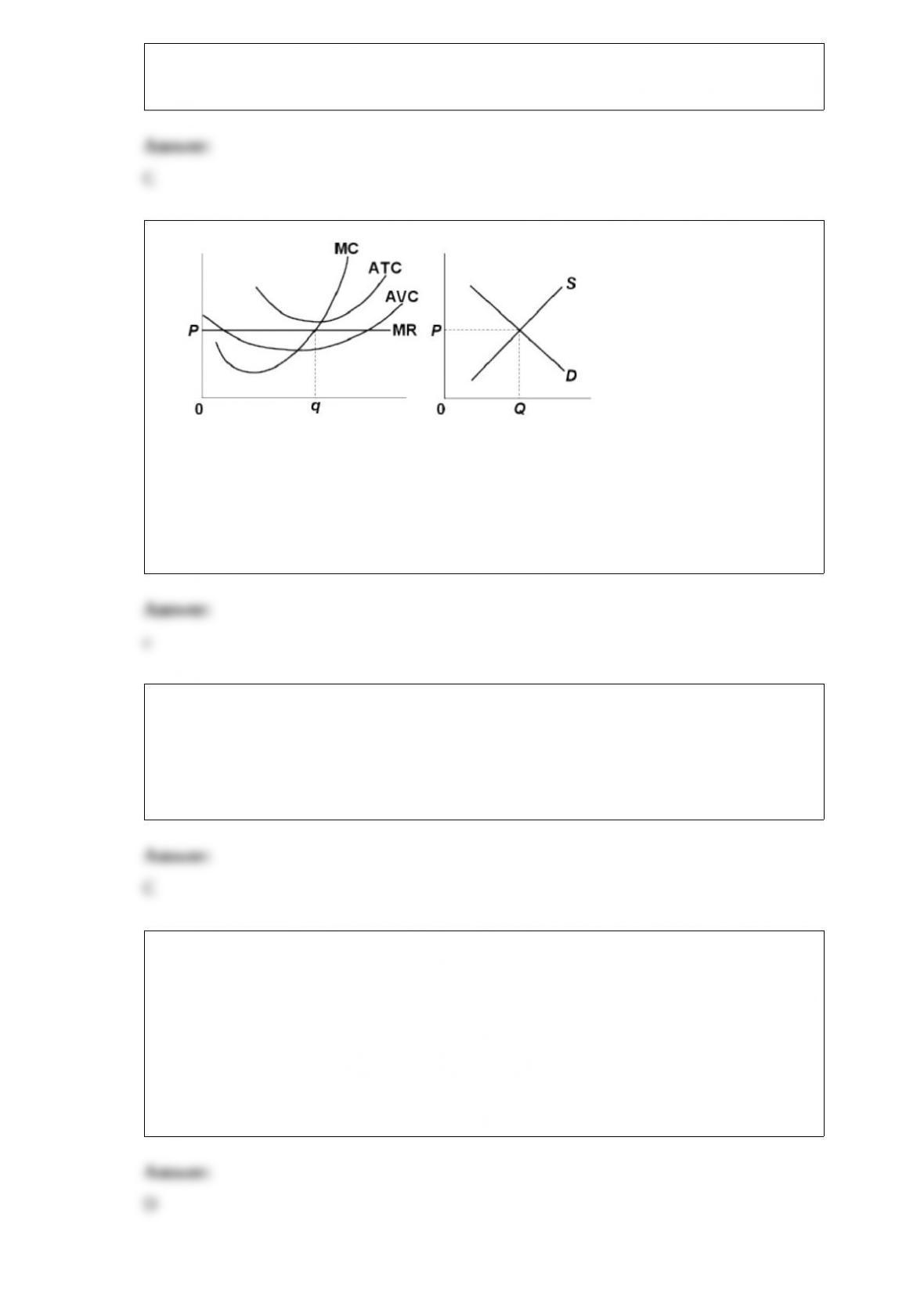
8) answer the next question(s) on the basis of the following data. all figures are in
billions of dollars.
refer to the above data. gross domestic product is:
a.$395.
b.$380.
c.$375.
d.$360.
9) The parity ratio:
A.compares worker productivity in the farm and nonfarm sectors.
B.is the ratio of per capita farm income to per capita nonfarm income.
C.is the ratio of prices received by farmers to prices paid by farmers.
D.is the ratio of prices paid by farmers to prices received by farmers.
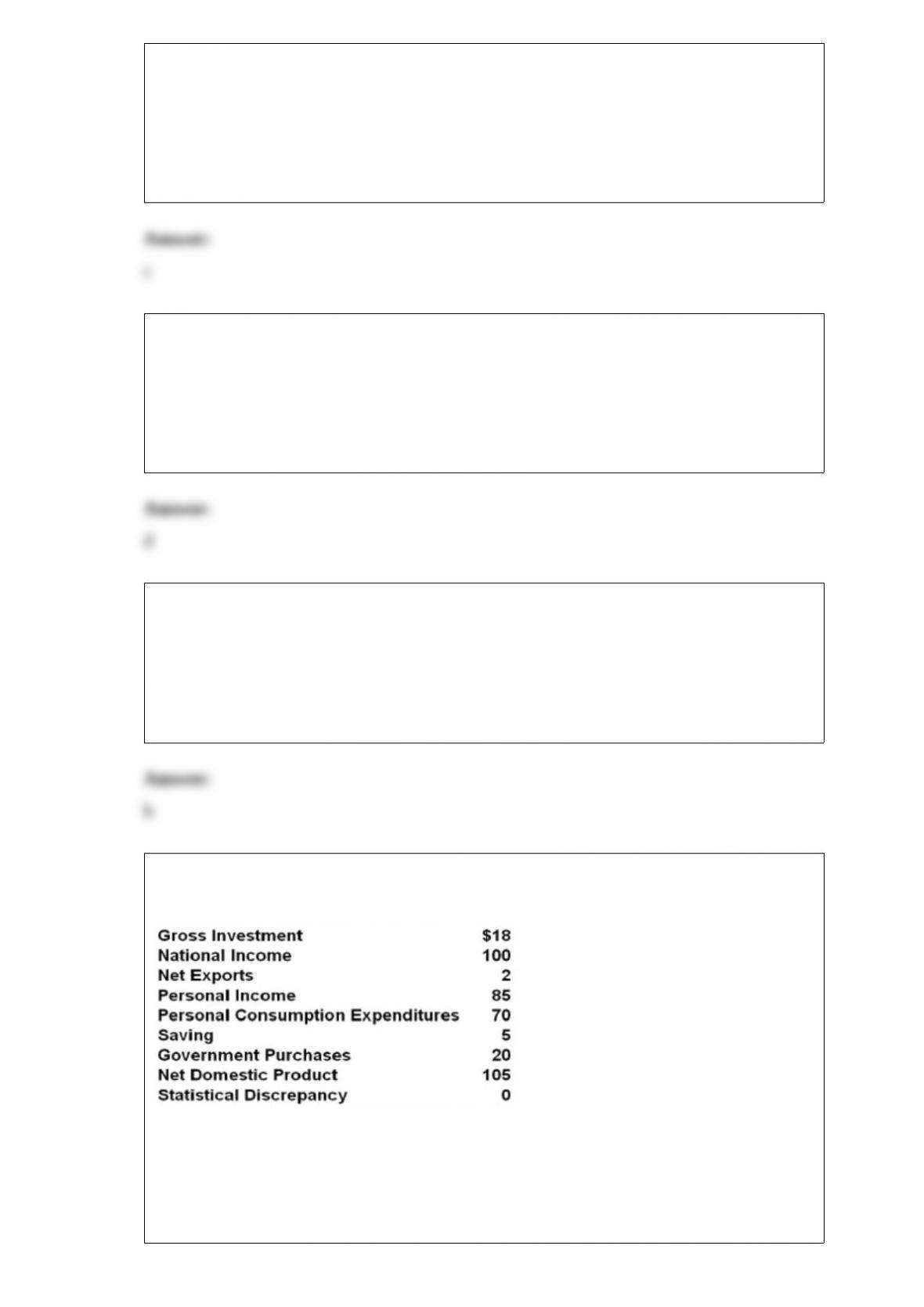
10)
refer to the above diagrams, which pertain to a purely competitive firm producing
output q and the industry in which it operates. which of the following is correct?
a.the diagrams portray neither long-run nor short-run equilibrium.
b.the diagrams portray both long-run and short-run equilibrium.
c.the diagrams portray short-run equilibrium, but not long-run equilibrium.
d.the diagrams portray long-run equilibrium, but not short-run equilibrium.
11) An efficiency wage is:
A.a wage payment necessary to compensate workers for risk of injury on the job.
B.a “wage” that contains a profit-sharing component as well as traditional hourly pay.
C.an above-market wage that minimizes a firm’s labor cost per unit of output.
D.a wage that automatically rises with the national index of labor productivity.
12) Suppose that two firms in an industry with a Herfindahl index of 5,000 announce a
merger. The U.S. Justice Department concludes the merger will boost the index to
5,500. The antitrust authorities will most likely:
A.ignore this merger because of the relatively small increase in the Herfindahl index.
B.allow the merger but watch the new firm carefully for future violations of the
antitrust laws.
C.allow the merger if foreign entry to the industry is possible.
D.prevent the merger, contending that it violates the Clayton Act.
13) (last word) which of the following has to do with the problem of distinguishing
cause and effect in economic reasoning?
a.the law of large numbers.
b.the law of averages.
c.the post hoc, ergo propter hoc fallacy.
d.the fallacy of composition.
14) in comparing the changes in tc and tvc associated with an additional unit of output,
we find that:
a.the change in tvc is equal to mc, while the change in tc is equal to tfc.
b.the change in tc exceeds the change in tvc.
c.the change in tvc exceeds the change in tc.
d.both are equal to mc.
15) ben is exhausting his money income consuming products a and b in such quantities
that mua/pa = 5 and mub/pb = 8. ben should purchase:
a.more of a and less of b
b.more of b and less of a
c.more of both a and b
d.less of both a and b
16) answer the next question(s) on the basis of the following data. all figures are in
billions of dollars.
refer to the above data. from this information we can conclude that the net foreign
factor income is:
a.negative $5 billion.
b.zero.
c.positive $5 billion.

d.positive $15 billion.
17) The demand for agricultural products is:
A.relatively elastic with respect to price.
B.relatively inelastic with respect to price.
C.relatively elastic with respect to income.
D.downward sloping to the individual farmer, but perfectly elastic to farmers as a
group.
18) The standardized budget refers to:
A.the inflationary impact that the automatic stabilizers have in a full-employment
economy.
B.that portion of a full-employment GDP that is not consumed in the year it is
produced.
C.the size of the Federal government’s budgetary surplus or deficit when the economy
is operating at full employment.
D.the number of workers who are underemployed when the level of unemployment is 4
to 5 percent.
19) real gdp and nominal gdp differ because the real gdp:
a.is adjusted for changes in the volume of intermediate transactions.
b.includes the economic effects of international trade.
c.has been adjusted for changes in the price level.
d.excludes depreciation charges.
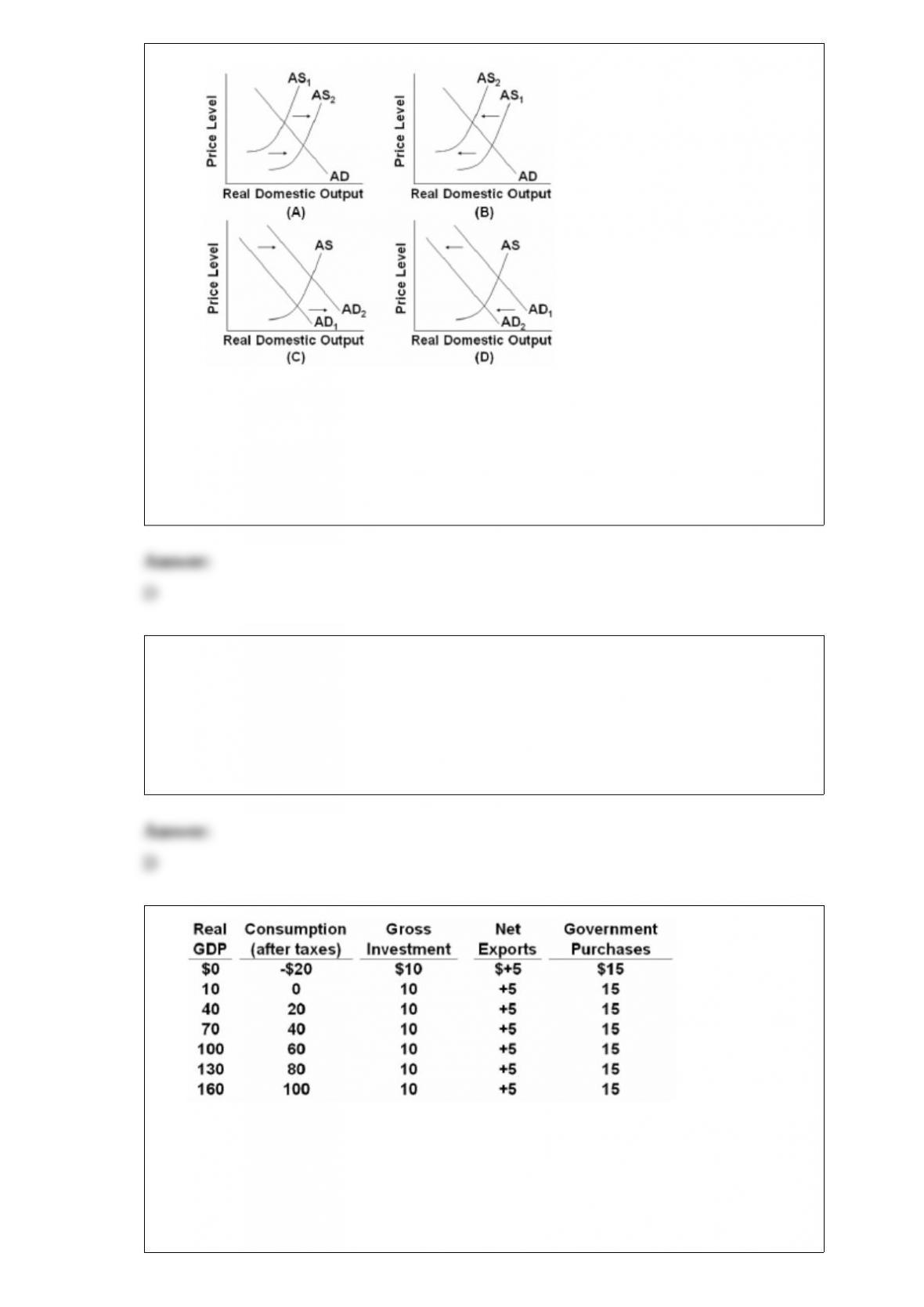
20)
Which of the above diagrams best portrays the effects of declines in the incomes of
U.S. trading partners?
A.A
B.B
C.C
D.D
21) If the equilibrium level of GDP in a private open economy is $1000 billion and
consumption is $700 billion at that level of GDP, then:
A.saving must be $300 billion.
B.net exports must be $300 billion.
C.S + C must equal $300 billion.
D.Ig + Xn must equal $300 billion.
22)
Refer to the above table. The multiplier is:
A.5.
B.4.
C.3.
D.2.
23) Government can push the unemployment rate below the natural rate only by:
A.instituting supply-side economic policies.
B.producing a higher rate of inflation than people expect.
C.balancing the federal budget.
D.achieving zero inflation.
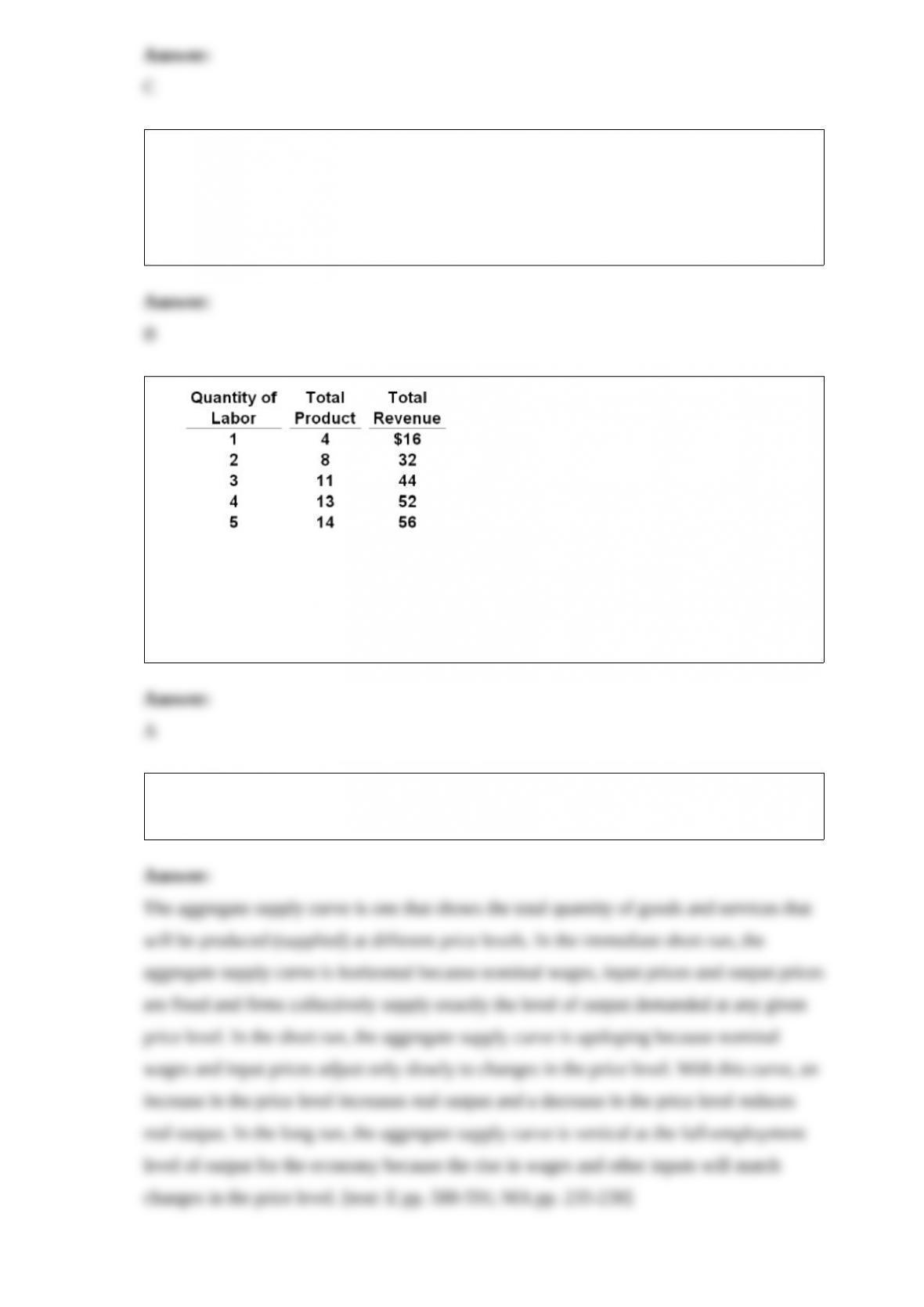
24)
Refer to the above data. The marginal revenue product of the second worker is:
A.$16.
B.$32.
C.$8.
D.$4.
25) Define aggregate supply. Describe the characteristics of the aggregate supply curve
in the immediate short-run, short-run and long-run perspectives.
26) Why is the interest rate such an important price in the economy?
27) Describe how changes in tastes affect the value of a nations currency.
28) The theory of resource pricing is sometimes referred to by economists as the theory
of income distribution. Why?

29) In a recent recession the losses sustained by the developing countries through a
decline in raw-material prices by far outweighed any foreign aid given over several
years. Explain.
30) Explain the effect of a discretionary increase in government spending of $50 billion
on the economy when the economys marginal propensity to consume is .75.
31) Define total fertility rate and replacement rate. Use them to describe the population
prospects for many developed countries.