Which of the following characteristics iscommon to monopolistic competition and
perfect competition?
A) Firms produce identical products.
B) Entry barriers into the industry are low.
C) Each firm faces a downward -sloping demand curve.
D) Firms take market prices as given.
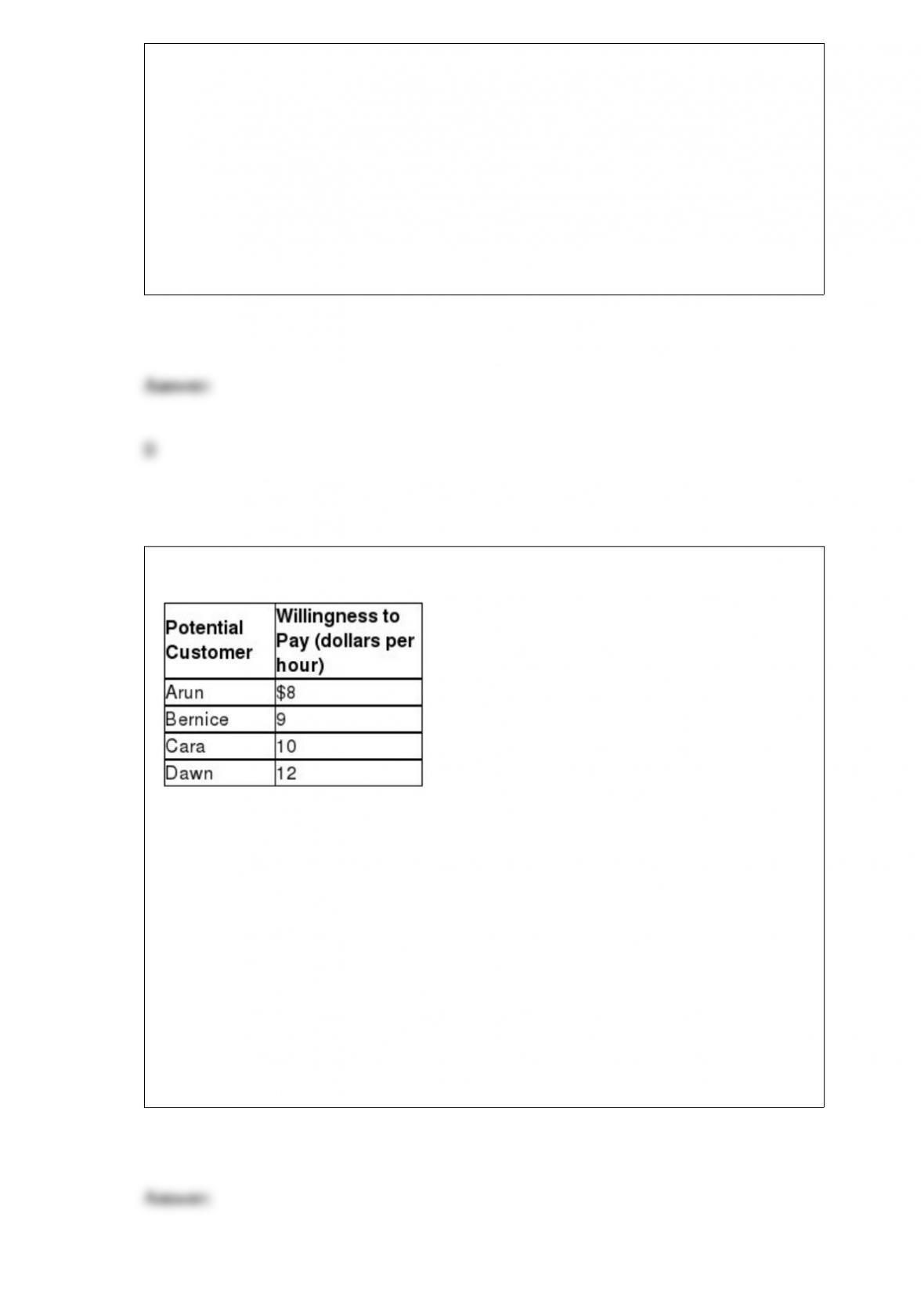
Table 16-3
Julie plans to start a pet-sitting service. She surveyed her neighborhood to determine the
demand for this service. Assume that each person surveyed demands only one hour of
pet sitting services per period. Table 16-3 above shows a portion of her survey results.
Suppose Julie’s marginal cost of providing this service is constant at $7 and she charges
$7. How many hours will be purchased and what is her total revenue?
A) 5 hours; total revenue = $35
B) 4 hours; total revenue = $28
C) 3 hours; total revenue = $21
D) 2 hours; total revenue = $14

Which of the following characterizes the Fed’s ability to prevent recessions?
A) The Fed is able to “fine tune” the economy and entirely eliminate recessions.
B) The Fed is incapable of changing aggregate demand through its monetary policy
tools.
C) The Fed is able to keep a recession shorter and milder than it would otherwise be.
D) The Fed is able to eliminate the business cycle and achieve absolute price stability.
When a monopolistically competitive firm lowers its price, one good thing happens to
the firm. What is this “one good thing” called?
A) the output effect
B) the price effect
C) the income effect
D) the substitution effect
Consider three pricing strategies that the firm can pursue:
a. optimal two-part tariff pricing

b. perfect price discrimination
c. single-price monopoly pricing. Of these three strategies, which is least likely to
benefit society as a whole?
A) a two-part tariff pricing because consumers have to pay a fixed fee in addition to a
per-unit price
B) perfect price discrimination because those willing to pay higher prices are forced to
subsidize those who are not
C) Both perfect price discrimination and two-part tariff pricing do not benefit society
because the entire consumer surplus is extracted by the producer.
D) single-price monopoly pricing because there are mutually beneficial trades (between
consumers and seller) that are not exploited
A firm that successfully differentiates its product or lowers its average cost of
production creates
A) value for its customers.
B) entry barriers into its market.
C) a perfectly inelastic demand curve for its product.
D) economies of scale.
If the consumption function is defined as C = 5,500 + 0.9Y, what is the marginal

propensity to consume?
A) 0.1
B) 0.9
C) 5.5
D) 6.1
Despite being in a market with ________, from the mid-1990s to the mid-2000s
Starbucks was able to significantly differentiate its products from the products of its
competitors.
A) few barriers to entry
B) significant barriers to entry
C) blocked entry
D) no barriers to entry
Table 15-2
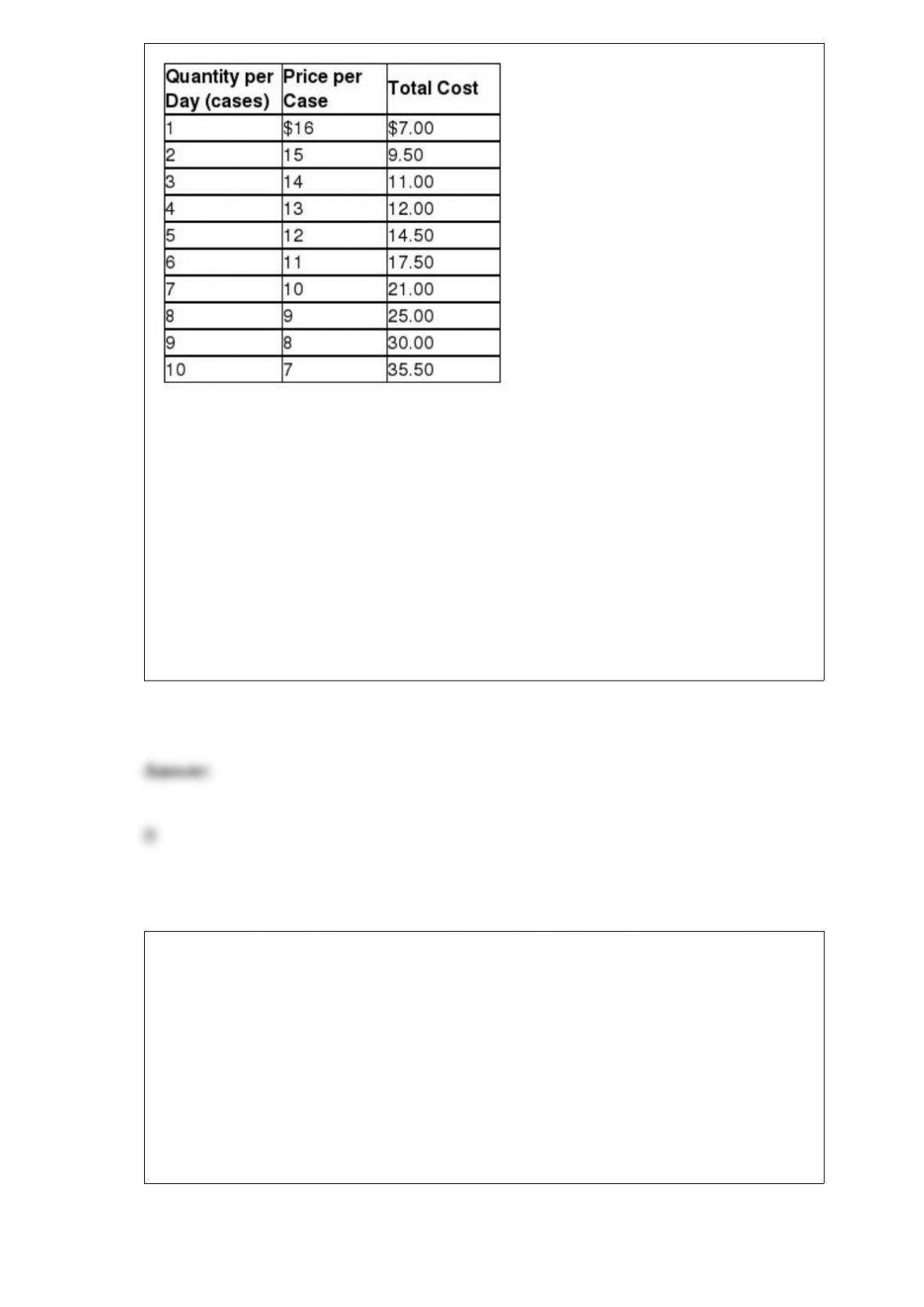
The government of a small developing country has granted exclusive rights to Linden
Enterprises for the production of plastic syringes. Table 15-2 shows the cost and
demand data for this government protected monopolist. What is the profit-maximizing
quantity and price for the monopolist?
A) Quantity = 8 cases, Price = $9
B) Quantity = 7 cases, Price = $10
C) Quantity = 9 cases, Price = $8
D) Quantity = 10 cases, Price = $7
When inflation is very low, how do workers and firms adjust their expectations of
inflation?
A) They rapidly adjust their expectations of inflation upward.
B) They rapidly adjust their expectations of inflation downward.
C) They tend to ignore inflation.
D) They are more aggressive in asking for wage and price increases.
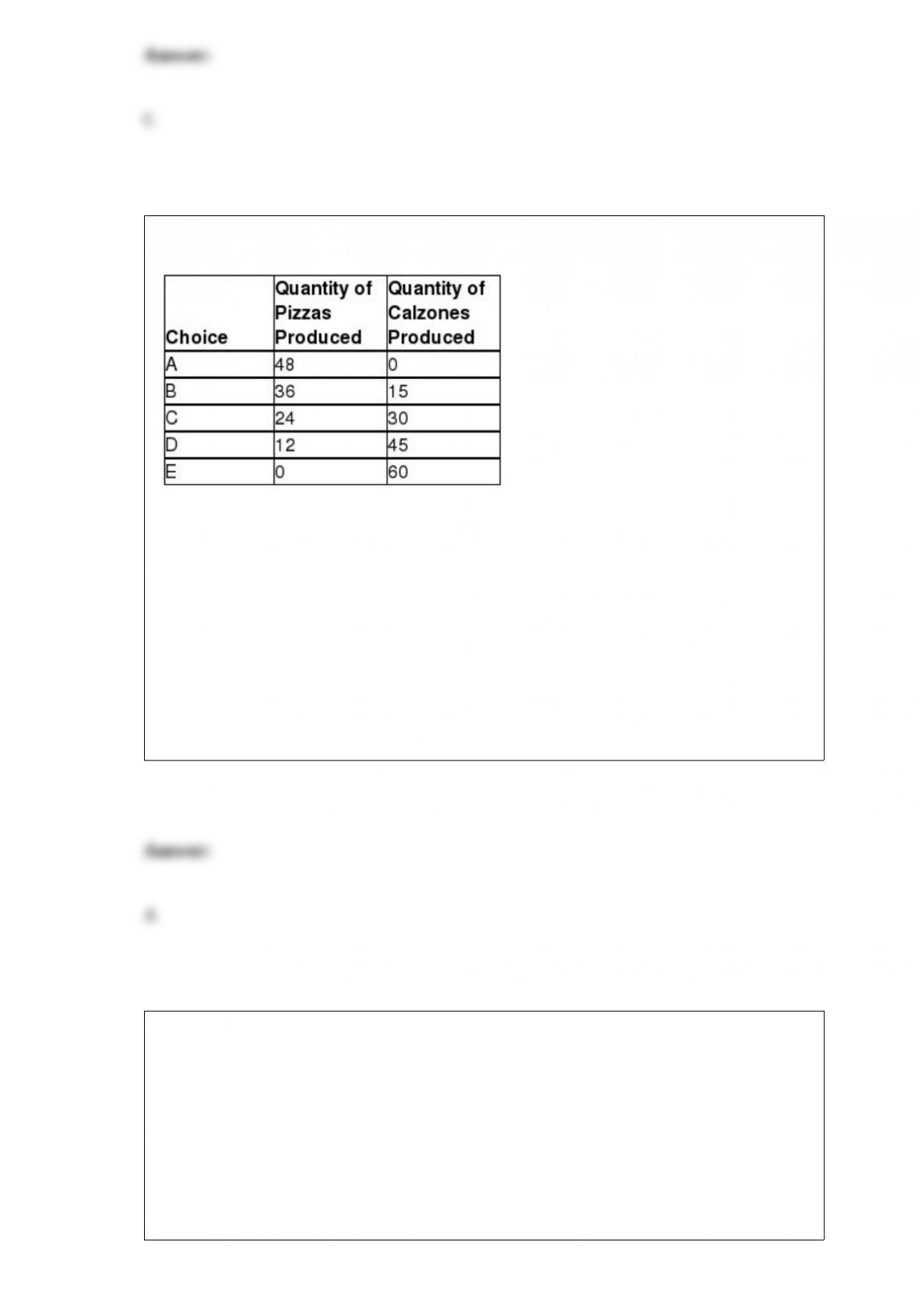
Table 2-1 Production choices for Tomaso’s Trattoria
Assume Tomaso’s Trattoria only produces pizzas and calzones. A combination of 24
pizzas and 30 calzones would appear
A) along Tomaso’s production possibilities frontier.
B) inside Tomaso’s production possibilities frontier.
C) outside Tomaso’s production possibilities frontier.
D) at the horizontal intercept of Tomaso’s production possibilities frontier.
If the long-run average cost curve is U-shaped, the optimal scale of production from
society’s viewpoint is
A) the minimum efficient scale.
B) where maximum economic profit is earned by producers.
C) where firm profit is large enough to finance research and development.

D) one which guarantees economic profit.
In response to accounting scandals in 2002, the federal government passed legislation
requiring that corporate directors have a certain level of expertise with financial
information and mandating that chief executive officers personally certify the accuracy
of financial statements. What is the name of this legislation?
A) the Accountant Reliability Act
B) the 24th amendment to the Constitution
C) the Kennedy-Lott Act
D) the Sarbanes-Oxley Act
Which of the following are positive economic statements and which are normative
economic statements? a. An increase in the minimum wage causes unemployment.
b. The government should raise the minimum wage above $7.25 per hour.
c. The prolonged recession has caused the unemployment rate to reach a 30-year high.
d. Interest rates need to be lower for the economy to emerge from the recession.
e. Inflation has decreased since the onset of the recession.
f. Once the recession has ended, interest rates should increased to assure that inflation
does not go up.

Competitive markets tend to eliminate economic discrimination, but there are many
historical examples of firms that hired few, or no, black or female workers. Which of
the following is not a reason for the persistence of this form of discrimination?
A) In many cases, white workers refused to work with black workers.
B) Some white consumers were unwilling to buy from companies that employed black
workers.
C) If discrimination makes it difficult for a member of a group to be hired in a
particular occupation, there is less incentive for members of the group to be trained to
enter that occupation.
D) Laws passed by the federal government made it more expensive to hire black or
female workers. As a result, it was less expensive for employers to hire mostly white
male workers.
Which of the following statements is true about optimal two-part tariff and perfect price
discrimination for a given demand curve?
A) The total revenue received under the two pricing schedules is the same.
B) The total revenue received under an optimal two-part tariff exceeds that received
under perfect price discrimination.
C) The total revenue received under an optimal two-part tariff is less than that received
under perfect price discrimination.
D) The total revenue received under an optimal two-part tariff could be greater than,
less than or equal to that received under perfect price discrimination, depending on the
fixed-fee portion of the two-part tariff.
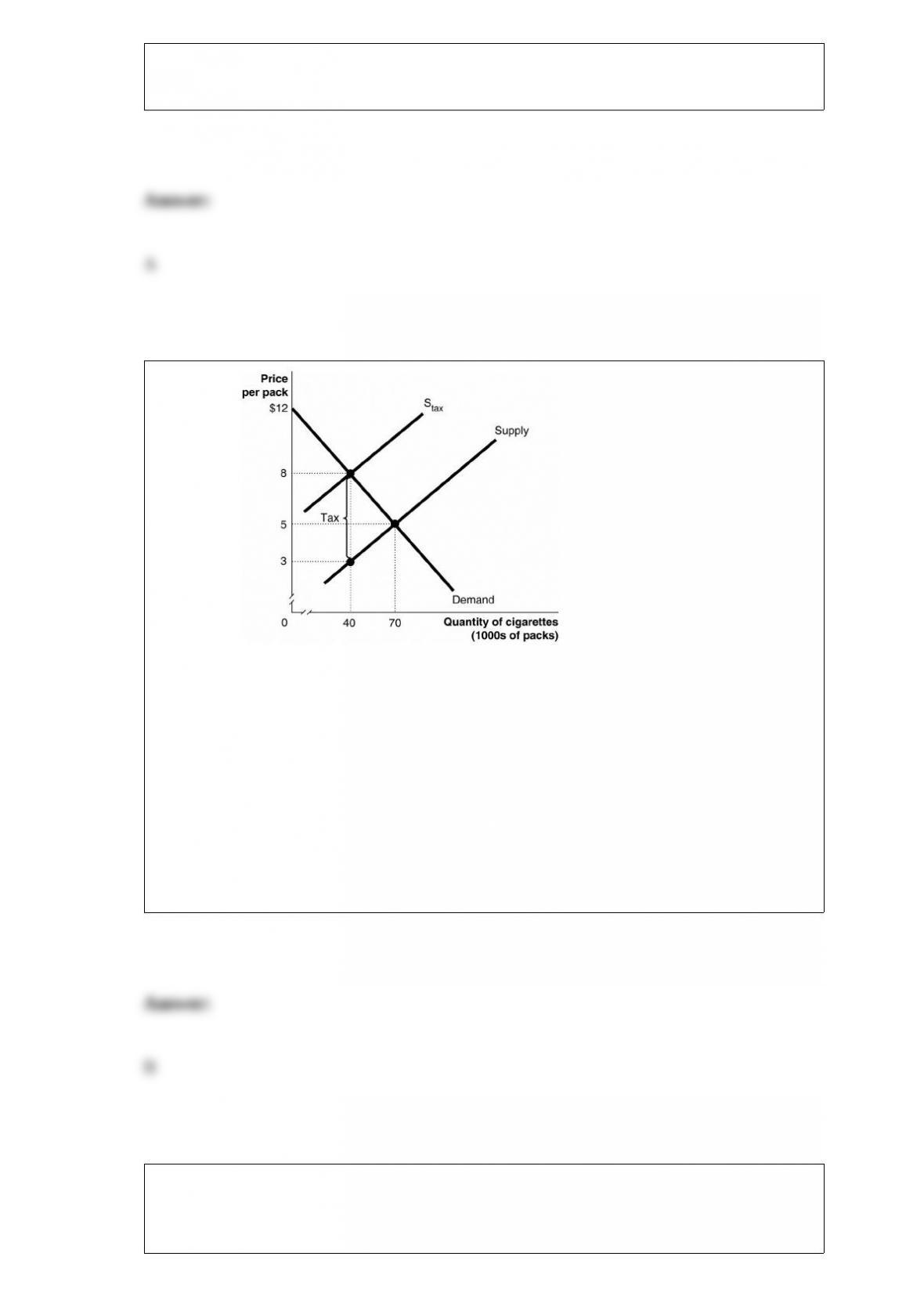
Figure 4-9 Figure 4-9 shows the market for
cigarettes. The government plans to impose a unit tax in this market.
What is the size of the unit tax?
A) $8
B) $5
C) $3
D) cannot be determined from the figure
The profit-maximizing rule for a monopolistically competitive firm is to select the
quantity at which

A) marginal revenue equals marginal cost.
B) average revenue exceeds marginal cost by the greatest amount.
C) price equals marginal cost.
D) average revenue equals average total cost.