
In the market for factors of production, firms earn income by selling factors of
production to households.
In economics, technology only refers to the development of new products.
Those who favor changes in the market for health care that would make it more like the
markets for other goods and services are generally in favor of universal health care
coverage.
“An increase in the price of gasoline will increase the demand for hybrid vehicles.” This
statement is an example of a positive economic statement.

Producers in perfect competition receive a smaller producer surplus than a monopoly
producer.
If by purchasing more apples and fewer oranges you increase your total utility, then
apples must be cheaper than oranges.
If Sanjaya can shuck more oysters in one hour than Tatiana, then Sanjaya has a
comparative advantage in shucking oysters.

In the short-run, changes in output can only be brought about by a change in the
quantity of variable inputs.
In labor economics, the term “customer discrimination” refers to a situation where
customers are charged different prices for services rendered by a firm.
The income effect explains why there is an inverse relationship between the price of a
product and the quantity of the product demanded.
The sales revenue a seller receives from the sale of an additional unit of goods is called
the marginal benefit.

In a Nash equilibrium, all players select non-dominant strategies.
Colleges offer merit awards to students who ordinarily would not qualify for financial
help. Some have criticized this on grounds that merit awards disproportionately benefit
students from wealthier communities with better school systems, siphoning resources
away from lower-income students with greater financial need. A college’s decision to
grant merit awards is motivated by economic efficiency.
If the demand for a product is elastic, the quantity demanded changes by a larger
percentage than the percentage change in price.

Price ceilings are illegal in the United States.
Supporters and critics of globalization appear to agree that globalization prevents
dislocation in labor markets.
Corporate managers and shareholders always have the same goals.
In explaining consumer behavior economists explain how consumer tastes and
preferences are formed.

If a firm experiences diminishing returns its marginal product must be negative.
A tariff is a tax imposed by a government on its own exports.
A price ceiling is a legally determined maximum price that sellers may charge.

Entrepreneurs who earn arbitrage profit are able to do so by extracting the total
consumer surplus from buyers.
A monopoly is defined as a firm that has the largest market share in an industry.
A U-shaped long run average cost curve implies that a firm experiences economies of
scale at low levels of production and diseconomies of scale at high levels of production.
A natural monopoly is characterized by large fixed costs relative to variable costs.

A positive technological change will cause the supply of a good to increase.
Price leadership is a form of explicit collusion where one firm in an oligopoly
announces a price change and expects all other firms to follow suit.
For a profit-maximizing monopolistically competitive firm, for the last unit sold, the
marginal cost of production is less than the marginal benefit received by a customer
from the purchase of that unit.

Economists assume people’s tastes are identical.
Logrolling refers to attempts by individuals to use government action to make
themselves better off at the expense of others.
The minimum wage is an example of a price ceiling.
Horizontal equity is achieved when taxes are collected from those who benefit from the
government expenditure of the tax revenue.

Purchasing a firm’s stock in an IPO can be risky because financial information may not
be fully disclosed.
An increase in wages raises the opportunity cost of leisure and leads to an increase in
the quantity supplied of labor.
The demand for heating oil in the short run is more elastic than the long run demand for
heating oil.

“The distribution of income should be left to the market” is an example of a positive
economic statement.
An increase in the labor force shifts the production possibility frontier inwards over
time.
The short run is the time period during which a firm has at least one input constraint.
In the United States, imports and exports make up more than half of GDP.
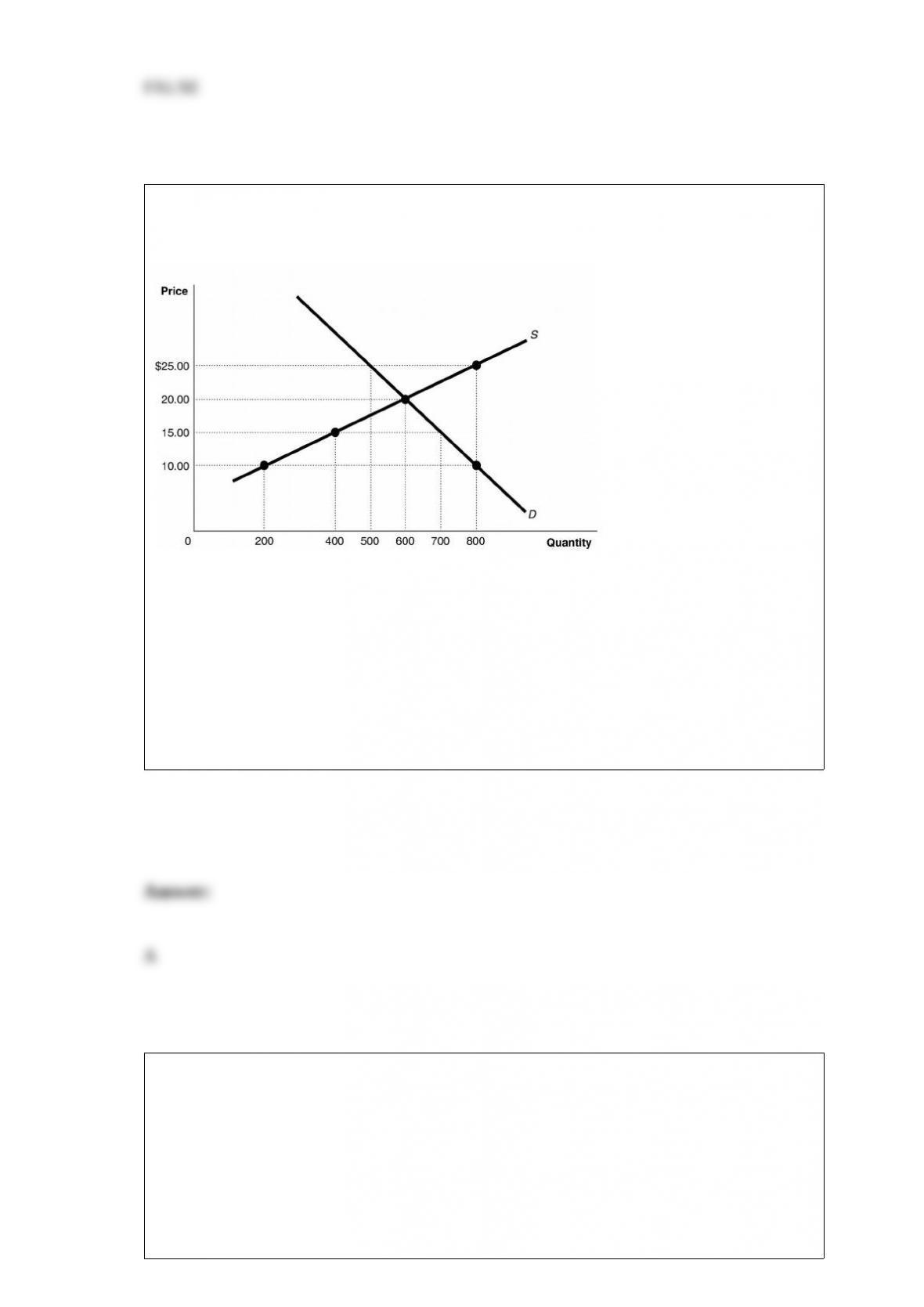
Figure 3-4
Refer to Figure 3-4. At a price of $10, how many units will be sold?
A) 200
B) 400
C) 600
D) 800
Consider the following statements about the signaling hypothesis of education:
a. The signaling hypothesis of education is based on the idea that college graduates are
more productive than non-college graduates.
b. The signaling hypothesis of education suggests that firms rely on human capital
requirements to ensure worker quality.

c. Employers rely on certain signals, such as a college diploma, to gauge a potential
employee’s abilities because it could lower the cost of acquiring information about the
person that is not easily observed.
Which of the statements above is true about the signaling hypothesis of education?
A) a, b, and c
B) a and b only
C) b and c only
D) a and c only
Which of the following is an example of globalization of production?
A) Canadian consumers who import food products from Australia
B) A German company which sells car components to British car makers
C) A U.S. company that builds a computer hardware manufacturing facility in India
D) A Swiss watch manufacturer that builds a manufacturing facility in Switzerland
Determine if each of the products below displays any of the following characteristics:
(i) rivalry
(ii) nonrivalry
(iii) excludability
(iv) nonexcludability.
a. a freeway during peak commute hours
b. an online college course
c. infectious disease prevention
d. open source software such as Linux
e. a movie showing at Century Theatres
The substitution effect of an increase in the price of Raisin Bran refers to
A) the decrease in the demand for Raisin Bran when its price rises.
B) the result that consumers will now switch to a substitute good such as Cheerios, and
the demand curve for Raisin Bran shifts to the left.
C) the fact that the higher price of Raisin Bran lowers consumer’s purchasing power,
holding money income constant.
D) the fact that the higher price of Raisin Bran relative to its substitutes, such as
Cheerios, cause consumers to buy less Raisin Bran.
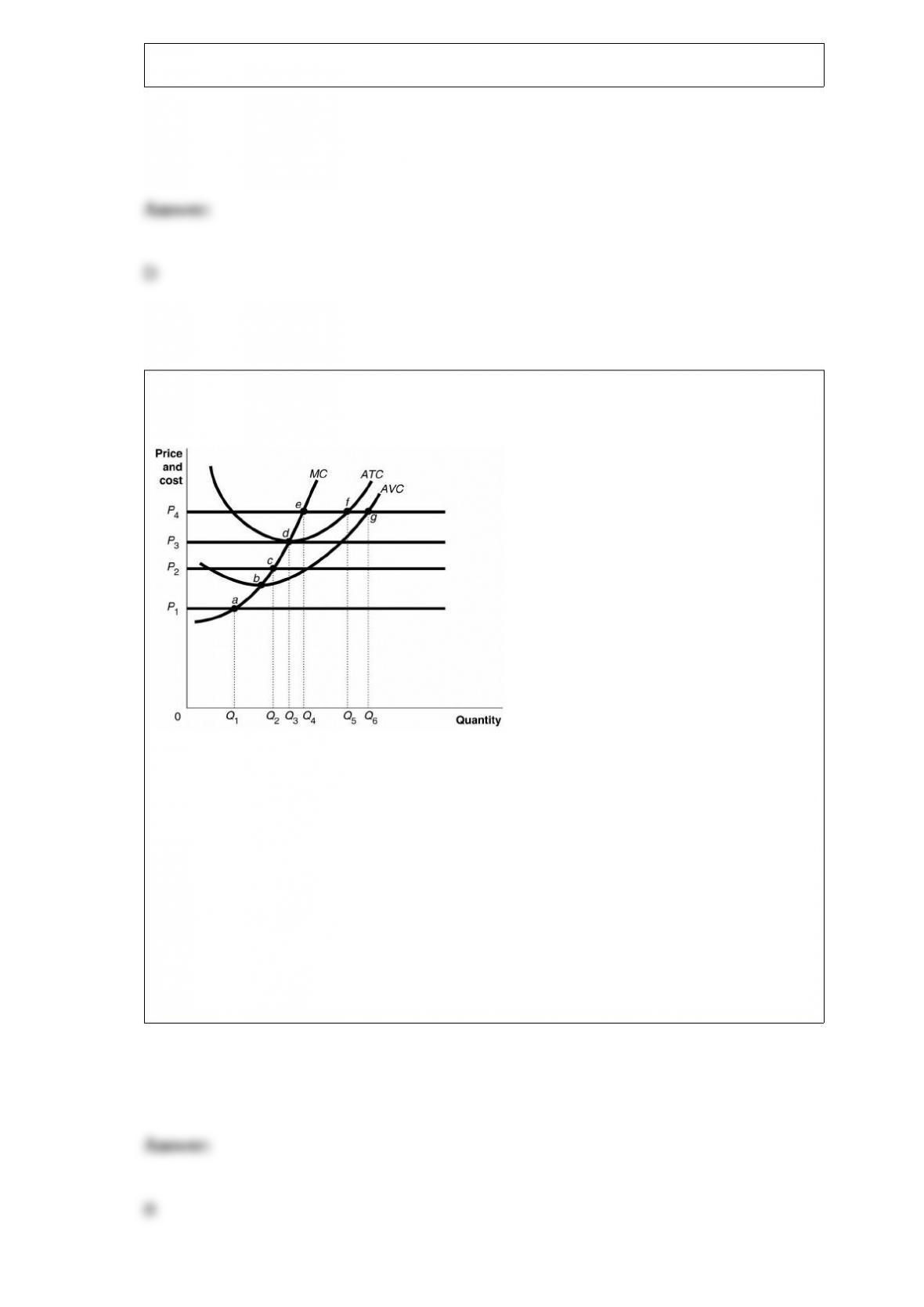
Figure 12-9
Figure 12-9 shows cost and demand curves facing a profit-maximizing, perfectly
competitive firm.
Refer to Figure 12-9. At priceP4, the firm would
A) lose an amount equal to its fixed cost.
B) make a profit.
C) lose an amount less than fixed cost.
D) make a normal profit.

Suppose the demand for milk is relatively inelastic. What happens to sales revenue if
the government imposes a price floor above the free market equilibrium price in the
market for milk?
A) Sales revenue falls.
B) Sales revenue rises.
C) Sales revenue remains unchanged.
D) It cannot be determined without information on prices.
In order for a labor supply curve to be backward bending at high wages
A) leisure must be an inferior good.
B) the substitution effect of a wage increase must be greater than the income effect.
C) workers must have an irrational response to wage increases.
D) the income effect of a wage increase must be greater than the substitution effect.
A decrease in the equilibrium quantity for a product will result
A) when the quantity demanded for the product exceeds the quantity supplied.

B) when there is a decrease in supply and a decrease in demand for the product.
C) when there is an increase in supply and a decrease in demand for the product.
D) when there is a decrease in demand and a decrease in the number of firms producing
the product.
The delivery of first-class mail by the U.S. Postal Service is an example of
A) a monopoly.
B) perfect competition because consumers have access to other methods of written
communication; for example, email and text messaging.
C) monopolistic competition, because mail delivery is a differentiated product provided
by many firms.
D) an oligopoly because a few other firms provide delivery of letters and packages.
The current price of canvas messenger bags is $36 each and sales of the bags equal 400
per week. If the price elasticity of demand is -2.5 and the price changes to $44, how
many messenger bags will be sold per week? Use the midpoint formula.

Goodyear’s sales were negatively affected by the tariff on Chinese tires because
A) Goodyear operates factories in China, and some of the tires produced there were
exported to the United States and subject to the tariff.
B) China retaliated and imposed a tariff on Goodyear tires exported to China.
C) despite being a U.S. company, all of Goodyear’s tires are produced in China.
D) the tariff raised the price on Chinese tires, allowing these tires to compete more
directly with the more expensive Goodyear tires.
For a perfectly competitive firm, average revenue is equal to
A) marginal cost.
B) the market price.

C) total revenue.
D) average fixed cost.
The World Trade Organization (WTO) promotes foreign trade and investment, or
globalization. In recent years opposition to globalization has led to violent protests at
meetings of the WTO. One reason for these anti-globalization protests is
A) foreign trade and investment are examples of zero-sum games.
B) protesters believe that globalization will result in a return to communism in
developing countries.
C) protesters believe that free trade destroys the distinctive cultures of many countries.
D) protesters object to the loss of intellectual property (such as software programs and
movies) that results from foreign trade and investment.
A situation where a member of Congress votes to approve a bill in exchange for
favorable votes from other members on other bills is called
A) rent seeking.
B) logrolling.
C) regulatory capture.

D) special interest legislation.
A baseball hat worn by the Boston Red Sox Hall of Fame outfielder Ted Williams was
auctioned on eBay. The three highest bidders and their bids were:
Roger Bulava $5,000
Tony Millasiti $4,900
Joe Albano $4,200
What price did Roger have to pay for the Ted Williams hat?
A) $4,200
B) $4,700 (the average of the three highest bids)
C) $4,900
D) $5,000
A situation in which each firm chooses the best strategy given the strategies chosen by
other firms is called a
A) Nash equilibrium.
B) dominant strategy.

C) collusion.
D) pay-off matrix.
The additional utility that George receives from consuming one more slice of pizza is
called
A) average utility.
B) marginal utility.
C) total utility.
D) diminishing utility.
Figure 15-5
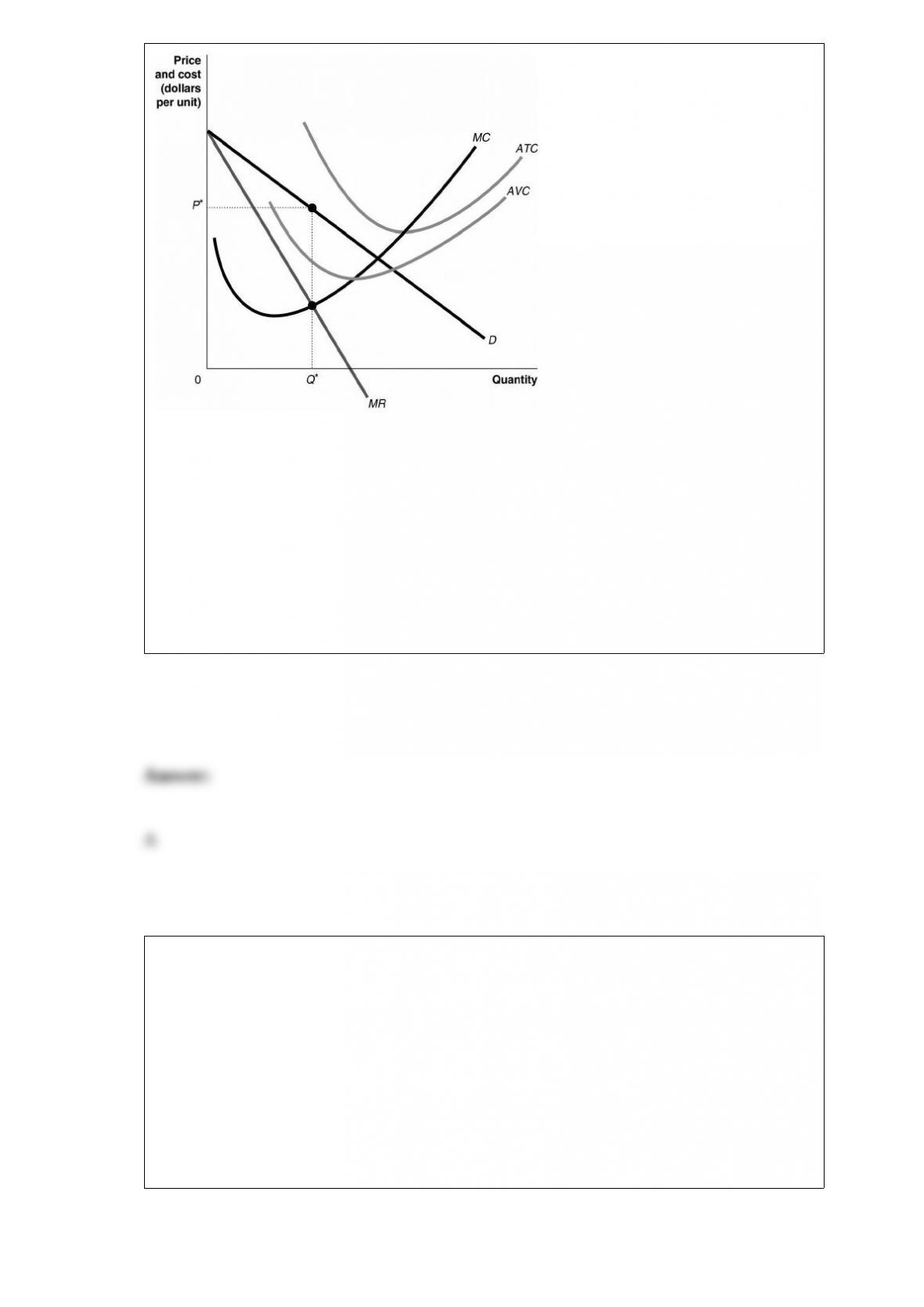
Refer to Figure 15-5. If the monopolist charges price P* for output Q*, in order to
maximize profit or minimize loss in the short run, it should
A) continue to produce because price is greater than average variable cost.
B) shut down because price is greater than marginal cost.
C) shut down because price is less than average total cost.
D) continue to produce because a monopolist always earns a profit.
The minimum amount that investors must earn on the funds they invest in a firm,
expressed as a percentage of the amount invested, is referred to as
A) the explicit costs of production.
B) net worth.
C) net income.
D) a normal rate of return.
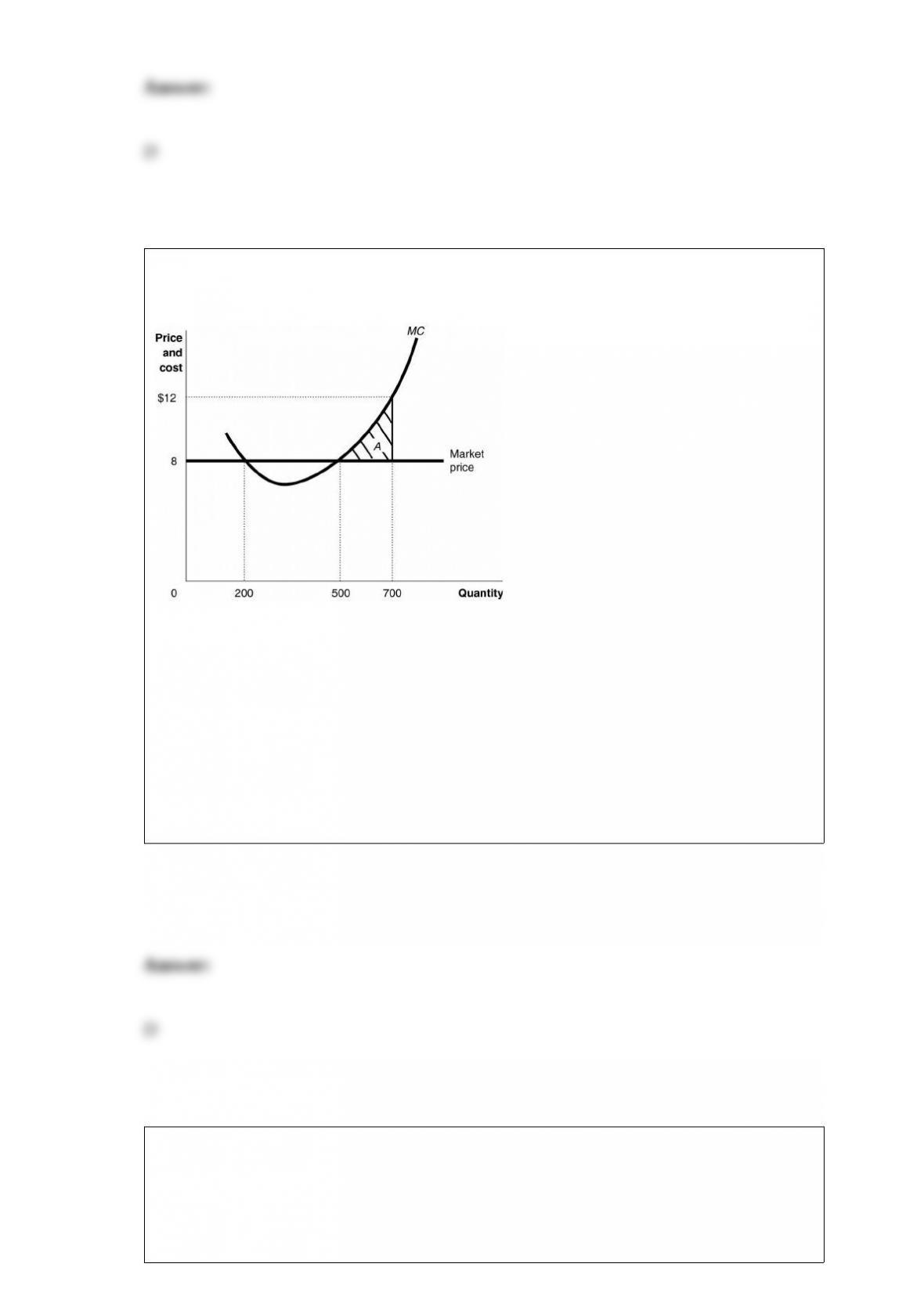
Figure 12-1
Refer to Figure 12-1. If the firm is producing 700 units, what is the amount of its profit
or loss?
A) loss of $280
B) loss equivalent to the area A
C) profit equivalent to the area A
D) There is insufficient information to answer the question.
Article Summary
Based on resale prices for tickets for the 2013 Super Bowl in New Orleans, face-value
prices for the most expensive tickets to the 2014 game are expected to more than

double, with significant price increases for lesser-valued tickets as well. Evidence
indicates that sports teams are more interested in maximizing attendance instead of
ticket revenue, since greater attendance means more spending on items such as parking
and concessions. Higher ticket prices in secondary markets seem to verify that teams
are charging less than they could be if their goal was to maximize ticket revenue.
Source: Patrick Rishe, “Super Bowl XLVIII Pricing: A Lesson In Demand Elasticity,”
Forbes, September 19, 2013.
Refer to the Article Summary. How would sports teams know if they were operating on
the elastic portion of the demand curve for tickets?
A) If they increased ticket prices and the total revenue from ticket sales increased.
B) If they increased ticket prices and the total revenue from ticket sales did not change.
C) If they increased ticket prices and the total revenue from ticket sales decreased.
D) If they decreased ticket prices and the total revenue from ticket sales did not change.
A four-firm concentration ratio measures
A) the fraction of an industry’s sales accounted for by the four largest firms.
B) the production of any four firms in an industry.
C) how the four largest firms became so concentrated.
D) the fraction of employment of the four largest firms in an industry.

Assume that the four-firm concentration ratio in an industry is 85 percent. Which of the
following statements uses one of the five competitive forces to argue that this industry
may be more competitive than its concentration ratio suggests?
A) The high concentration may be due to patents owned by the largest firms but
competition will increase when patent rights expire.
B) If high concentration is the result of large firms owning much of the available supply
of a key input, the industry will become more competitive when new sources of the
input are discovered by other firms.
C) Even though concentration is high, large firms in the industry may act competitively
by spending large sums on advertising.
D) The threat of entry into this industry can cause firms in the industry to lower their
prices and profits in order to deter entry.
Which of the following would cause a decrease in the supply of milk?
A) an increase in the price of cookies (assuming that milk and cookies are
complements)
B) a decrease in the price of milk
C) an increase the price of a product that producers sell instead of milk
D) an increase in the number of firms that produce milk

Avner is maximizing total utility by buying sports magazines and protein supplements.
For him to buy more sports magazines
A) the price of protein supplements. has to fall.
B) the price of sports magazines has to fall.
C) the price of sports magazines has to rise.
D) Since Avner is maximizing his utility, nothing can change the consumption of sports
magazines.
Kireki is a small country with a corrupt government. Its population is rural for most part
and citizens have few or no legal rights. Which of the following is the type of market
featured in Kireki?
A) developed market
B) traditional market
C) emerging market
D) virtual market
Which of the following willshift the demand curve for a good?
A) a change in the technology used to produce the good

B) an increase in the price of the good
C) a decrease in the price of a complementary good
D) a decrease in the price of the good
Which of the following is part of the secondary market?
A) New York Stock Exchange
B) the over-the-counter market
C) NASDAQ
D) all of these
Figure 2-6
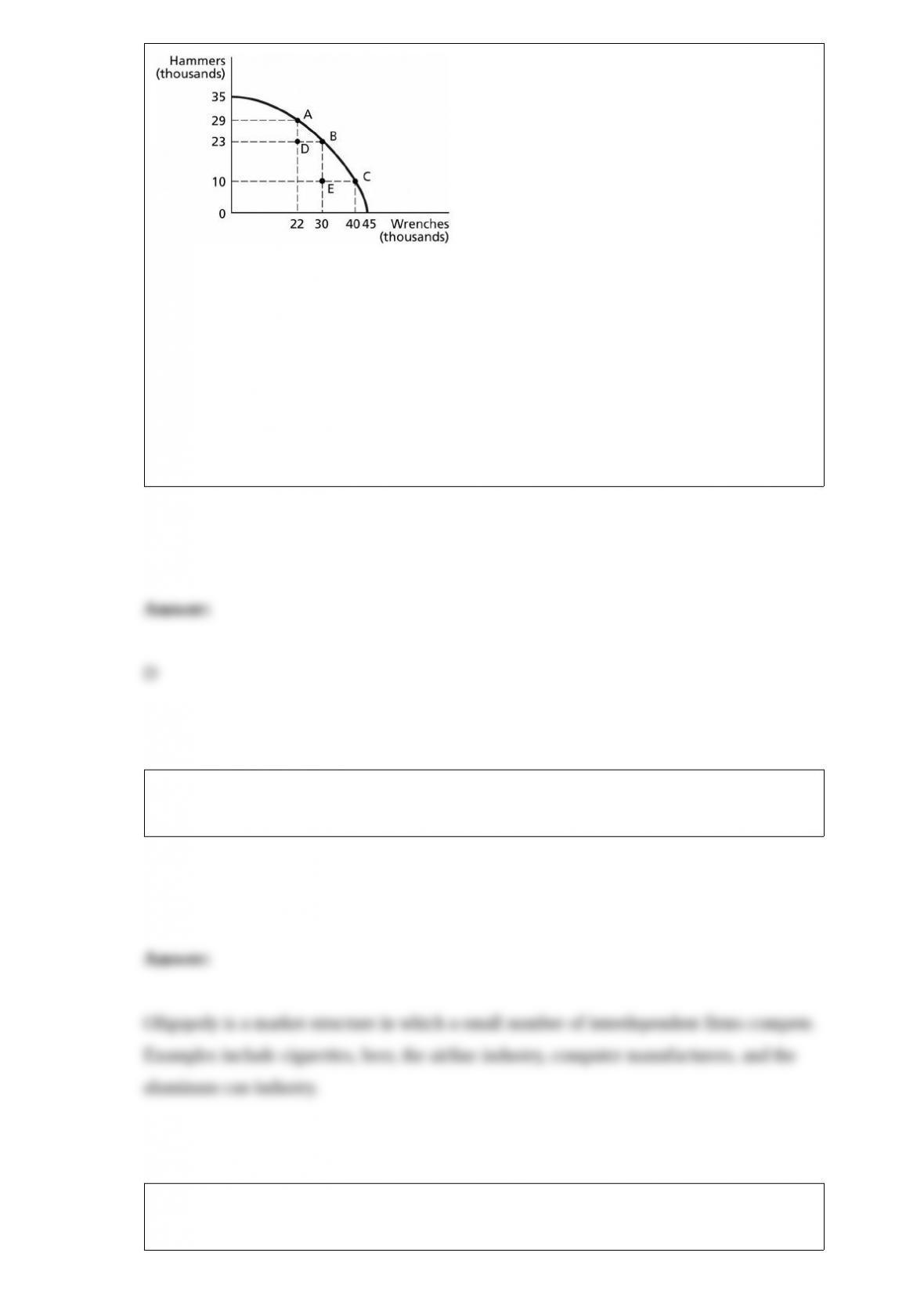
Refer to Figure 2-6. If the economy is currently producing at point D, what is the
opportunity cost of moving to point B?
A) 8 thousand wrenches
B) 23 thousand hammers
C) 30 thousand wrenches
D) 0 hammers
What is an oligopoly? Give two examples of oligopolistic industries in the United
States.
Explain whether it is possible for a country to have an absolute advantage in the
production of a product without having a comparative advantage in the production of
that product.
Ronald Coase is famous for the Coase Theorem, which is based on the premise that
there is an economically efficient level of pollution reduction. Many economists believe
that the tradable emissions allowance program that has been used to deal with the
problem of acid rain has been successful in reducing emissions of sulfur dioxide in an
economically efficient manner. Why isn’t this program an example of the Coase
Theorem?
What is a marginal benefit?

What is the substitution effect of a wage increase? What is the income effect of a wage
increase? Under what conditions will a worker’s labor supply curve become downward
sloping?
Describe the difference between technology and positive technological change.
What assumptions are necessary for a market to be perfectly competitive? Explain why
each of these assumptions is important.
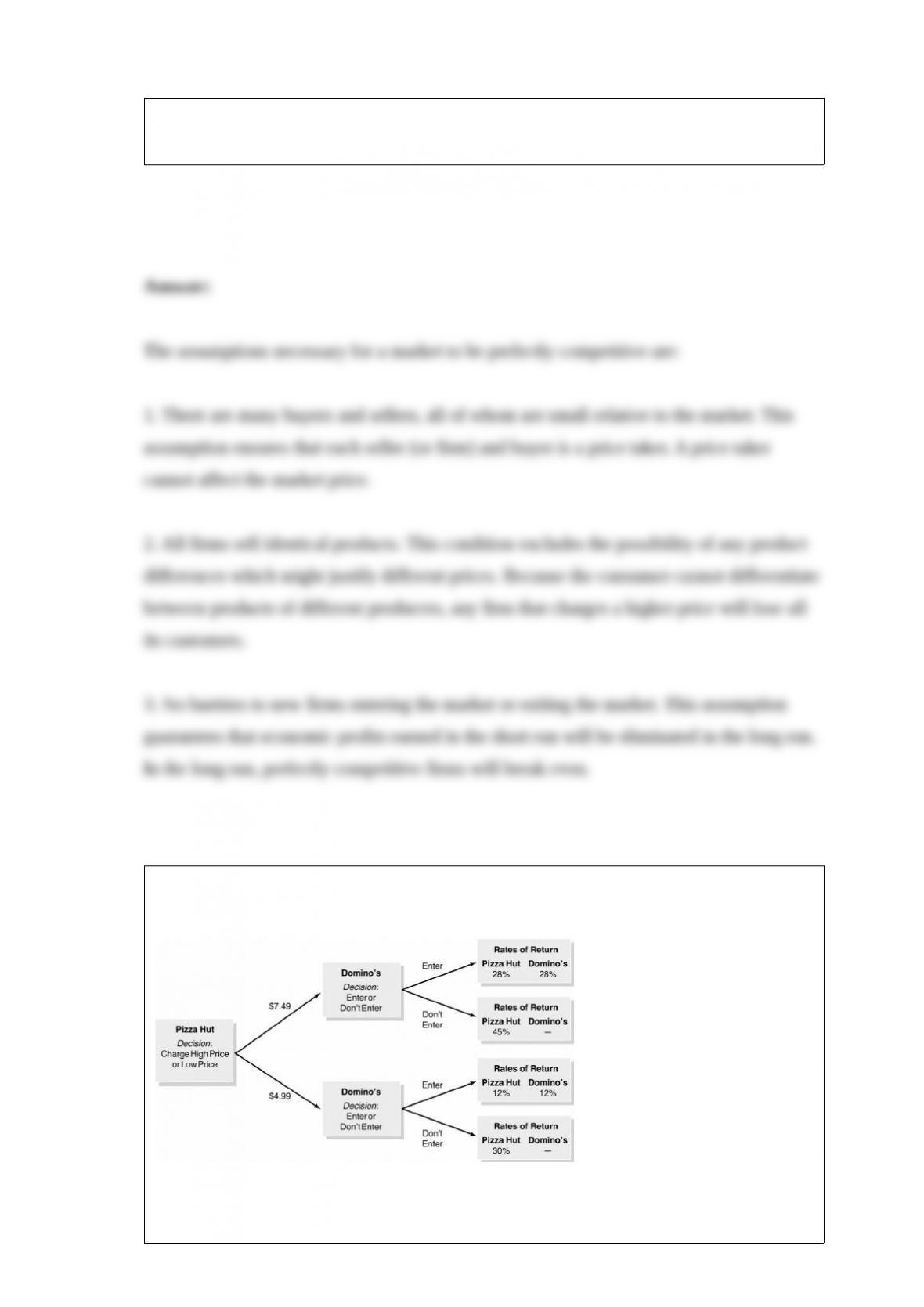
Figure 14-6
Refer to Figure 14-6 Use the decision tree to determine whether Pizza Hut should deter
Domino’s from entering the market for pasta salad. Assume that each firm must earn a
25% return on investment to break even. Explain Pizza Hut’s decision process.
On January 2, 1971, all cigarette advertising was banned on U.S. television and radio
stations. Did this ban likely increase or decrease the profits of cigarette companies in
1971? Briefly explain.
What is a firm? What other terms do economists use interchangeably with the term
“firm”?
Explain how collusion makes firms better off. Given the incentives to collude, briefly
explain why every industry does not become a cartel.
Why would a company continue to operate for many years while never once turning a
profit rather than shut down immediately? Using revenue and cost analysis, explain
when the company would shut down.
Economist Michael Spence uses a concept called the ‘signaling hypothesis” to argue
that college graduates don’t earn high incomes because the skills they learned while in
college serve to increase their productivity. Explain the signaling hypothesis. Is there
evidence that the signaling hypothesis is not valid?
Are restaurant coupons a form of price discrimination? Why or why not?
What is perfect price discrimination and why do economists believe that no firm is able
to practice perfect price discrimination?
If grocery stores were legally required to charge a 10-cent fee for disposable grocery
bags, who would bear the largest burden of this fee?
What is a Lorenz curve and what is a Gini coefficient?
The four-firm concentration ratio in the breakfast cereal industry is 78 percent. How
does the five competitive forces model provide better insight into the degree of
competition in the breakfast cereal industry than just observing the concentration ratio?
What is the relationship between marginal revenue and average revenue for a
monopolist and is it the same for a perfect competitor?
Under what conditions should a competitive firm shut down in the short run?