
The face value of a bond is
a. the dollar amount that a person would receive if he or she were to sell the bond.
b. the dollar amount that a person would receive if he or she were to buy the bond.
c. the total value of payments that will be made over the course of the bond’s life.
d. the dollar amount of the bond’s final payment at maturity.
For a factor price taker, the factor supply curve is __________, whereas the market
factor supply curve is __________.
a. horizontal; vertical
b. vertical; horizontal
c. upward sloping; horizontal
d. horizontal; upward sloping
e. upward sloping; upward sloping
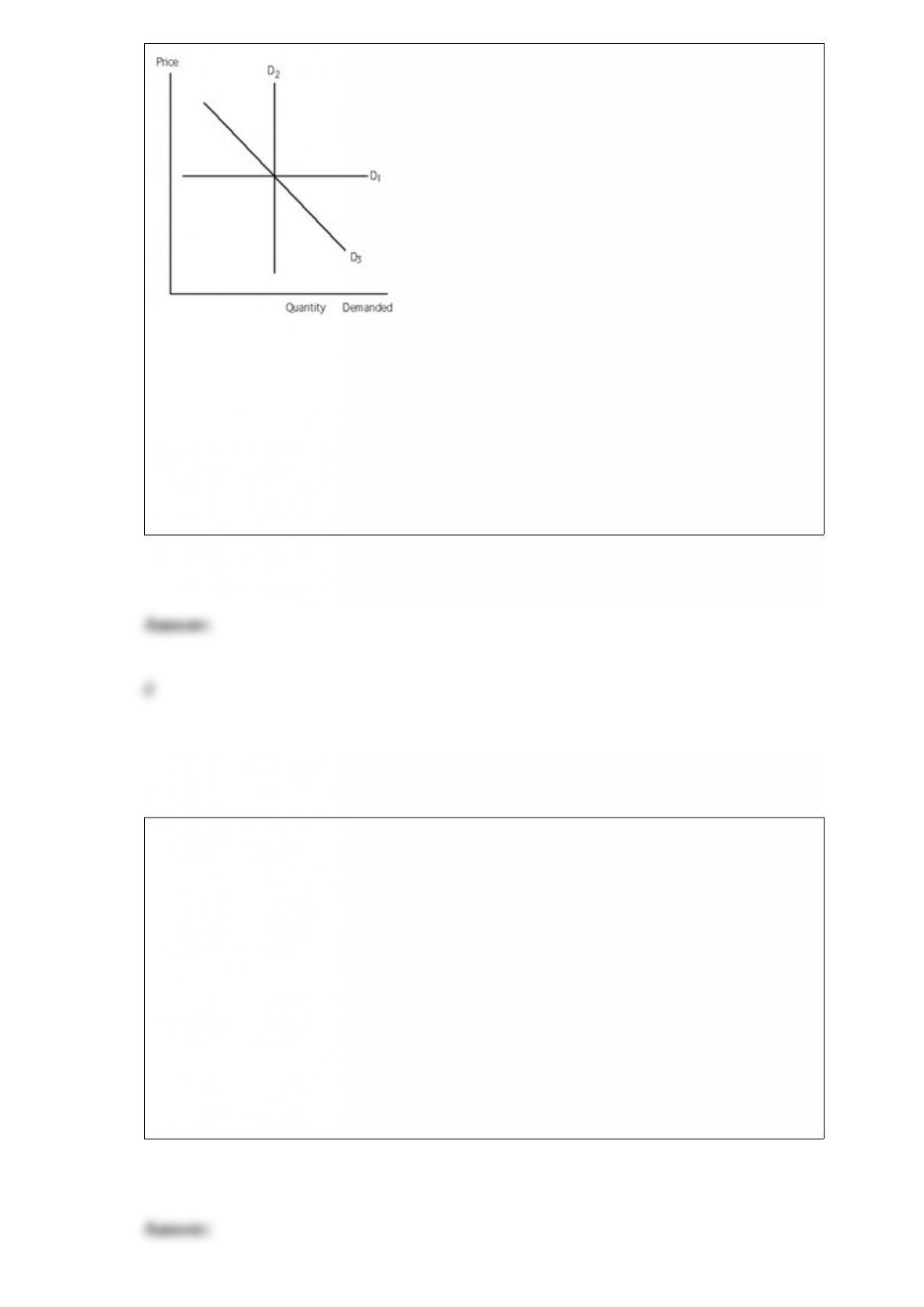
Refer to Exhibit 20-1. The demand for the good represented by demand curve D1 is
Exhibit 20-1
a. inelastic.
b. elastic.
c. unit elastic.
d. perfectly elastic.
e. perfectly inelastic.
The coordinates of point A are 20 units of X and 36 units of Y. The coordinates of point
B are 22 units of X and 30 units of Y. With X on the horizontal axis and Y on the
vertical axis, the slope of the line between points A and B is
a. + 3.00
b. + .20
c. + 0.33
d. – 0.33
e. – 3.00

Suppose 100 bushels of X are produced at a target price of $7 per bushel, but
consumers will only buy 100 bushels at $3 a bushel. What is the total deficiency
payment to farmers?
a. $400
b. $600
c. $300
d. $100
A politician running for political office does not speak in general terms, does not try to
move to the middle of the political spectrum, and does not take polls, therefore it
follows that
a. the median voter model is wrong.
b. rational ignorance does not exist.
c. the free-rider problem does not exist.
d. voter turnout is likely to rise.
e. none of the above
If the firms of an industry form a cartel, their goal is to
a. collectively increase output and thereby earn higher profits.
b. cut back on output and raise the price of their product to earn higher profits.
c. maintain a constant level of output, but increase price to earn higher profits.
d. maintain a constant price level, but increase output to earn higher profits.
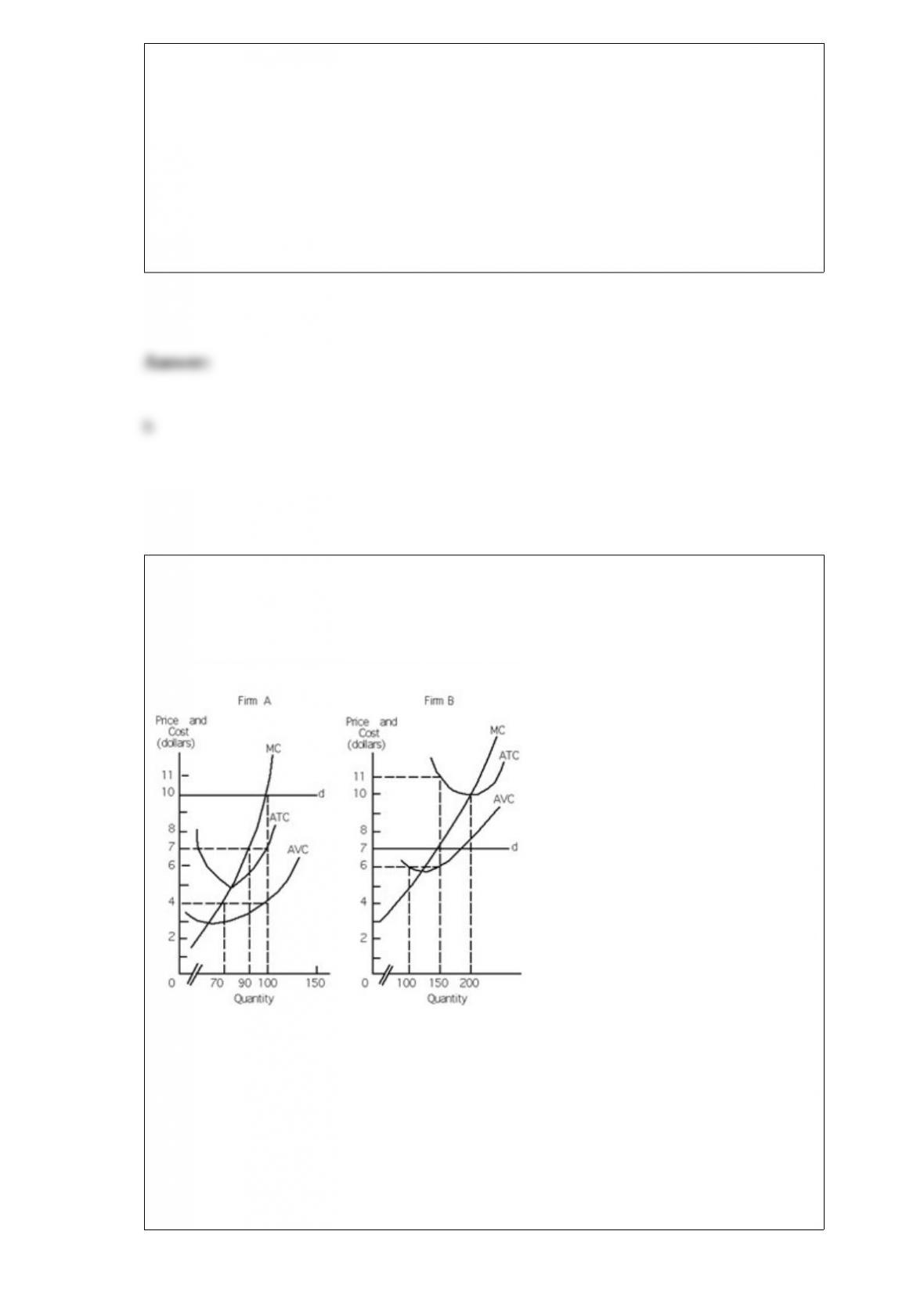
Refer to Exhibit 23-8. Which of the following is true in the short run of firms A and B,
two perfectly competitive firms?
Exhibit 23-8
a. Both firm A and firm B will
continue to produce in the short run.
b. Firm A will continue to produce and firm B will shut down.
c. Firm A will shut down and firm B will continue to produce.
d. Firm A will continue to produce in the short run and shut down in the long run.
e. a and d

Carlos can produce the following combinations of X and Y: 10X and 10Y, 5X and 15Y,
and 0X and 20Y. The opportunity cost of one unit of X for Carlos is
a. 1 unit of Y.
b. 2 units of Y.
c. 1/2 unit of Y.
d. 1/4 unit of Y.
e. none of the above
If there are two factors used in producing a good, the least-cost rule specifies that costs
have been minimized when
a. the MPP of the first factor divided by its price is equal to the MPP of the second
factor divided by its price.
b. the MPP of the first factor multiplied by its price is equal to the MPP of the second
factor minus its price.
c. the MPP of the first factor divided by the price of the second factor is equal to the
MPP of the second factor divided by the price of the first factor.
d. the MPP of the second factor minus the MPP of the first factor is equal to the price of
the second factor minus the price of the first factor.
e. none of the above

The interest rate on a loan will be lower,
a. the shorter the term of the loan.
b. the less risk associated with the loan.
c. the lower the processing costs of the loan.
d. the lower the administrative costs of the loan.
e. all of the above
Rising demand for an agricultural good __________ the payments government is
committed to pay farmers under a __________ program.
a. raises; production flexibility contract
b. raises; deficiency payment
c. lowers; production flexibility contract
d. lowers; deficiency payment

If demand for a given good is elastic, then a given percentage change in price will bring
about a(n) __________ percentage change in quantity __________.
a. larger; demanded
b. smaller; demanded
c. equal; supplied
d. smaller; supplied
e. equal; demanded
Which of the following can change the wage rate in labor market A?
a. An increase in the price of the product that employees in labor market A produce.
b. A negative change in the working conditions in labor market A.
c. A rise in the wage rate in related labor market B.
d. a and c
e. a, b, and c

The single-price monopolist produces the quantity of output at which marginal cost
equals marginal revenue and charges a price that is greater than marginal revenue.
a. True
b. False
Which of the following statements is false?
a. The perfectly competitive firm and the perfectly price-discriminating monopolist
both exhibit resource-allocative efficiency.
b. The perfectly competitive firm, unlike the single-price monopolist, exhibits
resource-allocative efficiency.
c. The perfectly competitive firm charges the same price for each unit of the good it
sells.
d. The perfectly price-discriminating monopolist charges the same price for each unit of
the good it sells.
Economists predict that the __________ the cost of shirking to an individual, the
__________ shirking that individual will undertake, ceteris paribus.
a. lower; less
b. higher; less

c. lower; more
d. higher; more
e. b and c
It is necessary for government officials to analyze cost data to determine what their
country should specialize in producing.
a. True
b. False
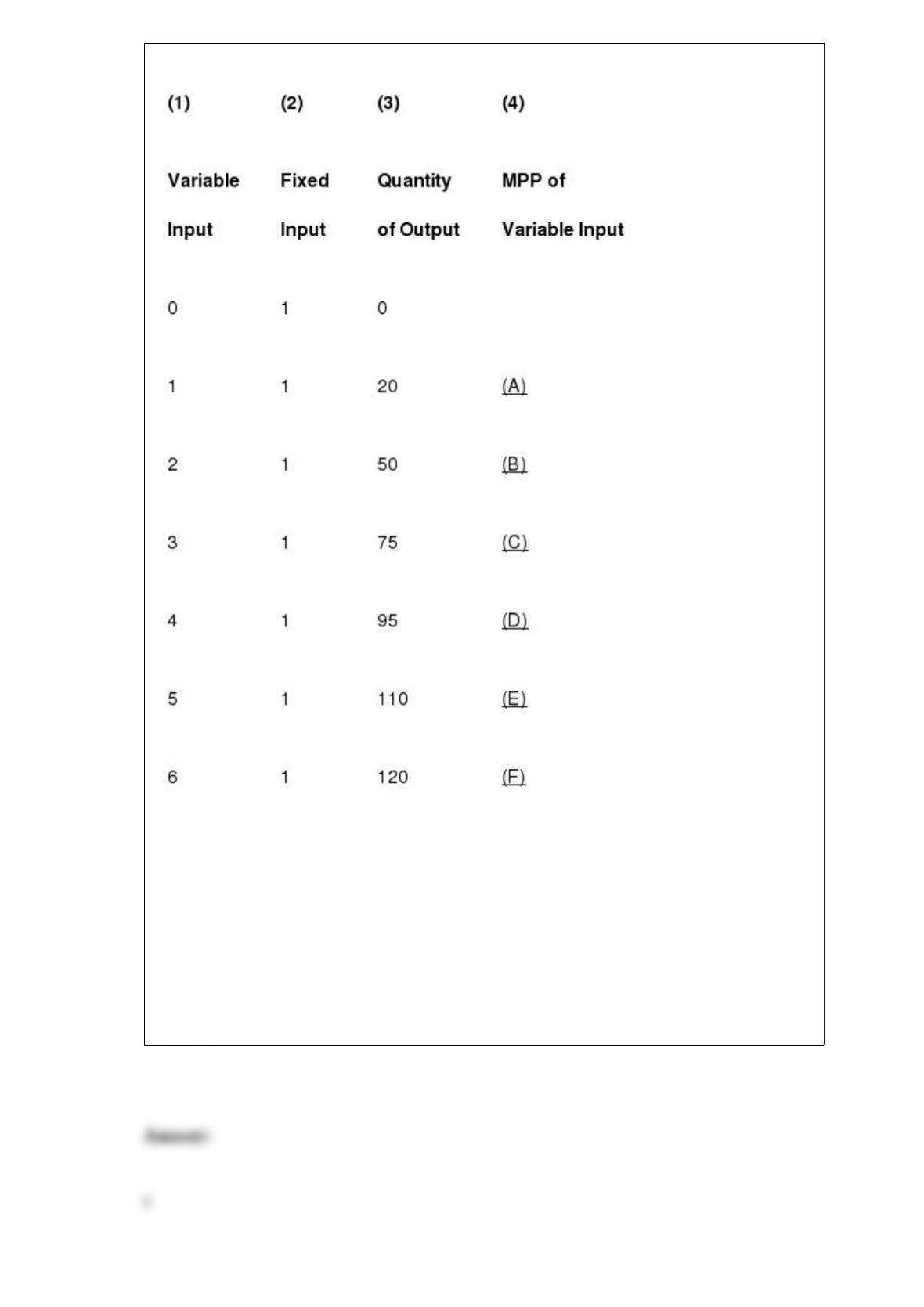
Refer to Exhibit 22-l. The numbers that go in blanks (E) and (F) are, respectively,
Exhibit 22-1
a. 25 and 20.
b. 20 and 22.
c. 15 and 10.
d. 22 and 20.
e. none of the above

A person is more likely to be poor if he or she is
a. African-American or Hispanic rather than white.
b. a member of a male-headed family rather than a female-headed family.
c. old rather than young.
d. all of the above
A side effect of an action that affects the well-being of third parties is
a. a marginal cost.
b. a marginal private benefit.
c. an externality.
d. a and b
e. all of the above
Refer to Exhibit 34-11. PW is the price that exists in the market before a tariff is
imposed and PW + T is the price that exists in the market after a tariff is imposed.
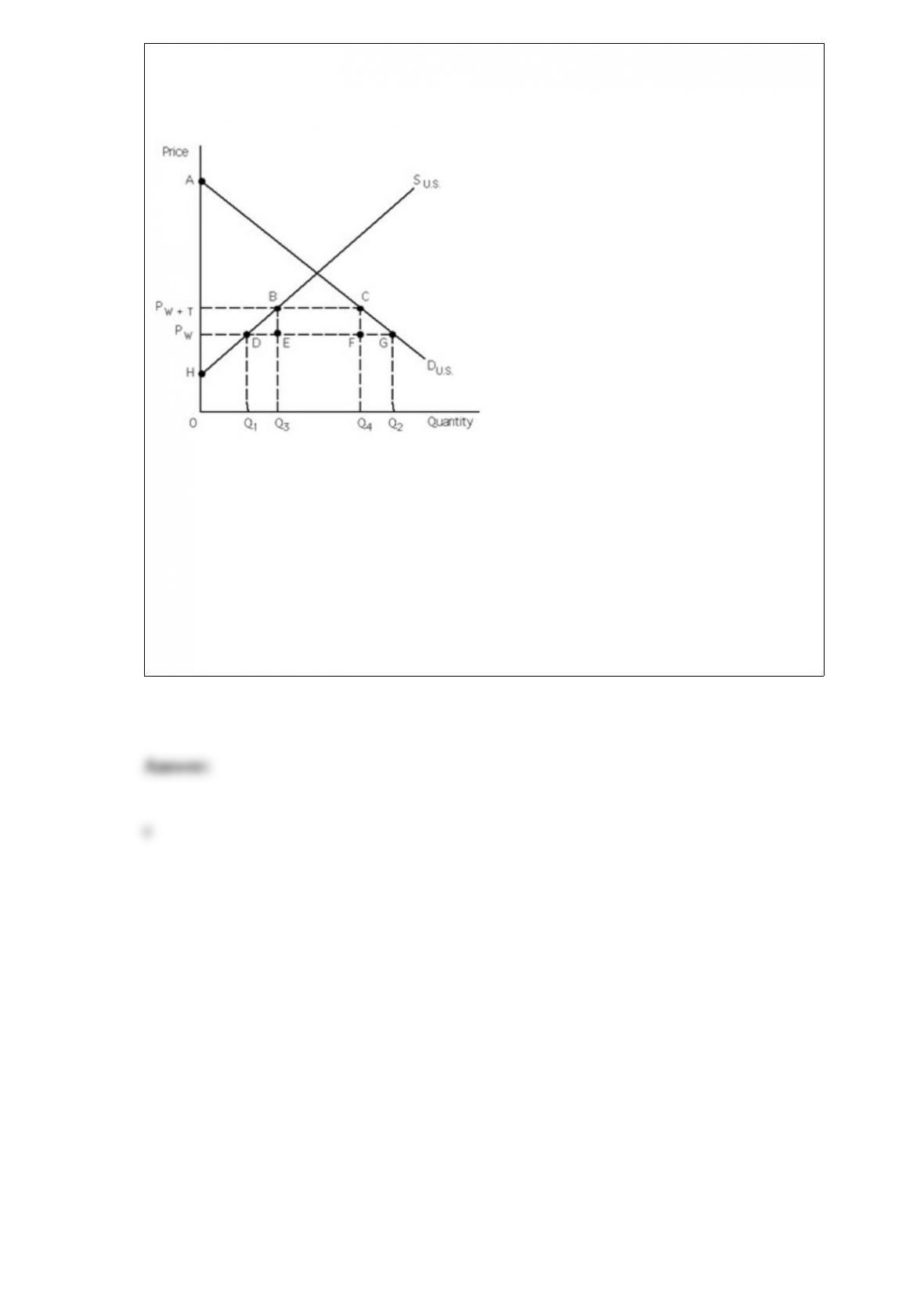
Because of the tariff, consumers’ surplus falls and producers’ surplus rises by the area
Exhibit 34-11
a. BCFE.
b. BCGE.
c. DBCG.
d. DBCF.
e. none of the above