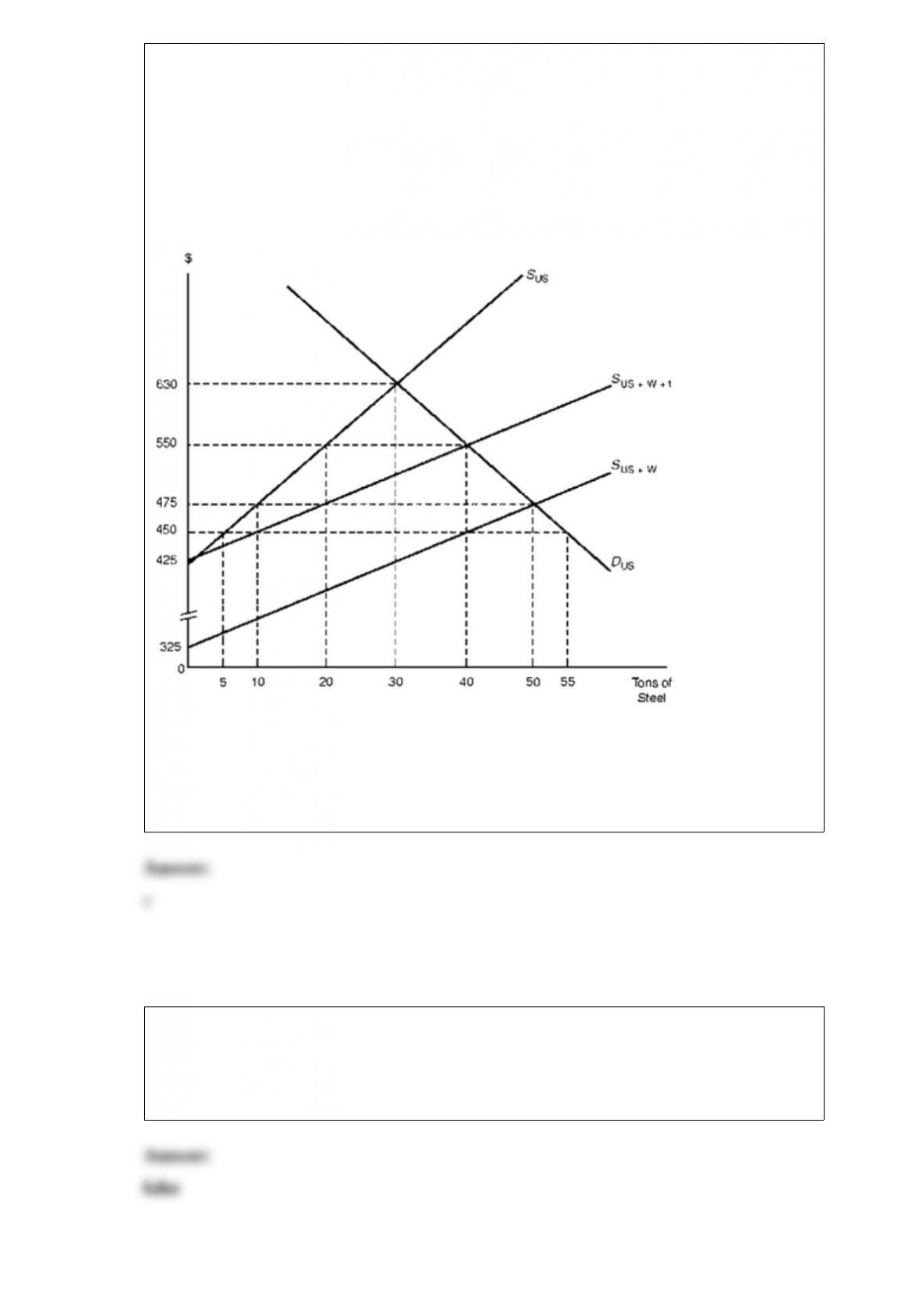
1) assume the united states is a large consumer of steel that is able to influence the
world price. its demand and supply schedules are respectively denoted by du.s. and su.s.
in figure 4.2. the overall (united states plus world) supply schedule of steel is denoted
by su.s.+w.
figure 4.2. import tariff levied by a “large” country
according to figure 4.2, the tariff’s terms-of-trade effect equals:
a.$300
b.$400
c.$500
d.$600
2) increased foreign competition tends to increase profits of domestic import-competing
companies.
a.true
b.false
3) if productivity in the german computer industry grows faster than it does in the
japanese computer industry, the opportunity cost of each computer produced in japan
increases relative to the opportunity cost of a computer produced in germany.
a.true
b.false
4) in the early 1990s, the yen sharply appreciated against the dollar. to protect
themselves from export reductions caused by the yen’s appreciation, japanese auto
companies transferred increasing amounts of auto production from the united states to
japan.
a.true
b.false
5) small nations (e.g., the ivory coast) whose trade and financial relationships are
mainly with a single partner tend to utilize:
a.pegged exchange rates
b.freely floating exchange rates
c.managed floating exchange rates
d.crawling pegged exchange rates
6) import substitution policies make use of:
a.tariffs that discourage goods from entering a country
b.quotas applied to goods that are shipped abroad
c.production subsidies granted to industries with comparative advantages
d.tax breaks granted to industries with comparative advantages
7) in the interbank market for foreign exchange, the ____ refers to the price that a bank
is willing to pay for a unit of foreign currency.
a.offer rate
b.bid rate
c.spread rate
d.transaction rate
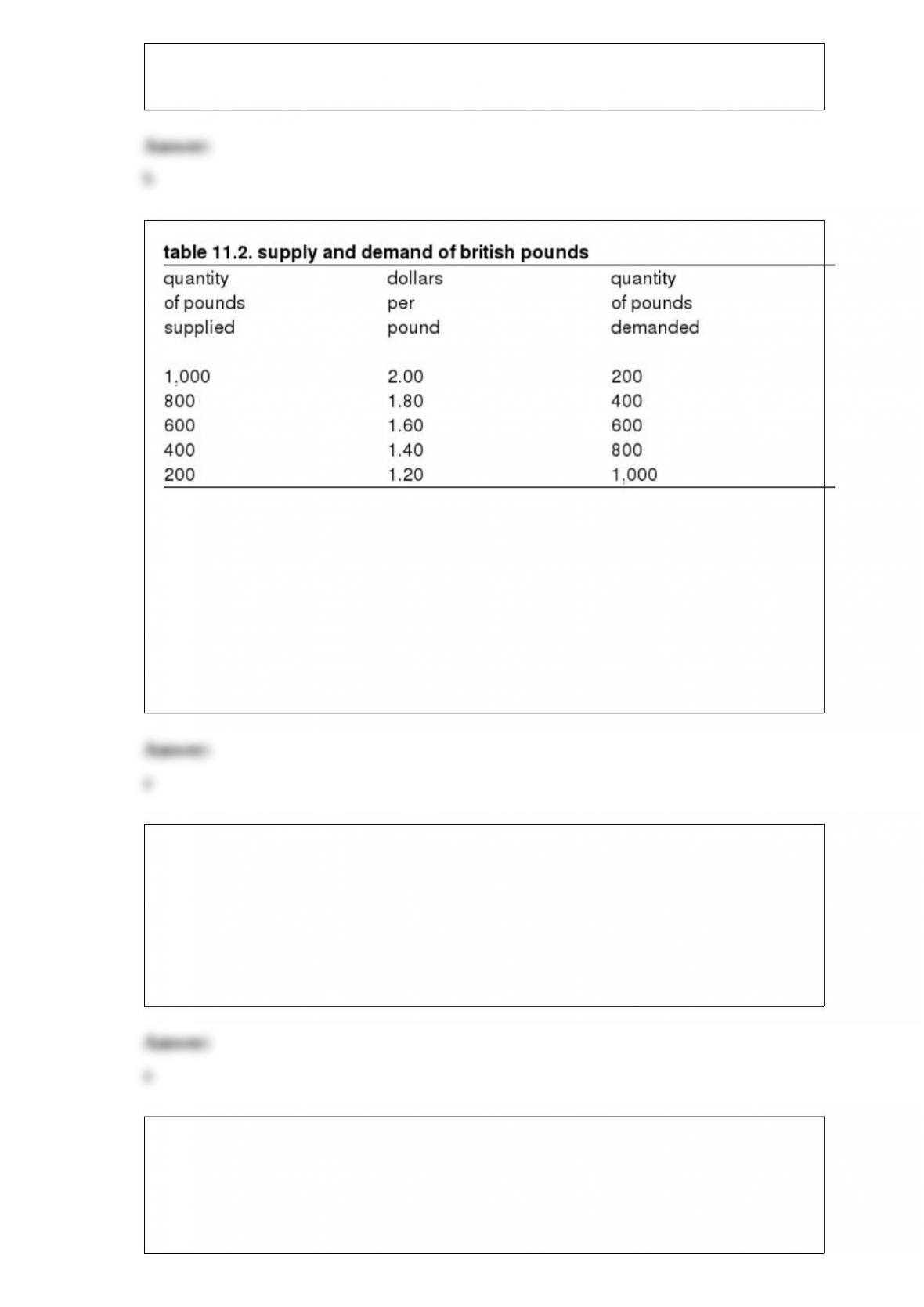
8) refer to table 11.2. at the exchange rate of $1.80 per pound, there is an ____ for
pounds. this imbalance causes ____ in the price of the pound, which leads to ____ in
the quantity of pounds supplied and ____ in the quantity of pounds demanded.
a.excess supply, a decrease, a decrease, an increase
b.excess supply, an increase, a decrease, an increase
c.excess demand, an increase, an increase, a decrease
d.excess demand, an increase, a decrease, an increase
9) assume a system of floating exchange rates. in response to relatively high interest
rates abroad, suppose domestic investors place their funds in foreign capital markets.
the result would be
a.a depreciation of the domestic currency and a rise in net exports
b.a depreciation of the domestic currency and a fall in net exports
c.an appreciation of the domestic currency and a rise in net exports
d.an appreciation of the domestic currency and a fall in net exports
10) exhibit 4.2
in the absence of international trade, assume that the equilibrium price and quantity of
motorcycles in canada is $14,000 and 10 units respectively. assuming that canada is a
small country that is unable to affect the world price of motorcycles, suppose its market
is opened to international trade. as a result, the price of motorcycles falls to $12,000 and
the total quantity demanded rises to 14 units; out of this total, 6 units are produced in
canada while 8 units are imported. now assume that the canadian government levies an
import tariff of $1,000 on motorcycles.
refer to exhibit 4.2. all of the import tariff is shifted to the canadian consumer via a
higher price of motorcycles.
a.true
b.false
11) as an economy opens up to international trade, domestic prices:
a.become lower
b.become more aligned with international prices
c.stabilize
d.none of the above; what will happen cannot be predicted
12) with a compound tariff, a domestic importer of an automobile might be required to
pay a duty of $200 plus 4 percent of the value of the automobile.
a.true
b.false
13) the figure below illustrates the supply and demand schedules of swiss francs in a
market of freely-floating exchange rates.
figure 12.1 the market for francs
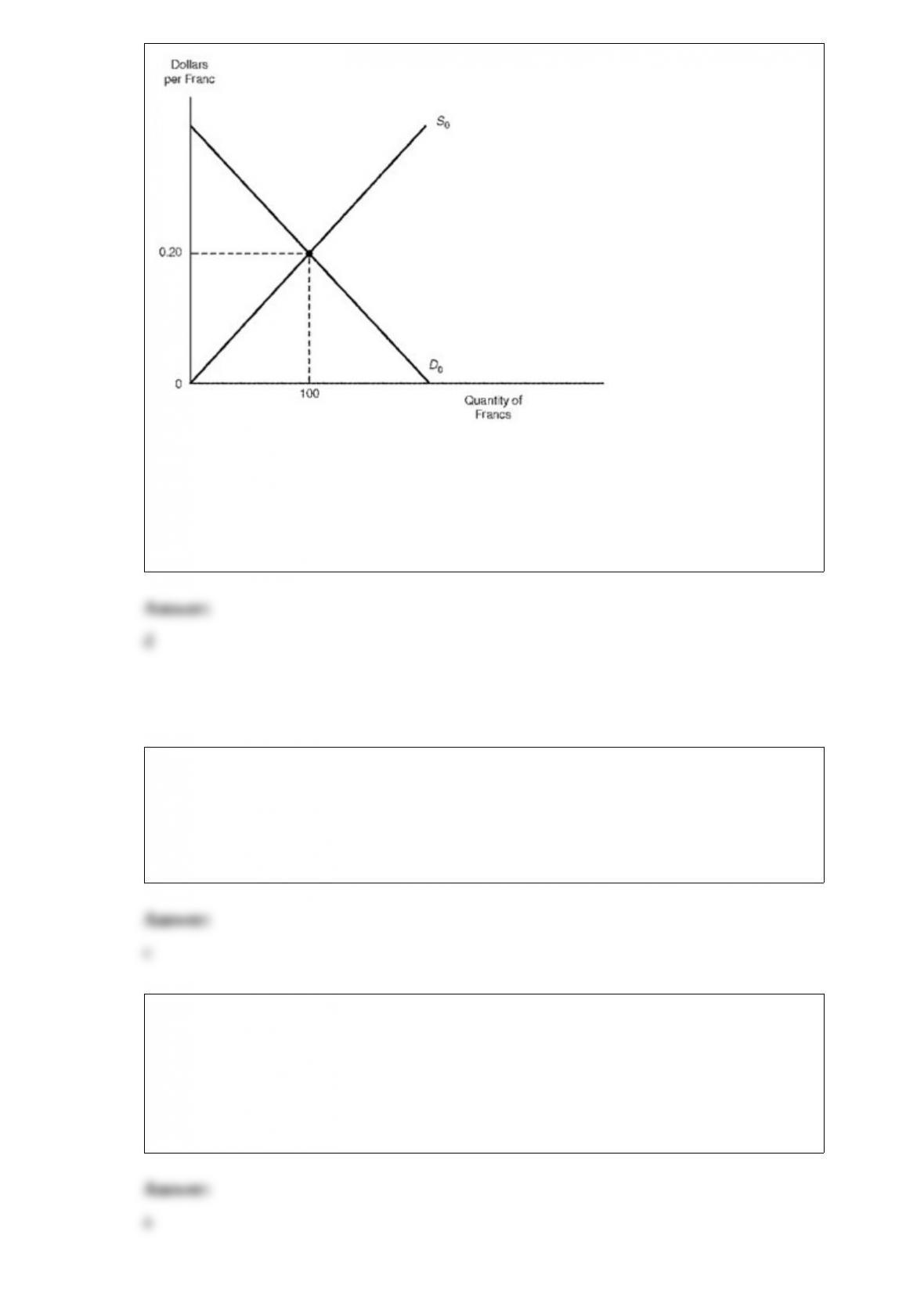
refer to figure 12.1. should swiss labor productivity rise, leading to a decrease in swiss
manufacturing costs, there would occur a (an):
a.increase in the supply of francs and a depreciation of the dollar
b.increase in the supply of francs and an appreciation of the dollar
c.decrease in the demand for francs and an appreciation of the dollar
d.increase in the demand for francs and a depreciation of the dollar
14) increased foreign competition tends to:
a.intensify inflationary pressures at home
b.induce falling output per worker-hour for domestic workers
c.place constraints on the wages of domestic workers
d.increase profits of domestic import-competing industries
15) the quantity of canadian dollars supplied to the foreign exchange market would
increase if, other things remaining equal:
a.preferences for imports rise in canada
b.labor productivity increases in canada
c.prices of goods and services decrease in canada
d.import tariffs rise in canada

16) given a two-country world, suppose japan devalues the yen by 20 percent and south
korea devalues the won by 15 percent. this results in:
a.an appreciation in the value of both currencies
b.a depreciation in the value of both currencies
c.an appreciation in the value of the yen against the won
d.a depreciation in the value of the yen against the won