
The existence of the “underground economy” causes measured GDP to overestimate
actual output.
a. True
b. False
If the multiplier is 4 and real GDP increases by $520 billion, the increase in investment
spending must have been
a. $110 billion.
b. $120 billion.
c. $130 billion.
d. $140 billion.
Specialization permits larger outputs and offers economies of large-scale production.
a. True
b. False

The task of deciding which consumer gets each of the goods produced in a free-market
economy is solved by
a. the price system.
b. the industries which produce the goods.
c. the central planners.
d. citizens with political power.
The aggregate demand and aggregate supply curve intersect
a. at potential GDP.
b. below potential GDP.
c. above potential GDP.
d. at a point which may or may not be equal to potential GDP.

Almost 85% of American firms have less than
a. 20 employees.
b. 100 employees.
c. 500 employees.
d. 1,000 employees.
An “optimally imperfect” decision is one that
a. is vaguely right instead of precisely wrong.
b. recognizes that the decision could always be better if given more time.
c. recognizes that the cost of additional information probably exceeds the potential gain
from making a better decision.
d. recognizes that any decision is imperfect because humans have limited intellectual
capacities.
All the land in a California valley is owned by one person. The supply of land is fixed
and is rented each year to farmers who bid for it in an open auction. Given the rents
they must pay, the farmers barely earn subsistence. Sympathy for the poor farmers leads
the state to bring in irrigation facilities to raise the productivity of the farms and raise
the farmers’ income. The most likely outcome is

a. the farmers will prosper.
b. the farmers and the landlord will share the new prosperity.
c. only the landlord will prosper.
d. no one will prosper.
Price ceilings set a legal maximum price on a product or commodity.
a. True
b. False
Macroeconomic models use abstract concepts such as “price level” and “national
income” that are calculated by combining many markets into one. This process is
known as
a. analysis and synthesis.
b. integration and derivation.
c. conceptualization.
d. aggregation.

“Stagflation” refers to the unwelcome combination of
a. inflation and rising prices.
b. deflation and unemployment.
c. inflation and unemployment.
d. inflation and expansion.
If the cross elasticity of demand for potato chips and pretzels equals 1.5,
a. potato chips and pretzels must both be luxury goods.
b. either potato chips or pretzels must be a luxury good, and both may be luxury goods.
c. potato chips and pretzels must be substitutes.
d. potato chips and pretzels must be complements.

Many countries impose tariffs or quotas to protect the domestic industry from
competition.
a. True
b. False
Models are simplifications that are used to observe the workings of a system.
a. True
b. False
A shortage occurs when price is higher than the market equilibrium.
a. True
b. False
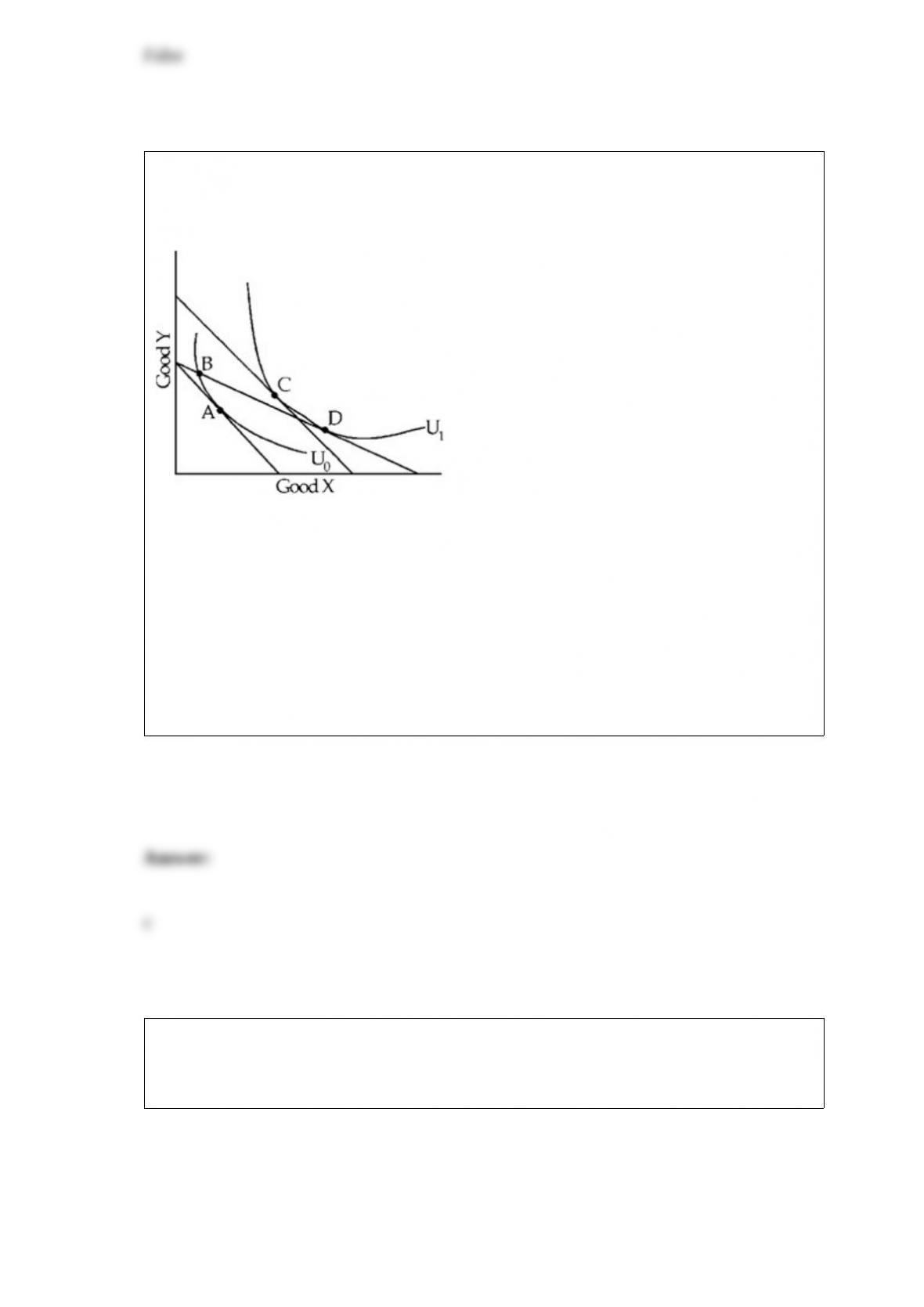
Figure 5-17
In Figure 5-17, the consumer would prefer
a. D to C.
b. B to D.
c. C to B or A.
d. D to A but not B.
Figure 11-9
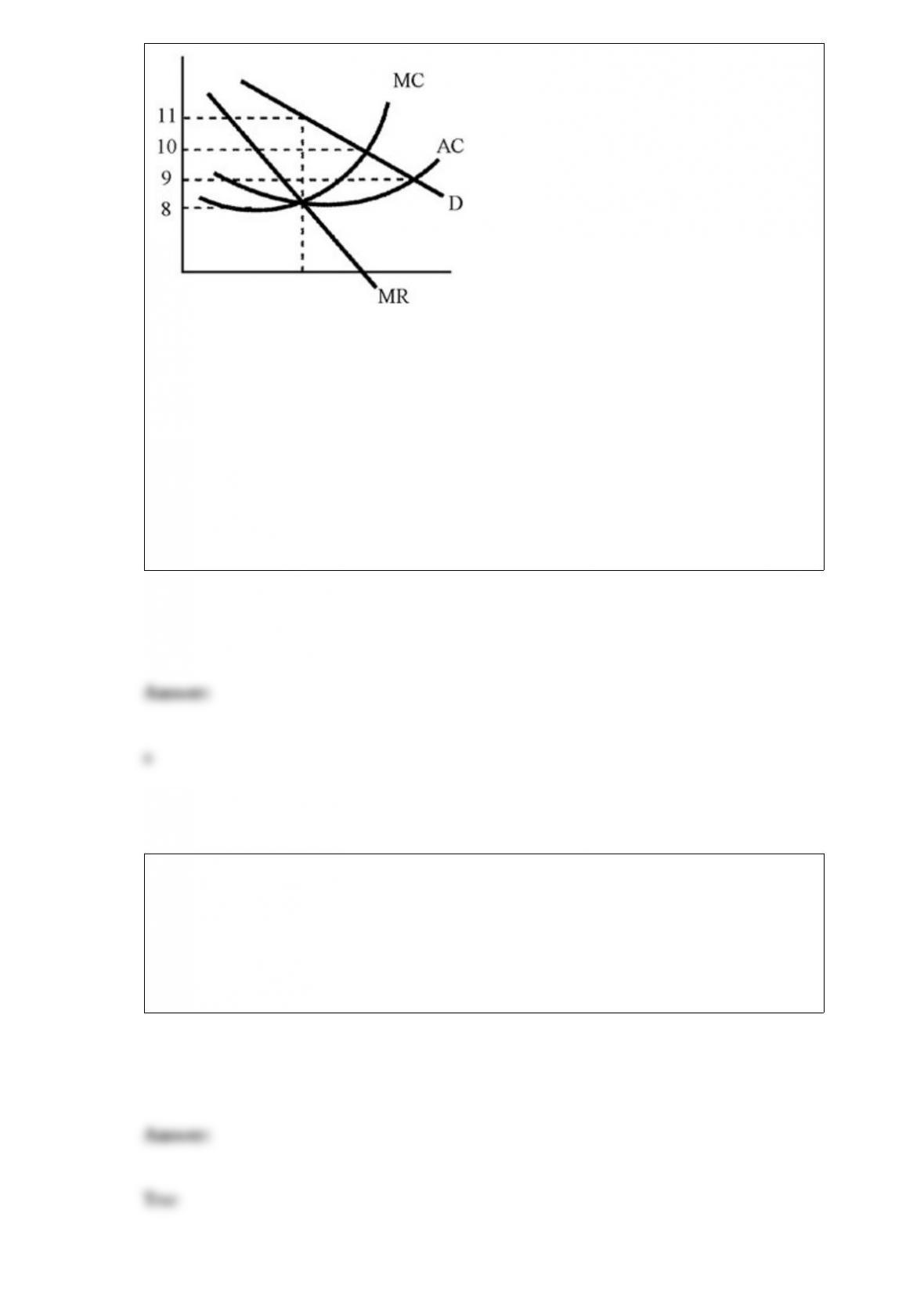
In Figure 11-9, how much more than the short-run competitive price will the
profit-maximizing monopolist charge?
a. $1
b. $2
c. $3
d. $10
Demand curves often do not remain stationary; they shift because of changes in other
variables.
a. True
b. False

Consumers should purchase quantities of a good to the point where MU > P.
a. True
b. False
Consumer surplus is what one consumer is willing to pay for a commodity over what
another consumer is willing to pay for the same commodity.
a. True
b. False
A perfectly competitive firm would be willing to remain in the industry in the long run
at zero economic profit because
a. its total revenues would be positive.
b. accounting profit would be negative.
c. revenue is equal to all costs, including the opportunity cost of capital and labor.
d. its fixed costs would prevent it from leaving the industry.

The primary feature of money is that it serves as
a. barter value.
b. a medium of exchange.
c. intrinsic value.
d. commodity value.
Which of the following is an example of unconventional monetary policy?
a. the Federal Reserve selling T-bills
b. the Federal Reserve decreasing the discount rate
c. the Federal Reserve purchasing mortgage-backed securities
d. none of the above

If inflation in the United States is higher than in Japan, what will happen to the
exchange rate between the U.S. dollar and the Japanese yen?
a. The dollar and yen will both depreciate.
b. The dollar and yen will both appreciate.
c. The dollar will depreciate and the yen will appreciate.
d. The dollar will appreciate and the yen will depreciate.
If all fixed taxes in the United States were removed and only variable taxes remained,
what would be the effect on the expenditures schedule?
a. The expenditure schedule will shift upward.
b. The expenditure schedule will shift downward.
c. The expenditure schedule will become flatter.
d. The expenditure schedule will become steeper.
Economics tells us which resource allocations are preferable.
a. True
b. False

Which of the following was not a reason that the Federal Reserve took on additional
risks associated with unconventional policy during the recession of 2007-2009?
a. The large budget deficit constrained fiscal policy.
b. The inflated price of Treasury bills made them too expensive to purchase in open
market operations.
c. Only the Federal Reserve acting as the central bank can serve as the lender of last
resort.
d. The Fed was able to act more quickly than Congress.
If a currency decreases in value as a result of government decree rather than market
forces, the process is known as
a. devaluation.
b. depreciation.
c. deflation.
d. degeneration.
The consumer maximizes his total utility (measured in money terms) when, at his
chosen quantity of every good he buys, marginal utility
a. equals zero.
b. divided by price equals zero.
c. equals price.
d. equals total utility.
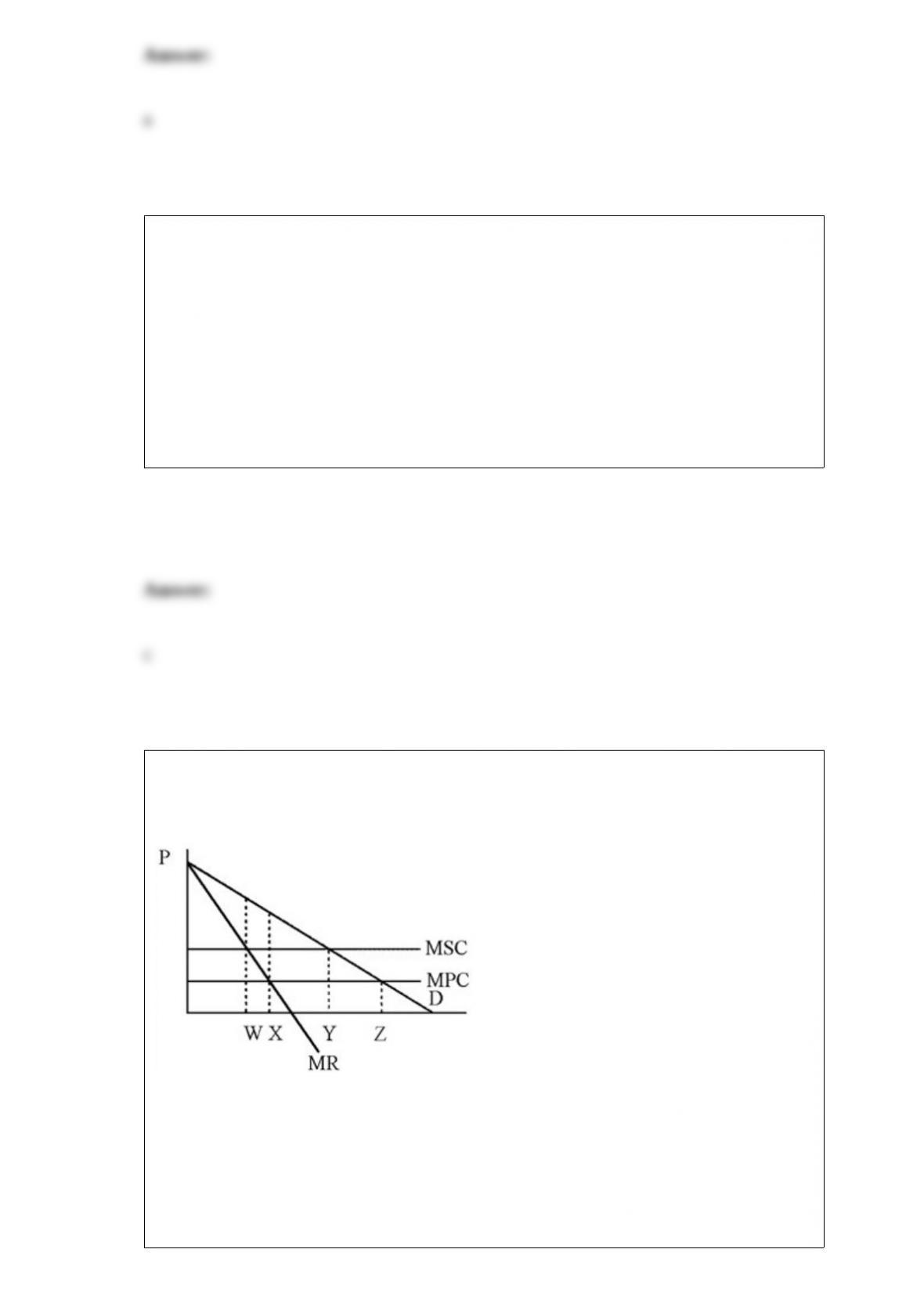
Figure 15-1
Figure 15-1 portrays conditions in the monopolized weezil industry. From the diagram,
the production of weezils
a. must cause a detrimental externality.
b. must cause a beneficial externality.

c. must cause either a detrimental or a beneficial externality, more information is
needed to determine which one.
d. may or may not cause an externality.
The fastest growing productivity increases in the United States have occurred in the
personal services sector.
a. True
b. False