
What replaced the Bretton Woods system?
a. the gold standard
b. a pooled currency system
c. a free float system
d. a managed float system
e. fixed exchange rates
Individuals maximize utility in allocating their time only when
a. any change in their use of time reduces their total satisfaction
b. they consciously and carefully weigh the expected marginal utilities per unit
c. they consciously and carefully weigh the actual marginal utilities per unit of time
spent in each activity
d. the expected average utility of each activity is equal
e. people make a concerted effort to measure satisfaction
Over time, regulatory machinery may shift toward the special interests of producers,
who, in effect, “capture” the regulating agency.

a. True
b. False
If both demand and supply increase, price will
a. always increase
b. always decrease
c. increase only if supply increases more than demand does
d. increase only if demand increases more than supply does
e. decrease only if supply increases less than demand does
Exhibit 11-5
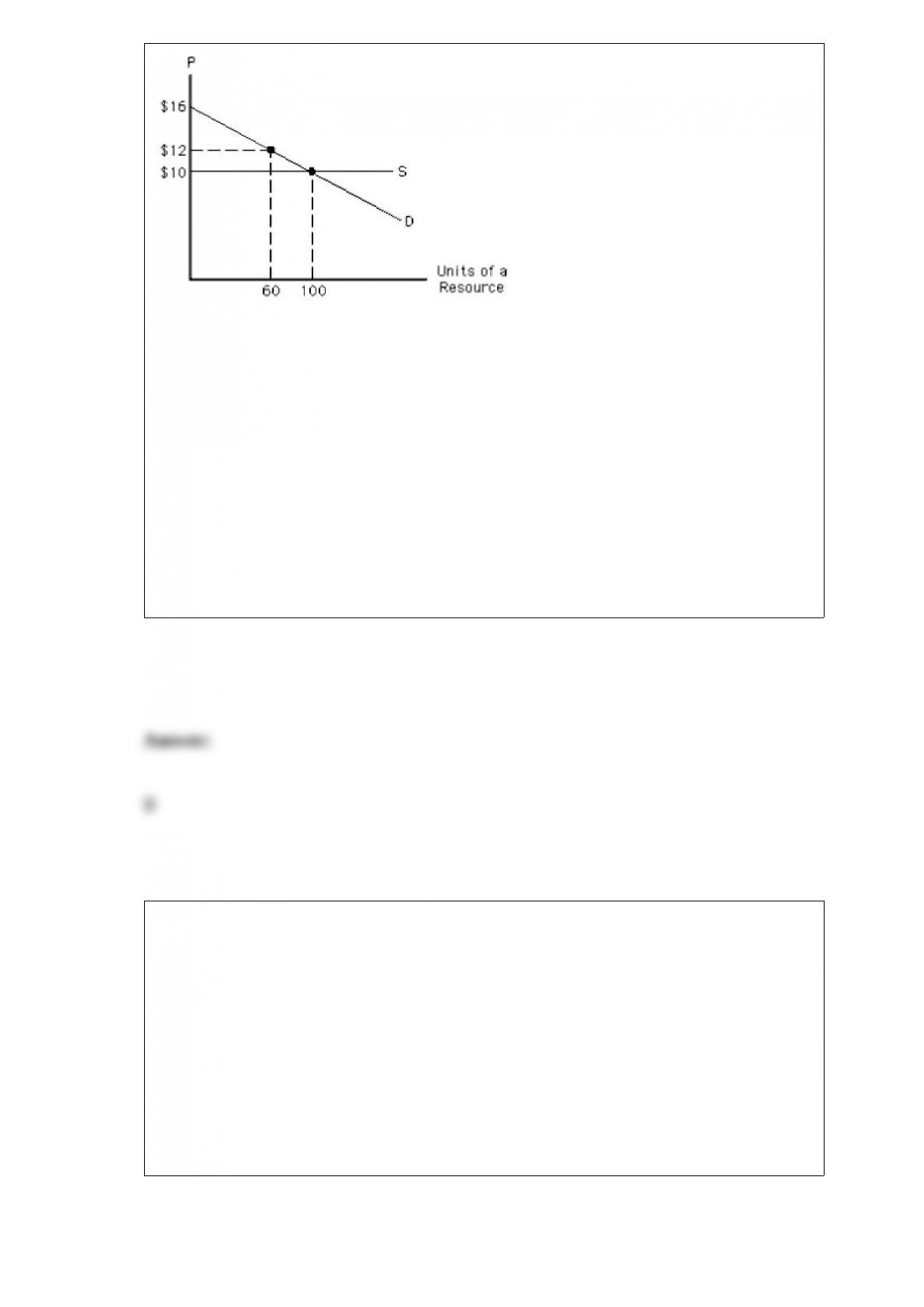
In Exhibit 11-5, what is the equilibrium amount of the resource exchanged in the
market?
a. more than 100 units
b. 100 units
c. 60 units
d. fewer than 60 units
e. unable to determine from information given
The consumers’ surplus derived from the last unit of a good purchased
a. tends to be less than 0
b. tends to be equal to 0
c. tends to equal the price of the good
d. tends to be greater than the price of the good
e. depends on the marginal utility of the first unit purchased

The law of comparative advantage says that a person should produce a good if she
a. has the greatest desire to consume that good
b. has the lowest opportunity cost of producing that good
c. has an absolute advantage in a related activity
d. has a comparative advantage in a related activity
e. is equally good at producing this good as someone else is
If MUx/Px > MUy/Py, the consumer can increase utility by buying more of good x,
which will cause the MUx to rise.
a. True
b. False

In the short run, if a firm shuts down, its loss is equal to
a. $0
b. its variable costs
c. its fixed costs
d. fixed costs minus variable costs
e. fixed costs minus total revenue
When marginal revenue equals marginal cost, the firm just “breaks even.”
a. True
b. False
An increase in the marginal rate of return on bread-mixing machines would
a. reduce the supply of loanable funds and reduce the equilibrium market interest rate
b. reduce the supply of loanable funds and increase the equilibrium market interest rate
c. increase the supply of loanable funds and reduce the equilibrium market interest rate
d. increase the supply of loanable funds and increase the equilibrium market interest
rate
e. increase the demand for loanable funds and increase the equilibrium market interest
rate

During recent elections, consumer groups in various states attempted to get the sales tax
on all medicines and drugs removed. They argued that such a tax is “severely
regressive.” What is the economic interpretation of their statement?
a. The poor get ill more often than do the rich.
b. The poor pay higher prices for medicine and drugs than do the rich.
c. The poor pay a higher percentage of their income for medicine and drugs than do the
rich.
d. All consumers pay too much money for medicine and drugs.
e. The sales tax discourages the poor from seeking medical treatment.
Which of the following is true of marginal product?
a. The firm should produce where marginal product is greatest.
b. The firm should produce where marginal product is increasing.
c. When marginal product is falling, total product is falling.
d. The firm should produce where marginal product is zero.
e. When marginal product is increasing, total product is increasing by increasing
amounts.
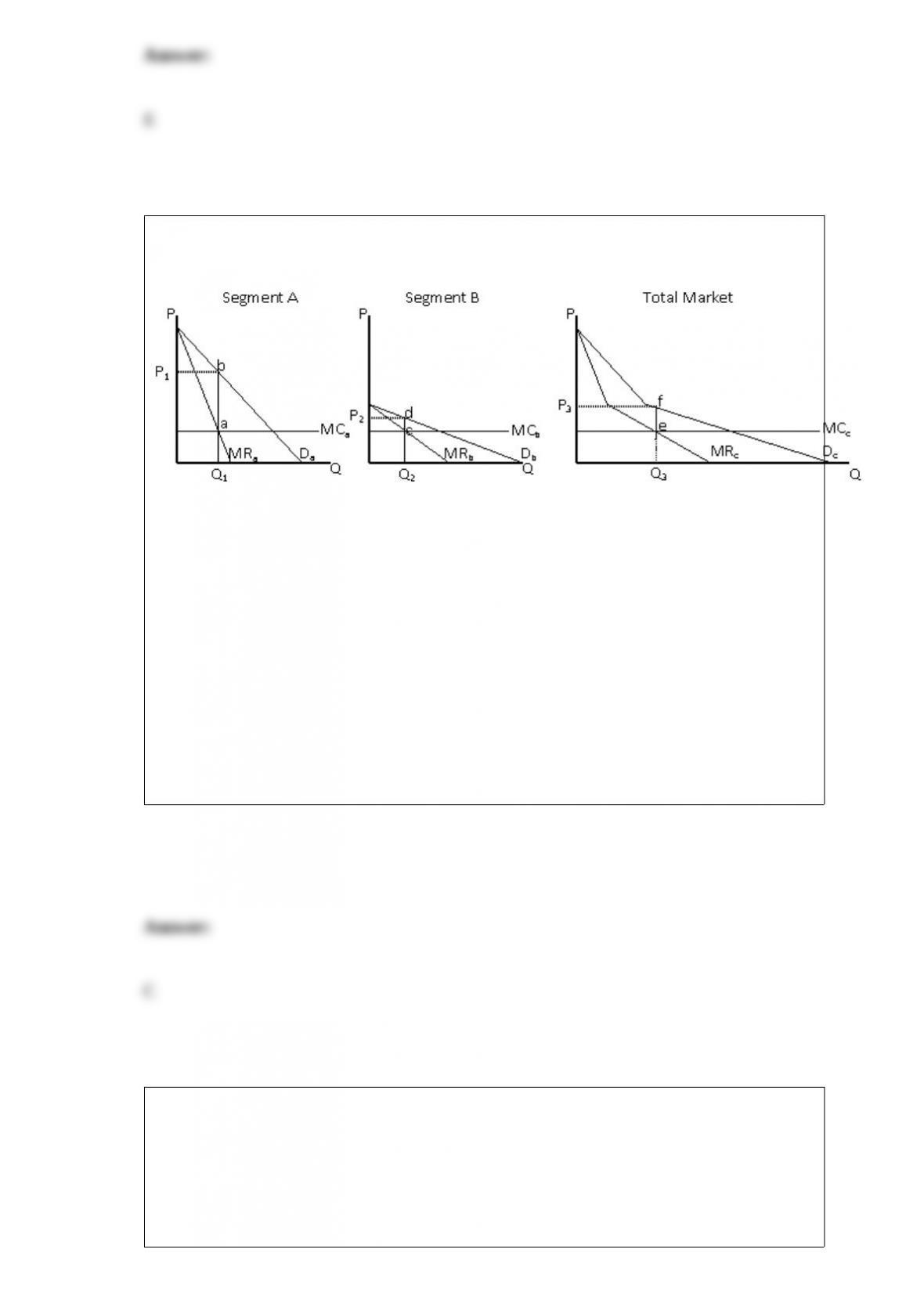
Exhibit 9-20
In Exhibit 9-20, a non-discriminating monopolist will charge what price?
a. P1
b. P2
c. P3
d. either P1 or P2
e. unable to tell from the information given
A firm enters into a consent decree to avoid an even greater legal setback. If the terms
of the consent decree effectively double the firm’s fixed costs, then
a. marginal cost more than doubles
b. marginal cost doubles

c. marginal cost remains unchanged
d. average total cost remains unchanged
e. average variable cost doubles
The marginal rate of return on investment is equal to capital’s
a. MRC x MRP/2
b. MRC/MRP
c. MRP/MRC
d. MRC x MRP/2
e. MRC x MRP x the interest rate
As a consumer allocates income between good A and good B, total utility is maximized
when
a. the marginal utility of A = the marginal utility of B
b. the marginal utility of A = the marginal utility of B = 0
c. the price of A = price of B
d. marginal utility of A/price of A = marginal utility of B/price of B = 0
e. marginal utility of A/price of A = marginal utility of B/price of B

The long-run market supply curve for an increasing-cost, perfectly competitive industry
a. is horizontal
b. slopes upward
c. is the portion of its marginal cost curve above the minimum point on its average
variable cost curve
d. is the portion of its marginal cost curve above the minimum point on its average total
cost curve
e. is vertical
The demand for flounder (a specific type of fish) is
a. more elastic than the demand for fish because there are more substitutes for flounder
than for fish in general
b. less elastic than the demand for fish because there are more substitutes for flounder
than for fish in general
c. more elastic than the demand for fish because there are more substitutes for fish in
general than for flounder
d. less elastic than the demand for fish because there are more substitutes for fish in
general than for flounder
e. more elastic than the demand for fish because flounder is one of the less expensive
kinds of fish

Sally, Kelly, and Debbie are roommates deciding on how many cats they want in the
apartment. Sally prefers three cats to two cats to one cat, Kelly prefers two to one to
three, and Debbie prefers one to two to three. If they decide by majority vote (one
versus two, two versus three, and so on), how many cats will they get?
a. none
b. one
c. two
d. three
e. the answer cannot be determined from the information given
Airlines are __________ than they were before deregulation.
a. more dangerous
b. more concentrated
c. higher priced
d. flying fewer miles
e. much more profitable
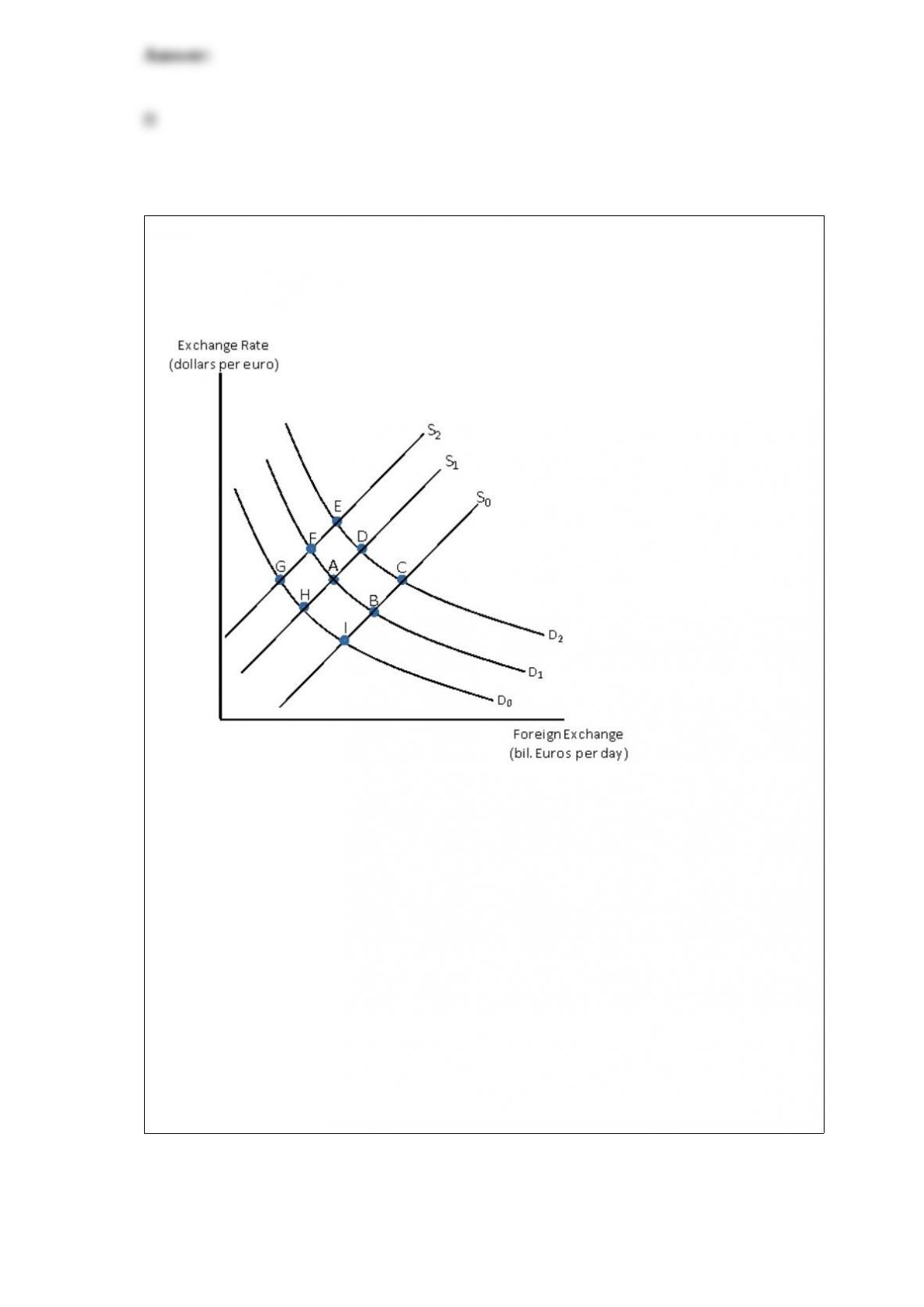
Exhibit 20-8
Exhibit 20-8 shows the market for euros in the US. Initially the demand for euros is
represented by D1 and the supply of euros is represented by S1. Equilibrium in the
market for euros is at point A. In response to a decrease in the income of US consumers
the equilibrium will be at point _____.
a. A
b. C
c. E
d. G
e. H

The law of demand states that
a. there is a positive relationship between price and quantity demanded
b. price is the only factor that influences the quantity that people are willing and able to
buy
c. price and quantity demanded are inversely related
d. the demand curve shifts whenever the price of a good changes
e. by producing a product, firms create a demand for it
When society receives more benefits from a good than the individuals who consume the
good,
a. the marginal social benefit for the good is less than the marginal social cost
b. too much of the good would be produced by a private market
c. property rights are assignable and well defined
d. the good produces a positive externality
e. the good is exhaustible with fixed-production technology

Managers experience bounded rationality when they focus narrowly on maximizing
their firm’s profits and ignore the broader perspective of society’s preferences.
a. True
b. False
When economic choice involves an adjustment to an existing situation, marginal
analysis
a. has no practical applications or real-world uses
b. eliminates incorrect decisions and bad choices
c. involves comparing the additional costs and additional benefits of an activity before
deciding
d. involves examining only the total costs and total benefits of an activity before
deciding
e. none of the above

Jennifer learns that the price of CDs will be going up 10 percent next week. She usually
buys three CDs per week. What happens to Jennifer’s demand for CDs this week?
a. It does not change because only quantity demanded changes when price changes.
b. It increases because the price will be lower next week.
c. It decreases because the price will be higher next week.
d. It increases because the price will be higher next week.
e. It decreases because the price will be lower next week.
A curve that shows the combination of goods that a consumer is able to purchase by
spending all of her income is called a(n)
a. income-consumption curve
b. income-allocation curve
c. budget line
d. indifference curve
e. budget-indifference curve
Japan is generally considered an economy closed to foreign trade.

a. True
b. False
The poverty rate of the elderly in the United States has
a. been constant since 1959
b. risen since 1959 because people are living longer
c. fallen since 1959 because of the growth in Social Security and Medicare programs
d. fallen since 1959 because of the growth in private retirement plans
e. fallen since 1959, mainly because of inflation
Compared to the profit-maximizing outcome, average cost pricing in natural monopoly
leads to
a. all of the following
b. a higher price
c. decreased consumer surplus
d. the elimination of economic profit

e. less output