
Following the 1960 and 1973 period, average real earnings of workers grew more
______ from 1973 to 1996 and then ______ from 1996 to 200
A. slowly; grew more rapidly
B. slowly; slowed even more
C. slowly; grew at about the same rate
D. rapidly; slowed
It is spring, and several graduates of State U are seeking employment. State U graduates
have evenly distributed GPAs, from 2.0 to 4.0, with an average GPA of 3.0. The largest
employer in town, Acme Dynamite, is interviewing candidates, hoping to hire a few
hard workers. While Acme does not require students to submit a transcript with their
applications, the hiring officer believes that high GPAs signal a willingness to work
hard.
Jordan is a recent graduate and is applying for a job with Acme. Jordan’s GPA is 3.3.
Should Jordan include a transcript with her job application?
A. No, because it is not required.
B. Yes, because if she does not, Acme will infer that it is 3.0 or worse.
C. No, because it is not much better than average.
D. No, because it will make Jordan look worse relative to those with higher grades.

Sven likes to water ski, but can only water ski during the one week that he is on
vacation. Therefore, he plans to ski every day, for eight hours a day. The first day, Sven
skied for eight hours and enjoyed every hour. The second day, Sven slept in and then
skied for seven hours, which was fun but not as much fun as the first day. The third day,
Sven skied for six hours, but was starting to get a bit bored by the end. The fourth day,
Sven skied for four hours and then took a nap. On the fifth day of Sven’s vacation, Sven
went blueberry picking all day.
Sven’s vacation convinced him that
A. even for activities he really enjoys, diminishing marginal utility eventually sets in.
B. blueberry picking yields higher total utility than does water skiing.
C. even for activities he really enjoys, total utility declines each time he engages in it.
D. economic theory applies only to things you buy, not recreation.
The reason a brand name item (e.g., Tyson chicken) has a larger price elasticity than a
class of items (e.g., chicken), is because:
A. there are fewer substitutes for Tyson chicken.
B. it takes a lot of time to adjust to a substitute brand of chicken.
C. the share of income spent on “chicken” is larger than spent on “Tyson Chicken”.
D. there are fewer substitutes for chicken than for Tyson chicken.

Labor income includes:
A. wages, salaries, and earnings of the self-employed.
B. payments to owners of factories, machines, and buildings.
C. interest, dividends, and rent.
D. profits, royalties, and rent.
For policymakers the problem with a recessionary gap is ______ and the problem with
an expansionary gap is _____.
A. a tendency for inflation to develop; wasted resources
B. wasted resources; a tendency for inflation to develop
C. an increase in cyclical unemployment; an increase in structural unemployment
D. an increase in structural unemployment; an increase in cyclical unemployment
Market equilibrium is considered efficient because:
A. prices are low.
B. the price consumers pay equals the profit producers receive.
C. no more trades remain that benefit some without harming others.
D. it assures that both the buyer and seller earn equal surplus.
An exchange rate that varies according to the supply and demand for the currency in the
foreign exchange market is called a ______ exchange rate.
A. real
B. nominal
C. fixed
D. flexible
In the twentieth century, average real wages have risen substantially:
A. only in the United States.
B. in industrial countries excluding the United States.
C. in industrial countries including the United States.
D. in neither the United States nor other industrial countries.
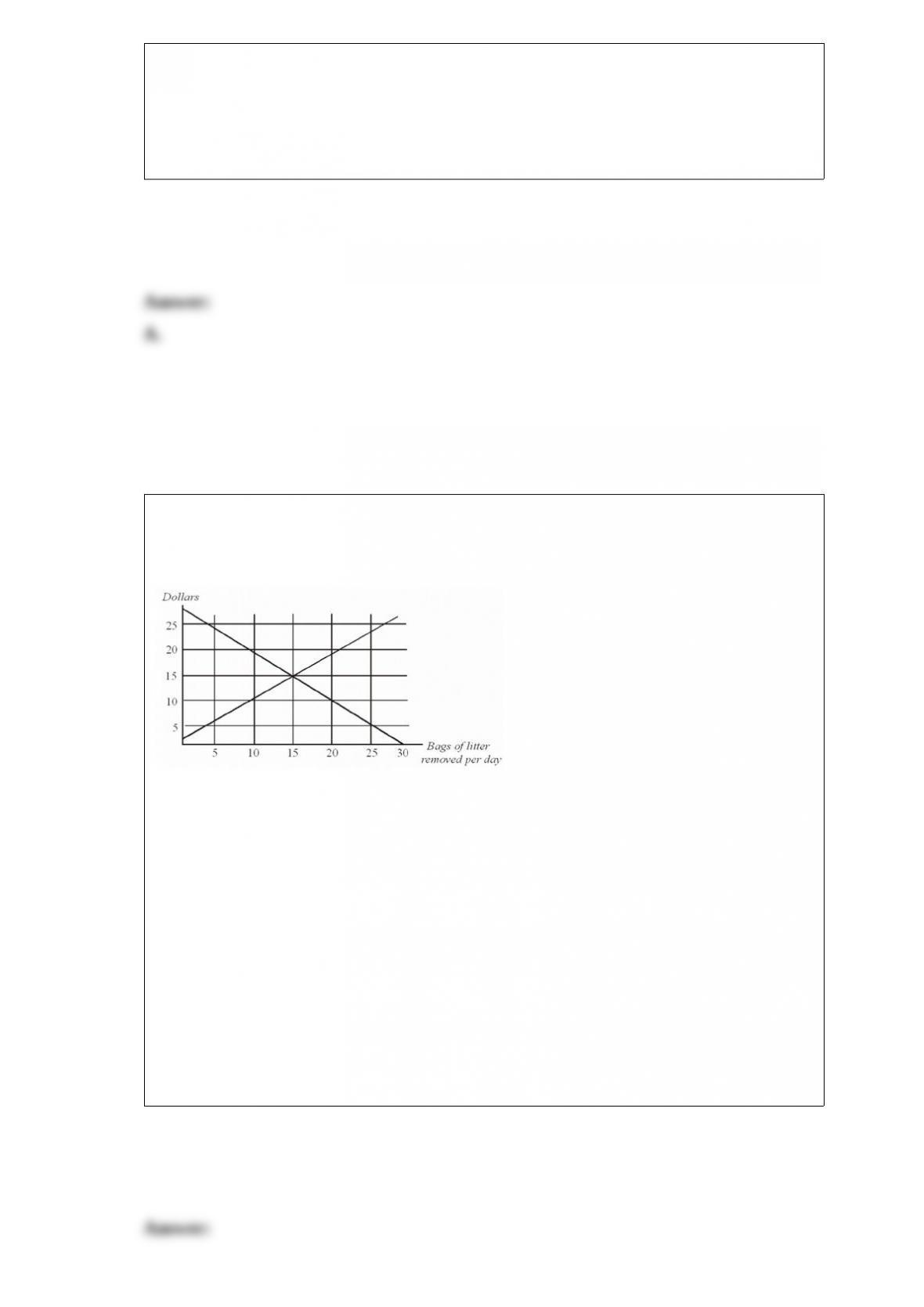
This table shows demand for shoes in a 3 consumer market:
At $100 per pair, the market demand
A. intersects the y-axis.
B. intersects the x-axis.
C. is exactly the same as Leigh’s demand.
D. is less than the quantity supplied.
The introduction of credit cards and debit cards has ______ velocity.
A. increased
B. decreased
C. had no impact on
D. eliminated
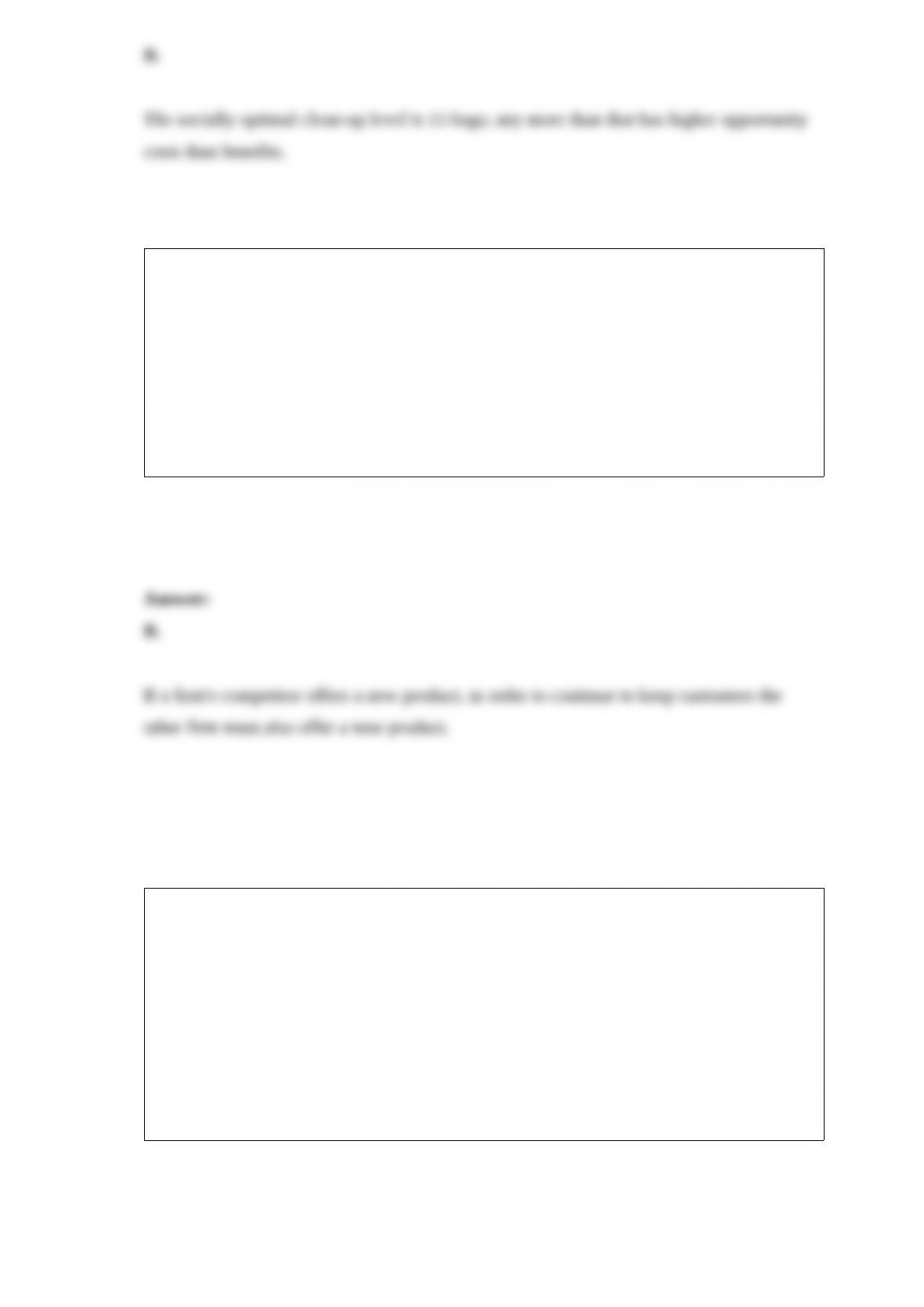
This graph shows the marginal costs and marginal benefits associated with roadside
litter clean up. Assume that the marginal cost and marginal benefit curves slope in the
usual directions.
Refer to the information given above. Suppose the state highway department has picked
up 15 bags of litter. Protesters have staged a demonstration demanding that the highway
department return to pick up the remaining litter. From an economic efficiency
perspective, the protesters have a ________ claim because ________.
A. legitimate; litter generates a negative externality
B. faulty; the additional resources needed to remove more litter could be better used
elsewhere
C. faulty; the government is not responsible for taking care of private property
D. legitimate; the government has a responsibility to take action when private market
incentives do not yield the socially optimal result
The town of Pleasantville has two local TV stations. If one of them invests in the
newest weather forecasting technology, one can predict that:
A. the other station will continue to use its current technology.
B. to maintain its relative standing, the other station will upgrade its radar technology.
C. to maintain its absolute standing, the other station will upgrade its radar technology.
D. the quality of forecasts will remain unchanged.
If planned aggregate spending in an economy can be written as PAE = 15,000 + 0.6Y –
20,000r, and potential output equals 36,000, what real interest rate must the Federal
Reserve set to bring the economy to full employment?
A. 0.02
B. 0.03
C. 0.04
D. 0.05

The most important tool of monetary policy is:
A. reserve requirement ratios.
B. the discount rate.
C. openmarket operations.
D. market interest rates.
Pascal is risk-averse while Marion is risk-neutral. Both are confronted with the
following gamble: win $5,000 with the probability of 65% or lose $9,000 with a
probability of 35%. One can predict that
A. both might accept the gamble.
B. only Pascal will accept the gamble.
C. only Marion will accept the gamble.
D. neither will accept the gamble.

Which of the following is most likely to be a variable factor of production at a
university?
A. The number of teaching assistants.
B. The size of the basketball arena or football stadium.
C. The school mascot.
D. The location of the university.
Real GDP per person in Westland is $30,000, while real GDP in Eastland is $10,000,
However, Westland’s real GDP per person is growing at 3 percent per year, and
Eastland’s real GDP per person is growing at 3 percent per year. If these growth rates
persist indefinitely, then:
A. Eastland’s real GDP per person will rise until it equals Westland’s real GDP per
person.
B. Westland’s real GDP per person will always be at least $20,000 greater than
Eastland’s.
C. Eastland’s real GDP per person will always be exactly $20,000 less than Westland’s.
D. Eastland’s real GDP per person will eventually be greater than Westland’s.

Suppose the value of the CPI is 1.100 in year one, 1.210 in year two, and 1.331 in year
three. Assume also that the price of computers increases by 3% between year one and
year two, and by another 3% between year two and year three. The price level is
increasing, the inflation rate is _______, and the relative price of computers is
_________.
A. increasing; increasing
B. constant; increasing
C. constant; decreasing
D. increasing; decreasing
If the price elasticity of demand for chicken is 2, a 20% decrease in the price of chicken
will lead to a:
A. 10% decrease in the quantity demanded of chicken.
B. 10% increase in the quantity demanded of chicken.
C. 40% decrease in the quantity demanded of chicken.
D. 40% increase in the quantity demanded of chicken.

According to economists, the satisfaction people get from their consumption activities
is called
A. demand
B. utility
C. needs
D. wants
The financial system consists of financial _____, such as commercial banks, and
financial _____, such as the stock market.
A. markets; intermediaries
B. allocations; investments
C. intermediaries; markets
D. markets; institutions

Government policy actions intended to decrease planned spending and output are called
______ policies.
A. aggregate
B. monetary
C. fiscal
D. contractionary
Economic activity moves from a trough into a period of ______ until it reaches a
______ and then into a period of _______.
A. expansion; trough; recession
B. recession; trough; expansion
C. expansion; peak; recession
D. recession; peak; expansion
Two firms can choose from five different technologies to reduce their pollution: A, B,
C, D and E. The amount of pollution emitted by each technology and the cost of the

technologies are shown in the table. Both firms have adopted technology A and
currently emit 4 tons apiece. The government is considering two plans to reduce
pollution: a 50% reduction by both firms or selling pollution permits. One permit
entitles the owner to emit one ton of pollution. Without a permit, no pollution can be
emitted.
Suppose a permit system has been adopted and each firm has already purchased one
permit. Industrio would be willing to pay up to ___ for the right to discharge a second
ton of pollution, and Capitalista would be willing to pay up to __ for the right to
discharge a second ton of pollution.
A. $200; $300
B. $200; $110
C. $100; $40
D. $500; $290
Net taxes equal the amount that:
A. the government pays the private sector plus the amount of private sector pays the
government.
B. the government pays the private sector minus the amount the private sector pays the
government.
C. the business sector pays the government minus the amount the private sector pays
the government.
D. the private sector pays the government minus the amount the private sector receives
from the government.

Suppose the economy is currently operating at potential output; a recessionary gap may
be caused by each of the following EXCEPT:
A. a negative demand shock.
B. a negative inflation shock.
C. a decrease in government spending.
D. a decrease in the inflation rate.
Which of the following is not a commitment device used to overcome a commitment
problem?
A. A non-refundable advance payment to reserve a room at a resort.
B. A manufacturer’s 2-year agreement to fix, at no cost to you, anything that breaks on
your computer.
C. A pre-nuptial agreement that provides for a large penalty in the event a spouse has an
affair.
D. High fines for illegal parking on campus.
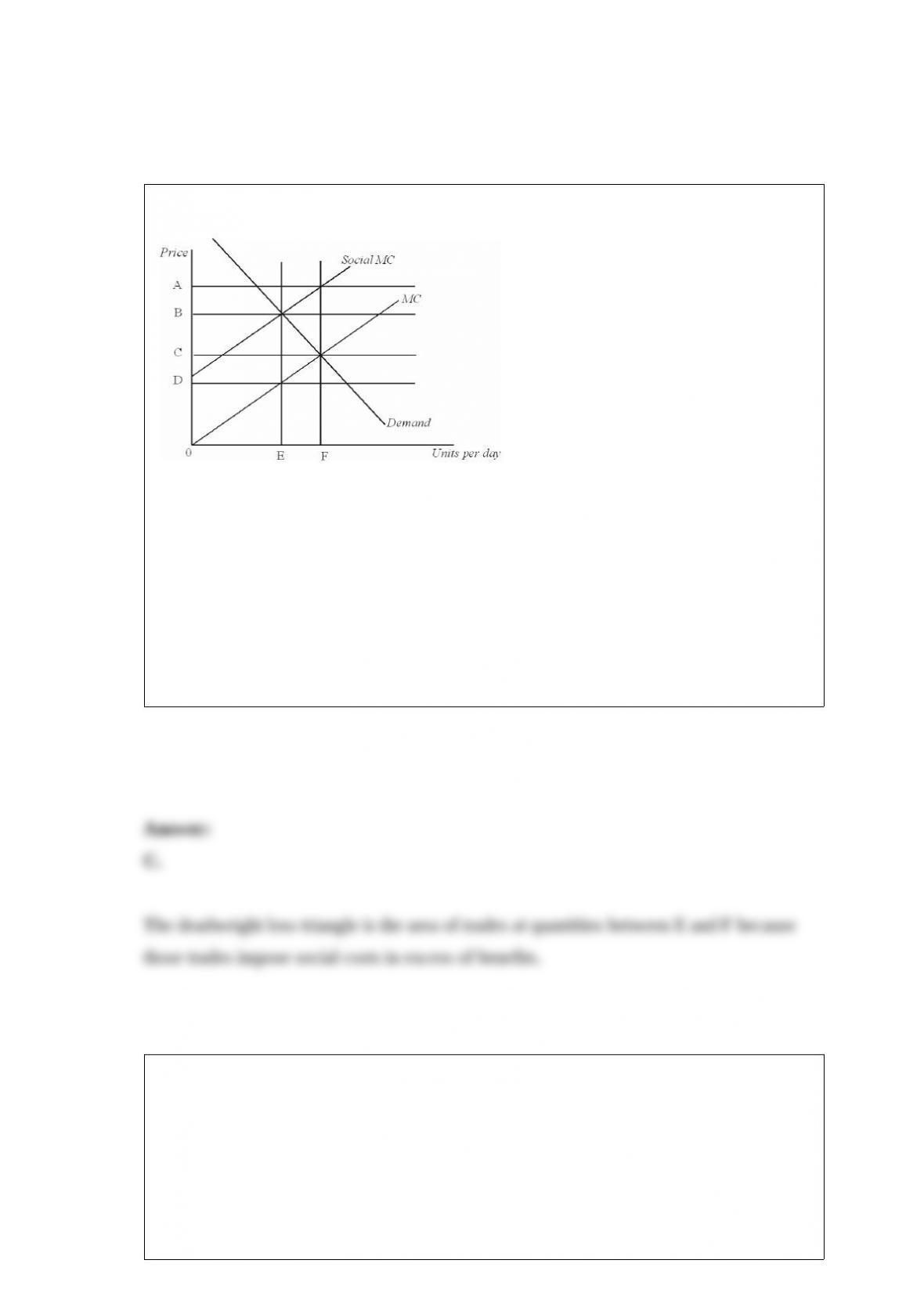
Refer to the figure above. The deadweight loss associated with private incentives in this
market is a triangle with area equal to _______.
A. ½ × EF × BC
B. ½ × 0C × 0E
C. ½ × EF × AC
D. ½ × EF × AB
Suppose the value of the CPI is 1.100 in year one, 1.160 in year two, and 1.270 in year
three. Assume also that the price of computers increases by 3% between year one and
year two, and by another 3% between year two and year three. The price level is
increasing, the inflation rate is _______, and the relative price of computers is
_________.
A. increasing; increasing
B. constant; increasing
C. constant; decreasing
D. increasing; decreasing
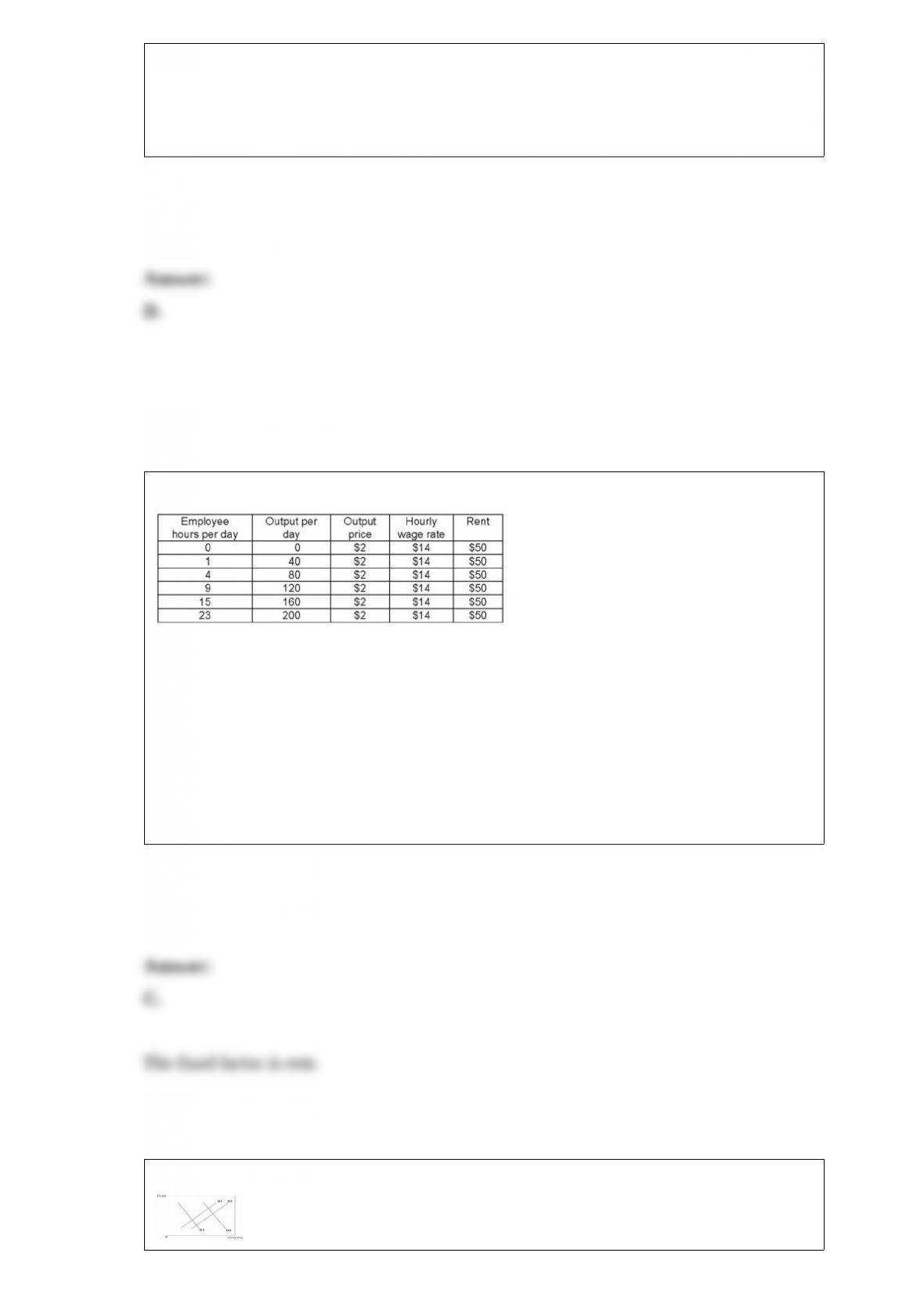
Refer to the figure above. Fixed cost for this firm is:
A. $66
B. $64
C. $50
D. $14
Refer to the figure above. If demand were to shift from D1 to D2 at the same time
supply were to shift from S1 to S2:
A. the equilibrium quantity would increase and the equilibrium price would remain the
same.
B. the equilibrium quantity would increase and the equilibrium price would increase.
C. the equilibrium quantity would remain the same and the equilibrium price would
increase.
D. the equilibrium quantity would decrease and the equilibrium price would remain the
same.
Saving for protection against unexpected setbackssuch as the loss of a job or a medical
emergencyis called ______ saving.
A. public
B. bequest
C. precautionary
D. life-cycle
If the slope of the demand curve is zero, the price elasticity of demand is:
A. perfectly inelastic.
B. unit elastic.
C. elastic.
D. perfectly elastic.