
1) we would expect the cross elasticity of demand for pepsi in relation to other soft
drinks to be greater than that for soft drinks generally because:
a.soft drinks are normal goods.
b.the income effect always exceeds the substitution effect.
c.there are fewer good substitutes for soft drinks as a whole than for pepsi specifically.
d.there are more good substitutes for soft drinks as a whole than for pepsi specifically.
2) In the 1990s and early 2000s, Japan’s central bank reduced real interest rates to zero
percent, but investment spending did not respond enough to bring the economy out of
recession. Japan’s experience is an illustration of:
A.the crowding-out effect.
B.”pulling on a string.”
C.the Taylor rule.
D.cyclical asymmetry.
3) Which is an example of a nontariff barrier (NTB)?
A.an export subsidy
B.an excise tax on the physical volume of imported goods
C.box-by-box inspection requirements for imported fruit
D.an excise tax on the dollar value of imported goods
4) In building the aggregate expenditures model, Keynes believed that:
A.economies are normally at full employment and thus frequently susceptible to bouts
of inflation.
B.government intervention into the economy is the primary cause of business cycle
fluctuations.
C.changes in aggregate expenditures are unable to affect the level of real output in the
economy.
D.massive unemployment of labor and capital created conditions where sudden demand
changes are unlikely to change prices.
5) Suppose in some economy there are 100 million workers; 10 million of those
workers work in retail trade, and 1 million of the retail workers belong to unions. Total
union membership in this economy is 40 million. The rate of unionization in retail trade
is:
A.1 percent.
B.10 percent.
C.40 percent.
D.100 percent.
6) a competitive firm in the short run can determine the profit-maximizing (or
loss-minimizing) output by equating:
a.price and average total cost.
b.price and average fixed cost.
c.marginal revenue and marginal cost.
d.price and marginal revenue.
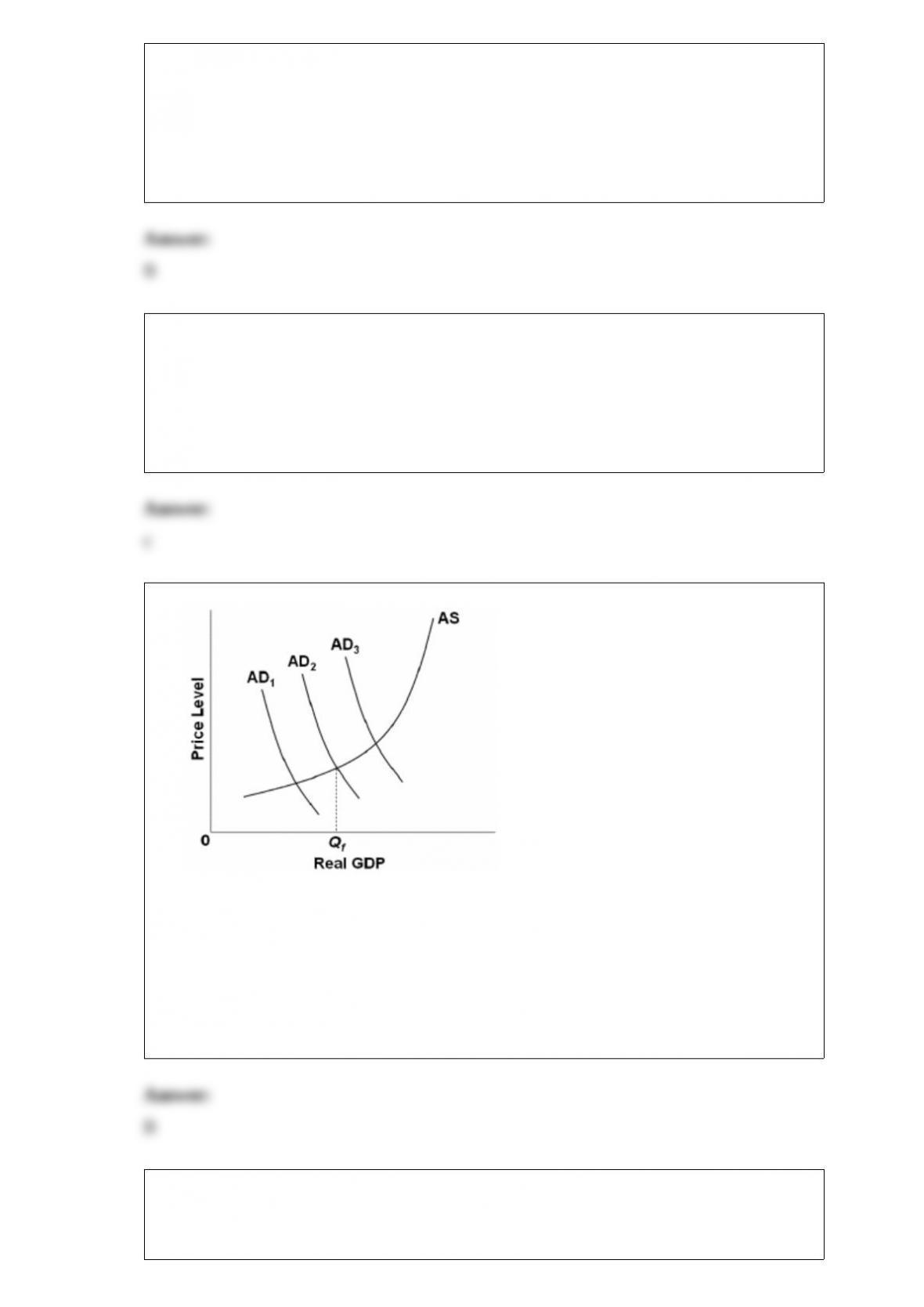
7)
Refer to the above diagram, in which Qf is the full-employment output. The shift in the
aggregate demand curve from AD3 to AD2 could result from which of the following
fiscal policy actions?
A.a tax reduction
B.a tax reduction accompanied by an even larger reduction in government spending
C.a tax increase accompanied by an even larger increase in government spending
D.an increase in government spending
8) If an unintended increase in business inventories occurs at some level of GDP, then
GDP:
A.entails a rate of aggregate expenditures in excess of the rate of aggregate production.
B.may be either above or below the equilibrium output.
C.is too low for equilibrium.
D.is too high for equilibrium.
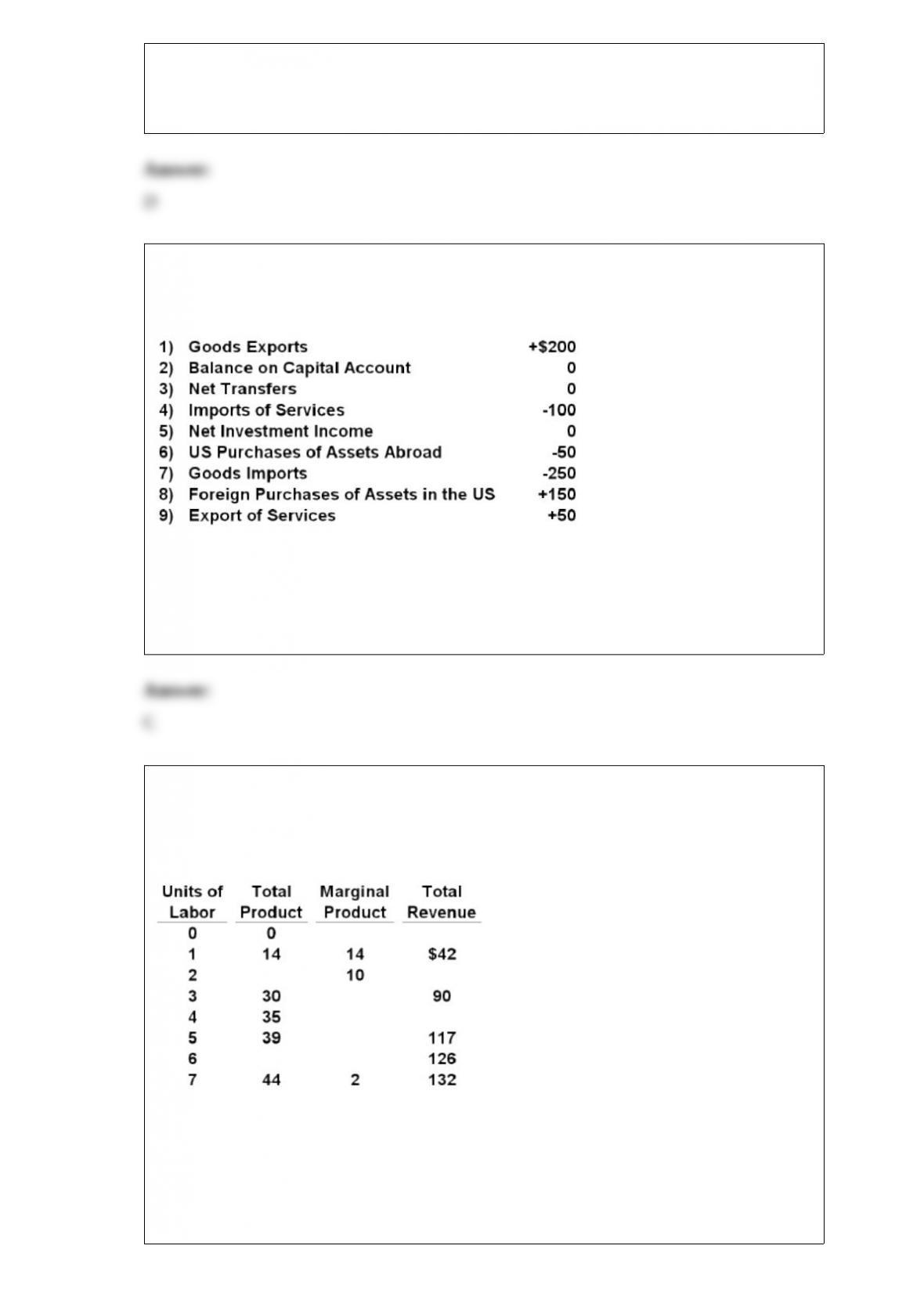
9) The plus items below are “export-type” entries and the minus items are “import-type”
entries in the balance of payments for the hypothetical country of Zippo.
Refer to the above information. Zippo has a:
A.current account surplus.
B.financial account deficit.
C.trade deficit on goods and services.
D.balance of services surplus.
10) Below is the information for Manfred’s Shoe Shine Parlor. Assume Manfred hires
labor, its only variable input, under purely competitive conditions. Shoe shines are also
sold competitively.
Refer to the above data. How many units of output are produced when 2 workers are
employed?
A.4
B.16
C.24
D.10

11) As it relates to R&D, the imitation problem is that:
A.patents, copyrights, and trademarks hinder imitation and thus limit economically
desirable diffusion.
B.brand names create entry barriers for would-be competitors.
C.diffusion of innovation occurs more slowly than is desirable from society’s
perspective.
D.a firm’s rivals may be able to copy its new product or process innovation, reducing its
return on R&D.